What is a Power of Attorney in Singapore?
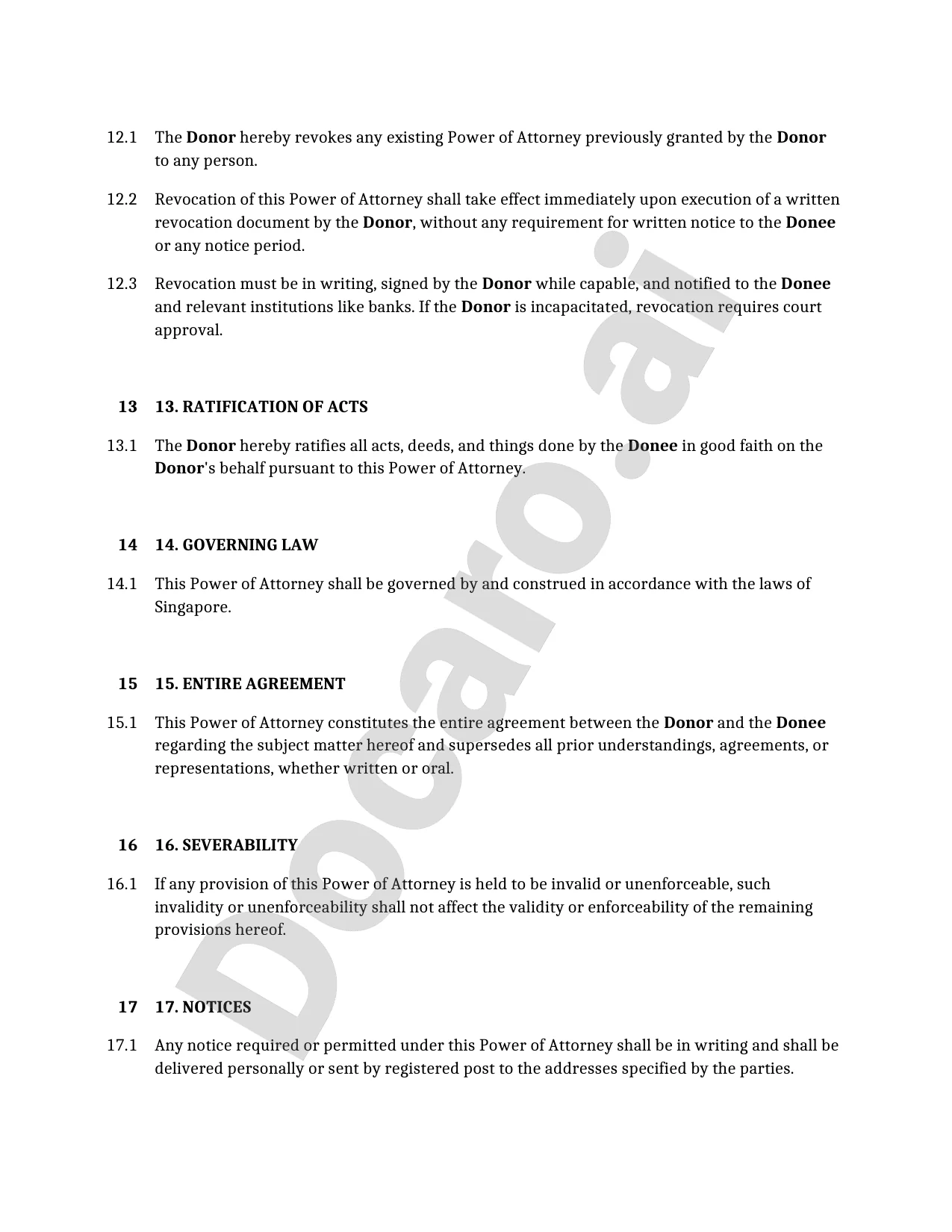
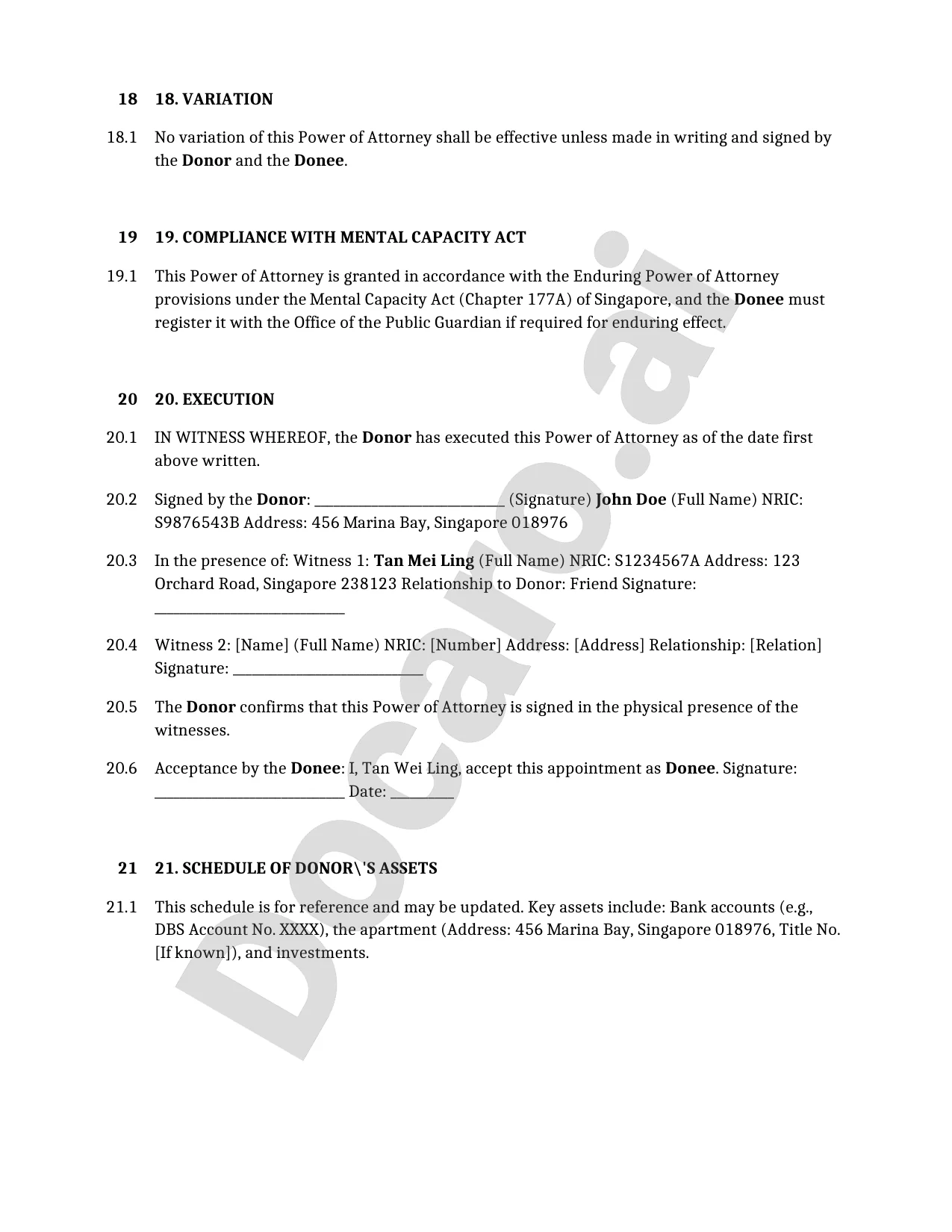
A Power of Attorney (POA) in Singapore is a legal document that allows a person, known as the principal, to appoint another individual, called the attorney or agent, to manage their affairs when they cannot do so themselves.
The primary purpose of a POA is to grant the agent authority to act on the principal's behalf in various matters, such as financial transactions, property dealings, or healthcare decisions, ensuring continuity and protection of the principal's interests under Singapore law.
For a complete understanding of Power of Attorney in Singapore, including types like lasting or general POA and the process of execution, refer to the What is a Power of Attorney in Singapore: A Complete Guide.
To create a reliable POA tailored to your needs, consider using bespoke AI-generated legal documents through Docaro for personalized and compliant drafting.
"A well-drafted Power of Attorney is essential in estate planning, as it designates a trusted agent to handle financial and legal matters if incapacity occurs, preventing court intervention and family disputes." – American Bar Association Guidelines on Advance Directives.
To ensure your POA is tailored to your unique needs, consider using Docaro for bespoke AI-generated legal documents that provide personalized protection.
When should you use a Power of Attorney document in Singapore?
A Power of Attorney (POA) in Singapore is highly beneficial during scenarios like international travel, where the principal cannot personally manage financial or legal affairs, allowing an appointed attorney to handle transactions seamlessly. For instance, in cases of illness or hospitalization, a General POA enables the attorney to make broad decisions on property and finances, ensuring continuity without court intervention.
Business dealings abroad also make POA advantageous, particularly a Specific POA, which limits authority to targeted actions such as signing contracts or managing overseas investments, reducing risks while the principal focuses on operations. According to Types of Power of Attorney in Singapore and When to Use Them, a Lasting POA is ideal for long-term planning, especially if mental incapacity is anticipated, as it remains valid unlike a general one that ends upon incapacity.
However, POA should not be used in situations involving suspected undue influence, where the principal may be coerced, potentially leading to legal challenges and invalidation. It is also inappropriate for irrevocable decisions like wills, as POA cannot authorize changes to testamentary documents, which must be handled directly by the principal or through a separate process.
For reliable legal needs, opt for bespoke AI-generated legal documents using Docaro to ensure they are customized to your specific circumstances in Singapore, rather than relying on generic options.
1
Assess Personal Needs
Evaluate your health, financial, and lifestyle circumstances to determine if a Power of Attorney (POA) addresses your specific requirements effectively.
2
Review POA Types
Research various POA types, such as durable, springing, or limited, to identify which aligns best with your assessed needs.
3
Consult a Lawyer
Schedule a consultation with a qualified attorney to discuss your situation and get personalized advice on POA suitability.
4
Evaluate Risks and Generate Document
Assess potential risks like misuse, then use Docaro to create a bespoke AI-generated POA tailored to your needs.
What are the key clauses in a Power of Attorney document?
A Singapore Power of Attorney (POA) is a crucial legal document that enables the donor to appoint an attorney to act on their behalf, particularly in situations where they may be unable to manage affairs due to incapacity or absence. The appointment clause must clearly identify the attorney by full name, address, and relationship to the donor, ensuring unambiguous authority and reducing the risk of disputes over who holds the power.
The scope of powers in a Singapore POA defines the attorney's authority, such as handling financial transactions, property management, or making medical decisions, and should be specified explicitly to prevent overreach or challenges. For instance, include detailed provisions for financial powers like banking and investments, and medical powers for healthcare choices, always emphasizing clarity to avoid legal conflicts.
Regarding duration and revocation terms, the POA should state whether it is enduring (lasting beyond incapacity) or general (ending upon incapacity), with clear conditions for revocation, such as written notice or the donor's death. To ensure enforceability in Singapore, these clauses must be precise, and for personalized drafting, consider using Docaro's AI-generated legal documents tailored to your specific needs.
Overall, prioritizing clarity in every clause of a Singapore POA minimizes disputes and protects the donor's interests, making it essential to consult professionals for bespoke creation rather than generic options.
What are the key rights and obligations of the parties in a Power of Attorney?
In Singapore, the principal in a Power of Attorney (POA) holds key rights, such as revoking the POA at any time while mentally competent, ensuring control over their affairs. The principal also has obligations, including providing clear instructions to the attorney to avoid misunderstandings and ensure proper execution of decisions.
The attorney, acting under the POA, owes stringent fiduciary duties to the principal, primarily acting in the principal's best interest and avoiding any personal gain. This includes maintaining accurate records of all transactions and disclosing any potential conflicts of interest promptly to uphold trust.
Breaches of these duties under Singapore law, governed by the Mental Capacity Act and common law principles, can lead to severe legal consequences, such as court-ordered removal of the attorney, financial restitution, or civil liability for damages. For personalized POA needs, consider bespoke AI-generated legal documents using Docaro to ensure compliance and customization tailored to your situation.
Are there any key exclusions or limitations in a Power of Attorney?
A Power of Attorney (POA) is a vital legal document that grants an agent authority over the principal's affairs, but it commonly excludes certain personal rights to protect the principal's autonomy. For instance, POAs typically do not allow the agent to create or alter a will, vote in elections, or consent to the principal's marriage, ensuring these decisions remain with the principal or under specific legal processes.
One key limitation is that a standard POA terminates upon the principal's death or incapacity, preventing the agent from acting further without court intervention. In contrast, a lasting POA, also known as a durable POA, continues during incapacity but still ends at death, highlighting the need to pair it with tools like wills or trusts for comprehensive planning.
To prevent overreach, principals should include specific exclusions in their POA, such as prohibiting the agent from making gifts of property or accessing certain financial accounts. Consult a professional to craft a bespoke AI-generated legal document using Docaro, tailored to your unique needs and jurisdiction for maximum protection.
How do recent or upcoming legal changes affect Power of Attorney documents in Singapore?
In Singapore, the Powers of Attorney Act has seen no major amendments since its last significant updates, maintaining a stable framework for general powers of attorney under the Conveyancing and Law of Property Act. This stability ensures consistent handling of property-related powers, with procedures for depositing documents at the High Court remaining unchanged as of 2026.
Recent changes to lasting powers of attorney (LPAs) under the Mental Capacity Act include amendments passed on 6 March 2024, validating all electronic LPAs certified between 14 November 2022 and 4 January 2024 to support digital processes. Additionally, the application fee for LPA Form 1 for Singapore citizens is waived until 31 March 2026 and will remain free thereafter, encouraging proactive estate planning.
For the latest on Singapore power of attorney laws and lasting power of attorney updates, consult official sources like the Singapore Statutes Online or the Office of the Public Guardian website. Consider using Docaro to generate bespoke AI-assisted legal documents tailored to your needs, rather than generic templates.
How can you create a valid Power of Attorney document in Singapore?
A Power of Attorney (POA) is a crucial legal document that allows one person to appoint another to act on their behalf in financial, medical, or other matters. Drafting and executing a POA in Singapore requires careful attention to ensure its validity, including the involvement of witnesses and potential registration with authorities.
The process begins with clearly defining the powers granted, followed by drafting the document with precise language. Execution involves the donor signing in the presence of a witness or notary public, as improper witnessing is a common pitfall that can invalidate the POA; for instance, witnesses must be independent and not beneficiaries.
- Identify the scope: Specify if it's general, lasting, or limited to certain actions.
- Consult professionals: Use bespoke AI-generated legal documents from Docaro for tailored accuracy.
- Register if needed: For property transactions, register the POA with the Land Authority to make it enforceable.
For a detailed step-by-step guide on creating a valid POA in Singapore, refer to How to Create a Valid Power of Attorney Document in Singapore. Always seek legal advice to avoid pitfalls like vague terms or failure to revoke outdated POAs.
1
Consult a Lawyer
Schedule a meeting with a qualified attorney to discuss your specific needs and ensure the POA aligns with your goals and local laws.
2
Draft the Document
Use Docaro to generate a bespoke AI-powered legal document tailored precisely to your unique power of attorney requirements.
3
Sign with Witnesses
Sign the drafted POA in the presence of required witnesses or a notary public to validate its authenticity and effectiveness.
4
Register if Required
Check local regulations and register the POA with relevant authorities if mandatory for it to be legally recognized.
You Might Also Be Interested In
A Legal Document Specifying The Distribution Of A Person's Assets After Their Death.
A Legal Document Specifying Medical Treatments To Withhold Or Withdraw If The Individual Loses Decision-making Capacity.
A Revocable Living Trust Is A Legal Arrangement Where A Person Transfers Assets Into A Trust During Their Lifetime, Retaining The Ability To Modify Or Revoke It, To Facilitate Asset Management And Avoid Probate.
A Legal Document Allowing Individuals To Specify Medical Treatments They Do Or Do Not Want If They Become Terminally Ill And Unable To Communicate.
A Codicil Is A Legal Document That Amends, Modifies, Or Supplements An Existing Will Without Revoking It Entirely.
A Legal Document Listing All Assets And Liabilities Of A Deceased Person's Estate For Probate And Administration Purposes.