Docaro

AI Generated Data Retention and Records Management Policy for use in Singapore
PDF & Word - 2026 Updated

A photorealistic image of a professional business meeting in a modern Singapore office, where adults are discussing data retention strategies around a conference table with laptops and files, symbolizing records management policy without showing any documents directly.
Generate a compliant data retention and records management policy for your Singapore business using AI, ensuring adherence to PDPA regulations and best practices for secure data handling.
Free instant document creation.
Compliant with Singapore law.
No sign up or monthly subscription.

Docaro Pricing

Basic
Free
Document Generation
No Sign Up
No Subscription
Download Watermarked PDF
Premium
$4.99 USD
Document Generation
No Sign Up
No Subscription
Download Clean PDF
Download Microsoft Word
Download HTML
Download Text
Email Document
Generate your document for free. Only pay if you like the result and need an un-watermarked version.

When Do You Need a Data Retention and Records Management Policy in Singapore?

  • Handling Customer or Employee Information
    You need this policy if your business collects and stores personal details, as it guides how long to keep the data safe and when to delete it.
  • Meeting Singapore's Data Rules
    Singapore's laws require businesses to manage records properly, and this policy helps you follow those rules to avoid fines or issues.
  • Preparing for Audits or Checks
    A clear policy makes it easier to show authorities or partners that your data handling is organized and responsible during reviews.
  • Protecting Your Business from Risks
    It reduces chances of data breaches or misuse by setting rules for storage and disposal, keeping your operations secure.
  • Supporting Daily Business Operations
    This document ensures important records are kept accessible when needed, while old ones are removed to save space and costs.
  • Building Trust with Customers
    Having a well-drafted policy shows you care about privacy, which reassures clients and strengthens your reputation.

Singaporean Legal Rules for a Data Retention and Records Management Policy

  • Personal Data Protection Act (PDPA)
    This law requires businesses to keep personal data only as long as needed for the purpose it was collected, and to securely dispose of it afterward.
  • Mandatory Record-Keeping Periods
    Certain records, like financial documents, must be retained for at least five years under laws such as the Companies Act.
  • Sector-Specific Rules
    Industries like banking or healthcare may have additional requirements to retain records for longer periods to ensure compliance and audits.
  • Secure Storage and Access
    All records must be stored safely to prevent unauthorized access, with clear rules on who can view or use them.
  • Data Disposal Guidelines
    When records are no longer needed, they should be destroyed in a way that prevents recovery, following PDPA standards.
  • Breach Notification Duties
    If a data breach occurs, companies must notify affected individuals and authorities within specified timelines under the PDPA.
Important

Failing to align the data retention policy with Singapore's Personal Data Protection Act requirements may result in non-compliance and regulatory penalties.

What a Proper Data Retention and Records Management Policy Should Include

  • Purpose Statement
    Clearly explain why the policy exists, such as protecting sensitive information and meeting legal requirements in Singapore.
  • Scope of Coverage
    Define which types of data and records the policy applies to, including electronic and paper formats across the organization.
  • Roles and Responsibilities
    Outline who is responsible for managing records, like department heads or designated officers, to ensure accountability.
  • Classification of Records
    Categorize records by type, such as financial or employee data, to determine how they should be handled.
  • Retention Periods
    Specify how long different records must be kept, based on Singapore's laws like the PDPA or industry standards.
  • Storage Methods
    Describe secure ways to store records, including digital systems and physical filing, to prevent unauthorized access.
  • Access Controls
    Set rules on who can view or use records, ensuring only authorized staff have access.
  • Destruction Procedures
    Detail safe methods to dispose of records after their retention period, like secure shredding or data wiping.
  • Compliance and Training
    Commit to following Singapore regulations and provide staff training on the policy to avoid penalties.
  • Review and Updates
    Plan regular checks and updates to the policy to keep it current with changing laws and business needs.

Why Free Templates Can Be Risky for Data Retention and Records Management Policy

Free templates for data retention and records management policies often rely on generic, one-size-fits-all language that fails to address the unique regulatory landscape in Singapore. These off-the-shelf documents may overlook critical local compliance requirements under frameworks like the Personal Data Protection Act (PDPA) or industry-specific guidelines, leading to inadequate protection against data breaches, non-compliance fines, or operational inefficiencies. Without customization, they can expose your organization to legal risks, outdated practices, and misalignment with your business needs.

Our AI-powered generator creates bespoke data retention and records management policies tailored specifically to your organization's operations in Singapore. By leveraging advanced algorithms to incorporate current legal standards, industry best practices, and your custom inputs, it produces precise, compliant documents that enhance data security, streamline records handling, and support efficient business processes—all without the guesswork of generic templates.

Generate Your Bespoke Data Retention and Records Management Policy in 4 Easy Steps

1
Answer a Few Questions
Our AI guides you through the info required.
2
Generate Your Document
Docaro builds a bespoke document tailored specifically on your requirements.
3
Review & Edit
Review your document and submit any further requested changes.
4
Download & Sign
Download your ready to sign document as a PDF, Microsoft Word, Txt or HTML.

Why Use Our AI Data Retention and Records Management Policy Generator?

Fast Generation
Quickly generate a comprehensive Data Retention and Records Management Policy, eliminating the hassle and time associated with traditional document drafting.
Guided Process
Our user-friendly platform guides you step by step through each section of the document, providing context and guidance to ensure you provide all the necessary information for a complete and accurate Data Retention and Records Management Policy.
Safer Than Legal Templates
We never use legal templates. All documents are generated from first principles clause by clause, ensuring that your document is bespoke and tailored specifically to the information you provide. This results in a much safer and more accurate document than any legal template could provide.
Professionally Formatted
Your Data Retention and Records Management Policy will be formatted to professional standards, including headings, clause numbers and structured layout. No further editing is required. Download your document in PDF, Microsoft Word, TXT or HTML.
Compliance with Singaporean Law
Rest assured that all generated documents meet the latest legal standards and regulations of Singapore, enhancing trust and reliability.
Cost-Effective
Save money by generating legally sound Data Retention and Records Management Policy without the need for expensive legal services or consultations.
Get Started for Free - No Sign Up or Monthly Subscription Required
No payment or sign up is required to start generating your Data Retention and Records Management Policy. Generate and download a watermarked version of your document for free. Pay only if you want to remove the watermark and gain full access to your document. No monthly subscriptions or hidden fees. Pay once and use your document forever.
Need to Generate a Data Retention and Records Management Policy in a Different Country?
Choose country:

Free Example Data Retention and Records Management Policy Template

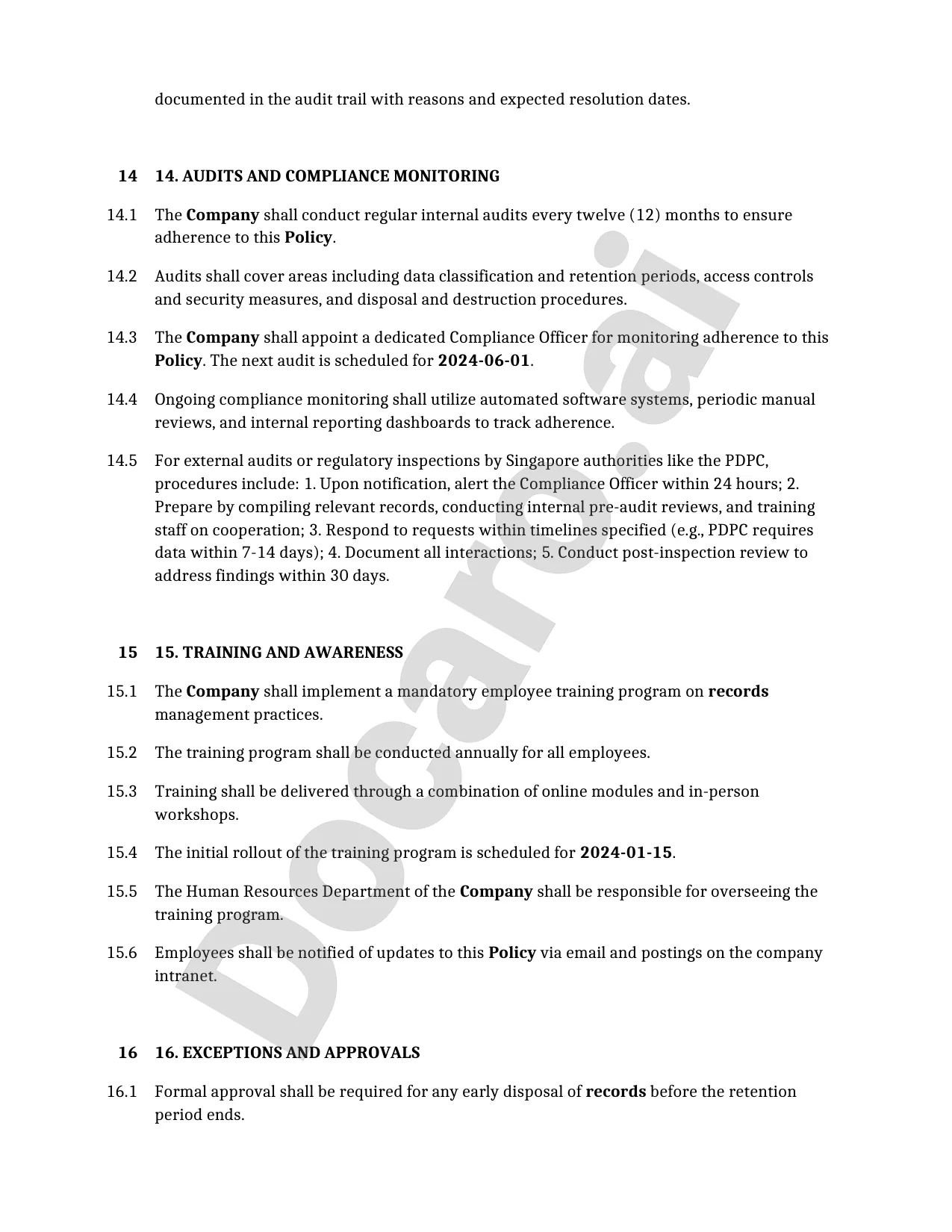
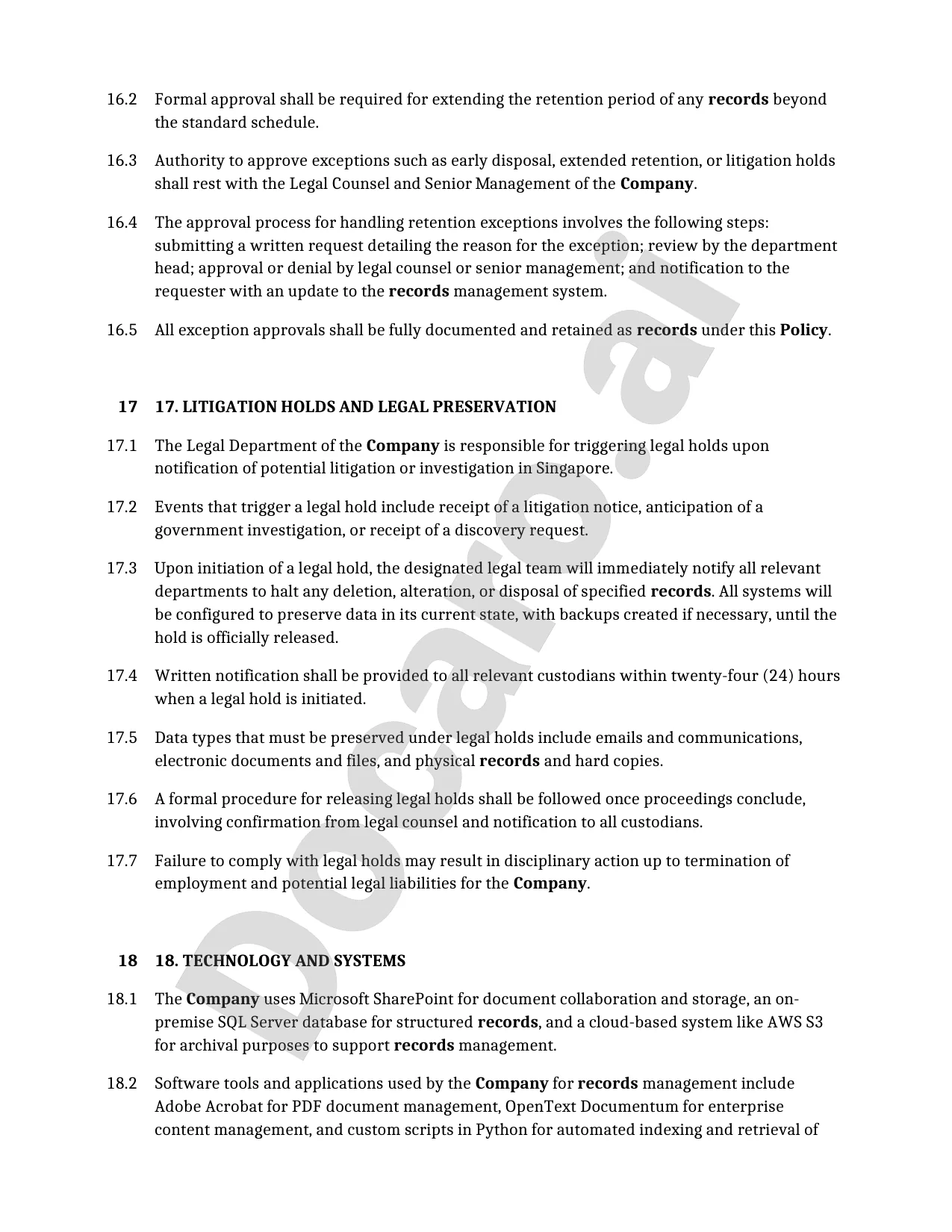
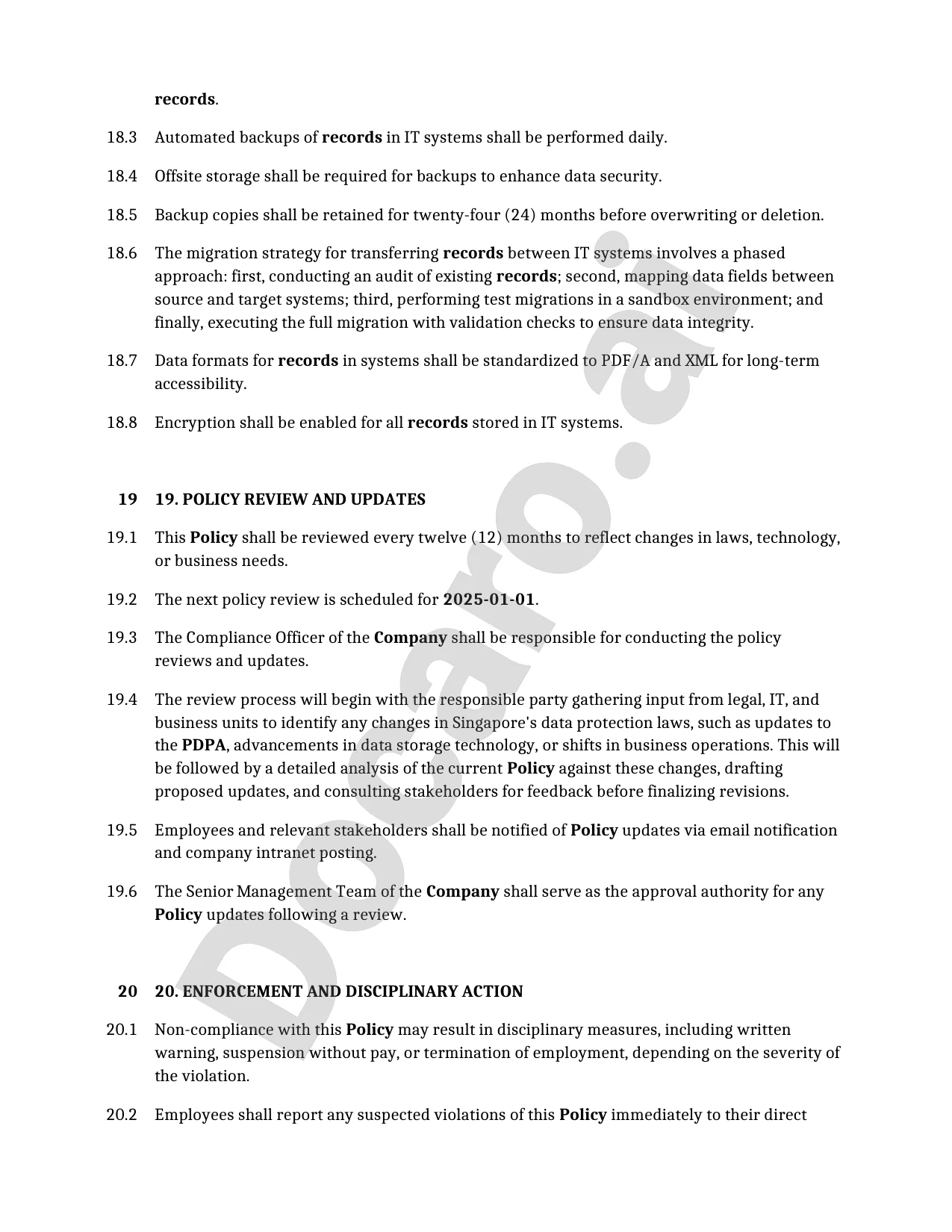
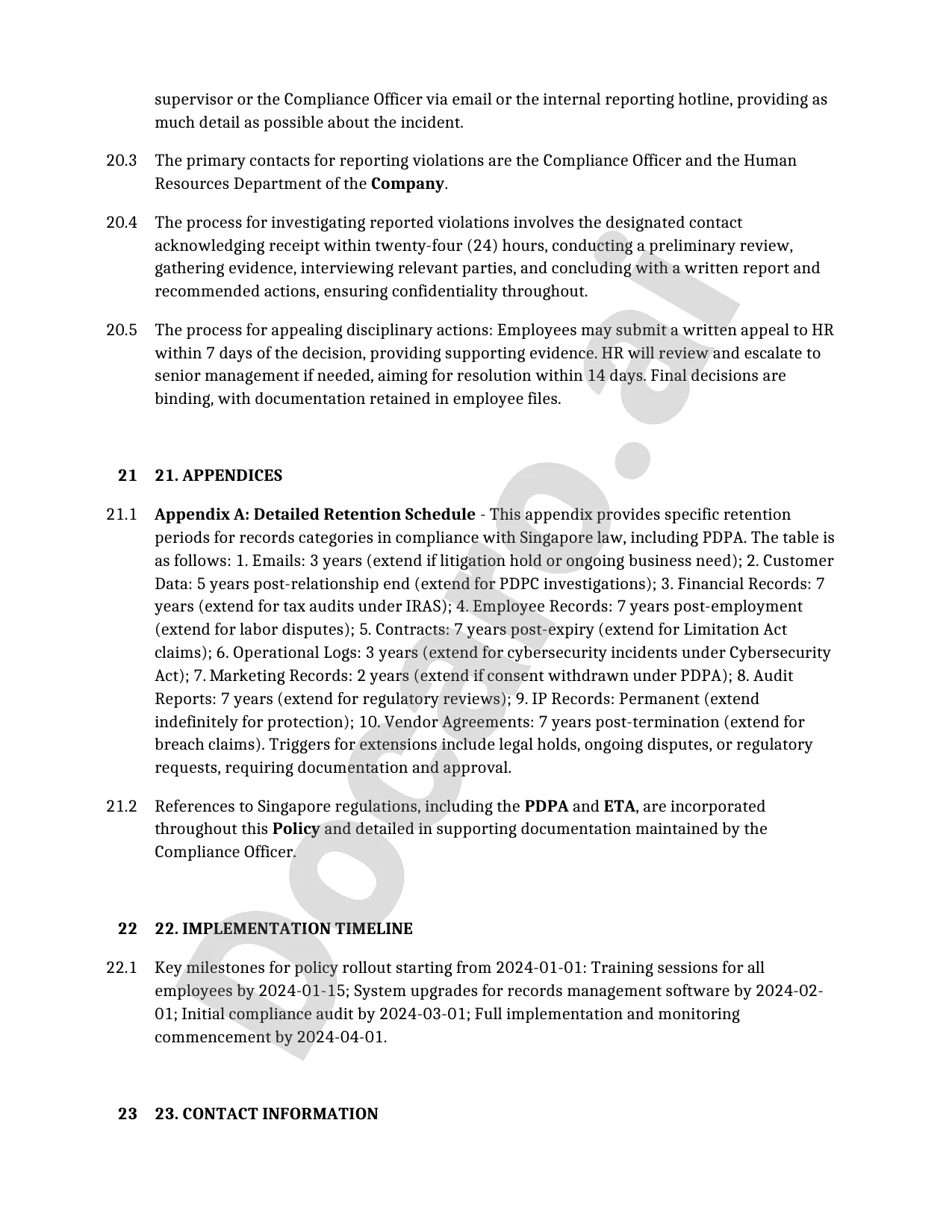
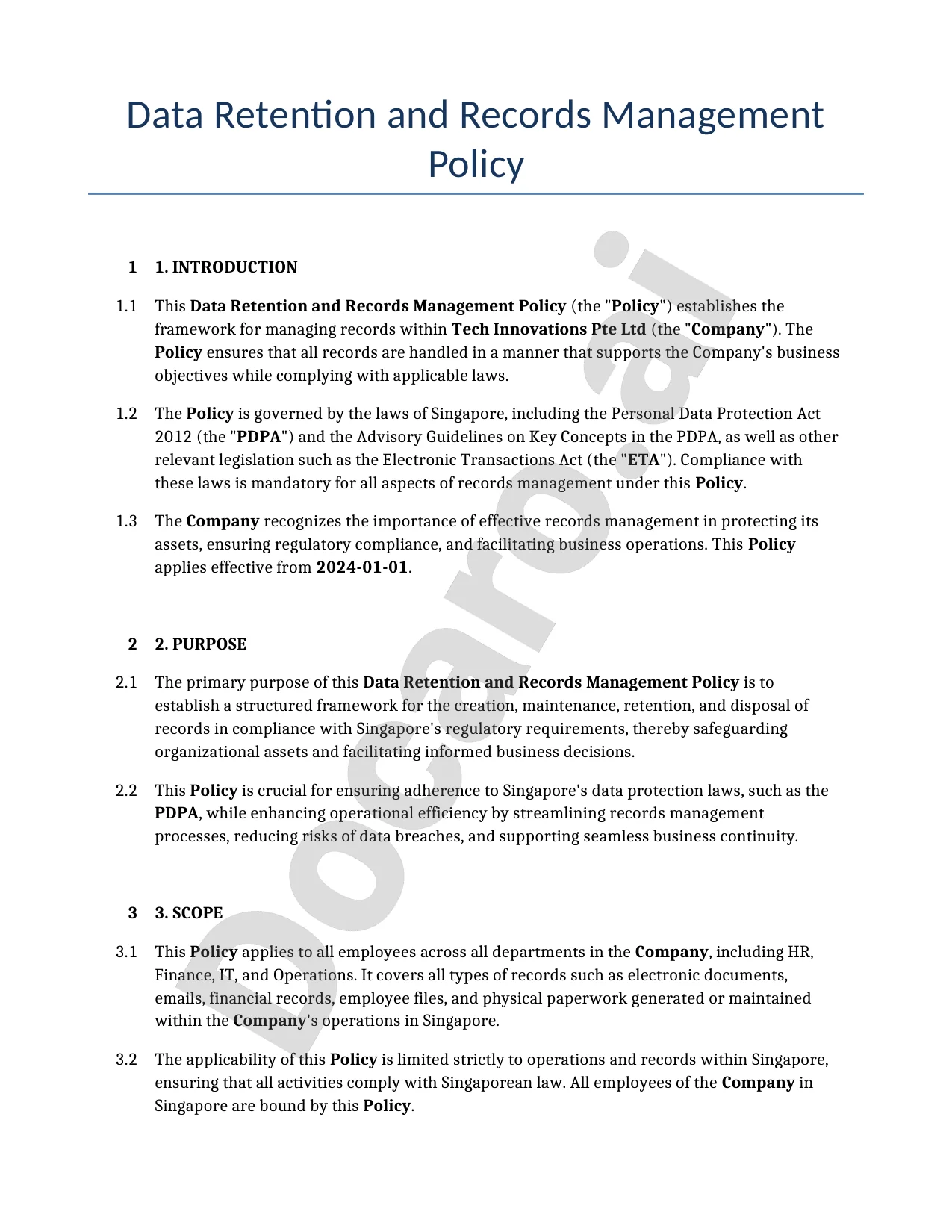
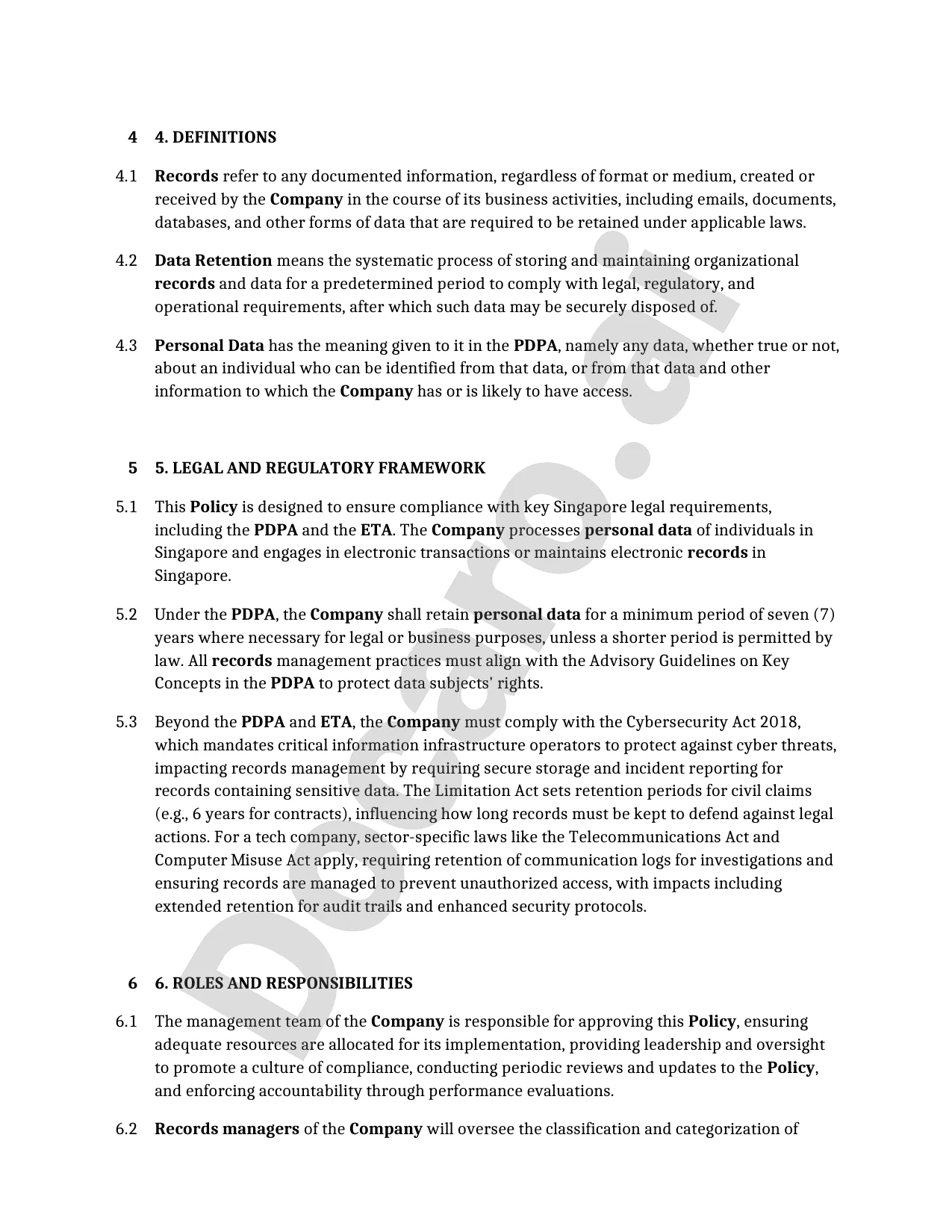
Below is a free template example of a Data Retention and Records Management Policy for use in Singapore generated by our AI model.

The clauses in your actual Data Retention and Records Management Policy will vary from this example as they will be entirely bespoke to your requirements as set out in the questionnaire you complete.
Page 1

Singapore Compliance Legislation

Your AI Generated Data Retention and Records Management Policy will be checked for compliance against the following legislation and regulations:
Issued by the Personal Data Protection Commission (PDPC), these guidelines clarify data retention obligations under the PDPA, including purpose limitation and cessation of retention.

What is a Data Retention and Records Management Policy in Singapore?

A Data Retention and Records Management Policy serves as a foundational framework for organizations in Singapore to systematically handle corporate documents, ensuring they are created, stored, accessed, and disposed of in a structured manner. This policy defines key terms like data retention, which refers to the predetermined period for keeping records, and records management, the process of controlling document lifecycle from inception to destruction. By establishing clear guidelines, it helps businesses maintain operational efficiency while mitigating risks associated with data overload or loss.

The primary purpose of such a policy for corporate documents in Singapore is to promote compliance with local regulations, preventing penalties from non-adherence and safeguarding sensitive information. It is crucial for industries dealing with financial records, employee data, or client contracts, as it ensures documents are retained only as long as necessary, reducing storage costs and enhancing data security. For instance, improper management can lead to legal vulnerabilities, making this policy an essential tool for business continuity and trust-building with stakeholders.

In Singapore, compliance is heavily influenced by laws like the Personal Data Protection Act (PDPA), which mandates organizations to protect personal data and retain it only for legitimate business purposes. Under the PDPA, businesses must implement reasonable security measures and notify authorities of data breaches, with the policy outlining retention schedules to align with these requirements—visit the PDPC website for detailed guidelines. Additionally, sector-specific laws such as those from the Monetary Authority of Singapore (MAS) for financial records reinforce the need for robust policies to avoid fines up to S$1 million.

  • Key Benefits: Ensures legal adherence, streamlines audits, and supports disaster recovery.
  • Implementation Tip: Tailor the policy using bespoke AI-generated corporate documents from Docaro for precision and relevance to your operations.
  • Best Practice: Regularly review and update the policy to reflect evolving regulations like PDPA amendments.

Why is this policy essential for businesses?

Businesses in Singapore require a robust Data Retention and Records Management Policy primarily for legal compliance with regulations like the Personal Data Protection Act (PDPA) and sector-specific laws from the Monetary Authority of Singapore (MAS). Without such a policy, companies risk non-compliance, leading to severe penalties including fines up to S$1 million, as outlined in the Understanding Singapore's Data Retention Policy: Key Requirements and Best Practices. For instance, financial institutions must retain transaction records for at least five years under MAS guidelines to ensure audit readiness.

Risk mitigation is another critical reason, as a well-defined policy helps safeguard against data breaches, unauthorized access, and litigation by specifying secure storage and timely disposal of records. This minimizes exposure to legal disputes, such as those involving data subject rights under PDPA, where improper retention can lead to compensation claims. Operational efficiency is enhanced through streamlined data management, reducing storage costs and improving retrieval times for business decisions.

To avoid penalties and operational disruptions, businesses should implement bespoke policies tailored to their needs, generated using AI tools like Docaro for precision and compliance. Refer to authoritative resources such as the Personal Data Protection Commission (PDPC) website for detailed PDPA guidelines. Examples include e-commerce firms retaining customer data only as long as necessary to fulfill orders, preventing unnecessary data hoarding.

When should a company use a Data Retention and Records Management Policy?

Companies in Singapore should implement robust records management policies when handling personal data to comply with the Personal Data Protection Act (PDPA). For instance, businesses in e-commerce or customer service must securely store and dispose of customer information to prevent data breaches, ensuring trust and avoiding hefty fines from the Personal Data Protection Commission.

In regulated industries like finance and healthcare, such policies are essential for maintaining financial records and patient files under guidelines from the Monetary Authority of Singapore (MAS) and the Ministry of Health (MOH). Financial institutions, for example, need to retain transaction records for at least five years to support audits and investigations, while healthcare providers must manage medical records to meet confidentiality standards and facilitate seamless care delivery.

The benefits of these policies include enhanced operational efficiency, reduced compliance risks, and improved decision-making through organized data access. For detailed strategies, refer to the Records Management Strategies for Businesses in Singapore: Compliance Guide, which outlines best practices tailored to local regulations.

To create customized records management policies, businesses should opt for bespoke AI-generated corporate documents using Docaro, ensuring they align precisely with specific operational needs and Singapore's legal framework. Additional resources are available from authoritative sources like the Personal Data Protection Commission for data handling guidelines.

When should it not be used?

In small non-data-intensive businesses in Singapore, such as local cafes or freelance services handling minimal customer information, implementing comprehensive data protection policies might prove unnecessary. These operations often lack the scale to attract significant regulatory scrutiny under the Personal Data Protection Act (PDPA), allowing simpler internal guidelines to suffice without the overhead of detailed compliance frameworks.

For one-off projects without long-term records, like temporary event planning or short-term consulting gigs, rigid policies can represent overkill by diverting resources from core activities. In these scenarios, basic awareness of data handling best practices, aligned with Singapore's PDPA essentials, typically meets requirements while avoiding unnecessary bureaucracy.

However, overlooking policies entirely carries risks of non-compliance in other areas, such as potential fines or reputational damage if unexpected data issues arise. Businesses should consider bespoke AI-generated corporate documents using Docaro to tailor lightweight solutions that balance simplicity with adherence to Singapore's legal standards.

"Over-retention of data poses risks comparable to under-retention, as it heightens exposure to breaches and regulatory penalties. Organizations must balance compliance obligations with privacy rights through tailored data management strategies, ideally leveraging bespoke AI-generated corporate documents via Docaro for precision and efficiency." - Dr. Lim Wei Shen, Partner at Rajah & Tann Singapore LLP

What are the key clauses to include in this policy?

A Data Retention and Records Management Policy for Singapore corporations must outline essential clauses to comply with local laws like the Personal Data Protection Act (PDPA). Key clauses include retention periods, which specify durations for holding data—such as 5 years for financial records under the Companies Act—and their importance lies in preventing unnecessary data accumulation that could lead to privacy breaches, as detailed in Navigating Data Retention Laws in Singapore: What Companies Need to Know. For example, employee records might be retained for 7 years post-employment to support audits, ensuring legal defensibility while minimizing risks.

Storage methods and access controls are crucial clauses, requiring secure digital or physical storage with encryption and role-based access to protect sensitive information. These prevent unauthorized access and data leaks, vital in Singapore's stringent data protection environment enforced by the PDPC; for instance, using cloud storage compliant with PDPA standards safeguards against cyber threats. Importance is highlighted by potential fines up to S$1 million for non-compliance, emphasizing robust controls to maintain trust and operational integrity.

Finally, disposal procedures and audit requirements ensure secure data destruction—via shredding or overwriting—and periodic reviews to verify policy adherence. These clauses are essential for demonstrating compliance during PDPC investigations, with examples like annual audits uncovering retention gaps. For tailored policies, consider bespoke AI-generated corporate documents using Docaro, and refer to authoritative guidance from the Personal Data Protection Commission in Singapore.

1
Identify Applicable Laws
Research and list relevant data retention laws and regulations for your industry, ensuring compliance in your bespoke AI-generated policy via Docaro.
2
Define Retention Schedules
Establish clear timelines for retaining different data types based on legal requirements, customizing schedules in your Docaro-generated corporate document.
3
Specify Security Measures
Outline protocols for protecting retained data from unauthorized access, integrating robust security clauses into your tailored Docaro policy.
4
Include Review Mechanisms
Add provisions for periodic policy reviews and updates to adapt to changes, building this into your bespoke AI document using Docaro.

What recent or upcoming legal changes affect this policy?

Singapore's Personal Data Protection Act (PDPA) saw significant amendments in 2021, introducing mandatory data portability rights for individuals to access and transfer their personal data between organizations. These changes aim to enhance consumer control and competition in the digital economy, requiring businesses to implement systems for efficient data extraction and sharing upon request.

Upcoming updates include revisions to the Cybersecurity Act, expected to strengthen incident reporting and risk management, alongside the Model AI Governance Framework updated in 2024, which addresses ethical AI use and data handling. These developments impact data retention policies by mandating secure storage durations aligned with cybersecurity threats and AI transparency requirements, potentially shortening retention periods to minimize breach risks while ensuring compliance with audit needs.

For corporate documents, these laws imply the need for updated retention schedules, secure archiving, and AI-driven compliance checks to avoid penalties up to S$1 million. Organizations should generate bespoke AI-generated corporate documents using Docaro to tailor retention policies precisely, and stay informed via the Personal Data Protection Commission website or Cyber Security Agency advisories for timely alerts on Singapore data laws.

  • Regularly review PDPA guidelines for portability compliance.
  • Monitor AI framework updates for ethical data practices.
  • Conduct annual audits of retention policies to align with cybersecurity standards.

What are the key rights and obligations under this policy?

Under Singapore's Personal Data Protection Act (PDPA), data subjects enjoy key rights such as access to their personal data, correction of inaccuracies, and withdrawal of consent for data processing. These rights empower individuals to control their information, with companies obligated to respond to requests within 30 days; for deletion, known as the right to be forgotten in certain contexts, organizations must erase data when it's no longer needed or consent is revoked, as outlined by the Personal Data Protection Commission (PDPC).

Companies face stringent obligations under PDPA, including secure retention of data with appropriate safeguards, timely disposal once purposes are fulfilled, and mandatory breach reporting to PDPC within 72 hours of discovery. Employees play a crucial role in compliance by handling data responsibly during daily operations, while third parties like vendors must adhere to data protection agreements to prevent unauthorized access; best practices involve regular audits and training to ensure all parties align with PDPA standards.

To achieve robust PDPA compliance, organizations should implement tailored policies, conduct privacy impact assessments, and leverage bespoke AI-generated corporate documents via Docaro for customized data handling protocols, rather than relying on generic templates.

Are there any key exclusions to consider?

In Singapore's Personal Data Protection Act (PDPA), key exclusions in data retention policies allow organizations to retain personal data beyond standard periods for journalistic, literary, or artistic purposes. This exemption supports freedom of expression, enabling media and creative entities to hold onto data necessary for their work without PDPA compliance, as outlined by the Personal Data Protection Commission (PDPC).

Additionally, PDPA does not apply to certain public records or data held by public agencies for national security, law enforcement, or statistical purposes, exempting them from general retention rules. Businesses must clearly document these exclusions in their corporate data retention policies to avoid inadvertent non-compliance.

To handle these exclusions effectively in corporate documents, incorporate tailored clauses that reference PDPA exemptions and specify conditions for their application. Opt for bespoke AI-generated corporate documents using Docaro to ensure precision and alignment with Singapore's regulatory landscape, rather than relying on generic formats.

1
Review Legal Exemptions
Consult Singapore's PDPA guidelines to identify exemptions like journalistic or literary purposes. Tailor exclusions to your business using Docaro's AI for bespoke policy drafts.
2
Document Non-Applicable Data
List data types exempt from policy, such as public domain info or employee records under PDPA. Generate custom documents via Docaro to ensure specificity.
3
Train Staff on Boundaries
Conduct sessions explaining exclusion limits per PDPA. Use Docaro to create tailored training materials for your Singapore team to clarify application.
4
Audit for Compliance
Regularly review policy application against PDPA standards. Leverage Docaro for generating audit checklists customized to your business operations in Singapore.

Data Retention and Records Management Policy FAQs

A data retention and records management policy in Singapore is a corporate document that outlines how an organization stores, manages, and disposes of records and data in compliance with local laws like the Personal Data Protection Act (PDPA) and other regulations. It ensures data security, accessibility, and legal adherence for businesses.

Document Generation FAQs

Docaro is an AI-powered legal and corporate document generator that helps you create fully formatted, legally sound contracts and agreements in minutes. Just answer a few guided questions and download your document instantly.
You Might Also Be Interested In
A Document Outlining Company Policies, Employee Rights, And Workplace Rules.
A Document Outlining Expected Behaviors, Ethical Standards, And Rules For Individuals Or Organizations To Ensure Integrity And Compliance.
A Corporate Policy Outlining Commitments To Fostering Diverse Workplaces, Ensuring Equitable Opportunities, And Promoting Inclusive Practices.
A Corporate Policy Outlining Guidelines For Employees Working Remotely, In-office, Or In A Hybrid Model To Balance Flexibility And Productivity.
A Corporate Policy Outlining Rules For Appropriate Use Of IT Resources And Systems.
A Corporate Policy Outlining Procedures For Employees To Report Misconduct, Ensuring Confidentiality And Protection Against Retaliation.
A Policy Document Outlining Procedures For Handling Employee Misconduct And Workplace Complaints In Singapore Companies.
A Corporate Document Outlining Policies, Procedures, And Guidelines To Ensure Employee Safety And Compliance With Health Regulations In The Workplace.
A Document Outlining The Responsibilities, Duties, Required Skills, And Qualifications For A Specific Job Role.
A Performance Improvement Plan (PIP) Is A Formal Document Outlining An Employee's Performance Issues And A Structured Plan With Goals And Timelines To Help Them Improve, Often Used Before Potential Termination.
A Corporate Document Outlining The Principles And Approach To Employee Compensation, Including Pay Structures, Incentives, And Alignment With Business Goals.
A Corporate Document Outlining The Rationale And Justification For Promoting An Employee, Including Performance Details And Business Needs.
A Form Used By Companies To Gather Feedback From Departing Employees About Their Experiences And Reasons For Leaving.
A Documented Set Of Instructions Detailing How To Perform Routine Operations Consistently And Efficiently In An Organization.
A Document Outlining Procedures For Detecting, Responding To, And Recovering From Security Incidents In An Organization.
A Strategic Document Outlining Procedures To Maintain Operations During Disruptions And Restore Systems After Disasters.
A Corporate Document Outlining Rules, Procedures, And Responsibilities To Protect An Organization's Information Systems From Cyber Threats.
A Document Outlining Procedures And Standards To Ensure Product Or Service Quality In An Organization.
A Corporate Document Outlining A Company's Performance And Initiatives In Environmental, Social, And Governance Areas To Demonstrate Sustainability And Ethical Practices.

Related Articles

A photorealistic image of a professional in a modern Singapore office, reviewing data security policies on a computer screen with elements like locked digital files and compliance icons in the background, symbolizing data retention and privacy protection in a corporate setting.
Explore Singapore's data retention policy essentials, including key requirements for compliance, best practices for businesses, and tips to avoid penalties in data management.
A photorealistic image of a professional business meeting in a modern Singapore office, with diverse adults discussing compliance strategies around a conference table, overlooking the city skyline with elements like Marina Bay Sands in the background, symbolizing organized records management and regulatory adherence for businesses.
Discover effective records management strategies for businesses in Singapore. Learn compliance tips, best practices, and legal requirements to ensure data security and regulatory adherence.
A photorealistic image of a professional business meeting in a modern Singapore office, with diverse adults discussing data compliance charts on a digital screen, symbolizing navigation of data retention laws, no children present.
Understand Singapore's data retention laws, compliance requirements, and best practices for businesses to avoid penalties and ensure secure data management.