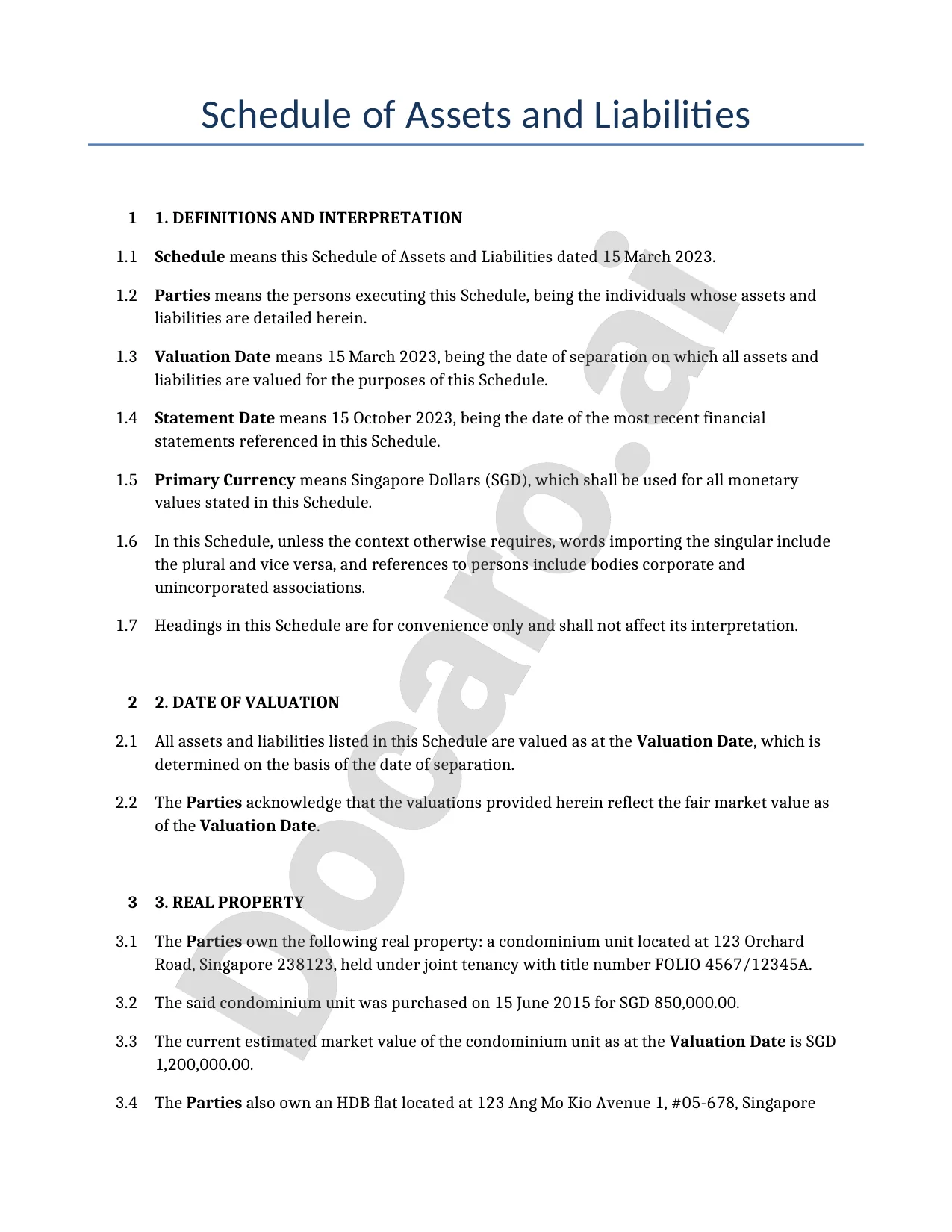
What is a Schedule of Assets and Liabilities in Singapore?
"In Singaporean matrimonial disputes, the accuracy of the Schedule of Assets and Liabilities is paramount for equitable division under the Women's Charter; any inaccuracies can lead to unjust outcomes and prolonged litigation," states legal expert Ms. Lim Wei Ling, Partner at Rajah & Tann. For precise, tailored preparation, utilize bespoke AI-generated legal documents via Docaro to ensure compliance and fairness.
When should you use a Schedule of Assets and Liabilities in Singapore?
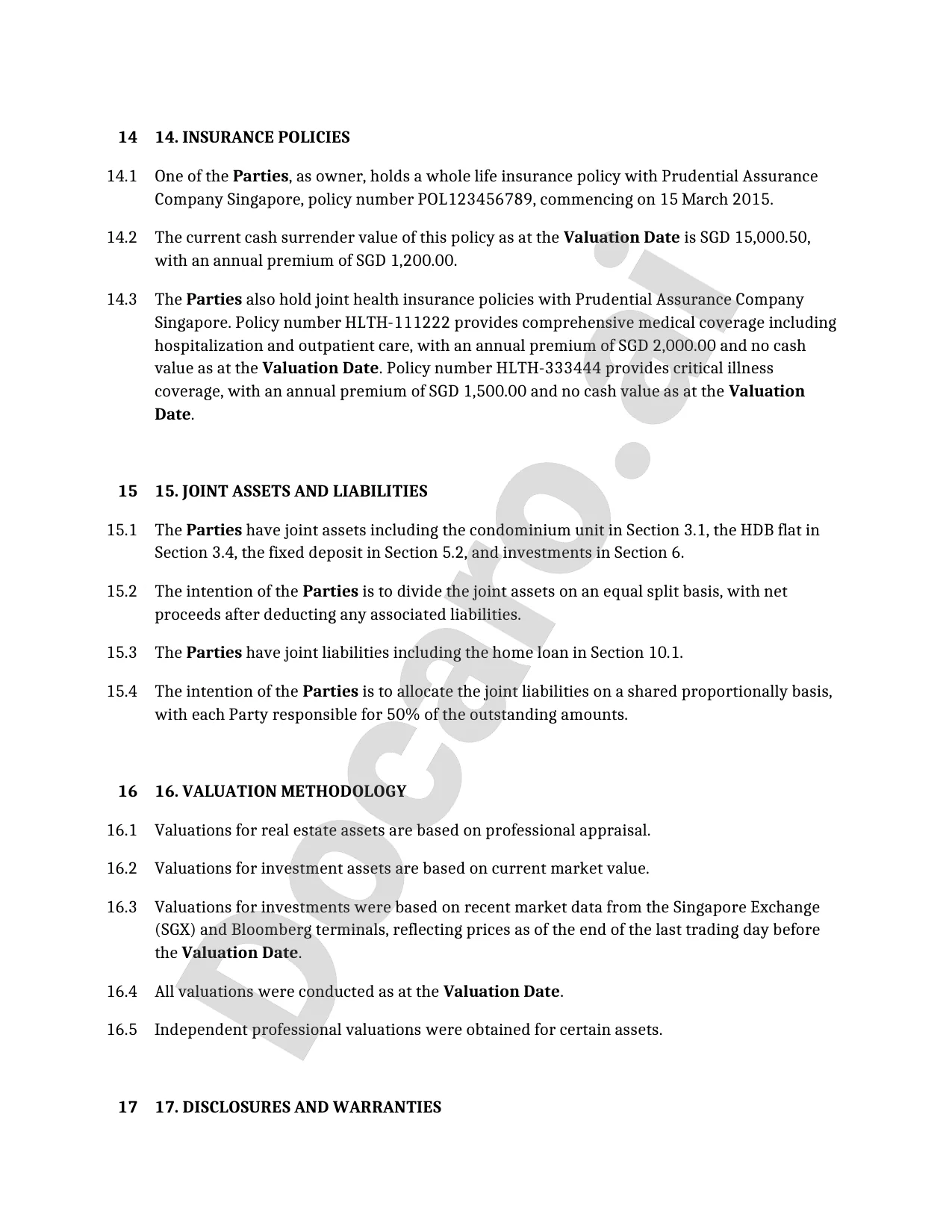
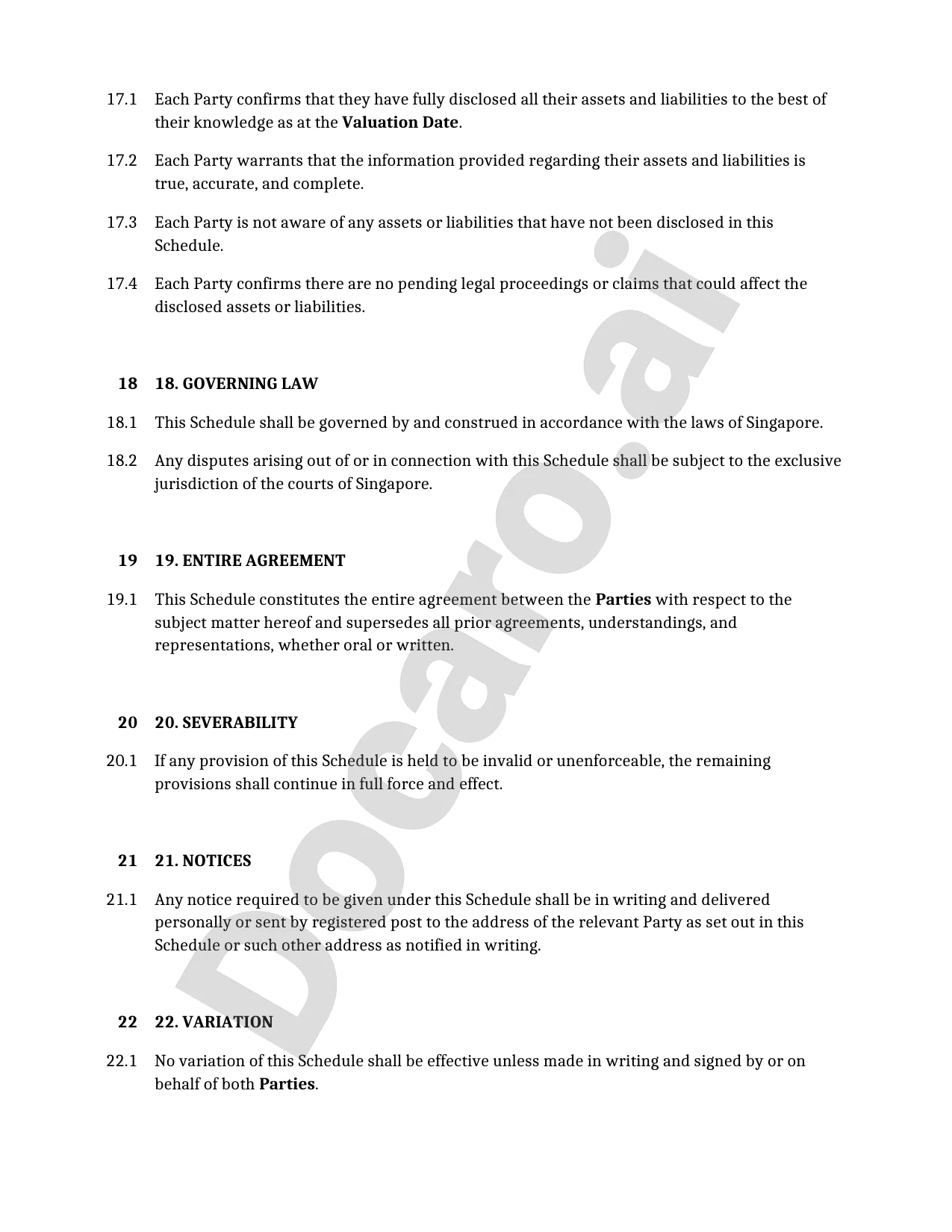
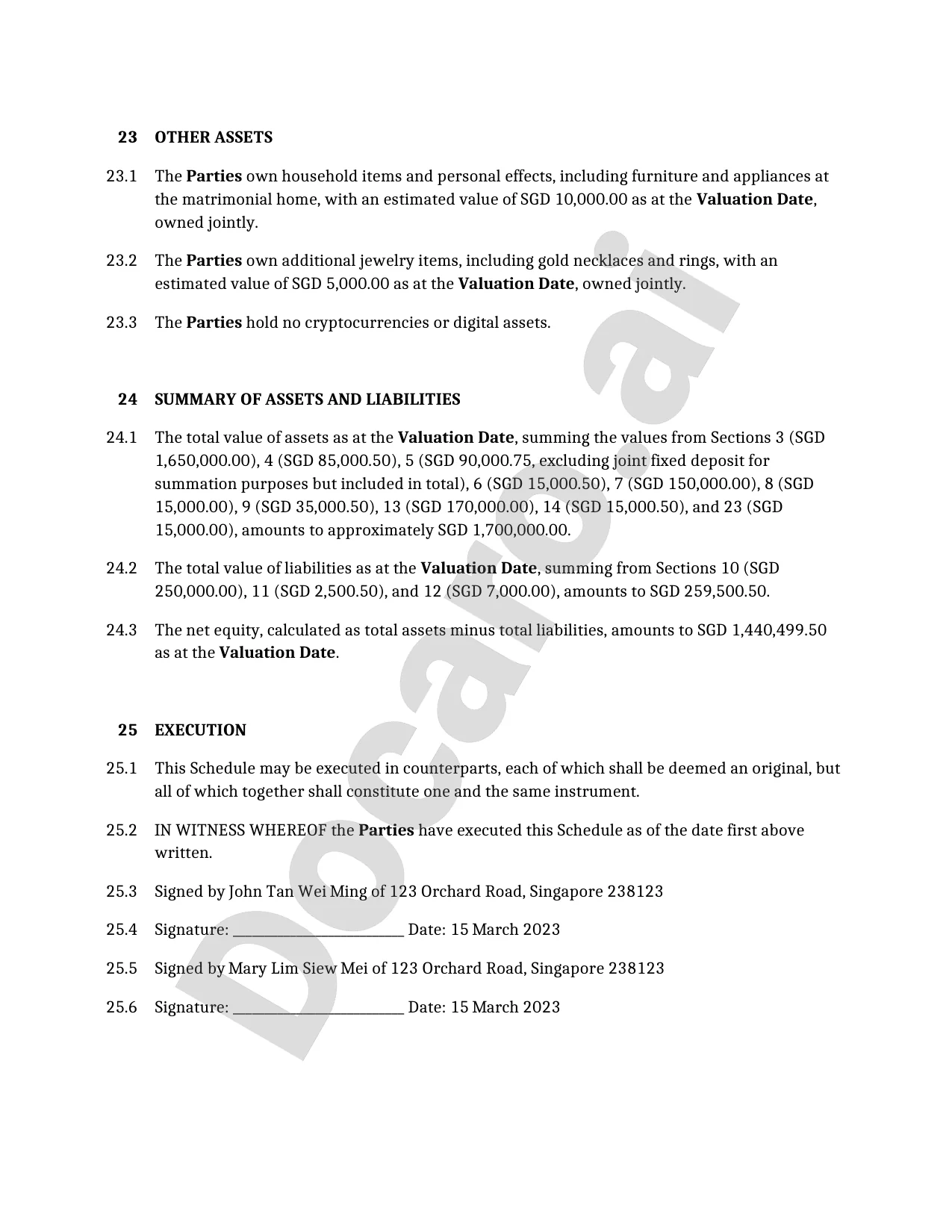
In Singapore matrimonial proceedings under the Women's Charter, a Schedule of Assets and Liabilities is often required to ensure fair division of marital property. This document lists all assets, debts, and their values, helping the court assess the couple's financial position for equitable distribution during divorce.
During bankruptcy filings with the Insolvency and Public Trustee's Office in Singapore, submitting a detailed Schedule of Assets and Liabilities is mandatory to declare the debtor's full financial status. It enables the official receiver to evaluate and manage assets for creditor repayment, forming the basis of the bankruptcy process.
For probate applications in Singapore, a Schedule of Assets and Liabilities is beneficial to inventory the deceased's estate accurately. Courts may mandate this schedule in contentious cases to verify the estate's value before granting letters of administration or probate.
Court-mandated uses of a Schedule of Assets and Liabilities extend to scenarios like enforcement of judgments or family court orders in Singapore. For instance, in ancillary relief applications, judges require this schedule to enforce maintenance payments or property settlements effectively.
When should you avoid using this document?
In Singapore estate planning, a Schedule of Assets and Liabilities may not be necessary for simple wills where there are no anticipated disputes among beneficiaries. For straightforward estates with clear asset distribution, such as jointly held properties or basic bank accounts, alternative disclosures like a basic inventory list often suffice to ensure smooth probate without the need for a detailed schedule.
During non-contentious business transfers in Singapore, preparing a full Schedule of Assets and Liabilities is typically inappropriate if the transaction involves minimal assets or relies on existing financial statements. In these cases, simplified affidavits or audited reports can adequately verify the transfer's integrity, avoiding unnecessary complexity in amicable agreements.
However, the risks of preparing an unnecessary Schedule of Assets and Liabilities include significant time and cost burdens for legal and accounting professionals, potentially delaying proceedings in Singapore. Over-disclosure might also inadvertently expose sensitive financial details, increasing the chance of disputes or privacy breaches where none were intended.
To handle such scenarios efficiently, consider using bespoke AI-generated legal documents via Docaro platform for customized solutions tailored to Singapore's legal requirements, ensuring precision without excess preparation.
What are the key clauses in a Schedule of Assets and Liabilities?
A Schedule of Assets and Liabilities in Singapore typically begins with an introductory section identifying the parties involved and the purpose of the document, such as in divorce proceedings or estate planning under the Women's Charter or Inheritance Act. This section includes the date of compilation and a declaration that the schedule represents a true and fair view of the financial position as of that date.
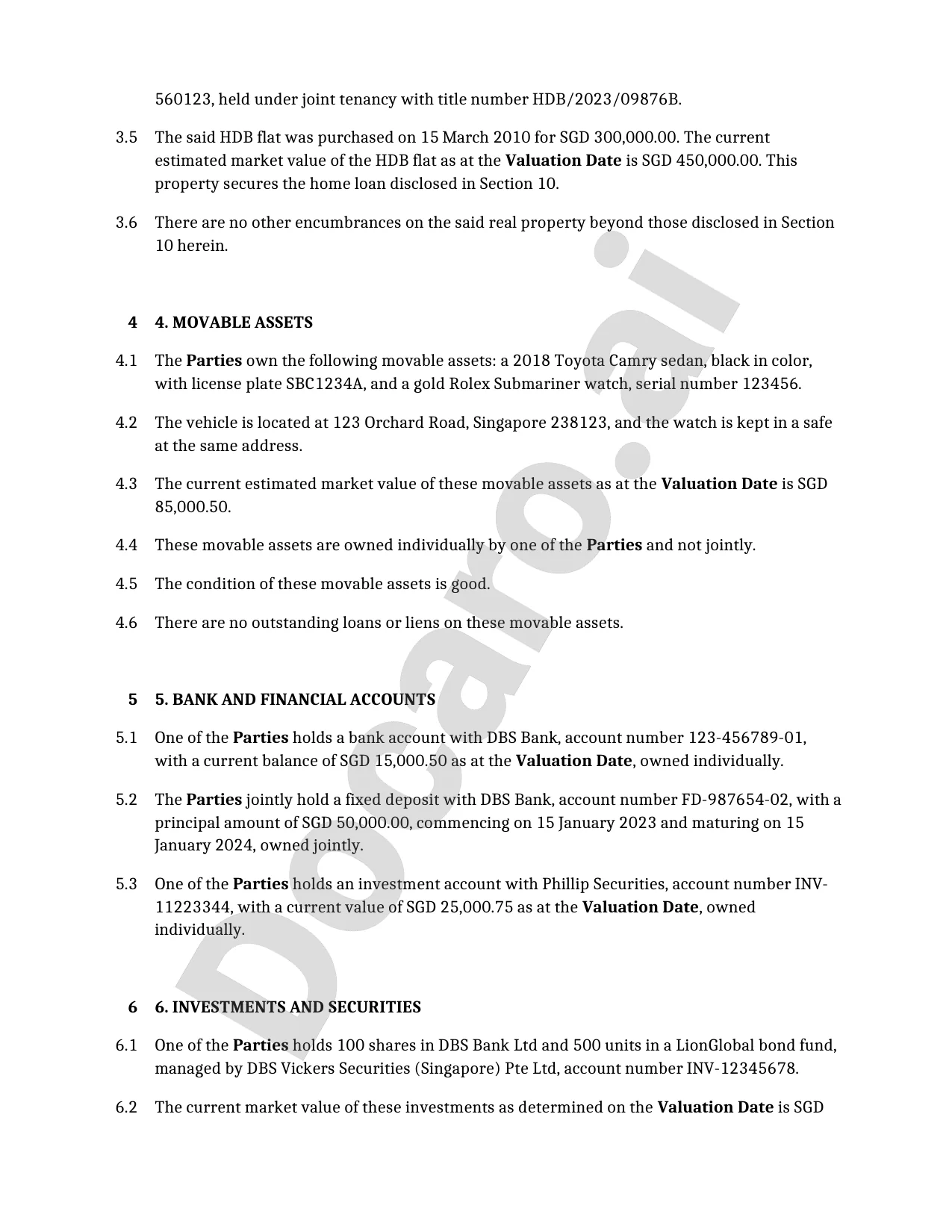
Essential asset categories outlined include real property like residential or commercial properties with details on location, ownership title, and current market value; investments such as shares, bonds, unit trusts, or CPF funds valued at fair market price; movable assets like vehicles, jewelry, and bank accounts; and intangible assets including intellectual property or business interests. Valuation methods commonly reference professional appraisals for real estate, closing balances for bank statements, or quoted market prices for securities, ensuring accuracy in Singapore asset valuation.
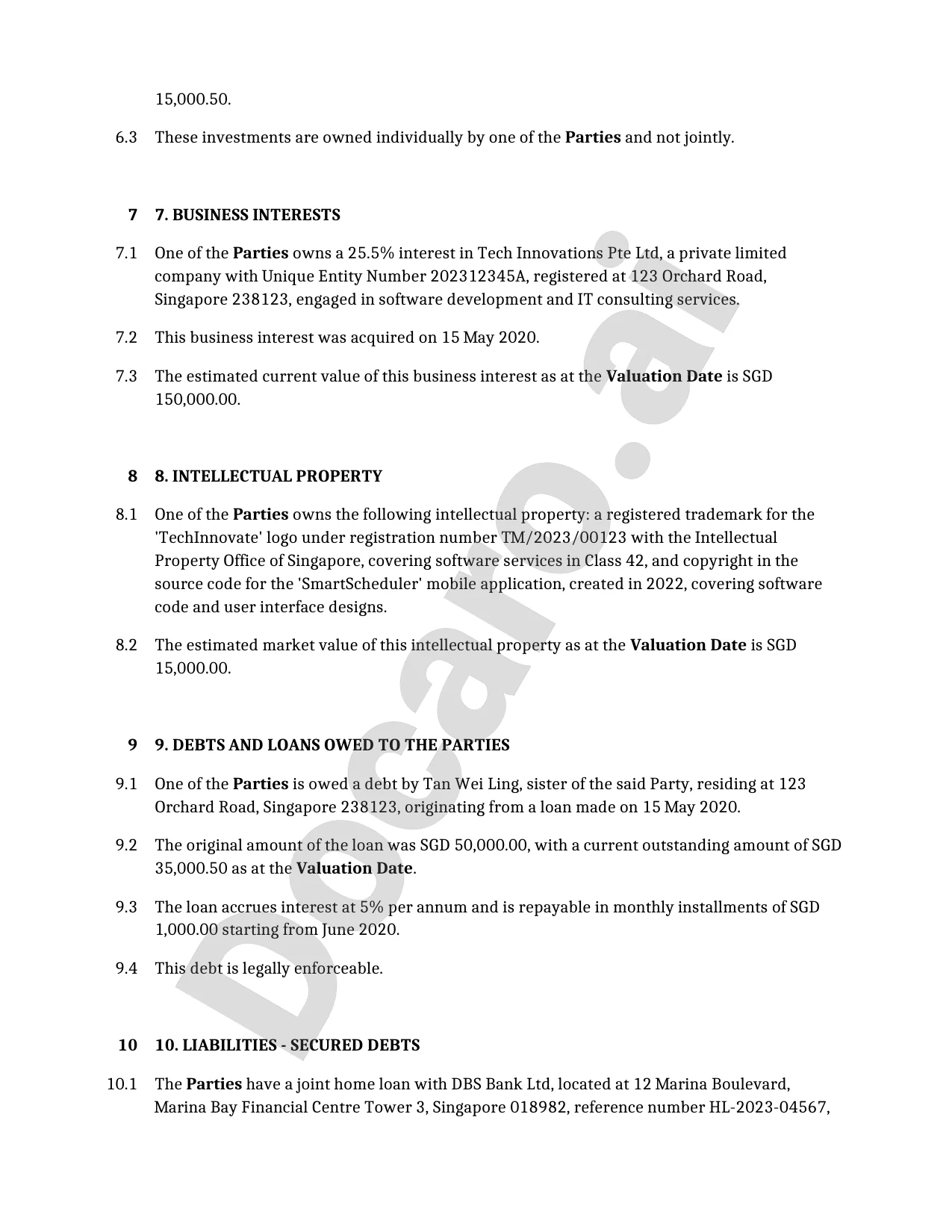
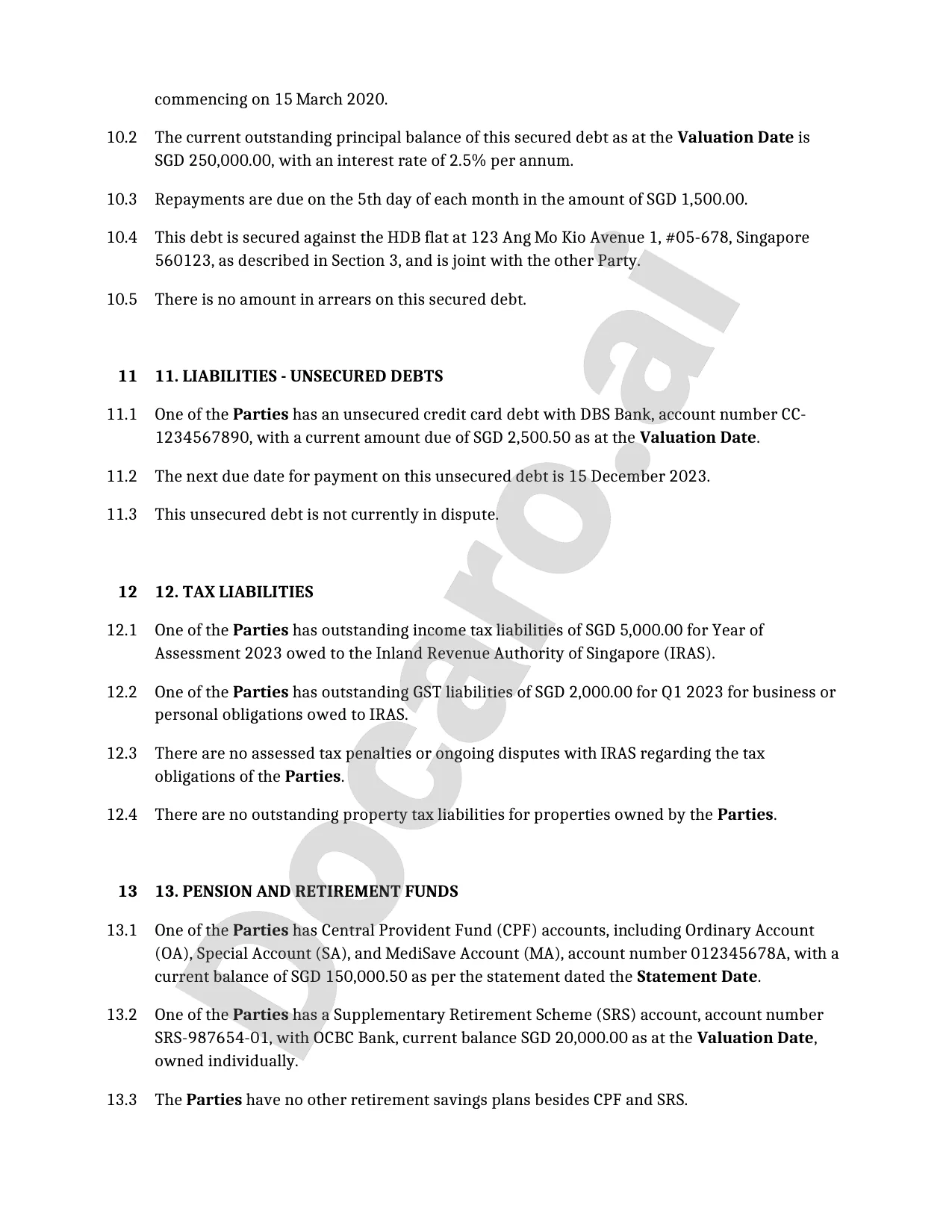
Liability types detailed encompass secured loans like mortgages with outstanding principal and interest rates; unsecured debts such as credit card balances or personal loans; contingent liabilities including guarantees or pending lawsuits; and tax obligations like outstanding income tax or property tax assessments, all quantified with repayment schedules or due dates.
The document concludes with declarations of completeness, where the declarant affirms under penalty of perjury that all assets and liabilities have been fully disclosed without omission, often phrased as: "I hereby declare that the information provided in this Schedule is complete and accurate to the best of my knowledge." For tailored Singapore legal documents, consider using Docaro AI to generate bespoke schedules compliant with local regulations.
What are the key rights and obligations of parties involved?
In Singapore family law, parties submitting a Schedule of Assets and Liabilities bear the primary obligation to disclose all relevant financial information accurately and completely, including assets, liabilities, income, and expenses. This duty ensures transparency in proceedings like divorce or ancillary matters, with non-compliance potentially leading to severe consequences such as perjury charges under the Penal Code or contempt of court for misleading the court.
Reviewing parties, often represented by lawyers or the court, have the right to challenge inaccuracies in the submitted schedule by requesting further documents, interrogatories, or cross-examination during hearings. This process upholds fairness, allowing for corrections or penalties if deliberate omissions are uncovered, thereby protecting the integrity of asset division in Singapore courts.
For precise handling of such disclosures, consider using bespoke AI-generated legal documents via Docaro platform, tailored to your specific case under Singapore regulations. Always consult a qualified lawyer to navigate these obligations effectively and avoid legal pitfalls.
Are there any key exclusions in this document?
In preparing a Schedule of Assets and Liabilities in Singapore, certain items are commonly excluded to maintain focus on verifiable and individually owned assets. For instance, future contingent liabilities such as potential lawsuits or guarantees that have not yet materialized are typically omitted, as they do not represent current obligations under the Family Justice Courts' guidelines.
Personal effects below a nominal value, like everyday clothing or low-cost household items, are often not itemized unless they hold significant financial worth. Similarly, jointly held assets with third parties, such as co-owned property with non-spouse individuals, may be excluded or only partially disclosed to avoid overcomplicating the schedule, with emphasis on the disclosing party's interest.
Handling borderline cases requires careful assessment, such as valuing personal items that might exceed minor thresholds or contingent liabilities with a reasonable probability of occurrence. Consult a legal professional or use Docaro's bespoke AI-generated documents to ensure accurate inclusion, promoting transparency while adhering to Singapore's matrimonial proceedings rules.
What recent or upcoming legal changes affect Schedules of Assets and Liabilities in Singapore?
In 2023, Singapore enacted the Insolvency, Restructuring and Dissolution (Amendment) Act, which mandates the appointment of private trustees in bankruptcy cases for applications filed on or after 1 November 2023, except in public interest matters. This change streamlines the administration of bankrupt estates, directly affecting the preparation and filing of Schedules of Assets and Liabilities by requiring debtors to submit detailed statements under the oversight of these trustees, as outlined on the Singapore Statutes Online.
The Women's Charter (Family Violence and Other Matters) (Amendment) Act 2023, passed on 4 July 2023 and partially commencing in 2025, expands protections against family violence but does not introduce significant alterations to asset disclosure processes in matrimonial proceedings. While ancillary matters like division of assets remain governed by existing provisions, professionals should ensure Schedules of Assets and Liabilities in divorce filings accurately reflect full financial transparency to support enforcement of orders.
Overall, these amendments enhance efficiency in bankruptcy filings without major overhauls to the core requirements for Schedules of Assets and Liabilities, indicating stability in current regulations. For precise compliance, consult reliable sources such as the Ministry of Law's Insolvency Office or generate bespoke legal documents using Docaro to tailor Schedules to individual circumstances.
How do you prepare a Schedule of Assets and Liabilities for Singapore compliance?
1
Gather Financial Documents
Collect all bank statements, property deeds, investment records, loan agreements, and credit card statements to compile a complete financial overview.
2
Categorize Assets and Liabilities
List and classify assets like cash, properties, and investments separately from liabilities such as loans and debts for clear organization.
3
Obtain Valuations
Get professional appraisals for assets like real estate and vehicles, and confirm current balances for all liabilities to ensure accurate figures.
4
Review and Sign Document
Verify all entries for accuracy, then generate a bespoke schedule using Docaro, and sign the finalized document to complete preparation.
What common mistakes should you avoid?
One common pitfall in preparing Schedules of Assets and Liabilities in Singapore is underreporting assets, where individuals overlook items like joint property or offshore holdings, leading to incomplete financial disclosures. To mitigate this, conduct a thorough inventory of all personal and shared assets using professional valuation services and consult with a financial advisor familiar with Singapore's legal requirements.
Another frequent error involves incorrect valuations, such as using outdated market prices for real estate or stocks, which can distort the true financial position. Mitigation strategies include engaging certified appraisers for accurate assessments and regularly updating valuations based on current Singapore market data to ensure compliance with regulatory standards.
Omitting contingent liabilities, like potential lawsuits or loan guarantees, is a critical oversight that may result in legal penalties under Singapore's insolvency laws. To avoid this, review all contracts and risks systematically, and seek expert legal advice to identify and quantify these liabilities properly.
For precise preparation of these schedules, consider using bespoke AI-generated legal documents from Docaro, tailored to Singapore's specific regulations, ensuring accuracy and reducing human error.
Where can you find more resources on this topic?
Understanding Schedules of Assets and Liabilities in Singapore is essential for financial compliance and legal proceedings. For a complete guide, explore our detailed resource on preparing these schedules effectively.
Learn practical steps with our article on how to prepare your schedule of assets and liabilities for Singapore compliance, ensuring accuracy in asset valuation and liability reporting.
Avoid pitfalls by reading about common mistakes to avoid in Singapore's schedule of assets and liabilities, which covers frequent errors in documentation and disclosure.
For official insights, consult the Singapore Courts website or contact legal aid services like the Legal Aid Bureau for personalized guidance on Singapore assets and liabilities schedules. Consider using Docaro for bespoke AI-generated legal documents tailored to your specific needs.
You Might Also Be Interested In
A Legal Document Specifying The Distribution Of A Person's Assets After Their Death.
A Legal Document Specifying Medical Treatments To Withhold Or Withdraw If The Individual Loses Decision-making Capacity.
A Legal Document Authorizing One Person To Act On Behalf Of Another In Specified Matters.
A Revocable Living Trust Is A Legal Arrangement Where A Person Transfers Assets Into A Trust During Their Lifetime, Retaining The Ability To Modify Or Revoke It, To Facilitate Asset Management And Avoid Probate.
A Legal Document Allowing Individuals To Specify Medical Treatments They Do Or Do Not Want If They Become Terminally Ill And Unable To Communicate.
A Codicil Is A Legal Document That Amends, Modifies, Or Supplements An Existing Will Without Revoking It Entirely.