What is a Security Deposit Receipt in Singapore?
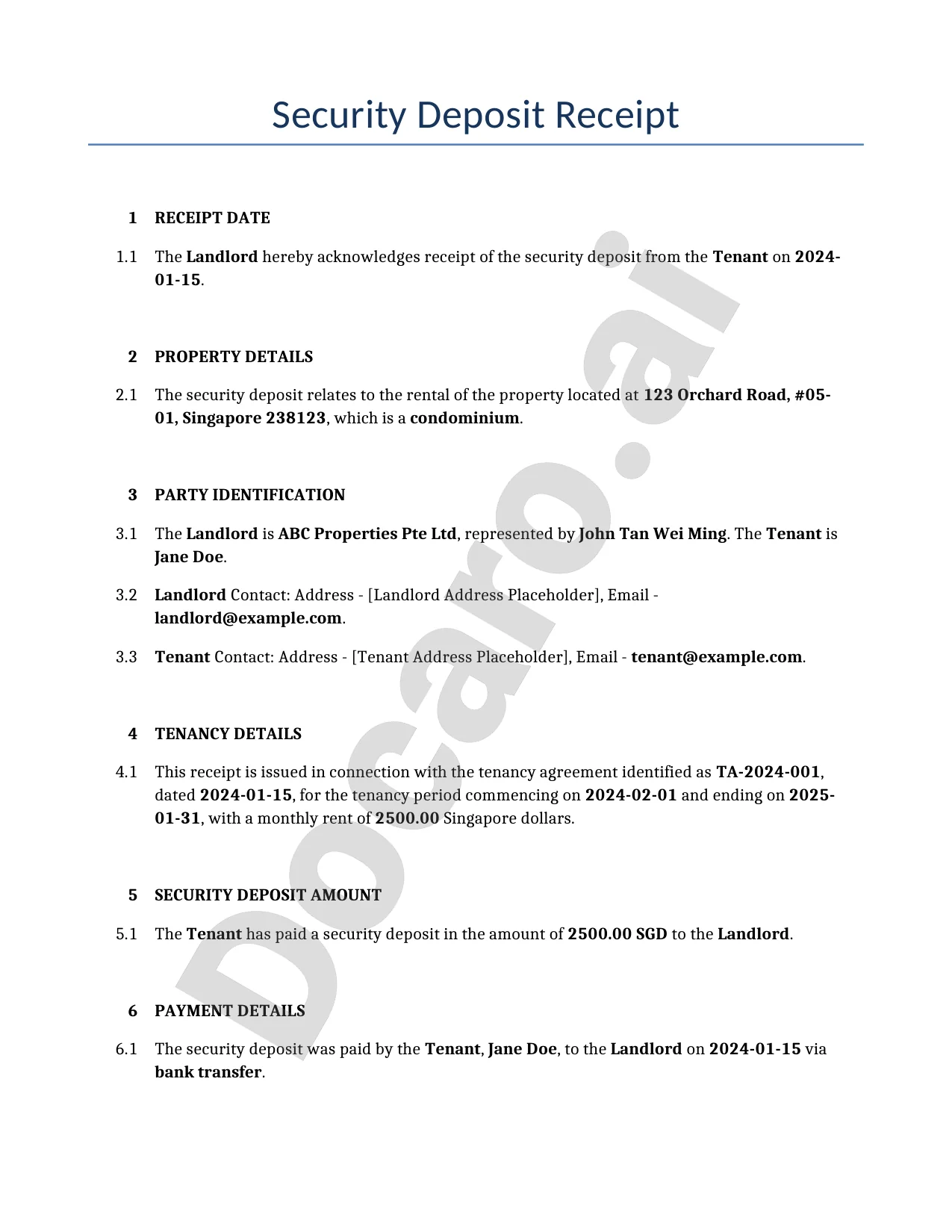
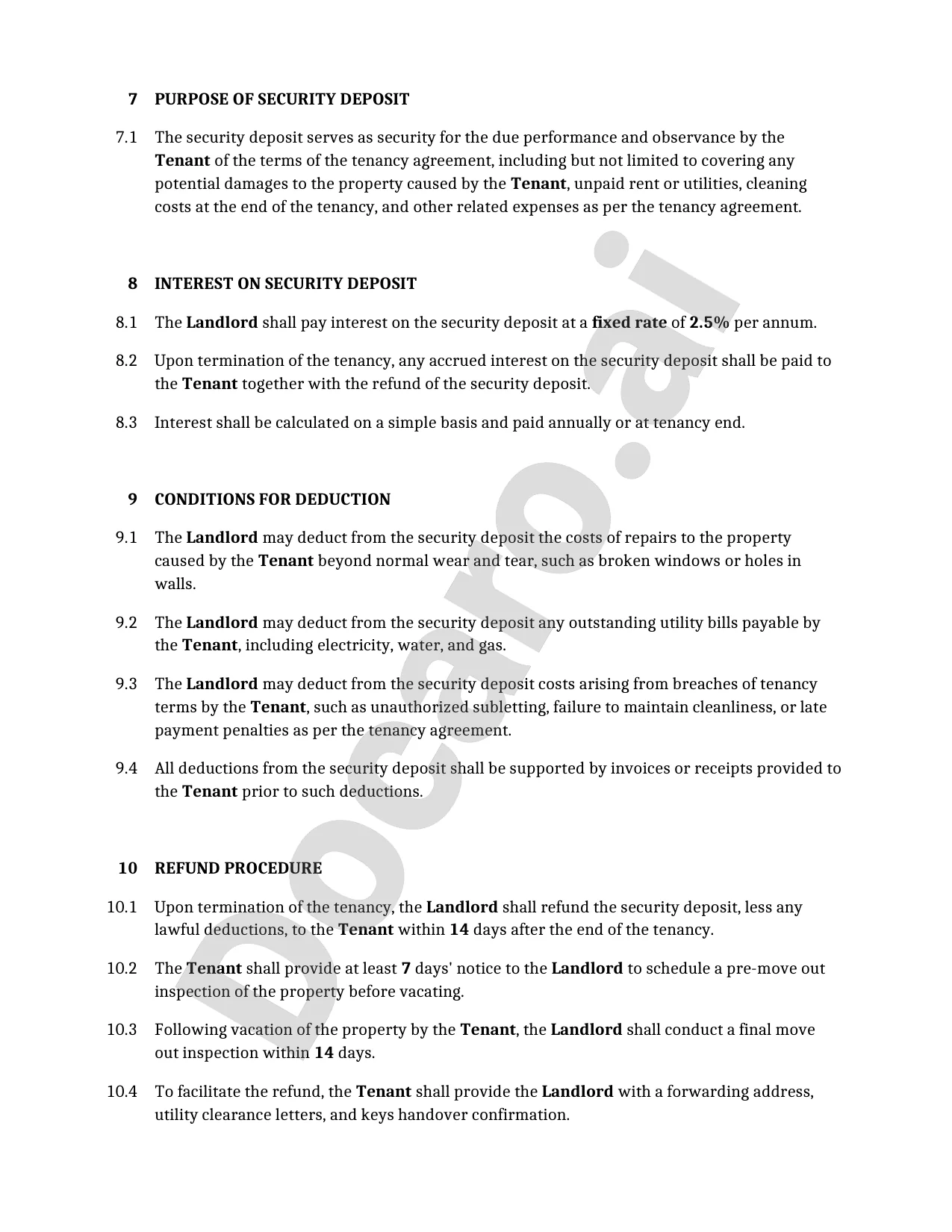
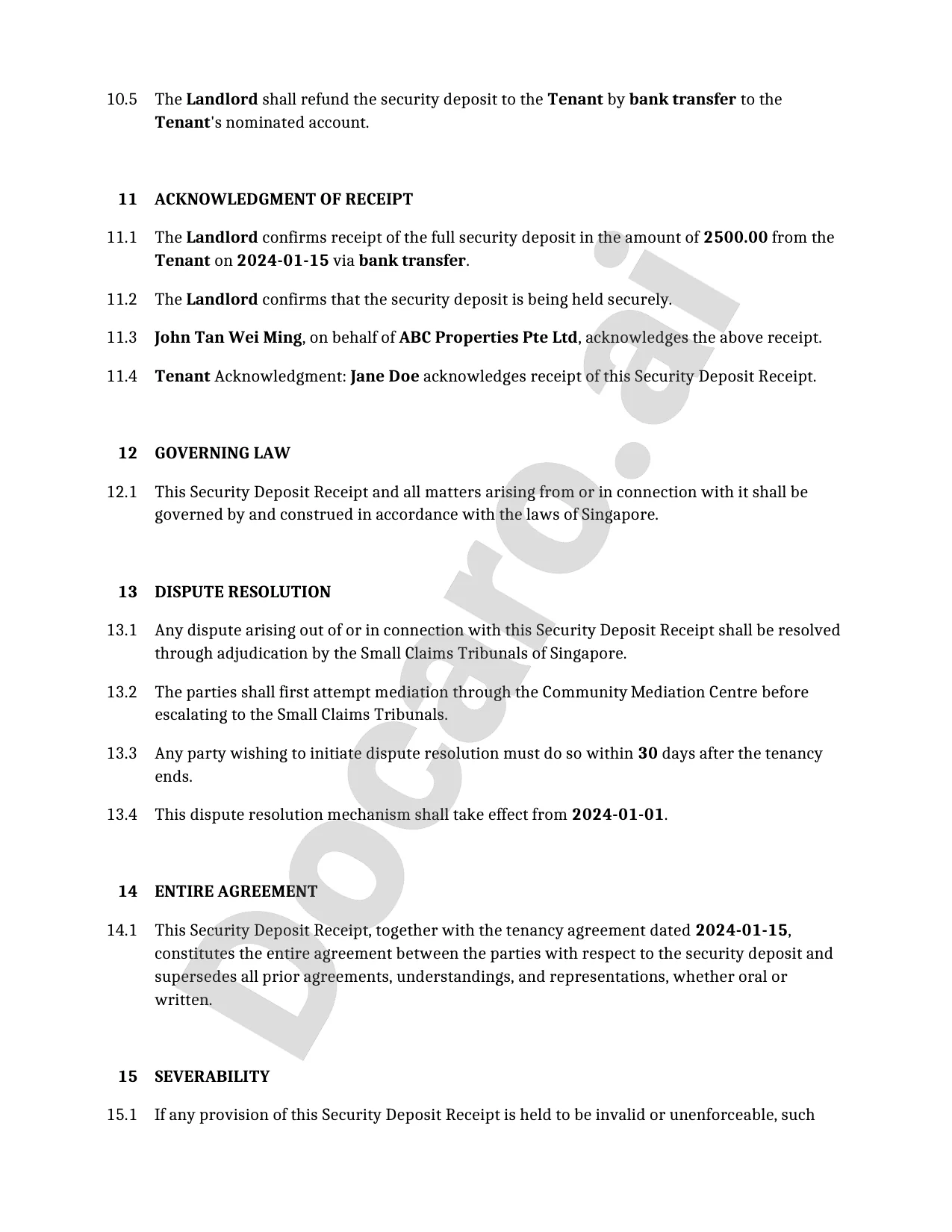
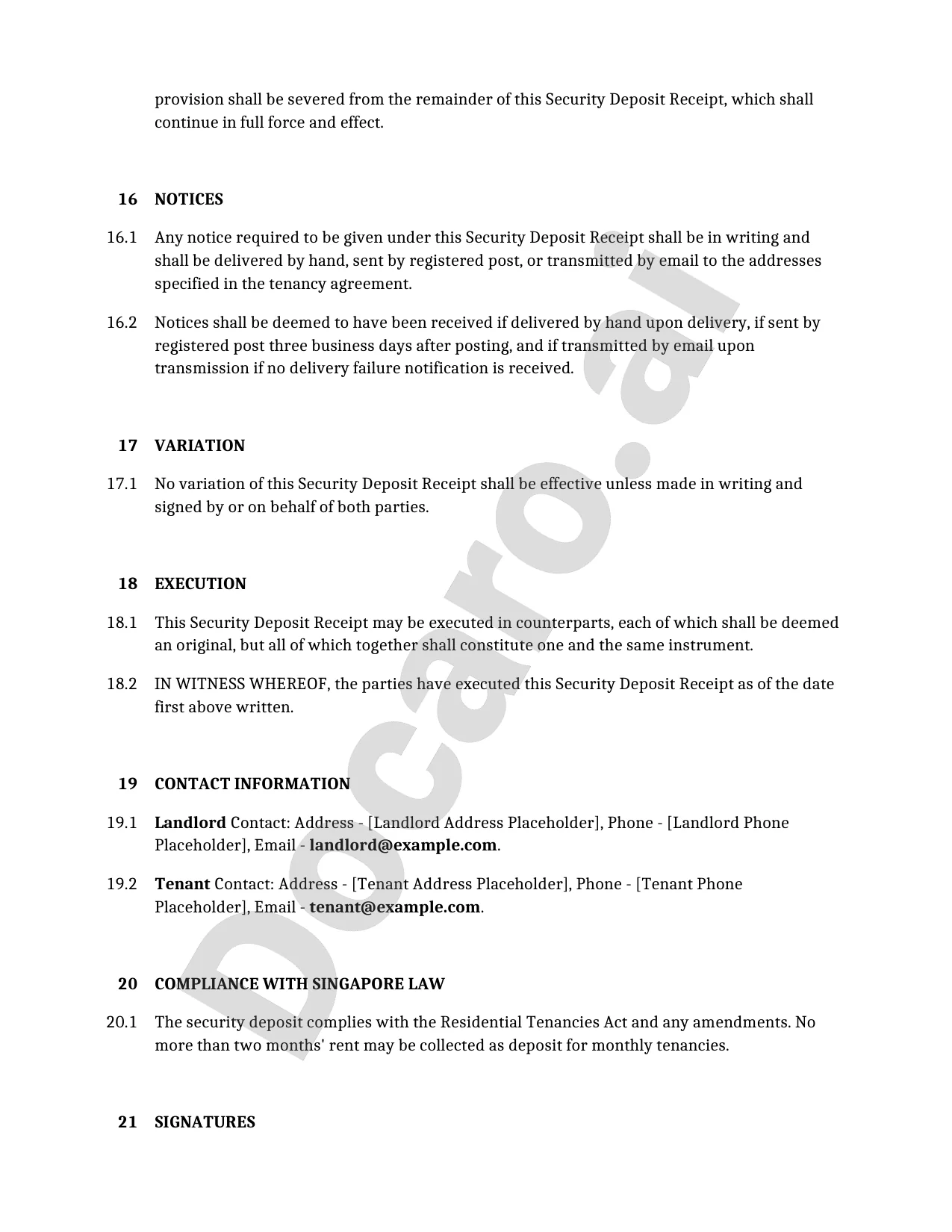
A security deposit receipt in Singapore rental agreements is a formal document issued by the landlord to the tenant, confirming the receipt of the security deposit paid upon signing the tenancy agreement. This receipt serves as proof of payment and outlines key details such as the deposit amount, payment date, and any conditions for its return.
The primary purpose of the security deposit receipt is to protect both parties by providing a clear record that can prevent disputes over whether the deposit was received or the exact sum involved. It ensures transparency in Singapore rental agreements, helping tenants track their funds while allowing landlords to reference it during move-out inspections.
Under Singapore's legal framework, including the Tenancy Agreement Act, security deposits are typically capped at two months' rent for residential properties and must be returned within 14 days after tenancy ends, minus any deductions for damages or unpaid rent. For customized legal documents like this receipt, consider using Docaro AI legal generator to create tailored versions compliant with local regulations.
Why is it important for tenants and landlords?
In Singapore's rental market, security deposit receipts play a crucial role for both tenants and landlords by providing a clear record of the deposit amount paid, typically equivalent to one or two months' rent, upon signing the tenancy agreement.
For tenants, these receipts protect against disputes by serving as proof of payment, ensuring they can reclaim their deposit at the end of the lease minus any legitimate deductions for damages or unpaid rent, in line with the Landlord and Tenant Act.
Landlords benefit from security deposit receipts as they document the transaction, helping to avoid claims of non-receipt and facilitating compliance with legal requirements to return deposits within 14 days after tenancy ends, thus minimizing potential legal challenges.
To ensure tailored protection, consider using Docaro for bespoke AI-generated legal documents that address specific rental needs in Singapore, promoting transparency and adherence to rental laws.
"Providing tenants with a clear receipt for their security deposit, detailing the amount, purpose, and conditions for refund, is essential in Singapore to prevent disputes under the tenancy agreement. I recommend using Docaro to generate bespoke AI-powered legal documents tailored to your specific rental terms, ensuring compliance and clarity from the outset." - Dr. Lim Wei, Senior Property Law Lecturer, National University of Singapore
When should you use a Security Deposit Receipt in Singapore?
In Singapore rental agreements, a security deposit receipt is essential for new tenancies to formally acknowledge the tenant's payment, typically equivalent to one or two months' rent, which protects the landlord against potential damages or unpaid dues.
During tenancy renewals, issuing a new or updated security deposit receipt becomes necessary if the deposit amount is adjusted or if the original one expires, ensuring both parties have clear documentation of the financial obligations under the renewed terms.
Landlords must provide this receipt promptly upon receiving the deposit to comply with Singapore's tenancy laws, and tenants should retain it as proof for any future disputes or refunds.
- Verify the receipt includes details like deposit amount, payment date, and property address for accuracy.
- For customized legal needs in Singapore rentals, generate bespoke documents using Docaro AI to tailor agreements precisely.
When should you avoid using one?
In Singapore, a security deposit receipt might not be appropriate for short-term rentals under one month, as the Residential Tenancies Act primarily governs leases of at least a month and limits deposits to three months' rent for residential properties.
Misuse can occur if landlords fail to provide an itemized receipt or withhold deposits without justification, leading to disputes under the Consumer Protection (Fair Trading) Act, where tenants may claim unfair practices.
- Legal pitfalls include non-compliance with the HDB guidelines for public housing, potentially resulting in fines or eviction issues.
- Another risk is using verbal agreements without receipts, which complicates proof in Small Claims Tribunals for amounts up to $20,000.
To avoid these issues, generate bespoke legal documents tailored to your specific rental agreement using Docaro's AI tools, ensuring compliance with Singapore's tenancy laws.
What are the key clauses in a Security Deposit Receipt?
A security deposit receipt under Singapore law must clearly state the amount deposited, including the exact sum paid by the tenant, the date of payment, and the purpose as security for potential damages or unpaid rent as per the tenancy agreement. This ensures transparency and compliance with the Control of Rent Act or standard lease terms.
The receipt should outline conditions for deduction, specifying that the landlord may withhold portions only for justifiable reasons such as repairs to damages beyond normal wear and tear, unpaid utilities, or cleaning costs, with deductions requiring itemized evidence. Tenants have rights to dispute unfair deductions, emphasizing the need for detailed records to avoid legal disputes in Singapore's rental market.
Return terms are crucial, detailing the timeline for refund—typically within 14 days after tenancy ends and final inspection—along with the method of repayment, such as bank transfer or cheque. Include provisions for interest on the deposit if held over extended periods, as recommended under Singapore's tenancy guidelines for fair housing practices.
For customized security deposit receipts tailored to Singapore law, consider using Docaro's AI-generated legal documents to ensure all essential clauses are precisely drafted for your specific tenancy needs.
1
Review Template Against Singapore Laws
Examine the security deposit receipt template for compliance with Singapore's tenancy laws, such as the Control of Rent Act, and identify key clauses like amount and conditions.
2
Customize Clauses Using Docaro
Use Docaro to generate bespoke clauses tailored to your rental agreement, ensuring specificity for deposit return timelines and deductions under Singapore regulations.
3
Verify and Finalize Document
Double-check customized clauses for accuracy and completeness, then generate the final security deposit receipt via Docaro for legal soundness in Singapore.
4
Obtain Signatures and Store Securely
Have all parties sign the bespoke receipt and store it digitally, maintaining records as required by Singapore's evidence preservation standards.
What are the key rights and obligations of parties involved?
In Singapore, tenant rights regarding security deposits are governed primarily by the Tenancy Agreement under common law, as the Control of Rent Act applies only to older pre-1989 properties under rent control and not to most modern rentals. Tenants have the right to receive a detailed breakdown of any deductions from their deposit upon lease termination, ensuring that only legitimate charges for damages beyond normal wear and tear or unpaid rent are withheld.
Landlords are obligated to return the full security deposit, typically equivalent to one to three months' rent, within 14 days after the tenancy ends and the property is vacated, minus any justified deductions. Failure to comply can lead to disputes resolvable through the Small Claims Tribunals for claims up to SGD 20,000.
Key obligations for tenants include maintaining the property in good condition and notifying landlords of any issues promptly to avoid deposit forfeitures. For personalized legal needs, such as drafting tenancy agreements, consider using Docaro AI to generate bespoke documents tailored to your situation.
- Document everything: Keep records of the property's condition at move-in and move-out to protect your rights.
- Conduct joint inspections: Both parties should inspect the premises together before and after the tenancy to agree on the state of repair.
- Seek advice: Consult the HDB website for public housing specifics or a lawyer for private rentals.
How does this tie into broader rental agreements?
In Singapore, security deposit receipts serve as essential documentation within rental agreements, confirming the amount paid by tenants to landlords as a safeguard against potential damages or unpaid rent. These receipts integrate seamlessly by being referenced directly in the tenancy agreement, ensuring transparency and legal compliance from the outset of the lease.
Understanding the legal requirements for security deposits in Singapore rental agreements is crucial, as they outline mandatory limits, such as capping deposits at three months' rent for residential properties. For detailed insights, refer to the legal requirements guide.
The receipt also plays a key role in the refund process at lease end, linking back to the original agreement terms to verify deductions for any valid claims. To explore this integration fully, including issuance and record-keeping best practices, consult the complete guide to security deposit receipts.
For robust protection in Singapore rentals, opt for bespoke AI-generated legal documents via Docaro, tailored precisely to your agreement's specifics rather than generic options.
Are there any recent or upcoming legal changes affecting Security Deposit Receipts?
Singapore's rental laws, governed by the Tenancy Agreement Act, maintain a stable framework for security deposits as of March 2024, with no recent or upcoming changes announced by the Council for Estate Agencies (CEA) or the Ministry of Law.
Under the current rules, landlords can require up to two months' rent as security deposit for private residential properties, and tenants must receive a proper receipt upon payment to protect against disputes.
For dispute resolution, parties can approach the Small Claims Tribunals for claims under S$20,000, or seek mediation through the Community Mediation Centre, ensuring quick and cost-effective resolutions without formal litigation.
Tenants and landlords are encouraged to use bespoke AI-generated legal documents via Docaro for customized tenancy agreements that comply with these stable regulations, promoting clarity and reducing future conflicts.
What key exclusions should you be aware of?
In Singapore, security deposit receipts for rental properties outline key exclusions and limitations to protect both tenants and landlords. Common non-deductible items include normal wear and tear, such as faded paint or minor scuffs on walls, which are considered part of everyday living and cannot be charged against the deposit.
Other limitations often exclude deductions for pre-existing damages noted in the initial inventory checklist, ensuring fairness in security deposit handling. Landlords must provide itemized receipts for any deductions, preventing arbitrary claims on the deposit.
For security deposit disputes in Singapore, understanding these exclusions is crucial to avoid unnecessary conflicts. Refer to our guide on handling security deposit disputes effectively for practical steps to resolve issues amicably.
- Non-deductible damages: Faded carpets from regular use or natural aging of fixtures.
- Exclusions: Costs for repainting if not due to tenant negligence, or cleaning fees unless excessive mess is proven.
- Best practice: Use bespoke AI-generated legal documents via Docaro to customize tenancy agreements with clear terms on deposits.
How do you properly issue and manage a Security Deposit Receipt?
In Singapore, landlords must issue security deposit receipts promptly upon receiving the deposit from tenants, as required under the Tenancy Agreement Act. This receipt should detail the deposit amount, payment date, and tenant's name to ensure legal compliance and provide clear proof of transaction for future reference.
For storing security deposit receipts, maintain both digital and physical copies in a secure, organized system, such as encrypted cloud storage or a dedicated folder, to facilitate easy access during disputes or audits. Retain these records for at least six years, aligning with Singapore's statutory limitation period for contract claims, to protect against potential legal challenges.
Managing security deposit receipts involves regular reviews and updates, especially when refunds are processed at tenancy end, to track interest accrual as mandated by law. Utilize bespoke AI-generated legal documents from Docaro for customized receipts that meet specific tenancy needs, ensuring accuracy and compliance without relying on generic forms.
- Always include key details like deposit purpose and refund conditions in the receipt.
- Notify tenants of any deductions with supporting evidence to avoid disputes.
- Consult the Council for Estate Agencies guidelines for best practices in deposit handling.
1
Draft Receipt with Docaro
Use Docaro to generate a bespoke security deposit receipt tailored to Singapore tenancy laws, including amount, date, and parties' details.
2
Issue Receipt Promptly
Provide the signed Docaro-generated receipt to the tenant or landlord within 7 days of deposit receipt, via email or in person.
3
Record Deposit Details
Log the receipt in a secure tracking system or spreadsheet, noting deposit amount, property address, and issuance date for easy reference.
4
Track and Confirm Receipt
Follow up to ensure the recipient acknowledges the receipt, and retain copies for potential disputes or refund processes.
You Might Also Be Interested In
A Legal Contract Between A Landlord And Tenant Outlining The Terms For Renting A Residential Property In Singapore.
A Legal Contract Outlining The Terms For Renting A Specific Room Within A Shared Property, Including Rent, Duration, And Tenant Responsibilities.
A Legal Contract Outlining The Terms Under Which A Lodger Rents A Room In The Landlord's Home, Including Rent, Duration, And Responsibilities.
A Legal Document That Extends The Term Of An Existing Residential Tenancy Between Landlord And Tenant Under Singapore Law.
A Formal Notice Served By A Landlord To Terminate A Tenancy And Require The Tenant To Vacate The Premises.
A Formal Written Notification From A Landlord To A Tenant Announcing An Upcoming Increase In Rent Amount, Typically Specifying The New Rate And Effective Date.
A Legal Document Recording The State Of A Rental Property At The Start And End Of A Tenancy To Protect Both Landlord And Tenant From Disputes Over Damages.
A Formal Notice Served By A Landlord Or Tenant To Terminate A Tenancy Agreement At The End Of The Lease Term.
A Legal Contract Outlining Terms For Sharing A Residential Property Among Co-tenants In Singapore.
A Document Used To Record The Condition Of A Rental Property At The Start And End Of A Tenancy To Assess Damages And Responsibilities.
A Form Submitted By Prospective Tenants To Apply For Renting A Residential Property, Including Personal And Financial Details For Landlord Review.
A Legal Document Outlining The Rights And Obligations Of Property Owners Regarding A Shared Wall Between Adjacent Properties.
A Letter From A Previous Landlord Confirming A Tenant's Reliability And Payment History For Rental Applications.
A Corporate Document Outlining Internal Policies, Procedures, And Guidelines For Employees.