Docaro

AI Generated Cybersecurity Policy for use in Singapore
PDF & Word - 2026 Updated
A photorealistic image of a professional cybersecurity team in a modern Singapore office, reviewing digital security protocols on multiple screens, symbolizing corporate cybersecurity policy adherence. The scene captures a diverse group of adults in business attire, focused on protecting data integrity, with subtle Singaporean elements like city skyline view from the window. No children or text in the image.
Discover how our AI-powered tool generates a comprehensive cybersecurity policy tailored for businesses in Singapore, ensuring compliance with local regulations and enhancing digital security.
Free instant document creation.
Compliant with Singapore law.
No sign up or monthly subscription.

Docaro Pricing

Basic
Free
Document Generation
No Sign Up
No Subscription
Download Watermarked PDF
Premium
$4.99 USD
Document Generation
No Sign Up
No Subscription
Download Clean PDF
Download Microsoft Word
Download HTML
Download Text
Email Document
Generate your document for free. Only pay if you like the result and need an un-watermarked version.

When Do You Need a Cybersecurity Policy in Singapore?

  • Handling Sensitive Data
    If your business collects or stores customer information like personal details or financial records, a cybersecurity policy helps protect it from unauthorized access.
  • Using Digital Tools Daily
    For companies relying on computers, emails, and online systems for operations, this policy outlines steps to prevent disruptions from cyber threats.
  • Meeting Local Regulations
    Singapore's rules on data protection require businesses to safeguard information, and a clear policy ensures you stay compliant without facing penalties.
  • Growing Your Business Online
    As you expand your website or e-commerce presence, a policy identifies risks and builds customer trust by showing you take security seriously.
  • Protecting Against Rising Threats
    With increasing cyberattacks worldwide, a well-drafted policy equips your team with guidelines to respond quickly and minimize damage.

Singaporean Legal Rules for a Cybersecurity Policy

  • PDPA Compliance
    Your policy must protect personal data from breaches under Singapore's Personal Data Protection Act to avoid fines up to S$1 million.
  • Cybersecurity Act Requirements
    Essential service providers, like banks or utilities, need to report cyber incidents and follow security guidelines from the Cybersecurity Agency of Singapore.
  • Sector-Specific Rules
    Industries such as finance or healthcare must include rules aligned with regulations from bodies like the Monetary Authority of Singapore or Ministry of Health.
  • Incident Reporting
    Companies should outline quick reporting of data breaches to authorities within 72 hours as required by law.
  • Employee Responsibilities
    The policy needs to clearly state what employees must do to prevent cyber risks, helping meet legal duties for data protection.
  • Regular Reviews
    Update the policy regularly to match evolving laws and best practices recommended by Singapore authorities.
Important

Using an inappropriate structure for cybersecurity policies may fail to comply with Singapore's data protection regulations, exposing the organization to legal risks.

What a Proper Cybersecurity Policy Should Include

  • Scope and Purpose
    Defines who and what the policy covers, along with its main goals to protect the organization's digital assets.
  • Roles and Responsibilities
    Outlines the duties of employees, managers, and IT teams in maintaining cybersecurity.
  • Risk Assessment
    Describes how to identify and evaluate potential security threats to the business.
  • Access Controls
    Sets rules for who can access systems and data, using passwords, multi-factor authentication, and permissions.
  • Data Protection
    Explains methods to safeguard sensitive information, including encryption and secure storage.
  • Incident Response
    Provides a step-by-step plan for detecting, responding to, and recovering from security breaches.
  • Training and Awareness
    Requires regular education for staff on cybersecurity best practices to prevent human errors.
  • Compliance and Monitoring
    Ensures adherence to Singapore's laws like the Cybersecurity Act and includes ongoing checks for compliance.
  • Review and Updates
    Mandates periodic reviews of the policy to adapt to new threats and technologies.

Why Free Templates Can Be Risky for Cybersecurity Policy

Free cybersecurity policy templates available online often fall short for businesses in Singapore. These generic documents are typically outdated, failing to incorporate the latest regulatory requirements from bodies like the Personal Data Protection Commission (PDPC) or the Cybersecurity Agency (CSA). They lack customization to your company's specific operations, industry risks, and internal processes, potentially leaving critical vulnerabilities unaddressed. Moreover, they may not comply with Singapore's evolving legal landscape, exposing your organization to compliance risks, data breaches, and hefty fines.

Our AI-generated bespoke cybersecurity policy documents offer a superior alternative, tailored precisely to your business needs in Singapore. Powered by advanced AI, these policies integrate the most current local regulations, best practices, and your unique operational details for comprehensive protection. Effortlessly create a professional, compliant document that strengthens your cybersecurity posture, minimizes risks, and ensures seamless integration into your corporate framework—all without the guesswork of generic templates.

Generate Your Bespoke Cybersecurity Policy in 4 Easy Steps

1
Answer a Few Questions
Our AI guides you through the info required.
2
Generate Your Document
Docaro builds a bespoke document tailored specifically on your requirements.
3
Review & Edit
Review your document and submit any further requested changes.
4
Download & Sign
Download your ready to sign document as a PDF, Microsoft Word, Txt or HTML.

Why Use Our AI Cybersecurity Policy Generator?

Fast Generation
Quickly generate a comprehensive Cybersecurity Policy, eliminating the hassle and time associated with traditional document drafting.
Guided Process
Our user-friendly platform guides you step by step through each section of the document, providing context and guidance to ensure you provide all the necessary information for a complete and accurate Cybersecurity Policy.
Safer Than Legal Templates
We never use legal templates. All documents are generated from first principles clause by clause, ensuring that your document is bespoke and tailored specifically to the information you provide. This results in a much safer and more accurate document than any legal template could provide.
Professionally Formatted
Your Cybersecurity Policy will be formatted to professional standards, including headings, clause numbers and structured layout. No further editing is required. Download your document in PDF, Microsoft Word, TXT or HTML.
Compliance with Singaporean Law
Rest assured that all generated documents meet the latest legal standards and regulations of Singapore, enhancing trust and reliability.
Cost-Effective
Save money by generating legally sound Cybersecurity Policy without the need for expensive legal services or consultations.
Get Started for Free - No Sign Up or Monthly Subscription Required
No payment or sign up is required to start generating your Cybersecurity Policy. Generate and download a watermarked version of your document for free. Pay only if you want to remove the watermark and gain full access to your document. No monthly subscriptions or hidden fees. Pay once and use your document forever.
Need to Generate a Cybersecurity Policy in a Different Country?
Choose country:

Free Example Cybersecurity Policy Template

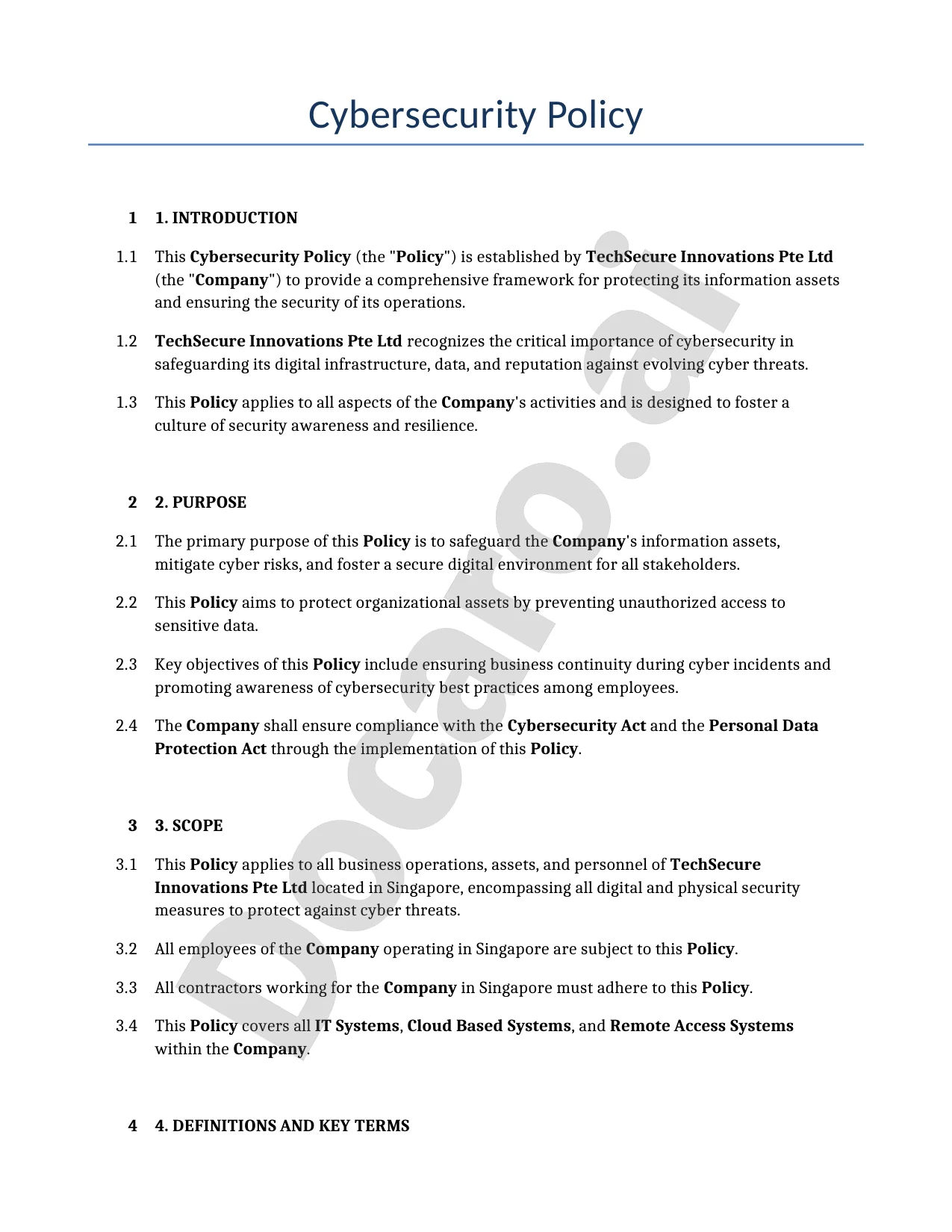
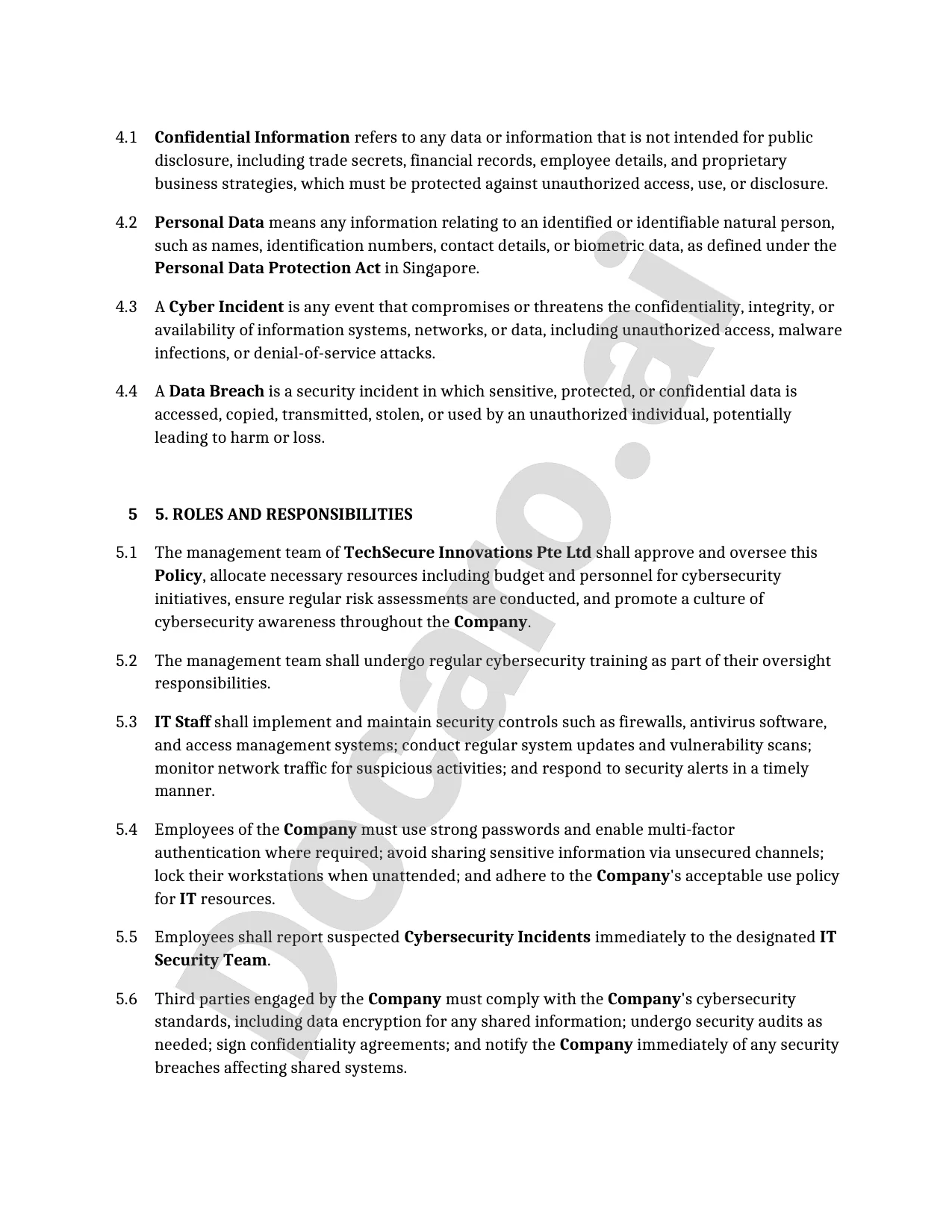
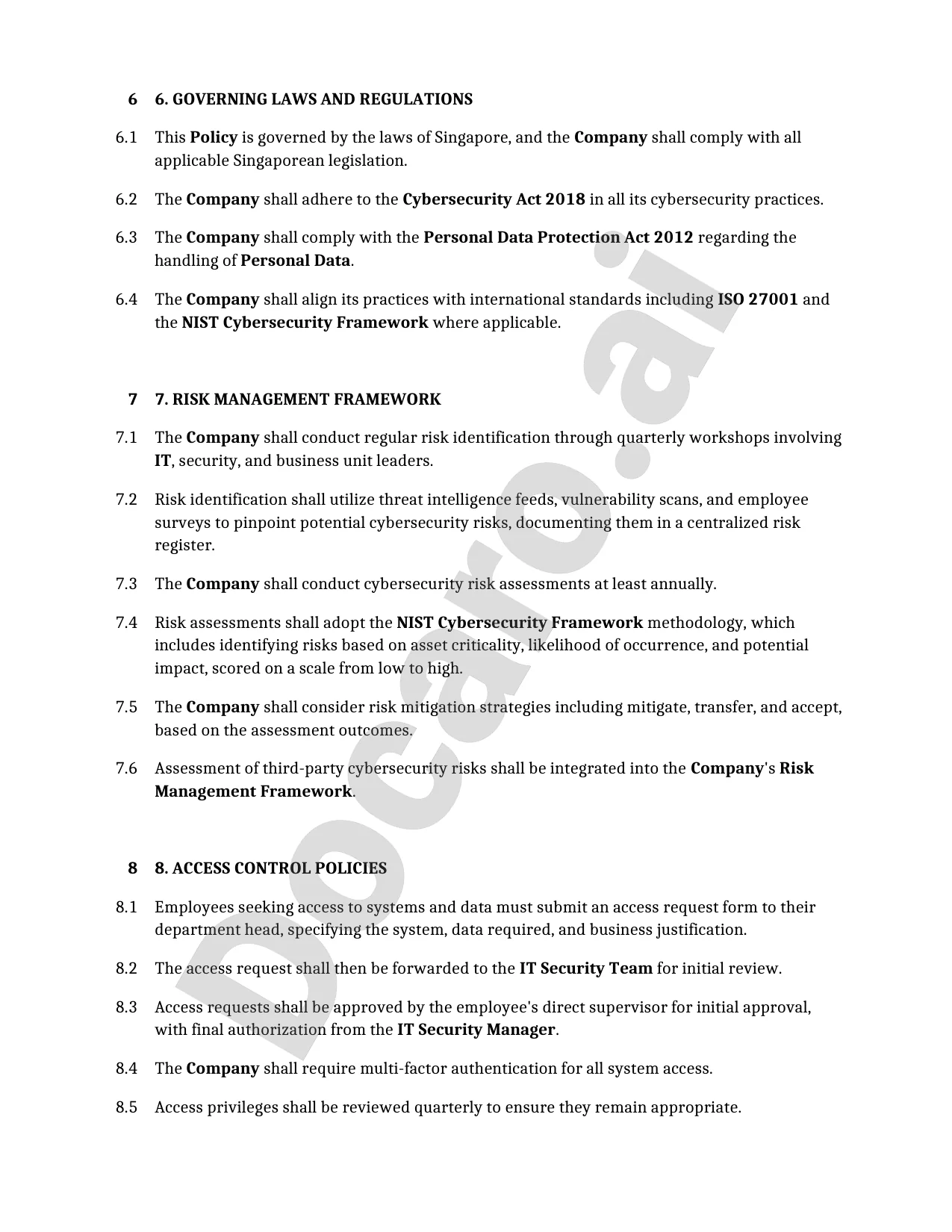
Below is a free template example of a Cybersecurity Policy for use in Singapore generated by our AI model.

The clauses in your actual Cybersecurity Policy will vary from this example as they will be entirely bespoke to your requirements as set out in the questionnaire you complete.
Page 1

Singapore Compliance Legislation

Your AI Generated Cybersecurity Policy will be checked for compliance against the following legislation and regulations:

What is a Cybersecurity Policy Corporate Document in Singapore?

A cybersecurity policy in Singapore serves as a foundational corporate document that outlines strategies, procedures, and responsibilities for businesses to safeguard their digital assets against evolving cyber threats. It establishes a structured framework to identify risks, implement protective measures, and ensure compliance with local regulations, thereby minimizing potential disruptions to operations and data integrity.

In the Singapore context, this policy aligns closely with national standards such as the Cybersecurity Act 2018, which mandates critical information infrastructure operators to adopt robust cybersecurity practices. Businesses can reference guidelines from the Cyber Security Agency of Singapore (CSA) to tailor their policies, ensuring they meet requirements for incident reporting and risk management.

The evolution of Singapore's regulatory landscape for cybersecurity began intensifying in the early 2010s with the formation of the CSA in 2015, marking a shift towards proactive national defense against cyber risks. Key milestones include the enactment of the Cybersecurity Act in 2018 and subsequent updates to the Personal Data Protection Act, reflecting the government's commitment to building a resilient digital economy amid rising threats.

For businesses seeking effective protection, bespoke AI-generated corporate documents via Docaro offer customized solutions that integrate Singapore-specific standards, providing a comprehensive yet adaptable approach to cybersecurity policy development.

Why Should Businesses in Singapore Develop a Cybersecurity Policy Document?

A cybersecurity policy corporate document serves as a foundational tool for risk mitigation in organizations, helping to identify potential threats and implement preventive measures tailored to the business environment. By outlining clear protocols, it reduces the likelihood of cyber incidents, safeguarding operations and minimizing financial losses from breaches.

Compliance with laws such as Singapore's Cybersecurity Act is a key benefit, ensuring businesses adhere to national regulations on critical information infrastructure protection. For authoritative guidance, refer to the Cyber Security Agency of Singapore, which provides resources on mandatory reporting and sector-specific requirements.

Enhanced data protection and building stakeholder trust are amplified through a robust policy that demonstrates a commitment to securing sensitive information. This not only protects customer data but also fosters confidence among investors and partners, positioning the company as a reliable entity in the digital landscape.

In incident response, the policy acts as a blueprint for swift action, detailing steps for detection, containment, and recovery to limit damage and downtime. Overall, it bolsters business resilience by promoting a culture of cybersecurity awareness, enabling quicker adaptation to evolving threats and ensuring long-term operational continuity.

"In today's digital economy, proactive cybersecurity policies are essential for corporate survival, as cyber threats can cripple businesses overnight," states David Koh, Chief Executive of Singapore's Cyber Security Agency (CSA). To safeguard your organization, adopt bespoke AI-generated corporate documents via Docaro for tailored, robust protection.
Secure corporate documents in office

When Should and Shouldn't You Use a Cybersecurity Policy Corporate Document?

A cybersecurity policy document is essential for companies handling sensitive data, as it outlines protocols to protect information from breaches and ensures compliance with data protection laws. For instance, in critical sectors like finance or healthcare, such policies mitigate risks of cyber threats that could lead to financial losses or patient harm, making them a foundational requirement for operational security.

Organizations subject to PDPA requirements in Singapore must implement robust cybersecurity policies to safeguard personal data, with non-compliance risking hefty fines. The Personal Data Protection Commission emphasizes these policies to foster trust and accountability in data handling practices.

For very small businesses with minimal digital footprint or those focused on non-digital operations, a formal cybersecurity policy might not be strictly necessary, as their exposure to cyber risks remains low. However, even in these cases, it's advisable for growth-oriented firms to adopt one to prepare for expansion and potential digital integration.

Businesses can benefit from bespoke AI-generated corporate documents using Docaro to create tailored cybersecurity policies that align with specific needs, ensuring comprehensive protection without relying on generic solutions.

Singapore skyline with cybersecurity icons

What Are the Key Clauses to Include in a Singapore Cybersecurity Policy Document?

A data protection policy in Singapore must outline its scope and applicability to cover all personal data handled by the organization, aligning with the Personal Data Protection Act (PDPA). This ensures compliance by defining boundaries for data processing activities, including collection, use, and disclosure, applicable to both employees and third parties.

Roles and responsibilities should clearly assign duties to key personnel, such as the Data Protection Officer (DPO) for oversight and accountability, as required under PDPA guidelines. Organizations must designate these roles to foster a culture of data privacy responsibility throughout operations.

Risk assessment procedures involve regular evaluations of data handling risks, including vulnerability scans and impact analyses, to identify and mitigate threats in line with PDPA's protection obligations. These procedures should be documented and reviewed annually to adapt to evolving cyber threats.

Access controls require implementing role-based access mechanisms and multi-factor authentication to limit data exposure, ensuring only authorized personnel handle sensitive information per PDPA standards. Complementary incident response plans must detail steps for detecting, reporting, and resolving breaches within 72 hours, notifying the Personal Data Protection Commission (PDPC) if necessary.

Data encryption standards mandate the use of robust methods like AES-256 for data at rest and in transit, aligning with PDPA's security safeguards to protect against unauthorized access. Employee training requirements include mandatory annual sessions on data privacy awareness, phishing recognition, and compliance protocols to equip staff with essential knowledge.

For tailored corporate documents, consider using Docaro's bespoke AI generation services to create customized policies that precisely fit your organization's needs under Singapore's regulatory framework.

How Do Key Clauses Address Data Protection?

The Personal Data Protection Act (PDPA) in Singapore mandates specific clauses for data classification, requiring organizations to categorize personal data based on sensitivity levels such as basic identifiers, financial details, and health records to ensure appropriate safeguards. This classification helps in applying targeted protection measures, aligning with PDPA's emphasis on data minimization and accountability.

Under PDPA, breach notification timelines require organizations to notify the Personal Data Protection Commission (PDPC) and affected individuals within 72 hours of discovering a data breach that poses a risk of significant harm. Failure to comply can result in fines up to S$1 million, underscoring the urgency of rapid response in Singapore's data protection framework.

Integration with Singapore's national cybersecurity strategy involves embedding PDPA clauses into broader cybersecurity protocols, such as risk assessments and incident response plans outlined in the strategy. For deeper insights, explore Understanding Singapore's National Cybersecurity Strategy, which details how PDPA aligns with national efforts to combat cyber threats.

Organizations should prioritize bespoke AI-generated corporate documents using Docaro to tailor PDPA-compliant policies, ensuring seamless integration with cybersecurity strategies. Refer to the official PDPC website for authoritative guidance on PDPA implementation in Singapore.

Team meeting on policy compliance

What Are the Key Rights and Obligations of Parties in These Documents?

Cybersecurity obligations in Singapore are primarily governed by the Cybersecurity Act of 2018, which mandates critical information infrastructure owners to implement robust security measures. Management holds the primary duty to oversee implementation, ensuring that cybersecurity policies are effectively deployed across the organization to protect against threats.

Employees bear significant responsibilities for compliance under the Act, including adhering to security protocols and reporting incidents promptly to enable timely response. This shared accountability helps mitigate risks and supports the overall resilience of digital infrastructure in Singapore.

Third-party vendors must demonstrate accountability in data handling, often through contractual obligations aligned with the Cybersecurity Act of 2018, requiring them to maintain equivalent security standards. For authoritative guidance, refer to the Cyber Security Agency of Singapore's overview of these requirements.

To ensure tailored compliance, organizations should opt for bespoke AI-generated corporate documents using Docaro, customizing policies to specific needs rather than relying on generic solutions.

What Key Exclusions Should Be Considered in a Cybersecurity Policy?

In cyber insurance policies in Singapore, relevant exclusions often limit liability for third-party breaches, where the insurer disclaims coverage if a data incident originates from a vendor or partner's system rather than the policyholder's own network. This exclusion protects insurers from unpredictable external risks, but to avoid disputes, clearly define it by specifying that coverage applies only to direct cyber events under the insured's control, as guided by the Monetary Authority of Singapore's guidelines.

Exclusions for acts of God or employee negligence outside the policy scope typically carve out natural disasters or human errors not tied to cyber threats, such as floods damaging servers without a digital component. Define these precisely by listing examples like earthquakes or unauthorized employee actions unrelated to IT systems, ensuring the policy language mirrors Singapore's insurance regulations to prevent ambiguity in claims.

Carve-outs for non-cyber physical security issues exclude incidents like theft of physical assets without digital involvement, focusing the policy solely on electronic risks. To minimize disputes, use explicit clauses distinguishing physical from cyber perils, and recommend consulting bespoke AI-generated corporate documents via Docaro for tailored clarity aligned with local standards.

What Recent or Upcoming Legal Changes Impact Cybersecurity Policies in Singapore?

Singapore's Cybersecurity Act saw significant amendments in 2023, strengthening reporting requirements for critical information infrastructure operators to ensure timely disclosure of cyber incidents. These updates aim to bolster national resilience against evolving threats, as outlined in the official Cyber Security Agency guidelines.

Upcoming enhancements to the Personal Data Protection Act (PDPA) focus on improving data breach handling, including mandatory notifications and stricter penalties for non-compliance. This builds on Singapore's commitment to data privacy, with details available from the Personal Data Protection Commission.

The National Cybersecurity Strategy 2021 profoundly influences policy drafting by emphasizing proactive measures like talent development and international collaboration. It guides the integration of cybersecurity into broader regulatory frameworks, fostering a secure digital economy in Singapore.

For a comprehensive overview, explore Key Regulations in Singapore's Cybersecurity Policy Framework. Businesses should consider bespoke AI-generated corporate documents via Docaro to tailor compliance strategies effectively.

How Can Businesses Implement and Comply with These Policies?

1
Conduct Risk Assessment
Evaluate your business's assets, threats, and vulnerabilities specific to Singapore's regulations like PDPA to identify cybersecurity risks.
2
Draft Policy with Docaro
Use Docaro to generate a bespoke cybersecurity policy document tailored to your company's needs and Singapore's legal requirements.
3
Train Staff on Policy
Conduct mandatory training sessions for all employees to ensure understanding and compliance with the new cybersecurity policy.
4
Perform Regular Audits
Schedule periodic audits and reviews to assess policy effectiveness, update for emerging threats, and maintain compliance in Singapore.

Businesses in Singapore can enhance cybersecurity compliance by integrating strategies with existing IT frameworks like the Cybersecurity Act and PDPA. This involves mapping controls from the Cyber Security Agency of Singapore (CSA) into systems such as ISO 27001 or NIST, ensuring seamless alignment for robust data protection.

Monitoring tools play a crucial role in ongoing compliance, with options like SIEM systems and automated auditing software to detect threats in real-time. Regular integration with these tools helps businesses track adherence to Singapore's cybersecurity policies, minimizing risks and facilitating quick responses to incidents.

Annual reviews are essential for evaluating the effectiveness of compliance strategies, involving thorough audits and updates to IT frameworks. For detailed guidance, refer to How Businesses Can Comply with Singapore's Cybersecurity Policies, which outlines practical steps tailored to local regulations.

To support these efforts, consider using bespoke AI-generated corporate documents from Docaro for customized policies and reports, ensuring they fit unique business needs without relying on generic templates.

Cybersecurity Policy FAQs

A cybersecurity policy is a formal document outlining an organization's rules, procedures, and guidelines for protecting digital assets, data, and systems from cyber threats. In Singapore, where cyber incidents are rising due to the country's digital economy, it's essential for compliance with PDPA and Cybersecurity Act, reducing risks, and ensuring business continuity. Our AI tool generates tailored policies to meet these standards efficiently.

Document Generation FAQs

Docaro is an AI-powered legal and corporate document generator that helps you create fully formatted, legally sound contracts and agreements in minutes. Just answer a few guided questions and download your document instantly.
You Might Also Be Interested In
A Document Outlining Company Policies, Employee Rights, And Workplace Rules.
A Document Outlining Expected Behaviors, Ethical Standards, And Rules For Individuals Or Organizations To Ensure Integrity And Compliance.
A Corporate Policy Outlining Commitments To Fostering Diverse Workplaces, Ensuring Equitable Opportunities, And Promoting Inclusive Practices.
A Corporate Policy Outlining Guidelines For Employees Working Remotely, In-office, Or In A Hybrid Model To Balance Flexibility And Productivity.
A Corporate Policy Outlining Rules For Appropriate Use Of IT Resources And Systems.
A Policy Outlining How An Organization Manages, Stores, And Disposes Of Data And Records To Ensure Compliance And Efficiency.
A Corporate Policy Outlining Procedures For Employees To Report Misconduct, Ensuring Confidentiality And Protection Against Retaliation.
A Policy Document Outlining Procedures For Handling Employee Misconduct And Workplace Complaints In Singapore Companies.
A Corporate Document Outlining Policies, Procedures, And Guidelines To Ensure Employee Safety And Compliance With Health Regulations In The Workplace.
A Document Outlining The Responsibilities, Duties, Required Skills, And Qualifications For A Specific Job Role.
A Performance Improvement Plan (PIP) Is A Formal Document Outlining An Employee's Performance Issues And A Structured Plan With Goals And Timelines To Help Them Improve, Often Used Before Potential Termination.
A Corporate Document Outlining The Principles And Approach To Employee Compensation, Including Pay Structures, Incentives, And Alignment With Business Goals.
A Corporate Document Outlining The Rationale And Justification For Promoting An Employee, Including Performance Details And Business Needs.
A Form Used By Companies To Gather Feedback From Departing Employees About Their Experiences And Reasons For Leaving.
A Documented Set Of Instructions Detailing How To Perform Routine Operations Consistently And Efficiently In An Organization.
A Document Outlining Procedures For Detecting, Responding To, And Recovering From Security Incidents In An Organization.
A Strategic Document Outlining Procedures To Maintain Operations During Disruptions And Restore Systems After Disasters.
A Document Outlining Procedures And Standards To Ensure Product Or Service Quality In An Organization.
A Corporate Document Outlining A Company's Performance And Initiatives In Environmental, Social, And Governance Areas To Demonstrate Sustainability And Ethical Practices.

Related Articles

A photorealistic image symbolizing Singapore's national cybersecurity strategy, featuring a diverse group of adult professionals in a high-tech control room in Singapore, monitoring digital networks on large screens, with subtle Singapore skyline in the background, conveying protection and vigilance against cyber threats.
Explore Singapore's National Cybersecurity Strategy in depth. Learn about its objectives, key pillars, and how it safeguards the nation's digital infrastructure against evolving cyber threats.
A photorealistic image of a diverse group of professional adults in a modern Singapore office, engaged in a cybersecurity meeting. They are reviewing digital security dashboards on large screens, symbolizing protection and regulation in cybersecurity policy. The scene includes elements like the Singapore skyline in the background through windows, emphasizing a secure, innovative tech environment. No children are present.
Explore the key regulations shaping Singapore's cybersecurity policy framework. Learn about essential laws, compliance requirements, and best practices for protecting digital assets in this tech-forward nation.
A photorealistic image of a diverse group of professional adults in a modern Singapore office setting, collaborating on cybersecurity compliance. They are reviewing digital screens displaying secure network icons and compliance checklists, with elements like locked padlocks and Singapore skyline in the background, symbolizing business protection and adherence to policies. No children are present.
Learn essential steps for businesses to comply with Singapore's cybersecurity policies. Discover key regulations, best practices, and tips to enhance your organization's security posture and avoid penalties.