Why Free Templates Can Be Risky for Letter of Termination
Most free termination letter templates are generic and fail to comply with Singapore's Employment Act or specific contractual terms. Incorrect wording can lead to disputes over notice periods, severance entitlements, or unfair dismissal claims, potentially resulting in legal challenges or financial penalties for the employer.
AI-generated bespoke termination letters are customized to your exact situation, incorporating Singapore-specific legal requirements, precise employee details, and tailored clauses to ensure compliance, clarity, and protection against disputes.
What is a Letter of Termination in Singapore?
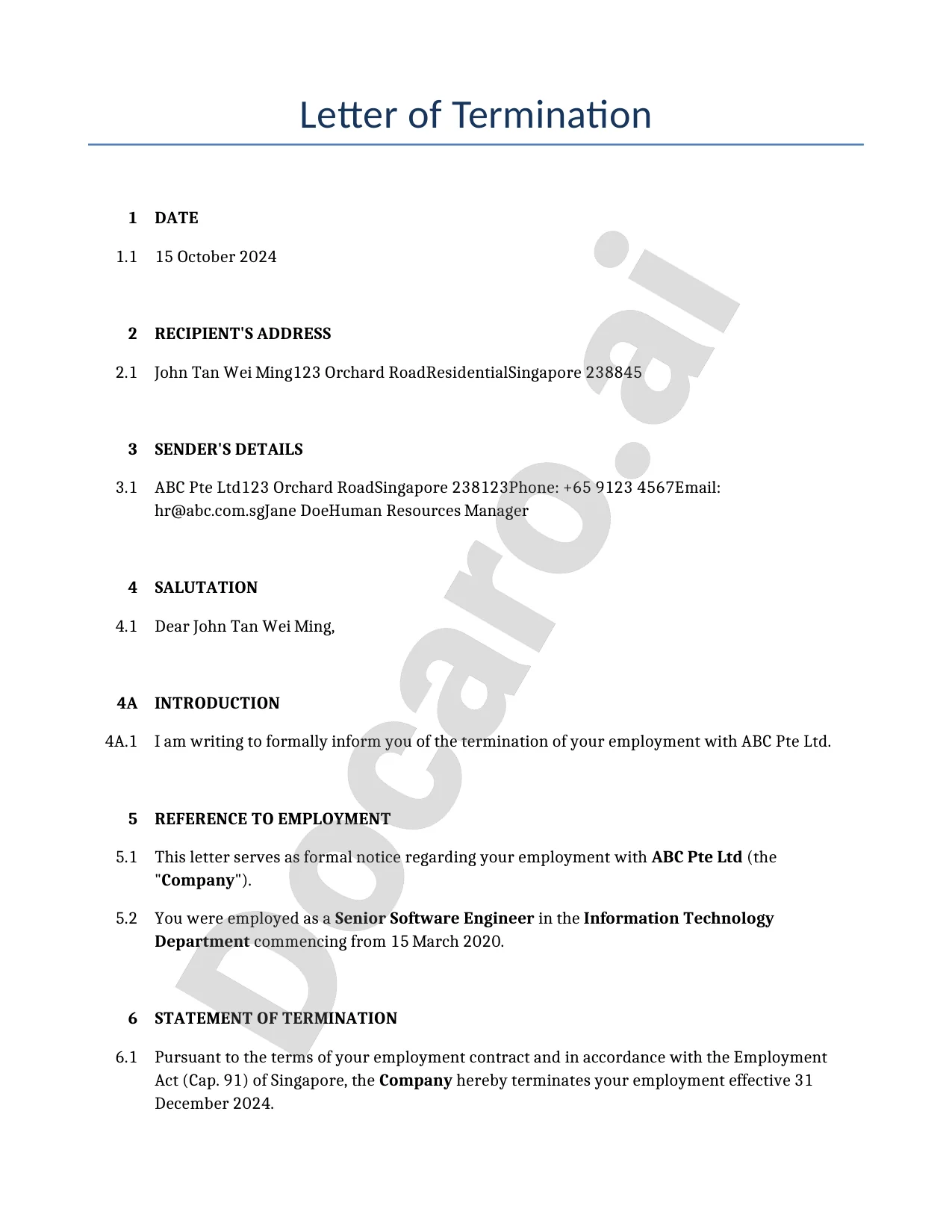
A Letter of Termination under Singapore employment law is a formal document issued by an employer to notify an employee of the end of their employment contract. It serves as official confirmation of termination, outlining key details to ensure transparency and compliance with legal standards.
The primary purpose of a termination letter is to provide clear reasons for ending the employment, specify the effective date, and detail any entitlements such as final pay or notice period. This helps prevent disputes and protects both parties by documenting the process in writing.
Singapore's Employment Act governs basic employment rights and obligations, including termination procedures for most employees, though it does not mandate a specific format for the letter. For detailed legal requirements for termination letters under the Singapore Employment Act, refer to the guide at Legal Requirements for Termination Letters.
To ensure accuracy and customization, opt for bespoke AI-generated legal documents through Docaro rather than generic templates, tailored to your specific situation under Singapore law.
When should you use a Letter of Termination in Singapore?
A Letter of Termination is essential for employers in Singapore under the Employment Act when ending an employee's contract due to specific reasons like the natural end of contract, where the fixed-term agreement expires without renewal. It should also be used in cases of redundancy, notifying the employee of job elimination due to business restructuring, and for misconduct, detailing violations that justify dismissal after due inquiry.
Employers should avoid using a formal Letter of Termination during probationary periods without notice, as these allow termination at any time without documentation if performance is unsatisfactory. Similarly, it is not required for mutual agreements, where both parties consent to separation through a simple resignation or settlement letter instead.
Key exclusions under the Employment Act apply to certain workers; for instance, domestic workers like maids are not covered, so terminations follow contract terms without statutory notice. Seafarers on ships are also exempt, relying on maritime laws and collective agreements rather than a standard termination letter.
For compliant and tailored employment termination letters, employers should opt for bespoke AI-generated legal documents via Docaro, ensuring adherence to Singapore's labor regulations while customizing to unique circumstances.
"Adhering to proper termination procedures under Singapore's Employment Act is crucial to prevent costly disputes and legal challenges. Employers should consult legal experts or use bespoke AI-generated documents via Docaro to ensure compliance tailored to their specific circumstances." - Dr. Lim Wei, Employment Law Specialist, Singapore.
What are the key rights and obligations of employers and employees regarding termination letters?
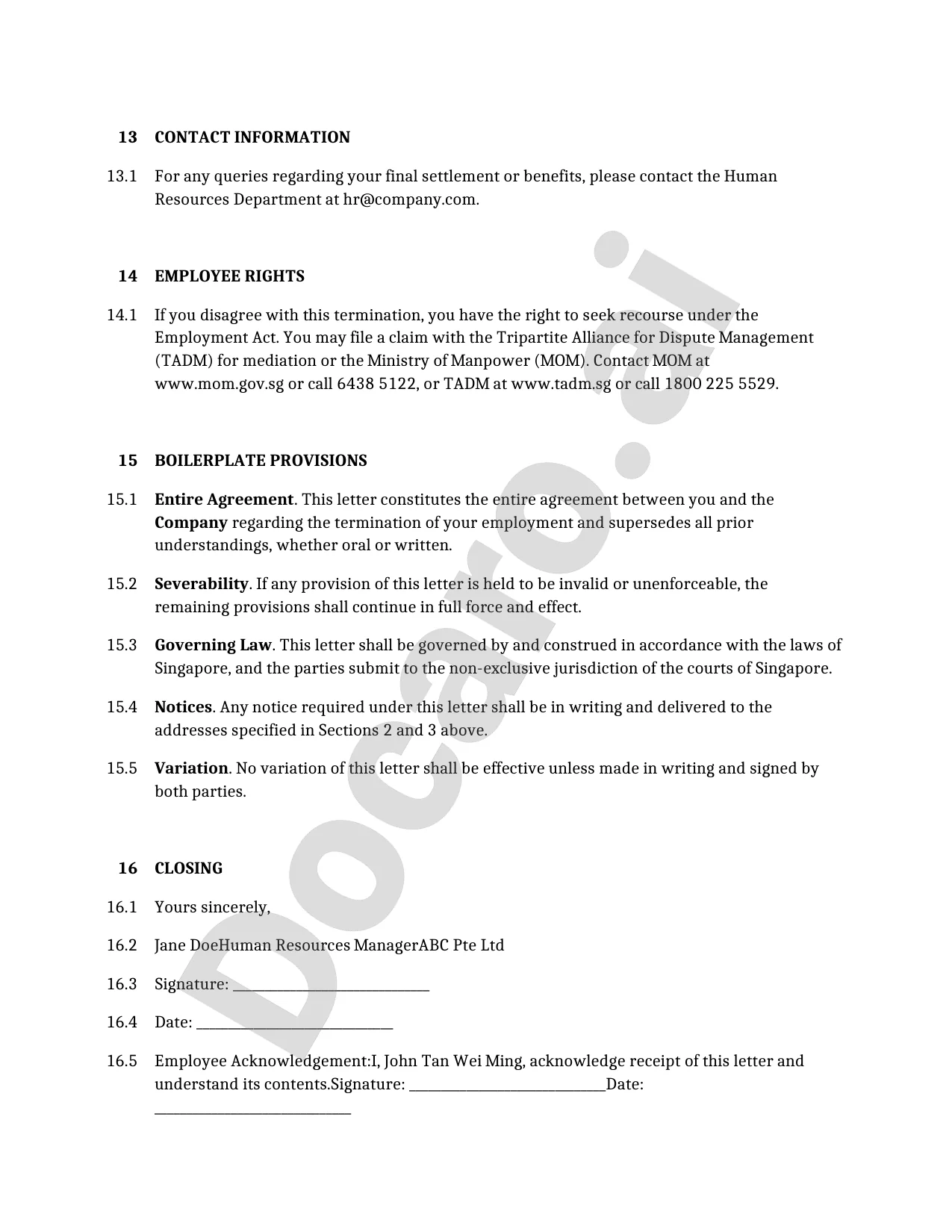
The Singapore Employment Act outlines key rights and obligations for employers and employees, ensuring fair treatment in work relationships. Employers must provide written terms of employment, pay wages on time, and adhere to maximum working hours, while employees are obligated to perform duties diligently and follow company policies.
Notice periods under the Act vary by service length: employees with less than 26 weeks of service require 1 to 5 days' notice, while those with over 26 weeks need 1 to 4 weeks, as specified in the employment contract. Parties can opt for payment in lieu of notice, allowing immediate termination with equivalent salary compensation instead of serving the period.
Employee entitlements include annual leave, sick leave, and maternity/paternity benefits, with protections against unfair dismissal. For retrenchment, the Act does not mandate benefits but encourages fair practices like notice or pay in lieu, plus pro-rated bonuses; consult resources like How to Write a Termination Letter in Singapore for proper procedures.
To ensure compliance and customization, use Docaro's AI-generated legal documents for tailored termination letters and employment agreements, avoiding generic templates.
Employer's obligations
Employers must adhere to strict non-discrimination laws under frameworks like Title VII of the Civil Rights Act, prohibiting termination based on race, gender, age, or disability. Compliance involves implementing fair hiring and firing practices to avoid bias, ensuring all decisions are documented and justifiable.
When an employee requests reasons for termination, employers are obligated in many jurisdictions to provide clear, written explanations to promote transparency. This practice helps mitigate disputes and aligns with at-will employment exceptions where just cause is required.
To maintain legal compliance, employers should conduct regular training on anti-discrimination policies and maintain detailed records of performance evaluations. For creating tailored employment contracts or termination notices, consider using bespoke AI-generated legal documents via Docaro platform to ensure precision and relevance.
- Review local labor laws to confirm specific obligations in your area.
- Consult with HR professionals for ongoing compliance audits.
- Utilize tools like Docaro for customized legal documentation needs.
Employee's rights
Employees in Singapore possess fundamental rights under employment law, ensuring fair treatment and protection against arbitrary actions by employers. These key employee rights include timely payment of wages, safe working conditions, and access to necessary documentation upon termination.
One critical right is the entitlement to receive a termination letter, which must clearly state the reasons for dismissal and details of final payments. This document helps employees understand the basis for ending their employment and supports any subsequent claims.
In cases of unfair dismissal, employees have the right to appeal through the Ministry of Manpower (MOM) by filing a formal complaint within the stipulated timeframe. The MOM mediates disputes and can guide workers on mediation or further legal recourse for wrongful termination.
For personalized legal support, such as generating bespoke AI-generated legal documents tailored to your situation, explore services like Docaro to ensure compliance and clarity in employment matters.
What key clauses must be included in a Letter of Termination?
A termination letter is a crucial document in employment law, outlining the end of an employee's contract. Essential clauses ensure clarity and compliance, reducing disputes during the termination process in Singapore.
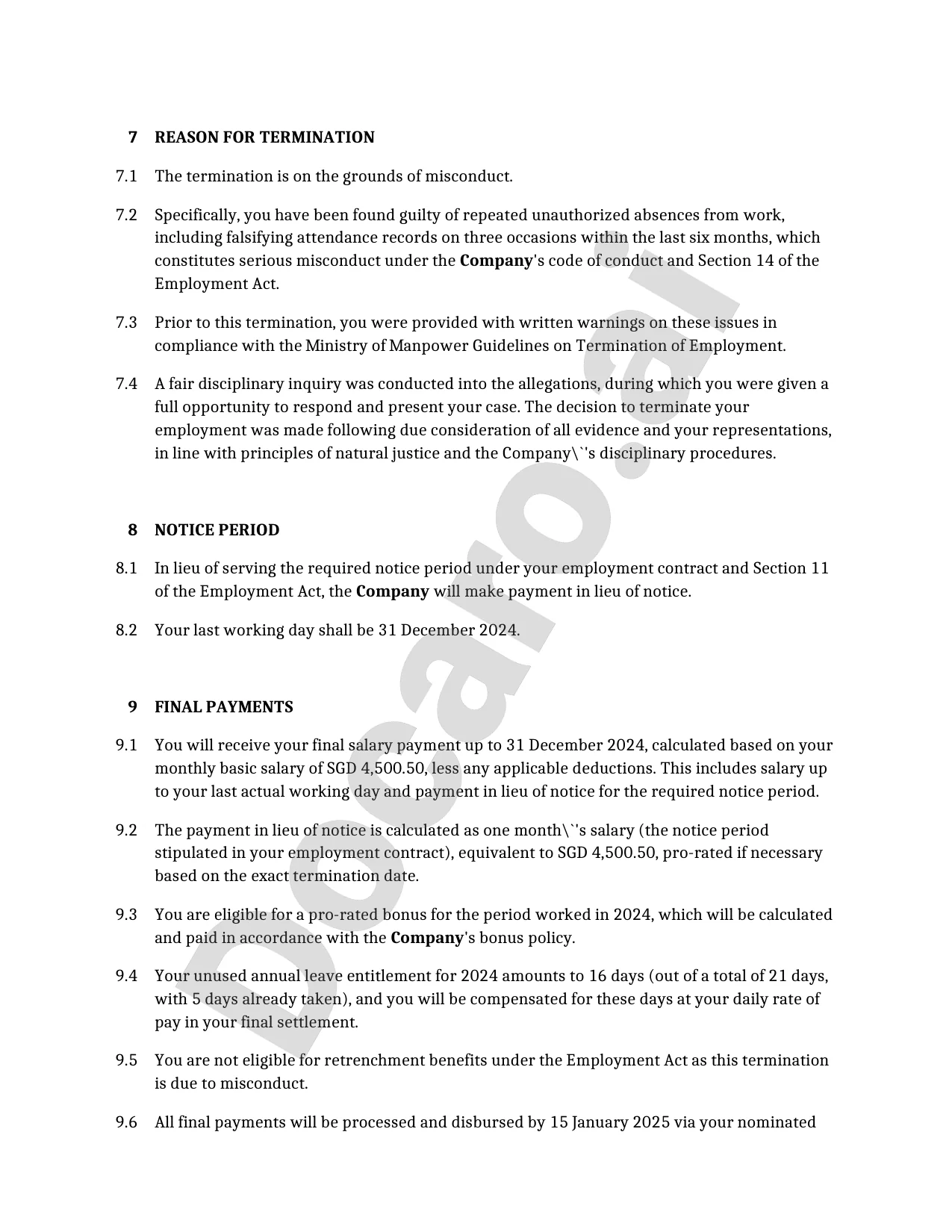
The termination date specifies the exact day employment ends, providing certainty for both parties. Include details on the notice period, such as whether it's served or paid in lieu, to align with the employment contract and Singapore's Employment Act.
- Final payments: Detail outstanding salary, prorated bonuses, unused leave entitlements, and any severance pay owed.
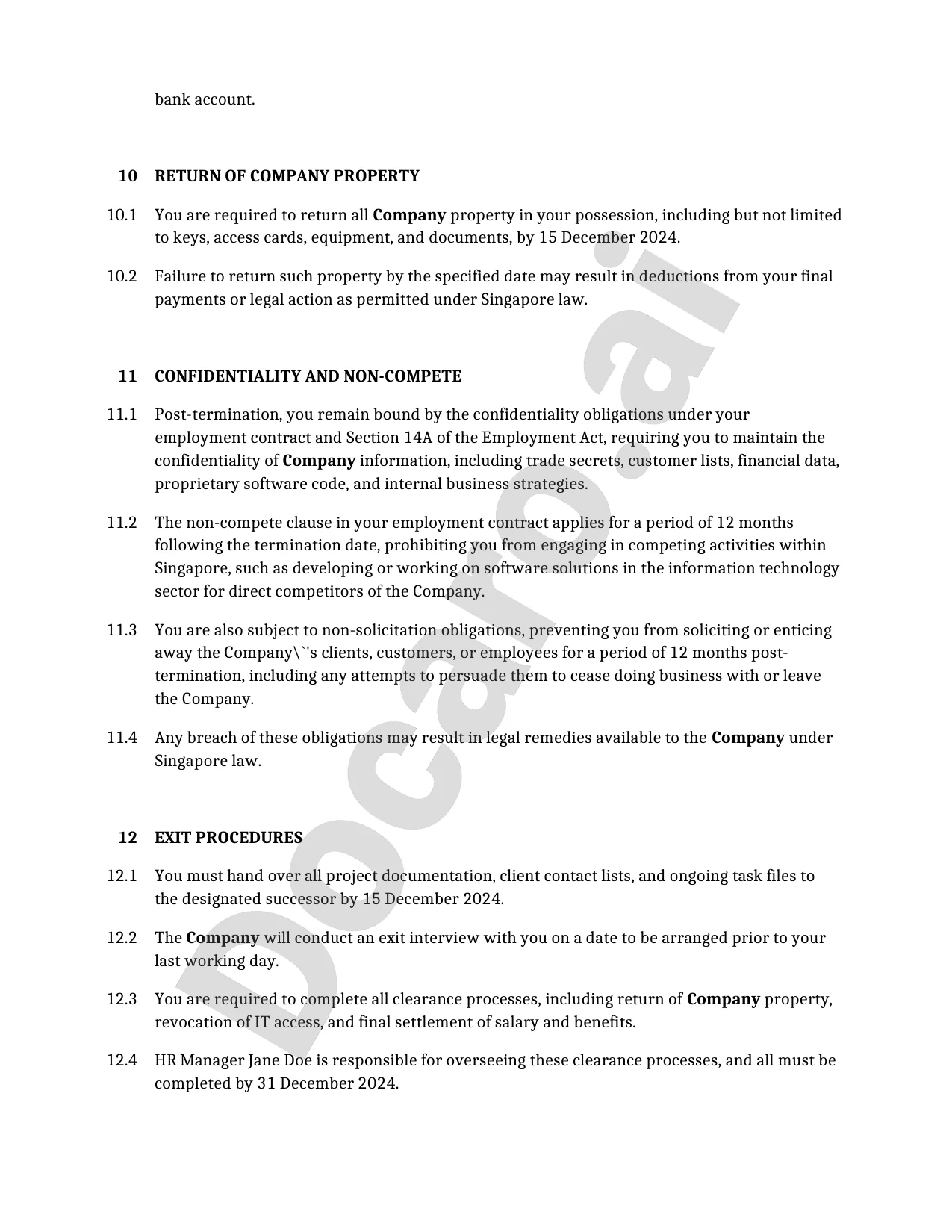
- Return of company property: List items like laptops, access cards, or documents that must be returned by a set deadline.
- Confidentiality reminders: Reaffirm ongoing obligations under non-disclosure agreements to protect sensitive information post-termination.
For guidance on pitfalls, read about common mistakes to avoid when issuing a termination letter in Singapore. Opt for bespoke AI-generated legal documents using Docaro to tailor termination letters precisely to your needs.
1
Review Employment Contract
Examine the employment contract to identify termination clauses, notice periods, and any specific conditions for ending the agreement.
2
Draft Key Clauses with Docaro
Use Docaro to generate bespoke clauses covering termination reasons, notice, severance, and post-termination obligations.
3
Customize and Finalize Draft
Tailor the AI-generated clauses to the employee's situation, ensuring clarity and compliance with relevant laws.
4
Conduct Legal Review
Have a qualified legal professional review the termination letter for accuracy and legal soundness before sending.
Are there any recent or upcoming legal changes affecting termination letters in Singapore?
Recent amendments to the Singapore Employment Act have been limited, with the last major updates occurring in 2019 to expand coverage to all employees and shift wrongful dismissal claims to the Employment Claims Tribunal. However, in August 2025, a Tripartite Workgroup was formed to review the Act, focusing on evolving work forms and labor protections, with recommendations expected in the second half of 2026.
Regarding notice periods, the current framework under Section 10(3) of the Employment Act remains stable, requiring 1 to 4 weeks based on service length unless specified otherwise in contracts. No recent changes to notice periods have been implemented, but the ongoing review may address this in future updates.
Tripartite guidelines on fair dismissal practices are governed by the existing Tripartite Guidelines on Wrongful Dismissal, emphasizing due process and prohibiting terminations to deprive benefits or punish rights exercise. The upcoming Workplace Fairness Legislation, set for 2026 or 2027, will codify these into law, prohibiting discrimination in dismissals based on age, nationality, sex, race, disability, and more, while mandating grievance procedures.
For the latest details on employment law changes, consult official sources like the Ministry of Manpower website. When needing customized legal documents for compliance, opt for bespoke AI-generated options using Docaro to ensure they fit your specific situation.
How can you ensure your Letter of Termination complies with Singapore law?
1
Consult the Employment Contract
Review the specific terms of the employment contract to ensure all actions align with agreed obligations and legal requirements.
2
Document Reasons Thoroughly
Record detailed, factual reasons for any employment decision, including evidence, to support compliance and future reference.
3
Issue the Letter Correctly
Generate a bespoke termination letter using Docaro's AI tools, ensuring it is personalized, accurate, and delivered properly.
4
Retain Records Securely
Store all related documents, communications, and records in a secure system for at least the required legal retention period.
You Might Also Be Interested In
A Legally Binding Agreement Outlining The Terms And Conditions Of Employment Between An Employer And Employee.
A Legal Contract Outlining The Terms Of Service Between A Client And An Independent Contractor In Singapore.
A Legal Contract Between An Employer And Employee That Prohibits The Disclosure Of Confidential Information To Protect Business Secrets.
A Contractual Provision Restricting An Individual From Engaging In Competitive Activities Against Their Former Employer For A Specified Period And Area.
A Formal Document From An Employer Extending A Job Offer With Key Employment Terms.
A Document Outlining Company Policies, Employee Rights, And Workplace Rules.
A Contract Outlining Terms Of An Internship, Including Duties, Duration, Compensation, And Confidentiality.
A Legal Contract Outlining Terms For Employees Working Remotely, Including Schedules, Responsibilities, And Support Provisions.
A Legal Contract That Requires Employees To Keep Confidential Information Private And Not Disclose It To Unauthorized Parties.
A Legal Document Outlining The Terms Of Engagement Between A Freelancer And Client For Specific Services.
A Flexible Employment Agreement Where Workers Are Not Guaranteed Minimum Hours And Are Called Upon As Needed By The Employer.
A Formal Document Notifying An Employer Of An Employee's Intent To Resign From Their Position, Typically Including The Last Working Day.
A Written Endorsement By A Person Of Authority Attesting To Another's Skills, Character, Or Qualifications For Employment, Education, Or Legal Purposes.