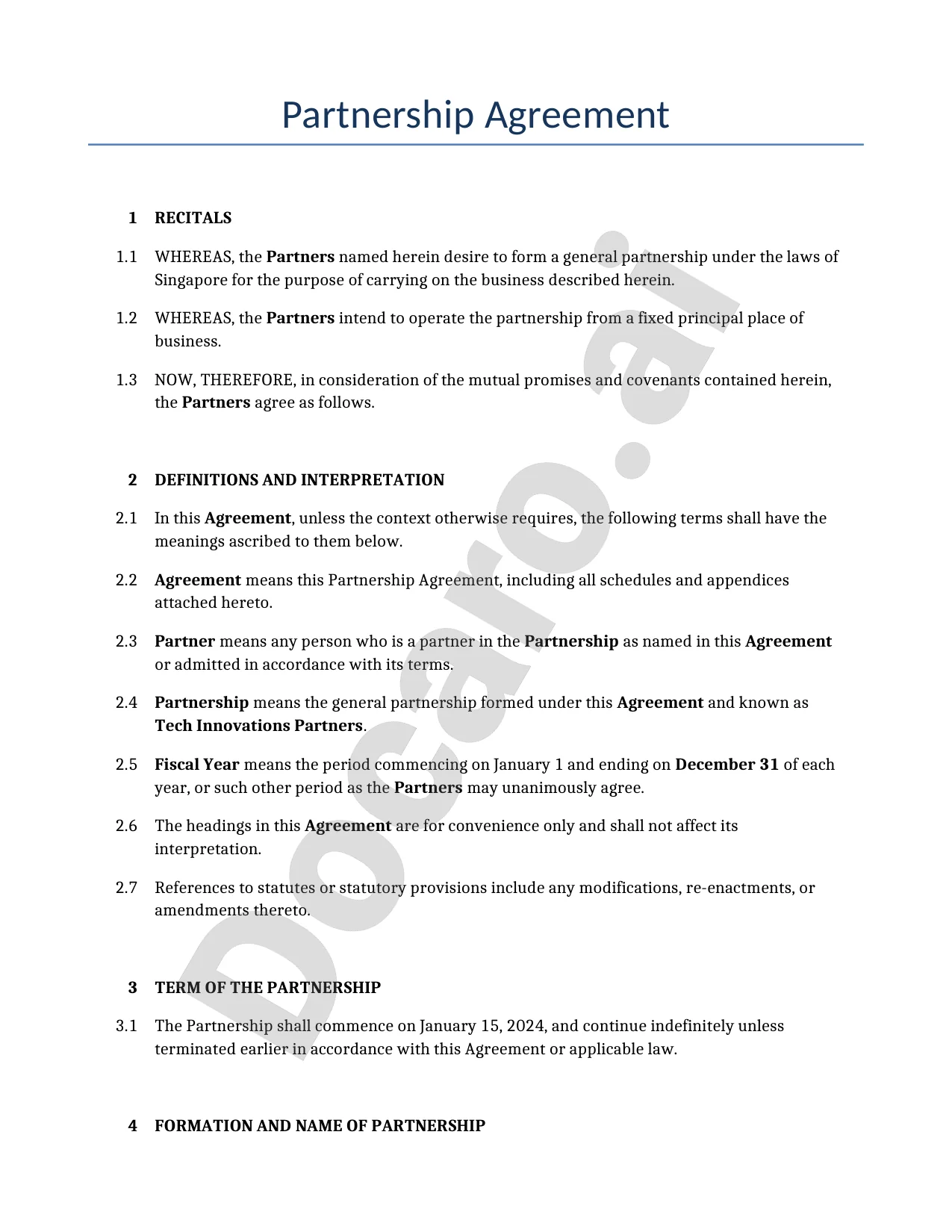
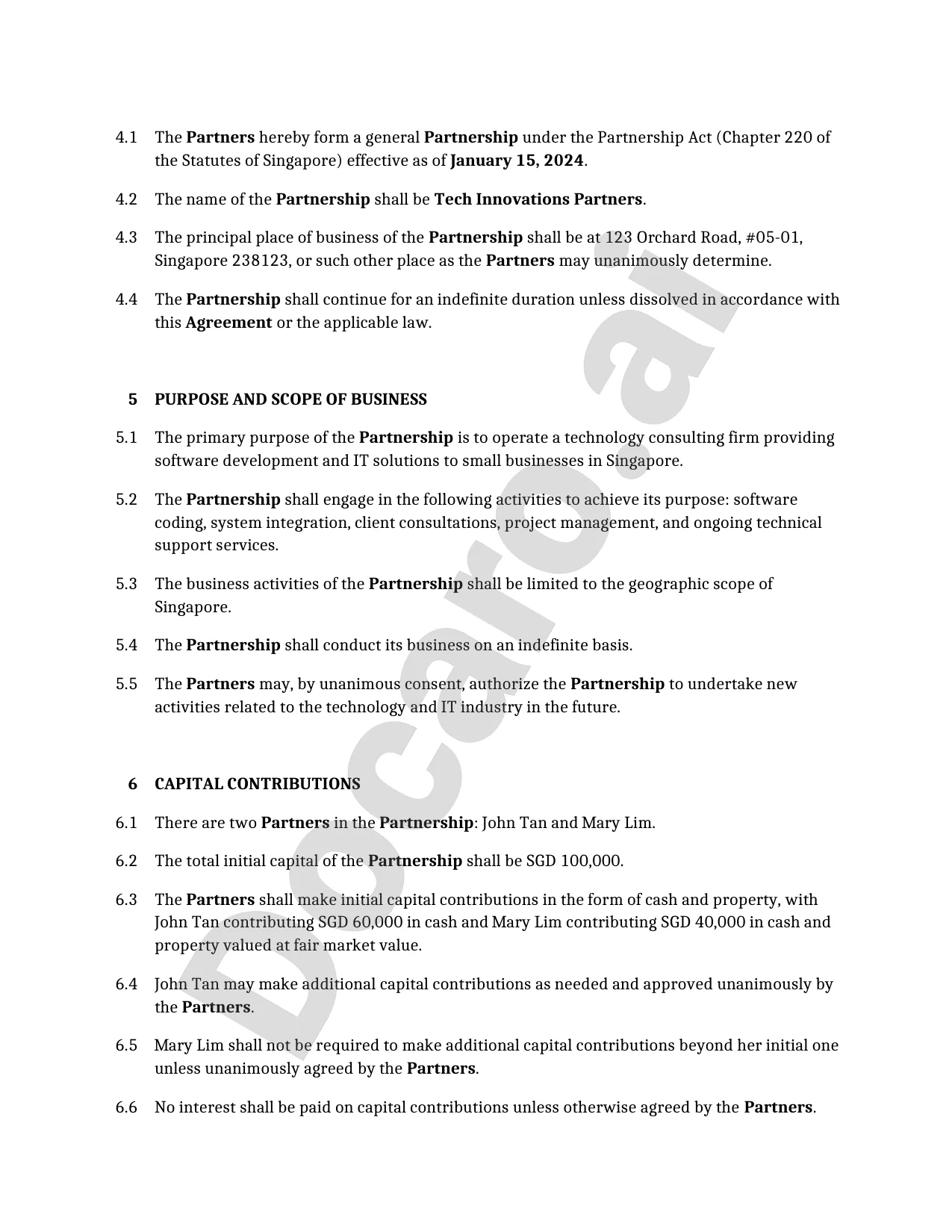
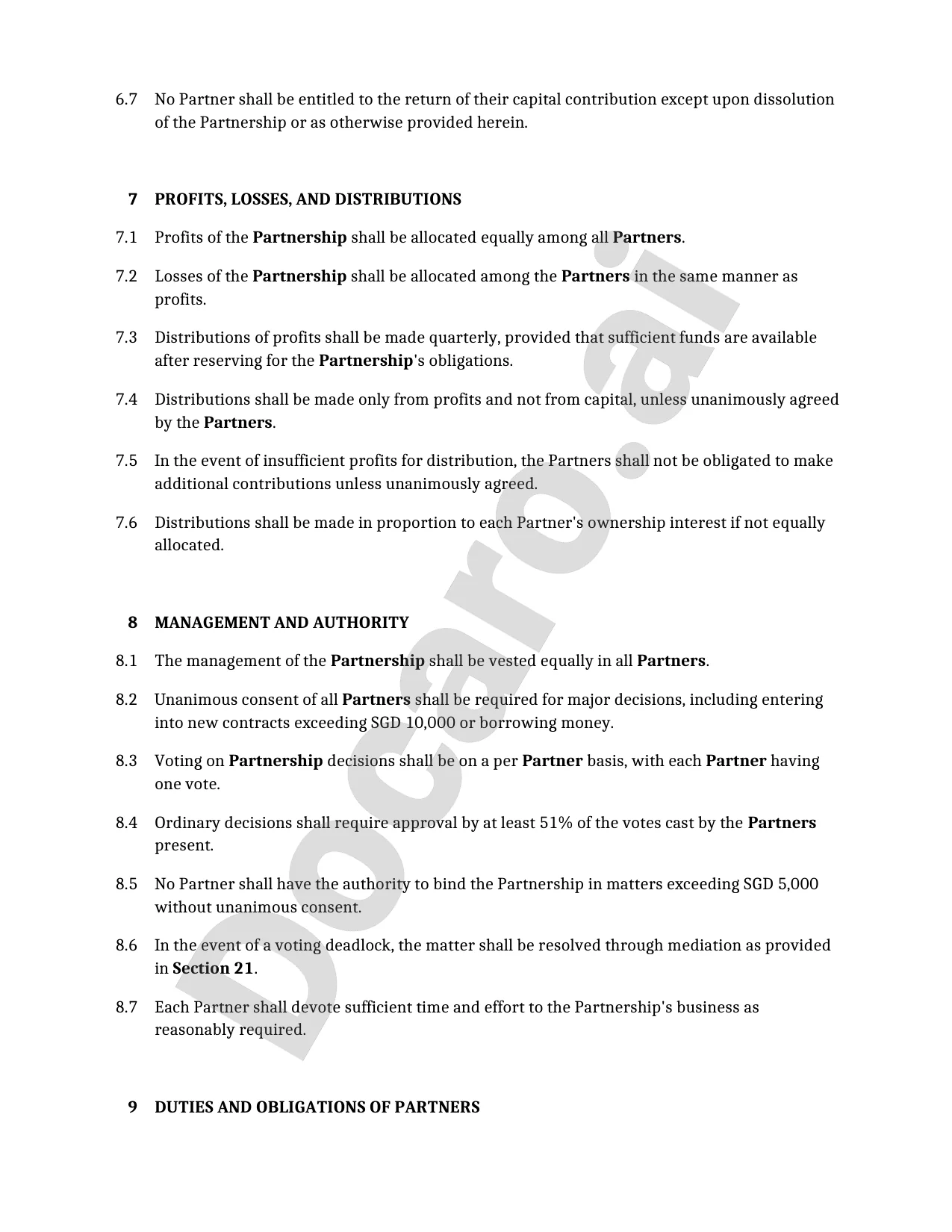
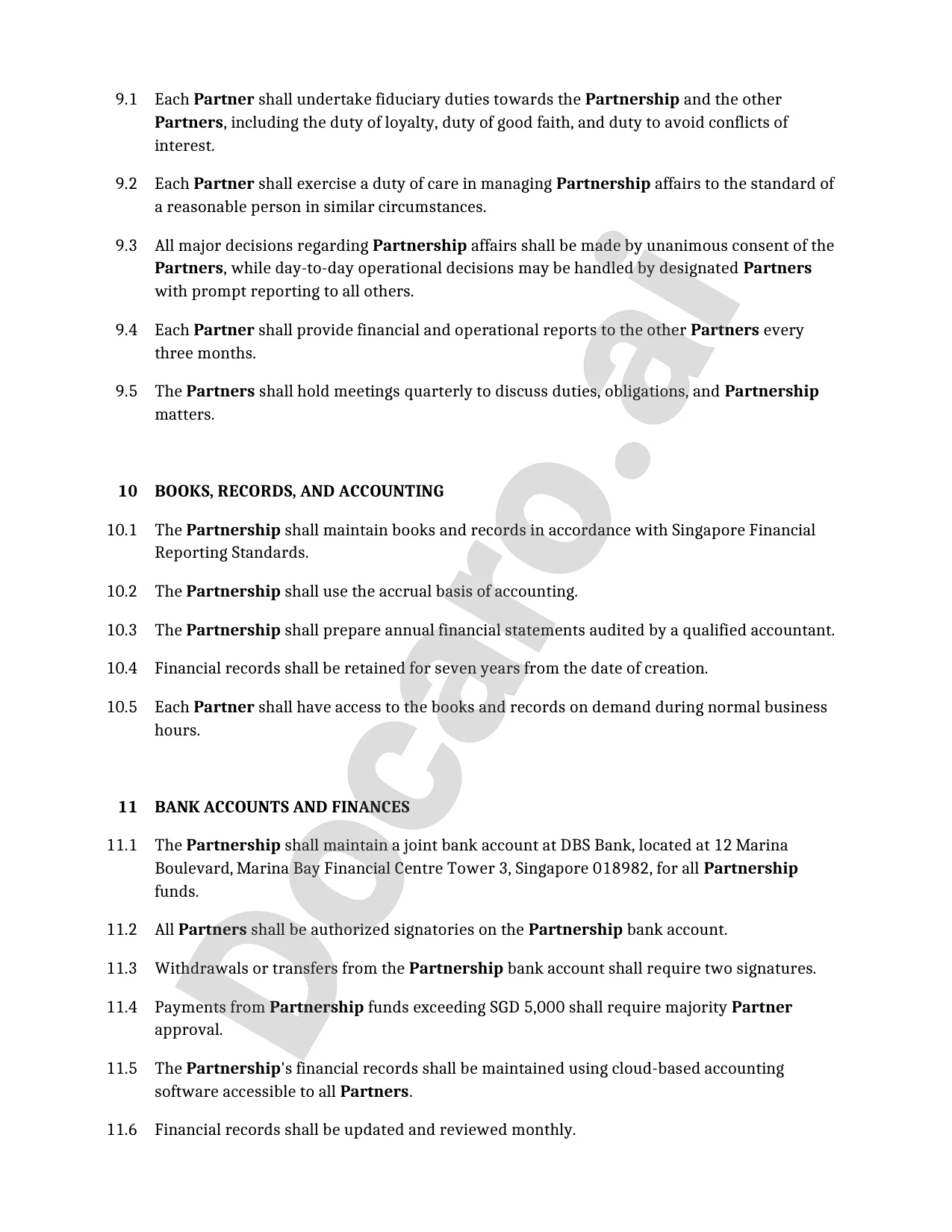
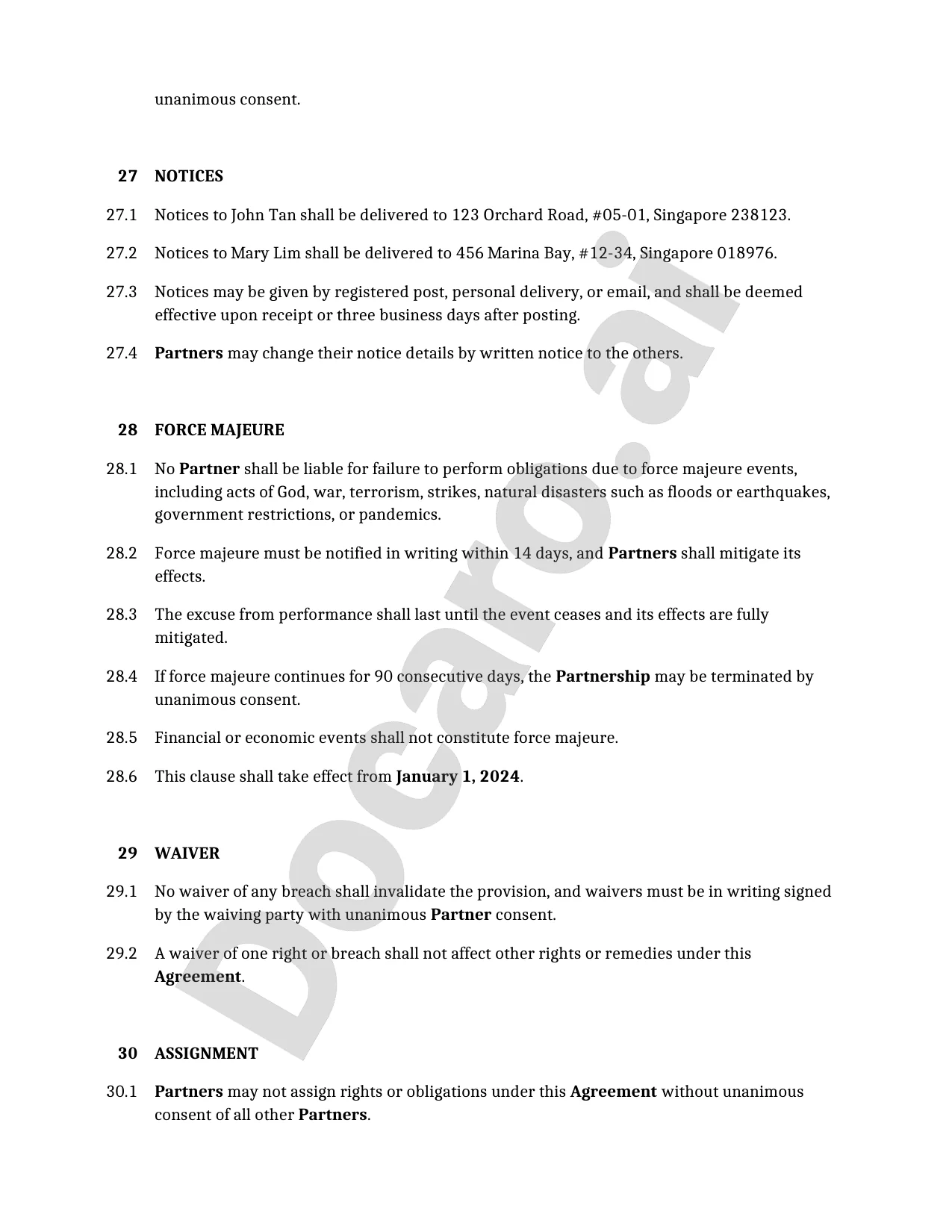
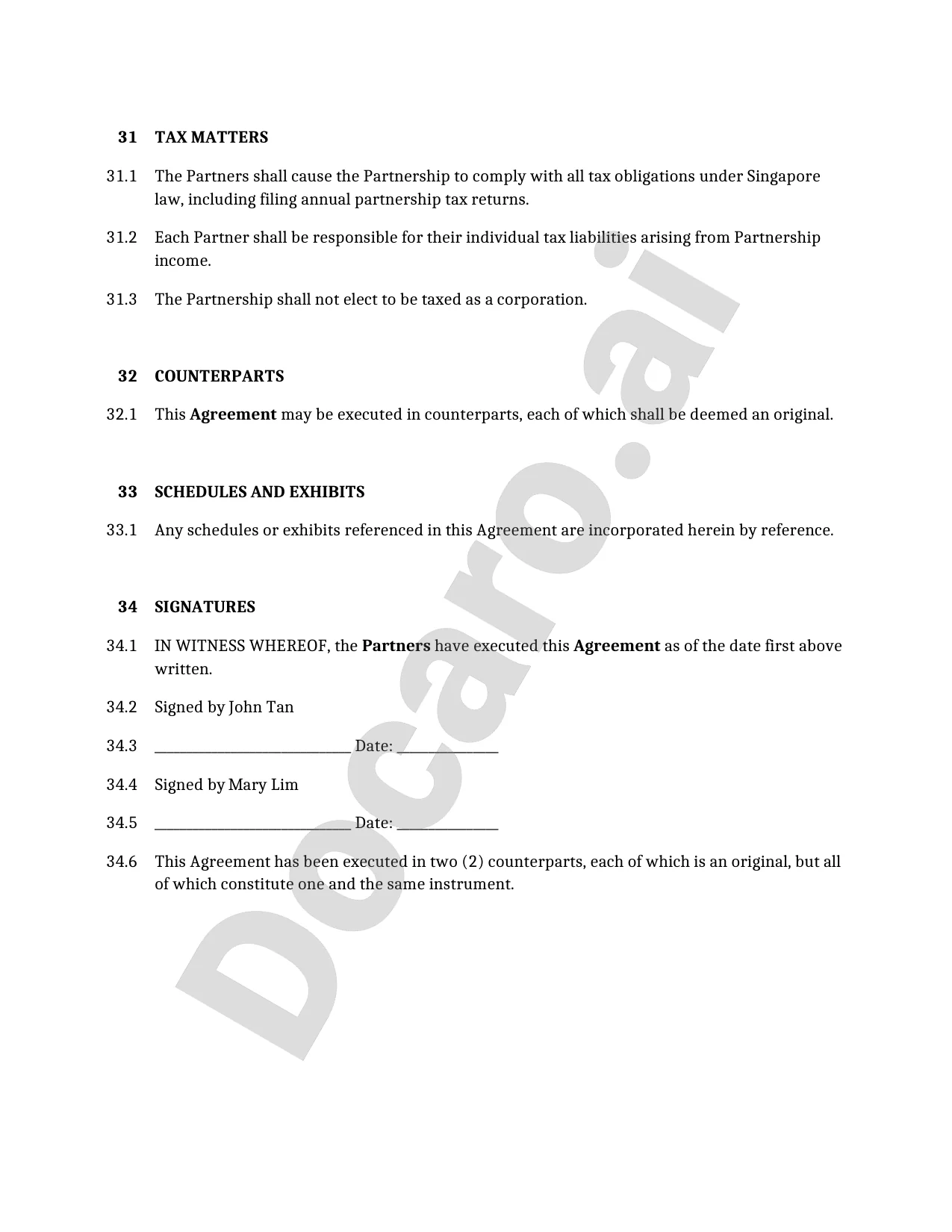
What is a Partnership Agreement in Singapore?
A partnership agreement in Singapore is a legal document that outlines the terms and conditions governing the relationship between two or more individuals or entities entering into a business partnership. Under the Partnership Act 1890, which applies in Singapore, a partnership is defined as the relation between persons carrying on a business in common with a view to profit, emphasizing mutual agency and shared responsibilities.
The primary purpose of a partnership agreement is to clarify the rights, duties, and obligations of partners, thereby preventing disputes and providing a framework for decision-making, profit sharing, and dispute resolution. It allows partners to customize arrangements beyond the default provisions in the Partnership Act, such as specifying capital contributions and management roles.
For optimal protection under Singapore law, partners should opt for bespoke AI-generated legal documents using Docaro, tailored to their specific needs rather than relying on generic forms. This approach ensures compliance with local regulations while addressing unique business circumstances effectively.
When Should You Use a Partnership Agreement in Singapore?
In Singapore business partnerships, a partnership agreement is essential when forming a general partnership, where all partners share unlimited liability and management responsibilities. This document clearly outlines profit-sharing ratios, decision-making processes, and dispute resolution mechanisms, preventing misunderstandings among partners.
For limited partnerships in Singapore, the agreement becomes crucial to define the roles of general partners—who bear full liability—and limited partners, who contribute capital with limited risk. It ensures compliance with the Limited Partnerships Act by specifying contributions, distributions, and exit strategies, fostering a structured business environment.
Beyond formation, a partnership agreement plays a vital role in clarifying terms during ongoing operations, such as handling intellectual property rights or non-compete clauses. Businesses should opt for bespoke AI-generated legal documents using Docaro platform to tailor agreements precisely to their unique needs, ensuring enforceability under Singapore law.
When Should You Not Use a Partnership Agreement?
In Singapore business law, a partnership agreement is not necessary for sole proprietorships, where a single individual operates the business without partners. This structure avoids the need for any formal agreement since there are no shared ownership interests or liabilities to outline.
Opting to incorporate a company instead of forming a partnership in Singapore also renders a partnership agreement irrelevant, as companies are governed by the Companies Act and their own constitution or articles of association. Incorporation provides limited liability protection and a separate legal entity, making partnership-specific documents unnecessary.
Additionally, short-term collaborations or informal ventures without profit-sharing may not require a partnership agreement under Singapore regulations, provided they do not meet the legal definition of a partnership. For any formal business setup, consider generating bespoke legal documents using Docaro AI to ensure compliance and customization.
What Are the Key Clauses in a Singapore Partnership Agreement?
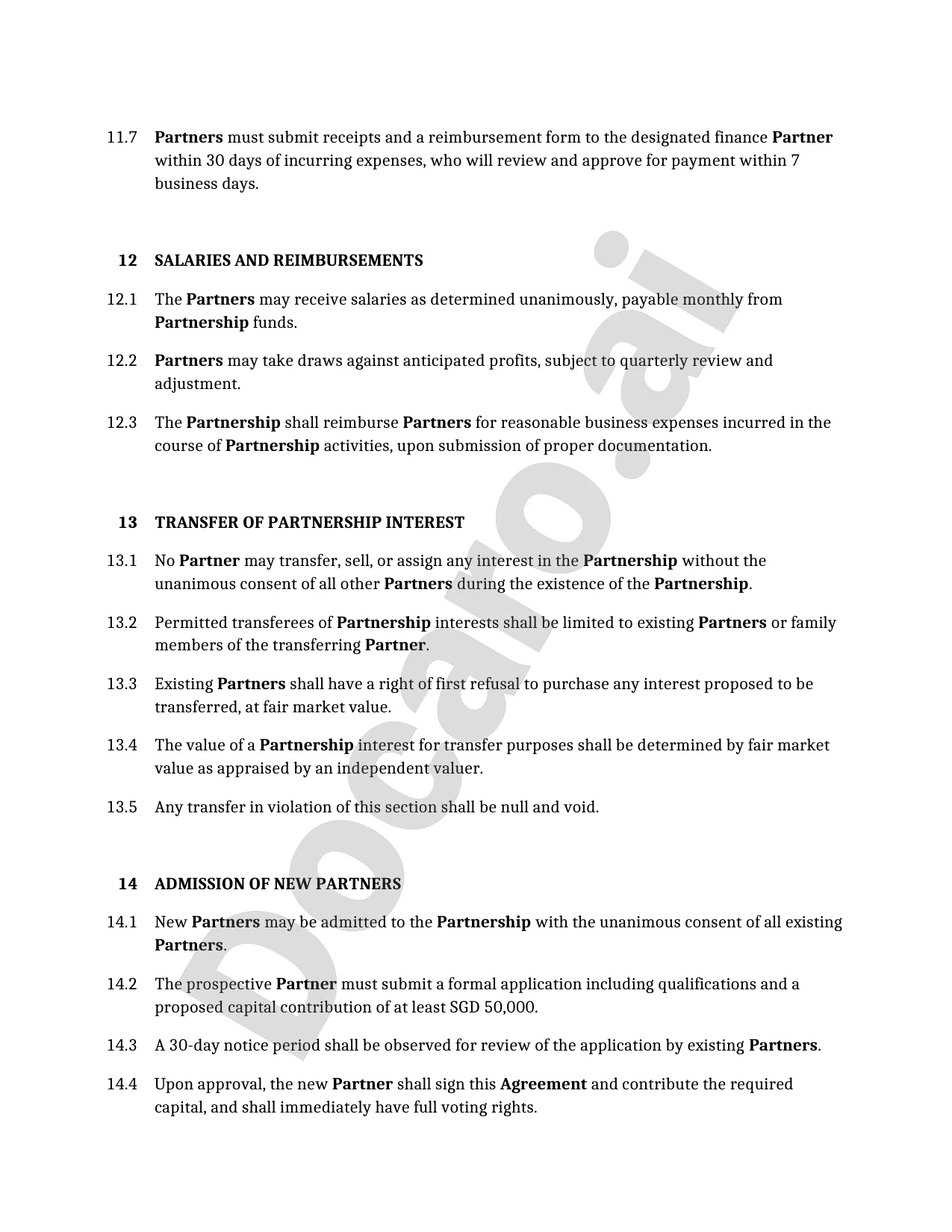
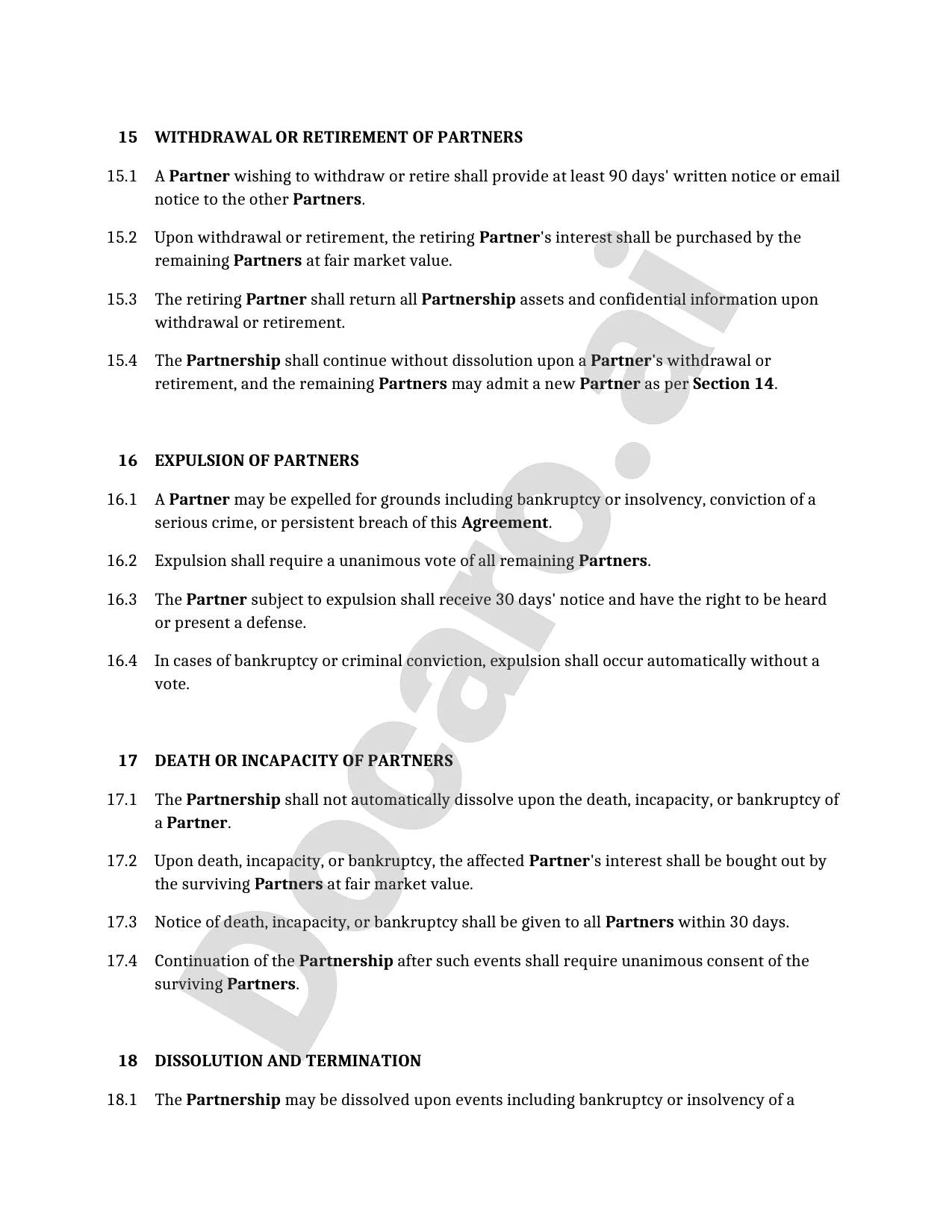
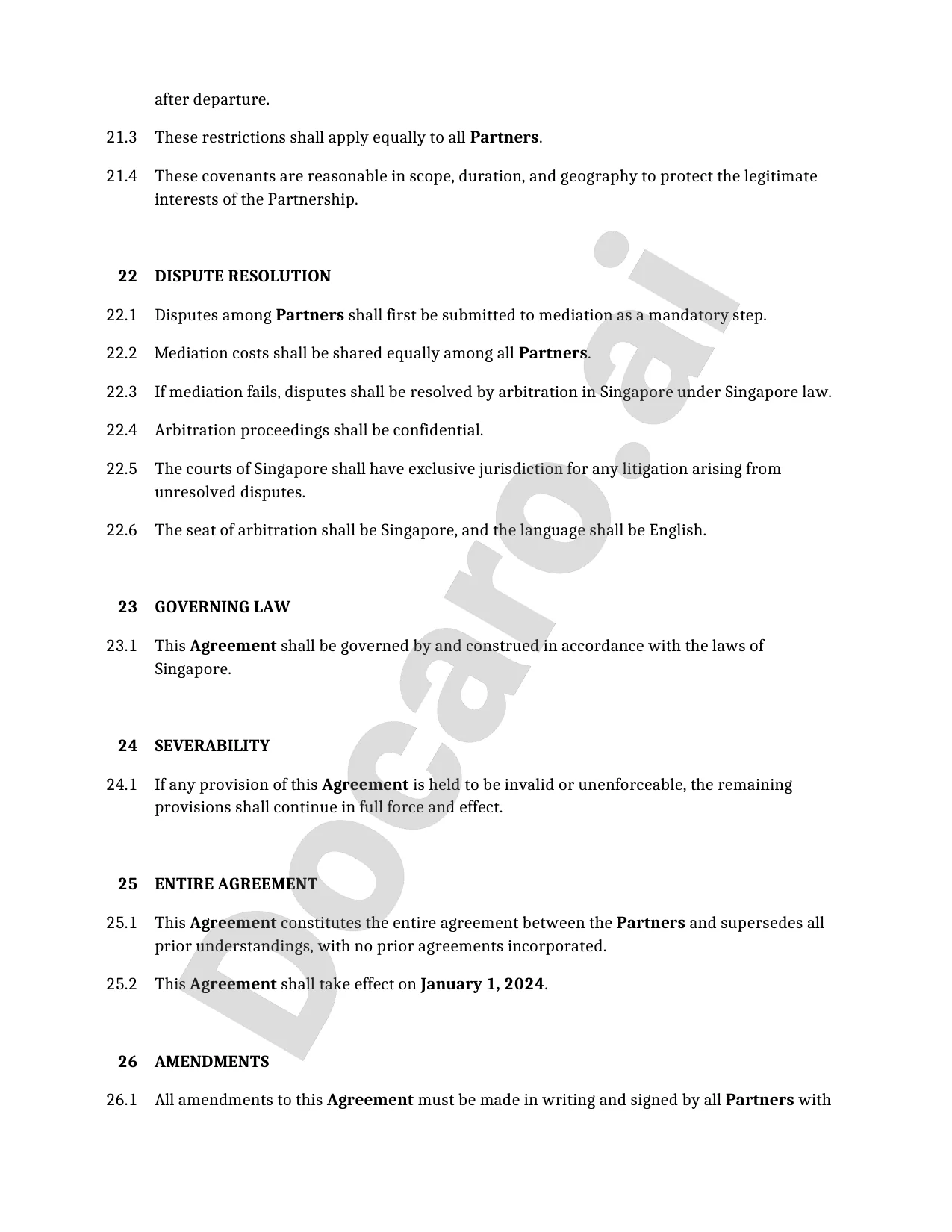
A partnership agreement in Singapore is a vital legal document that outlines the rights and obligations of partners in a business venture. Essential clauses cover contributions, where each partner's financial, property, or service inputs are specified, ensuring clarity on initial and ongoing commitments. For more details, explore Key Elements of a Partnership Agreement in Singapore.
Profit sharing clauses define how profits and losses are distributed among partners, often based on contribution ratios or agreed percentages under Singapore's Partnership Act. These provisions prevent disputes by establishing fair and transparent allocation methods, tailored to the partnership's structure.
Management clauses detail decision-making processes, including voting rights and authority levels for day-to-day operations and major decisions. In Singapore, these ensure smooth governance, with options for majority rule or unanimous consent on key issues like admitting new partners.
Dispute resolution mechanisms, such as mediation or arbitration, are crucial to handle conflicts efficiently without resorting to costly litigation. Singapore partnerships often include escalation procedures aligned with local laws, promoting amicable resolutions while protecting business continuity. For customized documents, consider bespoke AI-generated legal agreements using Docaro to fit your specific needs.
"Clear profit-sharing clauses in partnership agreements are essential to avert disputes; ambiguity often leads to costly litigation," states legal expert Dr. Elena Vasquez. To ensure precision, opt for bespoke AI-generated legal documents via Docaro, tailored to your specific needs.
What Rights and Obligations Do Partners Have Under a Singapore Partnership Agreement?
In a Singapore partnership, partners hold key rights including the ability to participate fully in management and share equally in profits unless otherwise agreed, as outlined in Section 24 of the Partnership Act. Partners also have the right to inspect partnership books and obtain information on partnership affairs under Section 25, ensuring transparency in partnership operations.
Regarding obligations, partners owe fiduciary duties to act in utmost good faith towards each other and the partnership, prohibiting secret profits or competing interests as per Section 30 of the Partnership Act. They must diligently contribute to the business and account for any benefits derived from partnership property without consent, reinforcing trust in partnership agreements.
Decision-making authority in a Singapore partnership is typically unanimous for ordinary matters, with every partner acting as an agent of the firm under Section 5, binding the partnership in usual business dealings. However, partners cannot act unilaterally in matters outside the ordinary course without consent, balancing authority with collective responsibility in partnership governance.
Partners face unlimited liability for partnership debts, jointly and severally liable with other partners for obligations incurred during the partnership's existence, as specified in Section 9 of the Partnership Act. This extends to post-dissolution liabilities for prior debts under Section 37, underscoring the high financial risks in Singapore partnerships; for tailored legal documents, consider bespoke AI-generated options using Docaro.

Are There Key Exclusions to Include in a Partnership Agreement?
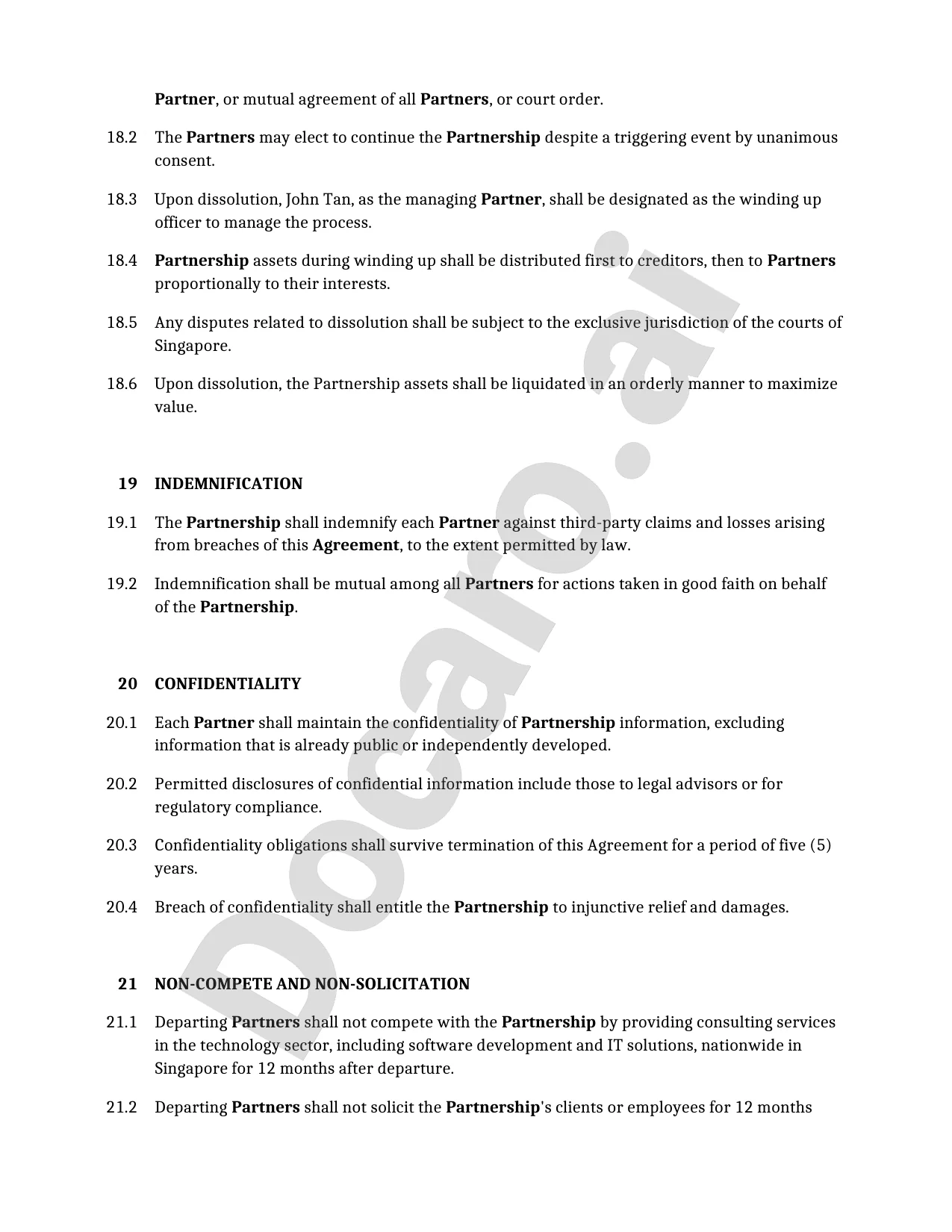
In Singapore, partnership agreements must clearly outline exclusions and limitations to safeguard partners' interests, particularly under the Partnership Act 1890. Key provisions include non-compete clauses, which restrict partners from engaging in competing businesses during and after the partnership, with enforceability depending on reasonableness in duration and scope as determined by courts.
Liability exclusions in a partnership agreement limit personal exposure for partners, but Singapore law imposes joint and several liability for partnership debts, making full exclusions challenging without specific indemnity clauses. Partners should specify scenarios like negligence or willful misconduct where liability remains, ensuring compliance with public policy.
Regarding intellectual property rights, the agreement should detail ownership and usage, defaulting to joint ownership under Singapore law unless bespoke terms assign rights to individual partners or the firm. Upon dissolution, IP provisions must address transfer or licensing to prevent disputes, emphasizing the need for bespoke AI-generated legal documents using Docaro for tailored clarity.
- Non-compete clauses: Protect business interests but must be reasonable.
- Liability exclusions: Limit risks while respecting statutory obligations.
- IP rights: Define ownership to avoid post-partnership conflicts.

How Do Recent Legal Changes Affect Partnership Agreements in Singapore?
In 2025, Singapore implemented significant updates through the Companies and Limited Liability Partnerships (Miscellaneous Amendments) Act 2024, effective from 16 June, which enhances transparency in partnership agreements by mandating companies and LLPs to maintain an up-to-date Register of Controllers. This requires annual verification of controller particulars, directly impacting general partnerships and LLPs under the Partnership Act and Limited Liability Partnerships Act by prohibiting nominee arrangements without registered corporate service providers.
Looking ahead to 2026, the Corporate and Accounting Laws (Amendment) Act, with key provisions effective in April, introduces stricter governance rules for business regulations in Singapore, including formal documentation for nominee directors and enhanced director attestations to financial statements in partnership structures. These changes aim to prevent misuse of partnerships for illicit activities and align with global anti-money laundering standards.
To ensure compliance with partnership agreements, businesses should promptly review and update their controller registers and nominee arrangements via ACRA-registered providers, avoiding penalties for non-adherence. For tailored solutions, consider generating bespoke AI-generated legal documents using Docaro to customize agreements that incorporate these recent regulatory updates, ensuring robust protection under Singapore's evolving business laws.
How Can You Draft a Legally Binding Partnership Agreement in Singapore?
1
Consult a Lawyer
Schedule a consultation with a Singapore lawyer to discuss partnership needs and ensure legal soundness. For guidance, see [How to Draft a Legally Binding Partnership Agreement in Singapore](/en-sg/a/how-to-draft-legally-binding-partnership-agreement-singapore).
2
Outline Key Terms
Collaborate with Docaro to generate a bespoke AI-powered draft outlining profit sharing, roles, and dispute resolution terms.
3
Review for Compliance
Have the lawyer review the Docaro-generated document for compliance with Singapore's Partnership Act and regulations.
4
Register if Necessary
Register the partnership with ACRA if required, using the finalized compliant agreement to formalize the business.
What Common Mistakes Should You Avoid in Partnership Agreements?
Creating partnership agreements in Singapore often leads to pitfalls like vague terms that cause disputes over profit sharing or decision-making. To avoid this, clearly define each partner's roles, contributions, and exit strategies in a bespoke AI-generated legal document using Docaro, ensuring precision tailored to your business needs.
Another common mistake is ignoring tax implications in Singapore partnerships, such as overlooking GST obligations or personal liability for debts. Consult professionals to integrate tax-efficient clauses from the start, and for detailed guidance, read our article on Common Mistakes to Avoid in Singapore Partnership Agreements.
Partnerships in Singapore may fail due to inadequate dispute resolution mechanisms, leading to costly litigation. Include mediation or arbitration provisions in your agreement to resolve conflicts efficiently, always opting for customized documents via Docaro over generic options.
You Might Also Be Interested In
A Contract Outlining The Terms For Consultancy Services Provided By An Independent Contractor.
A Contract Outlining The Rights, Obligations, And Governance Rules Among Shareholders Of A Company.
A Shareholders' Agreement Is A Contract Among Shareholders Of A Private Limited Company Outlining Ownership, Management, And Operational Rules.
A Constitution Is The Foundational Document For A Company In Singapore, Outlining Its Structure, Objectives, And Internal Rules.
A Constitution Is The Foundational Document Governing A Company's Internal Management, Operations, And Member Rights In Singapore.
A Legal Contract Outlining The Terms For Buying And Selling Shares In A Company.
A Formal Decision Or Action Approved By The Board Of Directors Of A Company, Documented In Writing.
A Founders' Agreement Is A Legal Contract Outlining The Rights, Obligations, And Roles Of Company Founders, Including Equity Distribution, Decision-making, And Dispute Resolution.
A Legal Contract Outlining The Terms For The Sale And Purchase Of Specific Assets Between Parties.
A Legal Contract Outlining The Terms For The Sale And Transfer Of A Business Entity, Including Assets, Liabilities, And Obligations.
A Legal Document That Alters The Terms Of An Existing Deed Or Agreement, Commonly Used In Property Or Inheritance Matters.
A Legal Contract Outlining The Terms For The Sale And Transfer Of Property Ownership From Seller To Buyer.
A Formal Receipt Is A Legal Document Issued By A Seller To A Buyer, Confirming Payment For Goods Or Services And Serving As Proof Of Transaction.
A Tax Invoice Is A Formal Document Issued By GST-registered Businesses In Singapore To Charge Customers For Goods Or Services, Including GST Details For Tax Compliance.
A Legal Contract Outlining The Terms Under Which One Party Provides Services To Another.
A Legal Document Used To Transfer Ownership Of Shares In A Company From One Party To Another, Typically Required For Registration With The Company.
A Document Outlining Measures To Protect Individuals, Especially Vulnerable Groups Like Children, From Harm And Abuse In Organizational Settings.
A Non-binding Document Outlining Preliminary Terms And Intentions For A Potential Business Deal Or Agreement.