Why Free Templates Can Be Risky for Resignation Letters
Using free resignation letter templates can lead to several pitfalls. These generic forms often fail to address specific details like your employment terms, notice period, or company policies in Singapore, potentially resulting in misunderstandings or disputes. They may also lack the professional tone needed for corporate environments, coming across as informal or incomplete, which could harm your professional reputation or even complicate your exit process.
Our AI-generated resignation letters provide a bespoke solution tailored to your unique situation. By inputting your details, the AI crafts a personalized document that complies with Singaporean employment standards, ensures clarity and professionalism, and minimizes risks, giving you peace of mind for a smooth transition.
What is a Resignation Letter in the Context of Corporate Documents in Singapore?
A resignation letter is a formal corporate document used in Singapore to notify an employer of an employee's intent to leave their position, ensuring a professional and respectful transition. It plays a crucial role in maintaining positive relationships and complying with Singapore's employment norms under the Employment Act.
The primary purpose of a resignation letter in Singapore is to provide official notice, typically one month for non-managerial roles, allowing time for handover and knowledge transfer. This document helps protect both parties' rights and avoids potential disputes, as outlined by the Ministry of Manpower (MOM).
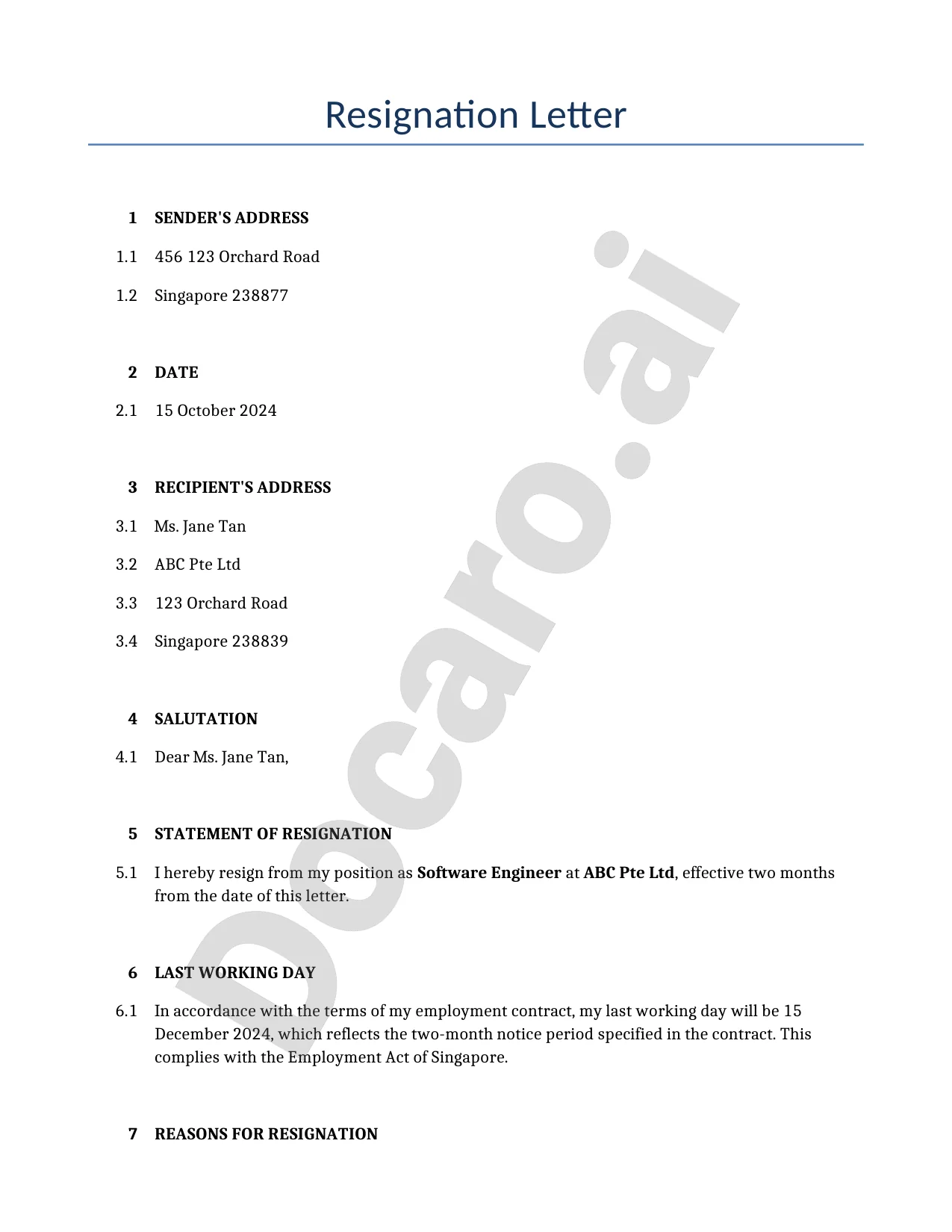
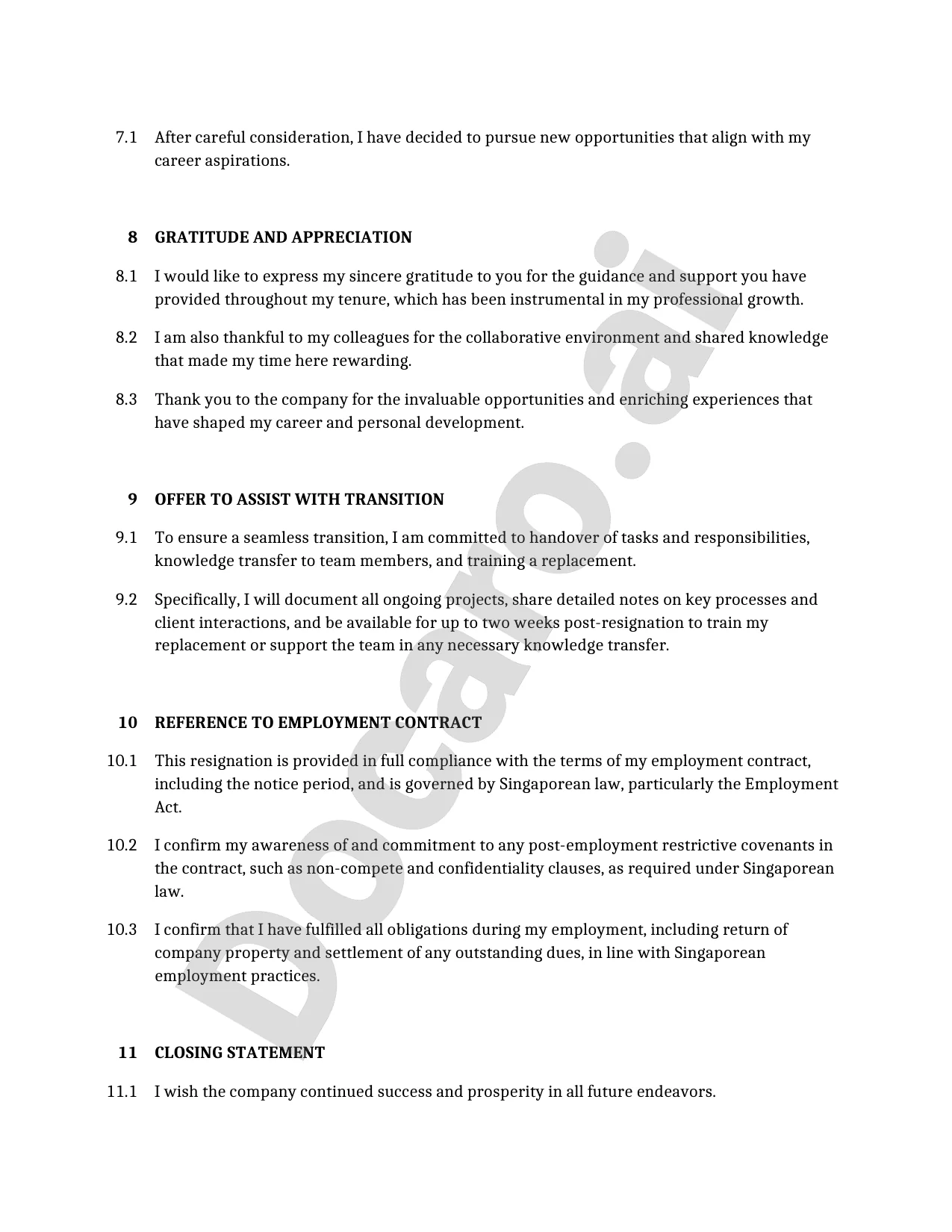
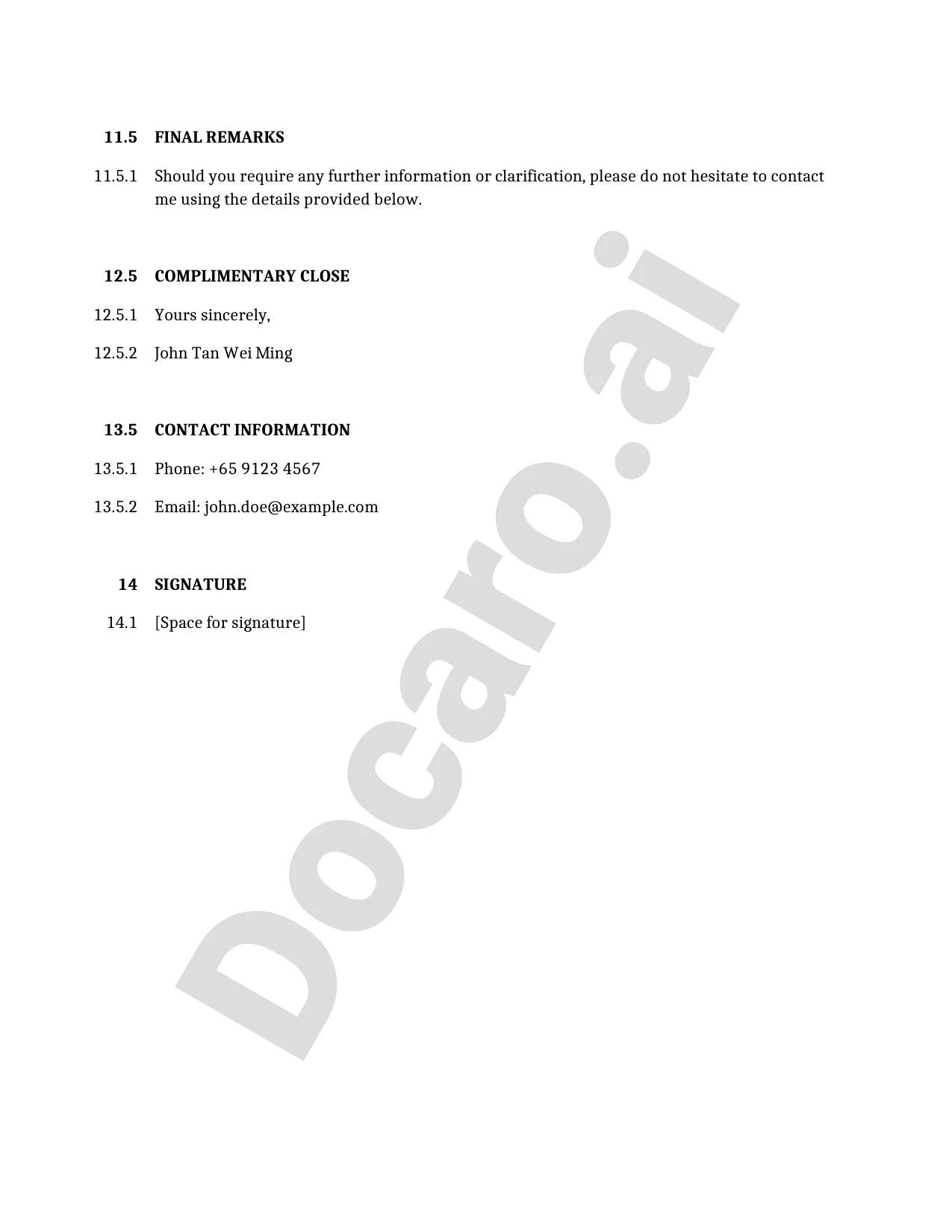
The standard format includes a clear subject line, date, employer's details, a polite resignation statement with the last working day, a brief reason for leaving, gratitude for opportunities, and an offer to assist during the notice period. For detailed writing tips on resignation letters in Singapore, refer to our guide.
In professional settings in Singapore, a well-crafted resignation letter upholds your reputation and may lead to future references or networking opportunities. Explore resignation letter templates and samples for Singapore to customize your own, or use Docaro for bespoke AI-generated corporate documents tailored to your needs.
When Should You Use a Resignation Letter as a Corporate Document in Singapore?
A resignation letter is essential in Singapore when an employee decides to voluntarily quit their job, whether for personal reasons or to pursue new opportunities. It serves as a formal notification to the employer, ensuring a smooth transition and upholding professional etiquette in the competitive job market.
During career changes, submitting a resignation letter is crucial to document the employee's intent to leave, helping maintain positive references for future roles. For retirements, it provides closure and allows the employer to plan succession effectively, preserving long-term professional networks.
Under Singapore's Employment Act, a resignation letter is necessary to fulfill the legal notice period, typically ranging from one day to one month based on service length; failure to do so may result in deductions from final pay. To comply, employees should refer to official guidelines from the Ministry of Manpower for accurate notice requirements.
Using bespoke AI-generated corporate documents from Docaro ensures a tailored resignation letter that meets Singapore's professional standards, avoiding generic templates and supporting seamless exits.
"A formal resignation letter is essential in Singapore to clearly document your notice period, reasons for leaving, and last working day, thereby safeguarding your entitlements under the Employment Act and facilitating a seamless handover to your employer," says Dr. Lim Wei, Senior Employment Consultant at the Singapore Institute of Human Resource Management. For a tailored resignation letter that fits your specific circumstances, generate one using Docaro's AI-powered corporate document tools.
When Should You Avoid Using a Resignation Letter in Singapore?
In scenarios involving immediate terminations due to misconduct, submitting a resignation letter may not be appropriate as it could inadvertently admit fault or weaken your position in potential disputes. For instance, if an employer terminates you on the spot for alleged wrongdoing, opting for a resignation might limit your ability to claim wrongful dismissal or seek references later.
Constructive dismissal claims present another risk, where resigning formally could undermine your case by suggesting voluntary departure rather than being forced out due to intolerable working conditions. In such cases, documenting evidence of the employer's breaches is crucial before any action, and a resignation letter might be seen as acceptance of the situation, complicating legal recourse.
For mutual separations, a resignation letter might formalize the end unnecessarily, potentially exposing you to liabilities if terms aren't clearly agreed upon. Alternatives include negotiating a separation agreement that outlines severance, non-disclosure, and reference provisions to protect both parties.
When resignation letters pose risks, consider consulting a lawyer for tailored advice under Singapore employment law, or providing verbal notice in urgent cases to exit quickly while preserving options. For generating bespoke corporate documents like separation agreements, use Docaro AI to create customized versions suited to your needs. For authoritative guidance, refer to the Ministry of Manpower Singapore termination guidelines.

What Are the Key Clauses in a Resignation Letter for Singapore?
A resignation letter in Singapore should clearly state your intention to resign and specify the last working day, calculated based on your employment contract's notice period. This ensures compliance with Singapore's employment laws, and for detailed legal requirements, refer to legal requirements for resigning from a job in Singapore.
Optionally, include brief reasons for leaving to maintain professionalism, but keep it positive and concise to avoid potential conflicts. Confirming the notice period in the letter reinforces your commitment to fulfilling obligations under the Employment Act.
Express your intentions for handover of duties to demonstrate responsibility and facilitate a smooth transition for your employer. For authoritative guidance, consult the Ministry of Manpower's resources on terminating employment in Singapore.
To create a tailored resignation letter, opt for bespoke AI-generated corporate documents using Docaro, ensuring it fits your specific circumstances without relying on generic templates.
1
State Your Resignation Intent
Clearly express your decision to resign from your position in a professional tone to set the letter's purpose.
2
Specify Effective Resignation Date
Indicate the exact date your resignation takes effect, providing adequate notice as per company policy.
3
Offer Transition Assistance
Propose helping with handover tasks or training a replacement to ensure a smooth departure process.
4
Express Gratitude and Generate Document
Thank your employer for opportunities gained, then use Docaro to create a bespoke AI-generated resignation letter.
What Are the Key Rights and Obligations of Parties Involved in a Resignation in Singapore?
Under Singapore's Employment Act, employees are entitled to notice pay if the employer terminates the contract without cause, equivalent to the required notice period's salary, or they can serve the notice instead. Obligations include serving the full notice period as stipulated in the employment contract, typically ranging from one day to one month based on service length, unless mutually agreed otherwise.
Employers must provide final pay within seven days of the last working day, including any outstanding salary, overtime, and prorated annual leave, as outlined in the Act. They are also required to issue a certificate of service upon request, detailing the employee's job title, duration of employment, and last drawn salary.
For detailed guidance on employment termination rights in Singapore, refer to the official Ministry of Manpower termination page. Always consult a professional for specific cases to ensure compliance with the Employment Act.
Are There Recent or Upcoming Legal Changes Affecting Resignation Letters in Singapore?
Singapore's Employment Act underwent significant amendments in 2019 to modernize labor protections. These updates expanded coverage to include managers and executives earning up to S$2,600 monthly, introduced progressive wage models for low-wage sectors, and enhanced family leave entitlements, such as an additional week of paternity leave.
Recent changes also addressed flexible work arrangements, with the Tripartite Guidelines on Flexible Work Arrangement Requests updated in 2023 to encourage employers to consider employee requests for part-time or telecommuting options. For notice periods, no major sector-specific alterations have been announced as of 2024, though the standard periods under the Employment Act remain 1 to 4 weeks based on service length, applicable across most industries.
Employers and employees should monitor for upcoming revisions, particularly in light of economic recovery efforts post-COVID. For the latest Singapore employment law updates, consult official resources like the Ministry of Manpower website or the Tripartite Alliance for Fair and Progressive Employment Practices.
What Key Exclusions Should Be Considered in a Resignation Letter in Singapore?
When drafting a resignation letter in Singapore, avoid admitting fault or expressing regret for any workplace issues, as this could weaken your position in potential disputes. Such statements might be interpreted as acceptance of liability, so keep the tone neutral and professional to protect your rights.
Steer clear of waiving rights to claims, such as unpaid wages or unfair dismissal, without consulting a lawyer, since these could limit your ability to seek redress through bodies like the Ministry of Manpower. Similarly, do not agree to unfavorable terms like reduced notice periods unless fully advised, to prevent unintended legal concessions.
Be cautious with non-compete clauses in your resignation letter if they seem irrelevant to your role, as referencing or accepting them might bind you unnecessarily and restrict future employment opportunities. For tailored guidance, consider bespoke AI-generated corporate documents using Docaro to ensure your letter aligns with Singapore employment laws without generic pitfalls.
You Might Also Be Interested In
A Legally Binding Agreement Outlining The Terms And Conditions Of Employment Between An Employer And Employee.
A Legal Contract Outlining The Terms Of Service Between A Client And An Independent Contractor In Singapore.
A Legal Contract Between An Employer And Employee That Prohibits The Disclosure Of Confidential Information To Protect Business Secrets.
A Contractual Provision Restricting An Individual From Engaging In Competitive Activities Against Their Former Employer For A Specified Period And Area.
A Formal Document From An Employer Extending A Job Offer With Key Employment Terms.
A Document Outlining Company Policies, Employee Rights, And Workplace Rules.
A Formal Notice From An Employer To An Employee Stating The End Of Their Employment Contract.
A Contract Outlining Terms Of An Internship, Including Duties, Duration, Compensation, And Confidentiality.
A Legal Contract Outlining Terms For Employees Working Remotely, Including Schedules, Responsibilities, And Support Provisions.
A Legal Contract That Requires Employees To Keep Confidential Information Private And Not Disclose It To Unauthorized Parties.
A Legal Document Outlining The Terms Of Engagement Between A Freelancer And Client For Specific Services.
A Flexible Employment Agreement Where Workers Are Not Guaranteed Minimum Hours And Are Called Upon As Needed By The Employer.
A Written Endorsement By A Person Of Authority Attesting To Another's Skills, Character, Or Qualifications For Employment, Education, Or Legal Purposes.