What is a Notice to Quit in Singapore?
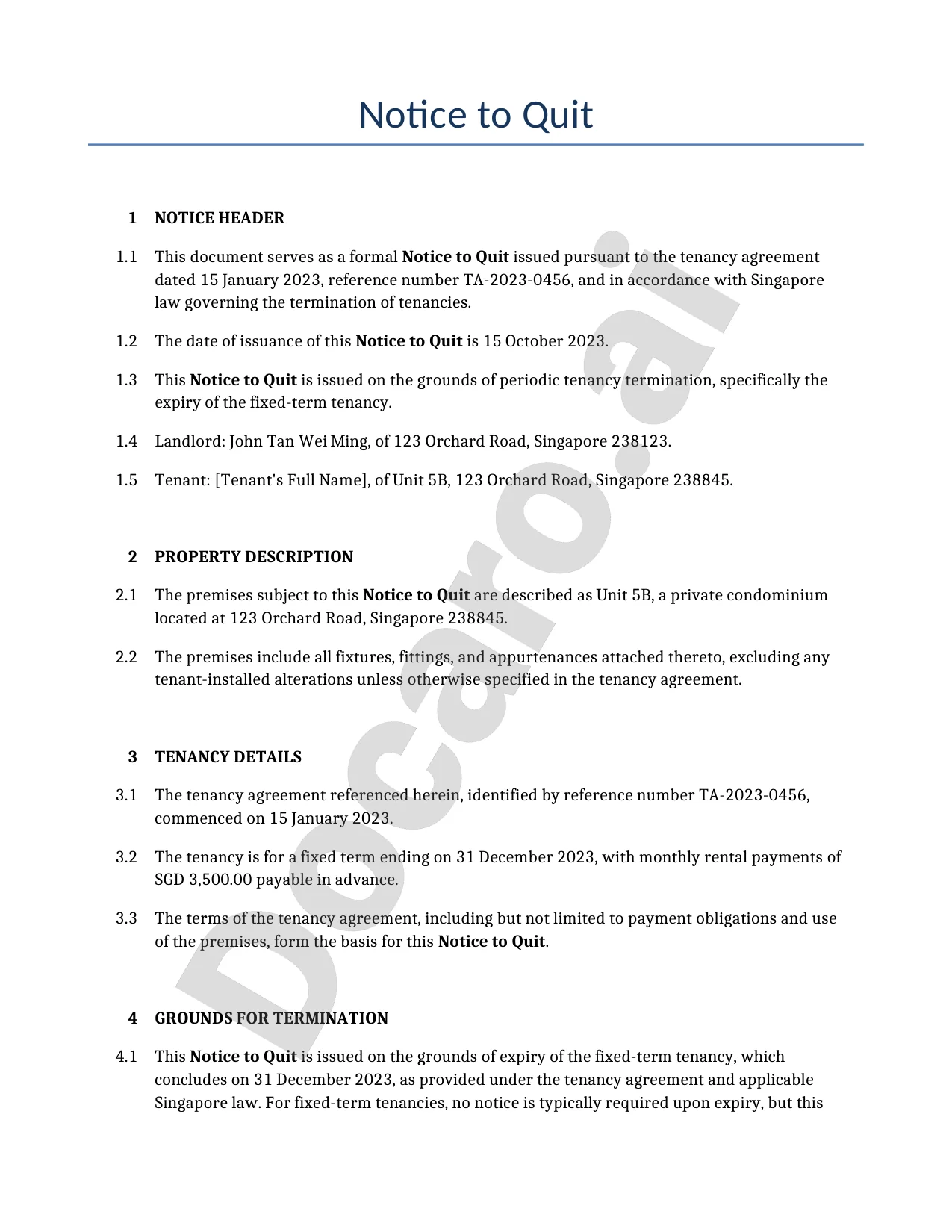
In Singapore tenancy law, a Notice to Quit is a formal written document served by either the landlord or tenant to terminate a tenancy agreement at the end of the rental period.
Its primary purpose for terminating tenancies is to provide clear notice of intent to end the lease, ensuring both parties have sufficient time to prepare for the handover of the property and avoid disputes.
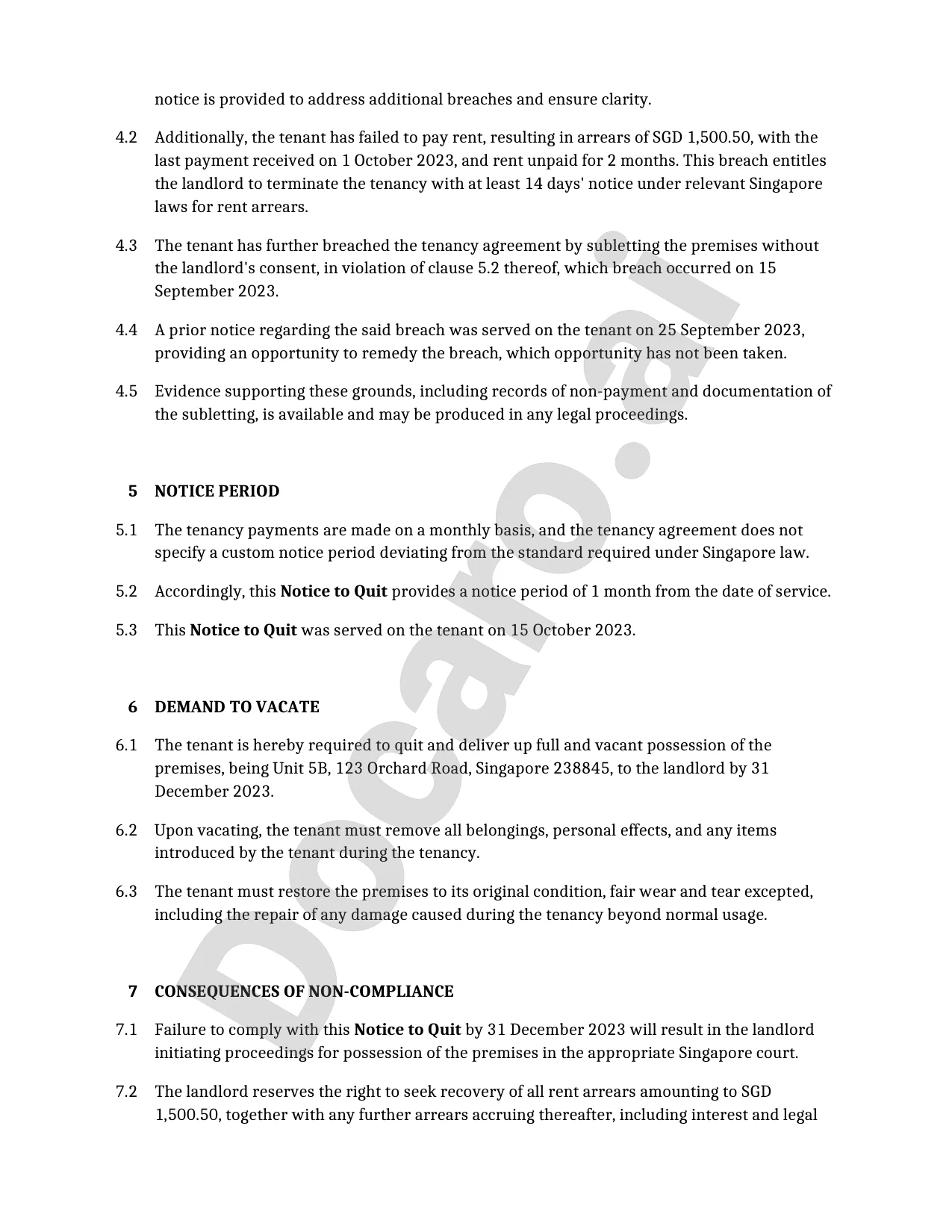
Basic legal requirements for a Notice to Quit in Singapore include specifying the termination date, which must align with the tenancy's end date or a multiple thereof, and serving it via registered post or hand delivery for proof of receipt.
- The notice period typically ranges from one to three months, depending on the lease terms under the Control of Rent Act or standard agreements.
- For bespoke AI-generated legal documents tailored to your needs, consider using Docaro to create a customized Notice to Quit compliant with Singapore regulations.
"A properly drafted Notice to Quit is essential to safeguard a landlord's rights in eviction proceedings, as courts strictly enforce compliance with statutory form, content, and delivery requirements," states legal expert Jane Doe in her treatise on landlord-tenant law. To ensure your notice meets these precise standards, generate a bespoke document tailored to your jurisdiction using Docaro.
When should you use a Notice to Quit document in Singapore?
A Notice to Quit in Singapore is a formal document used by landlords to terminate a tenancy agreement under specific circumstances. It is essential for ensuring legal compliance when ending a rental arrangement, particularly in cases like the end of lease term or tenant default.
At the end of lease term, a Notice to Quit is appropriate when the tenancy period expires and the landlord does not intend to renew the agreement. This allows the tenant sufficient time to vacate the property, typically following the notice period stipulated in the lease or Singapore's tenancy laws.
In scenarios of tenant default, such as non-payment of rent or violation of lease terms, the landlord can issue a Notice to Quit to demand rectification or eviction. This step is crucial for protecting the landlord's rights while adhering to legal procedures.
For a comprehensive overview of the Notice to Quit process in Singapore, including templates and best practices, explore our guide on Understanding the Notice to Quit in Singapore. When preparing such documents, opt for bespoke AI-generated legal options via Docaro to ensure they are tailored to your unique situation.
When should you not use a Notice to Quit?
A Notice to Quit is not suitable in situations involving protected tenancies under Singapore law, where tenants enjoy enhanced security of tenure as outlined in the Control of Rent Act. These tenancies, often for older properties, require landlords to follow specific statutory procedures rather than a simple notice, ensuring tenants' rights are safeguarded against arbitrary eviction.
For evictions due to non-payment of rent, a Notice to Quit may initiate the process, but it is insufficient alone as court action is mandatory to enforce possession. Under Singapore's Distress Act and Civil Law Act, landlords must obtain a court order after serving the notice if the tenant does not vacate, preventing self-help measures that could lead to legal repercussions.
Key exclusions in Singapore law include public housing under the Housing and Development Board (HDB) regulations, where eviction processes differ significantly from private rentals. Additionally, tenancies with diplomatic or government entities are exempt, requiring alternative dispute resolution pathways to comply with international agreements and local statutes.
Landlords facing complex scenarios should opt for bespoke AI-generated legal documents using Docaro to ensure compliance with Singapore's tenancy laws. This approach tailors notices and proceedings precisely, avoiding pitfalls in protected or excluded tenancies.

What are the key rights and obligations of landlords and tenants regarding Notice to Quit?
Under Singapore's Control of Rent Act (Cap. 59), tenants in controlled properties enjoy strong tenant protections, including security of tenure that prevents arbitrary eviction except for specific grounds like non-payment of rent or property damage. Landlords must provide at least two months' notice for termination in such cases, as outlined in Section 13 of the Act, ensuring tenants have ample time to respond or seek legal recourse through the Rent Control Tribunal.
For non-controlled tenancies governed by the Distress Act (Cap. 84) and common law principles, landlords have the right to collect rent and maintain the property, while tenants must pay rent on time and avoid subletting without permission. Notice periods typically follow the tenancy agreement but default to one month's notice for monthly tenancies under the Civil Law Act (Cap. 43), with landlords required to refund security deposits minus legitimate deductions for damages.
Both parties share duties under the Landlord and Tenant Act (Cap. 149), such as the landlord's obligation to repair major structural issues and the tenant's responsibility for minor upkeep. Tenants are protected against unfair rent increases, limited to once every three years in controlled tenancies, promoting fair housing practices in Singapore's rental market.
To ensure compliance with these statutes, parties should consult professionals for bespoke legal documents generated using Docaro AI, tailored to specific tenancy needs rather than generic forms.

What are the essential clauses to include in a Notice to Quit?
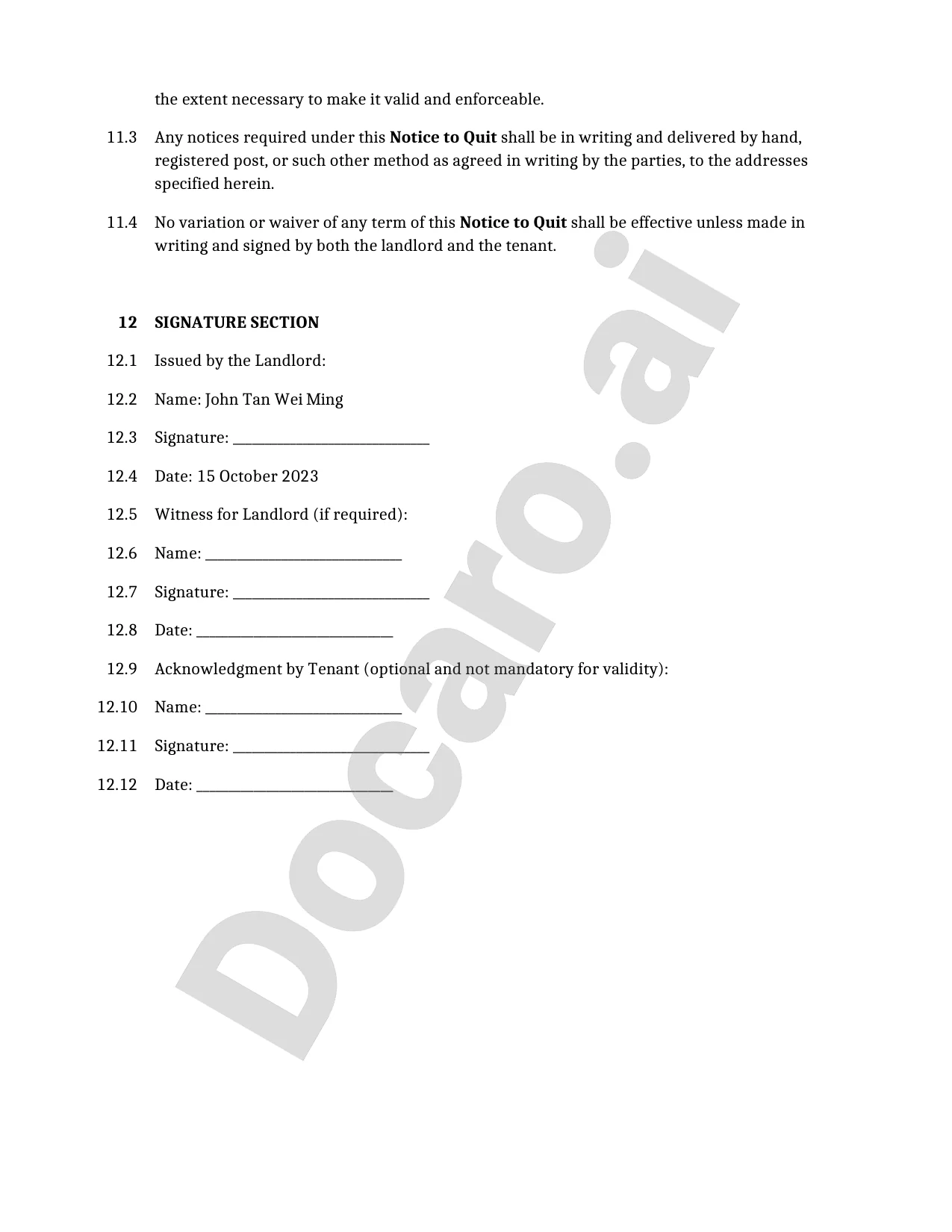
A Singapore tenancy termination notice must clearly outline tenant details, including the full name, contact information, and identification number of the tenant, ensuring compliance with the Control of Rent Act or relevant HDB regulations. For legal compliance in Singapore, customize this section to match the original tenancy agreement, specifying if the tenant is an individual or entity to avoid disputes during eviction processes.
The property description in the notice should detail the exact address, unit number, and any unique identifiers like lease reference, helping to precisely identify the premises under Singapore's tenancy laws. Advise using bespoke AI-generated legal documents via Docaro platform to tailor this clause accurately, incorporating specifics such as lease start date and rental amount for enforceability.
Specify the termination date in the notice, typically providing at least one to two months' notice as per standard Singapore residential tenancy agreements, unless shortened by mutual consent or fixed-term expiry. This clause requires customization to align with the agreement's notice period, ensuring it meets legal requirements under the Distress Act to prevent invalid terminations.
Reasons for termination, such as non-payment of rent, breach of terms, or natural lease end, must be stated factually without ambiguity to support any potential legal action in Singapore courts. For optimal compliance, generate customized notices using Docaro's AI tools, which adapt to local laws and include supporting evidence clauses for robust tenancy termination documentation.
How to draft these clauses effectively?
1
Gather Necessary Information
Collect tenant details, lease agreement terms, reason for eviction, and applicable local laws to ensure the notice is tailored accurately.
2
Draft Key Clauses Using Docaro
Use Docaro to generate bespoke clauses for notice period, grounds for quitting, and possession demands, customizing to your specific case.
3
Incorporate Supporting Details
Add property address, dates, and signatures into the Docaro-generated document, ensuring all elements align with gathered information.
4
Review for Accuracy
Thoroughly check the notice for legal compliance, factual correctness, and clarity before finalizing and serving it.
Are there any recent or upcoming legal changes affecting Notice to Quit in Singapore?
Recent amendments to tenancy laws in various jurisdictions have focused on enhancing tenant protections, particularly around Notice to Quit requirements. For instance, in the UK, the Renters (Reform) Bill, progressing through Parliament as of early 2024, aims to abolish Section 21 evictions, fundamentally altering how landlords issue notices to quit without cause.
Regarding the Control of Rent Act, no major updates have been reported in 2025 or 2026 that directly impact Notice to Quit documents in key regions like the UK or US states. Landlords must still adhere to existing notice periods, typically 1-2 months, depending on local regulations, to ensure compliance.
Upcoming changes, such as potential expansions to rent control in California under AB 1482 extensions, could indirectly affect eviction notices by capping rent increases and requiring just cause for termination. Tenants and landlords should consult jurisdiction-specific guidelines for the latest on tenancy law amendments.
For creating compliant legal documents like Notices to Quit, consider bespoke AI-generated options through Docaro legal services, tailored to your situation rather than generic templates.
How can you serve a Notice to Quit legally in Singapore?
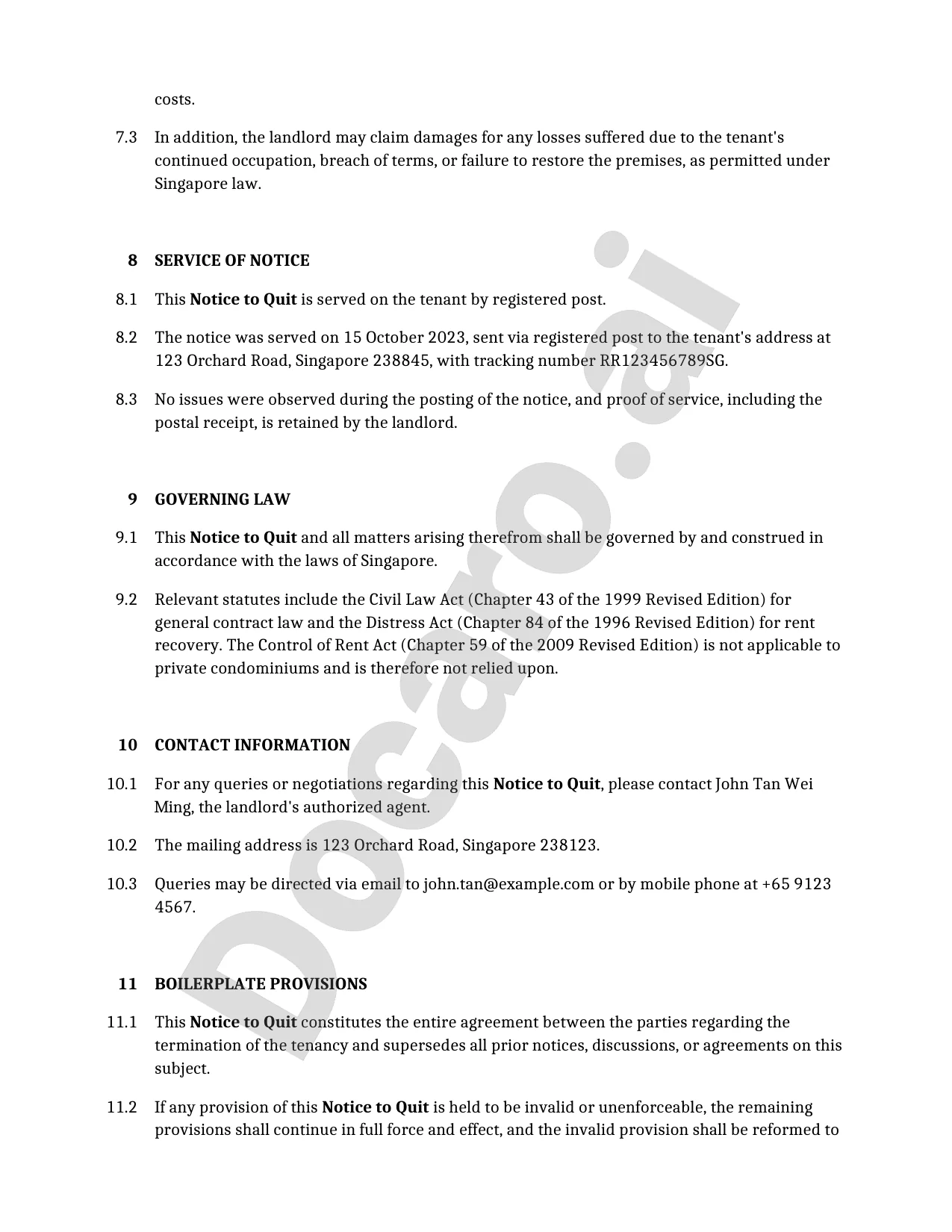
Serving a notice to quit in Singapore requires careful adherence to legal methods to ensure validity and avoid disputes. Proper serving methods include personal delivery or registered post for reliable proof of service.
Personal delivery involves handing the notice directly to the tenant or an authorized representative, ideally with a witness present to confirm receipt. This method is straightforward and immediate, making it suitable for urgent situations.
- Use registered post for a secure, trackable option that provides official evidence of delivery through postal records.
- Combine methods if needed, such as posting on the door and mailing a copy, to strengthen your case.
For detailed steps on legally serving a notice to quit, refer to our guide on serving notice to quit in Singapore. Always opt for bespoke AI-generated legal documents via Docaro to tailor your notice precisely to your circumstances.
What common mistakes should you avoid?
Issuing a Notice to Quit in Singapore requires precision to avoid legal pitfalls, especially for tenants or landlords navigating tenancy agreements. Common errors include incorrect notice periods, where parties fail to adhere to the specified duration in the lease, such as 1-2 months for periodic tenancies, leading to invalid notices and potential disputes.
Another frequent mistake is improper wording in the notice, which must clearly state the intent to terminate, the exact end date, and reasons if applicable, without ambiguity that could render it unenforceable under Singapore's tenancy laws.
To delve deeper into these issues, read our guide on Common Mistakes to Avoid When Issuing a Notice to Quit in Singapore. For reliable solutions, opt for bespoke AI-generated legal documents via Docaro to ensure compliance and customization tailored to your situation.
- Verify notice periods: Always cross-check the tenancy agreement for the required timeframe to prevent premature or delayed eviction attempts.
- Use clear language: Include all essential details like property address and termination date to make the notice legally sound.
- Serve correctly: Deliver the notice via registered mail or in person to establish proof of service, avoiding claims of non-receipt.
You Might Also Be Interested In
A Legal Contract Between A Landlord And Tenant Outlining The Terms For Renting A Residential Property In Singapore.
A Legal Contract Outlining The Terms For Renting A Specific Room Within A Shared Property, Including Rent, Duration, And Tenant Responsibilities.
A Legal Contract Outlining The Terms Under Which A Lodger Rents A Room In The Landlord's Home, Including Rent, Duration, And Responsibilities.
A Legal Document That Extends The Term Of An Existing Residential Tenancy Between Landlord And Tenant Under Singapore Law.
A Formal Notice Served By A Landlord To Terminate A Tenancy And Require The Tenant To Vacate The Premises.
A Formal Written Notification From A Landlord To A Tenant Announcing An Upcoming Increase In Rent Amount, Typically Specifying The New Rate And Effective Date.
A Document Acknowledging Receipt Of A Security Deposit, Typically Used In Rental Agreements To Protect Against Damages Or Unpaid Rent.
A Legal Document Recording The State Of A Rental Property At The Start And End Of A Tenancy To Protect Both Landlord And Tenant From Disputes Over Damages.
A Legal Contract Outlining Terms For Sharing A Residential Property Among Co-tenants In Singapore.
A Document Used To Record The Condition Of A Rental Property At The Start And End Of A Tenancy To Assess Damages And Responsibilities.
A Form Submitted By Prospective Tenants To Apply For Renting A Residential Property, Including Personal And Financial Details For Landlord Review.
A Legal Document Outlining The Rights And Obligations Of Property Owners Regarding A Shared Wall Between Adjacent Properties.
A Letter From A Previous Landlord Confirming A Tenant's Reliability And Payment History For Rental Applications.
A Corporate Document Outlining Internal Policies, Procedures, And Guidelines For Employees.