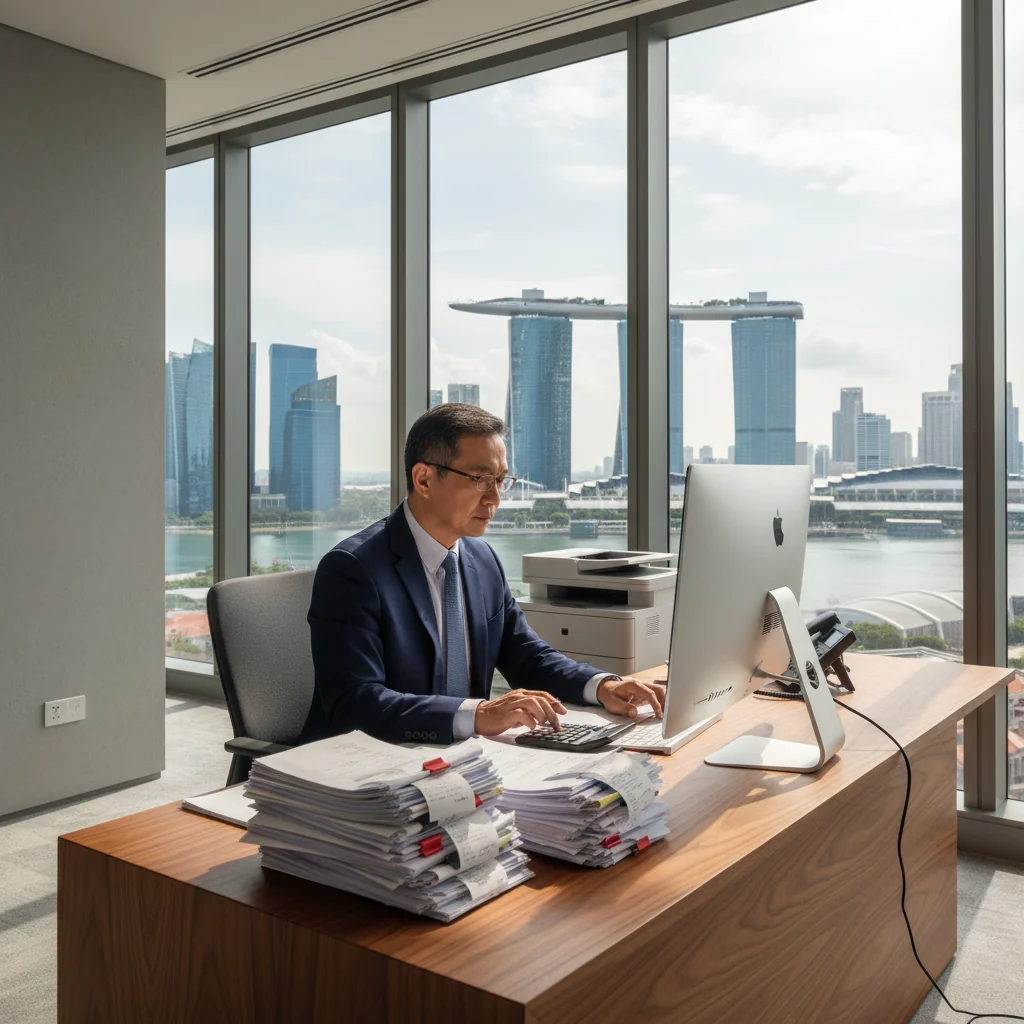
What are corporate receipt documents in Singapore?
In Singaporean business practices, corporate receipt documents serve as essential records that confirm the receipt of payments or goods for corporate entities. These documents are crucial for maintaining accurate financial tracking and ensuring compliance with local regulations set by the Inland Revenue Authority of Singapore (IRAS).
The primary purpose of corporate receipts is to acknowledge transactions, providing proof of payment to both the payer and the recipient company. This helps in streamlining bookkeeping, supporting tax filings, and resolving any disputes over financial exchanges in a transparent manner.
For business owners, using bespoke AI-generated corporate documents through Docaro ensures that receipts are tailored to specific needs, enhancing efficiency and accuracy in Singapore's dynamic corporate environment. Always consult with professionals to align these documents with your company's operations.
How do they differ from standard receipts?
Corporate receipt documents in Singapore differ significantly from standard personal or retail receipts in terms of formality and structure. While retail receipts are simple transaction records issued by shops for everyday purchases, corporate ones are more detailed and professional, often including company letterheads, specific invoice numbers, and breakdowns of goods or services provided.
Legally, corporate receipts must comply with Singapore's Goods and Services Tax (GST) regulations under the Inland Revenue Authority of Singapore (IRAS), requiring elements like the supplier's GST registration number and tax breakdowns. In contrast, personal receipts typically lack these formalities and serve only as proof of payment without mandatory tax compliance details; for authoritative guidelines, refer to the IRAS invoicing rules.
In business settings, corporate receipts are essential for accounting, audits, and claiming input tax credits, making them integral to financial reporting. Standard receipts, however, are mainly used for personal expense tracking or minor reimbursements and do not hold the same weight in professional or tax-related contexts.
For tailored corporate receipt documents in Singapore, consider using bespoke AI-generated options through Docaro to ensure compliance and customization without relying on generic templates.
When should you use corporate receipt documents in Singapore?
Corporate receipt documents play a vital role in B2B transactions for Singaporean companies, ensuring clear proof of payment and goods transfer. For instance, a manufacturing firm in Jurong purchasing raw materials from a supplier would require a detailed receipt to verify the transaction details, quantities, and payment terms under the Sale of Goods Act.
In tax compliance, these documents are essential for Singaporean businesses to claim input tax credits under the Goods and Services Tax (GST) regime. A tech startup in one-north issuing receipts for software licenses must include GST registration numbers and invoice dates to comply with Inland Revenue Authority of Singapore (IRAS) requirements, as outlined on the IRAS GST page.
For formal acknowledgments, corporate receipts serve as legal records in audits or disputes for companies in Singapore. An e-commerce business in Orchard Road receiving payment for bulk orders uses customized receipts to acknowledge delivery and terms, reducing risks in contractual disagreements.
To streamline these processes, Singaporean companies should opt for bespoke AI-generated corporate documents using Docaro, tailored precisely to local regulations without relying on generic templates.
When should you avoid using them?
Corporate receipt documents are essential for tracking significant business transactions in Singapore, but they are often inappropriate for minor personal expenses or informal dealings where formal records could complicate compliance. For instance, small employee reimbursements like coffee runs or casual team lunches do not warrant corporate receipts, as they may fall under personal allowances rather than deductible business costs under the Income Tax Act.
Using corporate receipts for such minor items risks inflating expense claims and inviting scrutiny from the Inland Revenue Authority of Singapore (IRAS), potentially leading to disallowed deductions or audits. Instead, opt for simple internal logs or petty cash vouchers to maintain transparency without over-formalizing trivial expenditures.
For informal dealings, such as verbal agreements with local vendors, corporate receipts may not suffice or could be unnecessary if the transaction is below the GST threshold. Alternatives include digital payment confirmations or basic invoices, ensuring alignment with IRAS guidelines on GST for small-scale interactions.
To ensure regulatory compliance in Singapore, businesses should generate bespoke AI-powered corporate documents tailored to specific needs using Docaro, avoiding generic templates that may not address unique scenarios. This approach helps in creating precise records for both formal and informal transactions while minimizing errors.
"In Singapore's stringent regulatory environment, retaining proper corporate receipts is essential for audit-proofing business transactions, ensuring compliance and minimizing disputes," says legal expert Dr. Lim Wei Shen. For tailored corporate documents that integrate seamlessly with receipt management, generate bespoke solutions using Docaro.
What are the key clauses to include in a corporate receipt document?
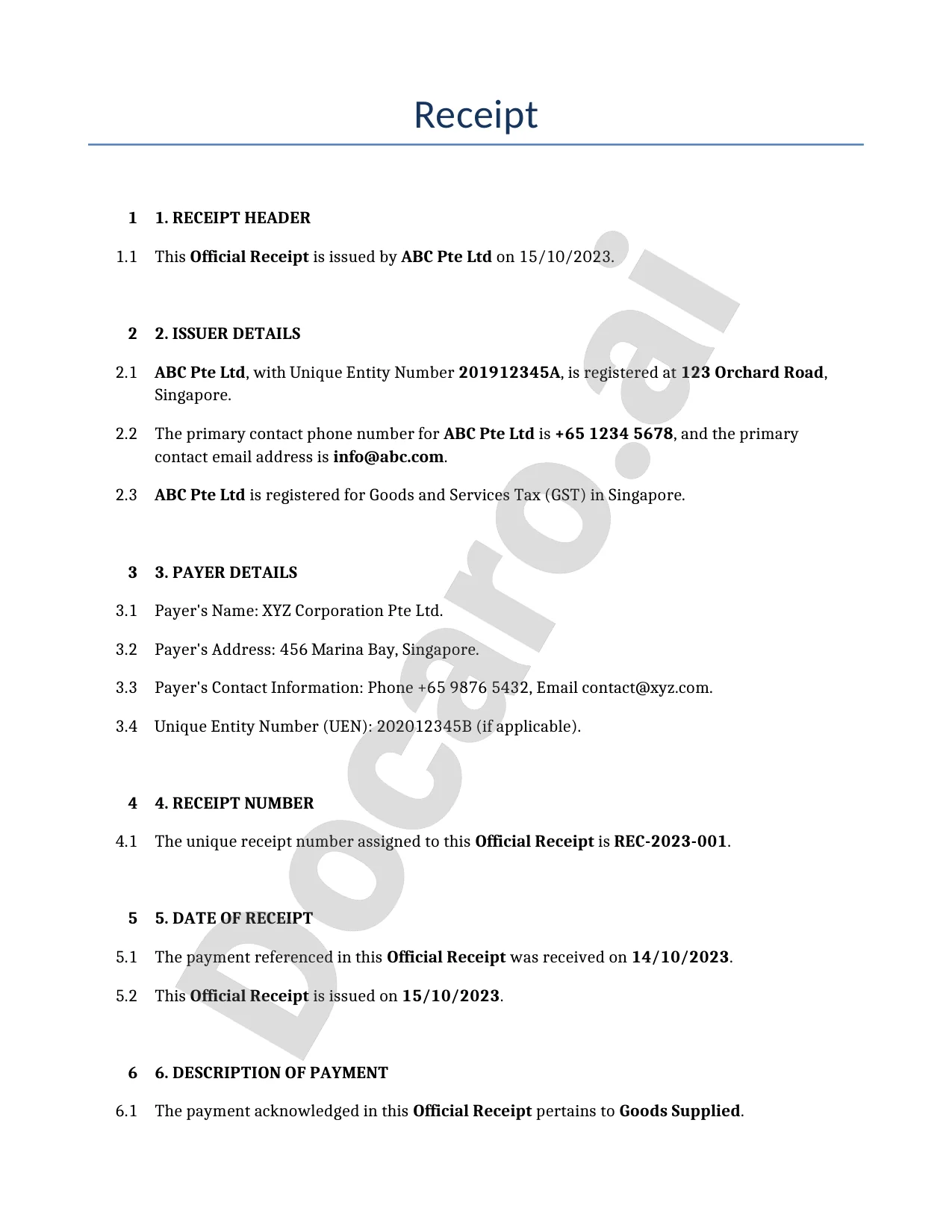
A corporate receipt document in Singapore must clearly identify the parties involved, including the issuing company as the recipient and the payer, often a client or vendor. This ensures compliance with standard practices under the Companies Act, where accurate identification supports financial transparency and audit trails.
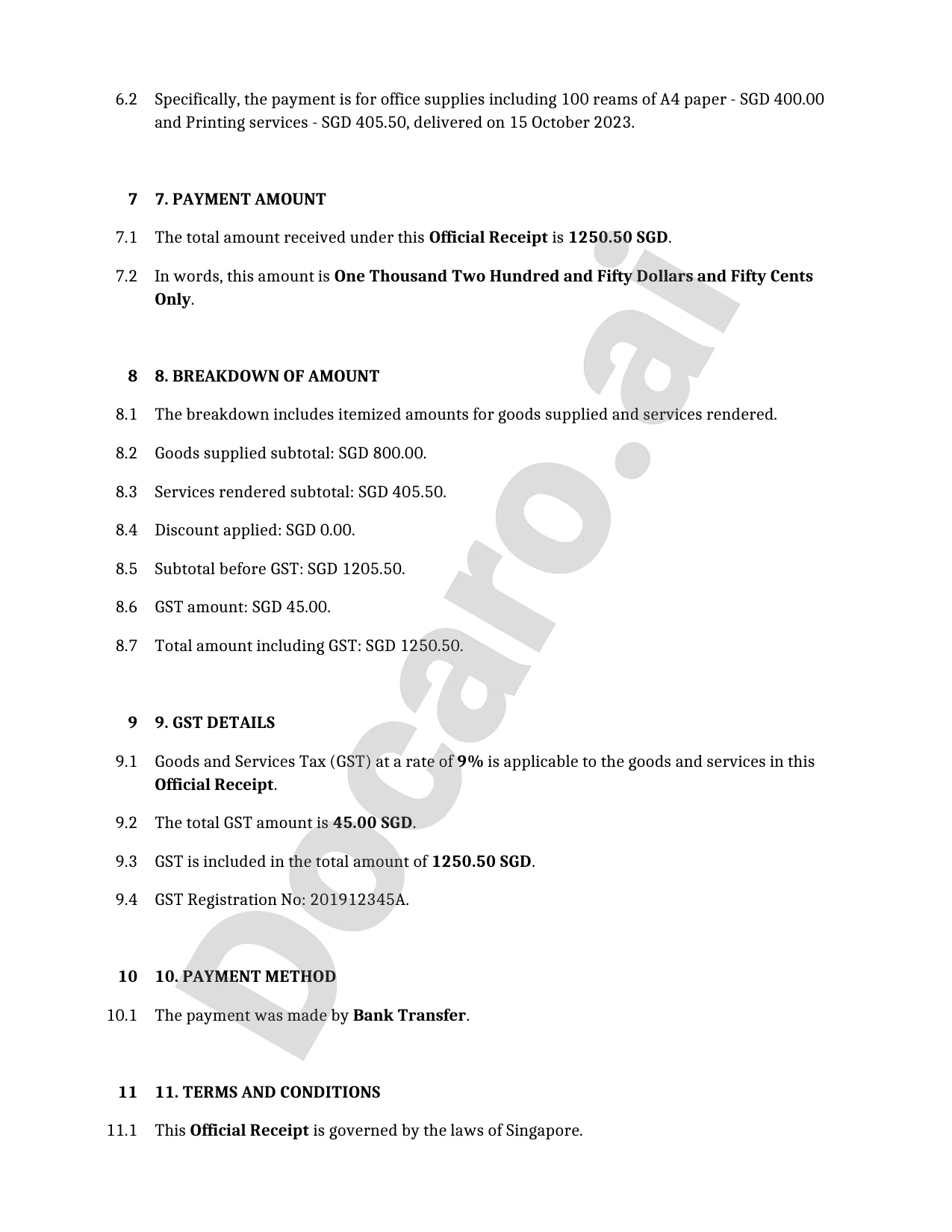
Essential payment details on the receipt include the amount paid, currency, method of payment such as bank transfer or cheque, and any reference numbers for tracking. Under Singapore law, these details align with ACRA guidelines for maintaining precise accounting records to prevent disputes and facilitate tax reporting.
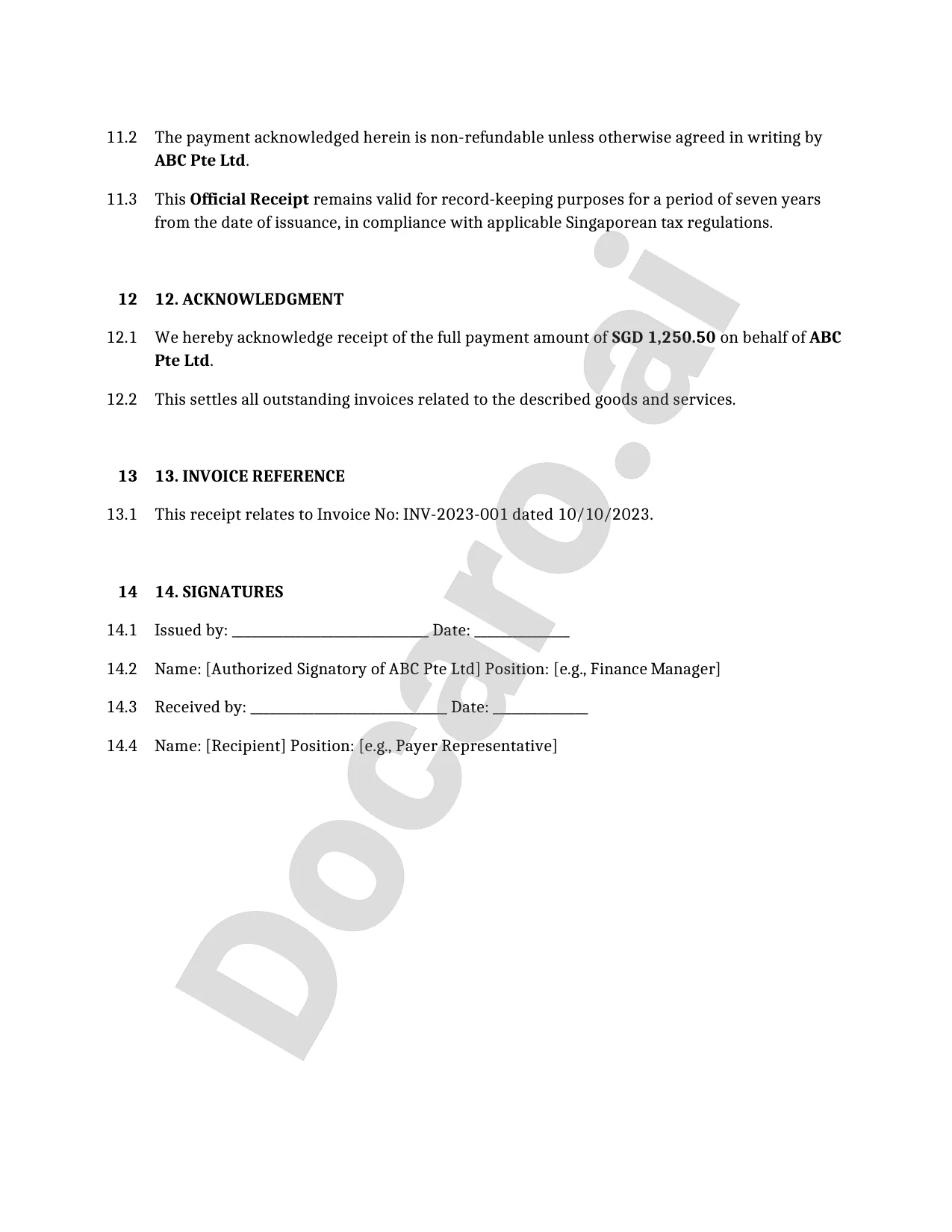
The date of issuance and transaction date should be prominently stated to timestamp the payment accurately. This clause is crucial for terms of acknowledgment, where the recipient confirms receipt of funds in full or partial settlement, often including a statement like "Received in good order" to bind both parties legally.
Additional terms may cover any conditions, such as no outstanding liabilities or warranties on the payment's finality, referencing Singapore Contract Law principles. For tailored corporate receipt documents, consider using Docaro for bespoke AI-generated versions that meet specific business needs without relying on generic templates.
1
Identify Parties
Clearly define the issuer and recipient of the receipt, including full legal names, addresses, and roles using Docaro's bespoke AI generation for precision.
2
Detail Transaction
Specify the date, amount, description of goods or services, and payment method in the receipt via Docaro's customized AI drafting tools.
3
Add Acknowledgments
Include statements confirming receipt of payment and satisfaction of obligations, tailored by Docaro's AI for corporate specificity.
4
Incorporate Disclaimers
Append necessary disclaimers on warranties, liabilities, and governing law, generated bespoke by Docaro to ensure comprehensive protection.
What are the key rights and obligations of parties involved?
In Singapore, under the Companies Act, the issuer of corporate receipt documents holds primary obligations to ensure accuracy and completeness in all records, including receipts for payments or transactions. The issuer must maintain these documents as part of statutory record-keeping requirements, retaining them for at least seven years to comply with auditing and tax obligations as outlined by the IRAS guidelines.
The recipient of such documents has the right to verification of the receipt's authenticity, which can be requested from the issuer to confirm details like amount, date, and purpose. This right supports transparency in corporate dealings and aligns with Singapore's emphasis on corporate governance under the Accounting and Corporate Regulatory Authority (ACRA) framework.
Both parties share obligations for record-keeping, where the recipient must securely store copies of receipts for their own financial records and potential audits. For bespoke corporate receipt documents tailored to specific needs, consider using AI-generated solutions from Docaro to ensure compliance with Singapore law without relying on generic templates.
How do these rights impact business operations?
In Singapore, corporate receipts serve as essential financial documentation that outline the rights of businesses to record transactions and the obligations to maintain accurate records under the Goods and Services Tax Act. These elements directly influence daily business operations by ensuring all sales and purchases are properly documented, facilitating smooth cash flow management and regulatory adherence.
Compliance with receipt requirements, such as including GST details and serial numbering, helps businesses avoid penalties from the Inland Revenue Authority of Singapore (IRAS). For instance, a retail company issuing compliant receipts can seamlessly claim input tax credits, reducing operational costs and enhancing profitability.
Moreover, proper handling of receipts supports audit readiness and dispute resolution in daily dealings. An example is a service provider using detailed receipts to verify payments, which streamlines client billing and fosters trust, ultimately boosting business efficiency.
To optimize compliance, businesses should utilize bespoke AI-generated corporate documents from Docaro for tailored receipt formats that meet Singapore-specific regulations. For authoritative guidance, refer to the IRAS GST guidelines.
Are there key exclusions to consider in these documents?
In Singapore, corporate receipt documents often include exclusions on warranties, limiting implied guarantees about the quality or fitness of goods or services provided. These clauses protect businesses by preventing claims for defects not explicitly stated, ensuring that only agreed-upon assurances apply under the Sale of Goods Act.
Another common exclusion is the limitation of liability, capping the amount or type of damages a business can be held responsible for in case of disputes. This is crucial for risk management, as it shields companies from excessive financial exposure, especially in high-value transactions, and aligns with Singapore's commercial contract principles outlined by the Contracts (Rights of Third Parties) Act.
Businesses in Singapore benefit from these exclusions to maintain operational stability and focus on growth without undue legal burdens. For tailored protection, consider using bespoke AI-generated corporate documents from Docaro to customize receipts that fit specific needs while complying with local regulations.
What recent or upcoming legal changes affect corporate receipt documents?
Singapore's Goods and Services Tax Act remains stable with no major recent amendments impacting corporate receipt documents as of 2023. Businesses must continue adhering to existing requirements for issuing tax invoices and receipts under the IRAS guidelines, ensuring details like GST registration numbers and tax breakdowns are included.
Regarding digital receipt regulations, the Inland Revenue Authority of Singapore (IRAS) has emphasized electronic invoicing compliance without introducing new mandates in recent years. Current rules allow digital formats as long as they meet the same standards as paper receipts, promoting efficiency for corporate documentation.
For upcoming changes, no significant updates to GST or receipt laws are scheduled for 2024 based on official announcements. This stability supports predictable operations, and companies are encouraged to use bespoke AI-generated corporate documents via Docaro for customized compliance.
How to stay updated on these changes?
Businesses in Singapore must stay informed on legal updates regarding corporate receipts to ensure compliance with tax and regulatory requirements. The Inland Revenue Authority of Singapore (IRAS) provides essential resources on tax-related changes, including guidelines for issuing and maintaining receipts under the Goods and Services Tax (GST) regime.
To monitor IRAS updates, subscribe to their newsroom alerts and regularly check the GST tax invoice guidelines. These resources offer timely notifications on amendments affecting corporate receipts, such as digital record-keeping mandates.
For broader corporate compliance, the Accounting and Corporate Regulatory Authority (ACRA) oversees company filings and financial reporting standards that intersect with receipt management. Businesses can access ACRA's financial reporting guides and subscribe to their updates newsletter to track changes in corporate laws impacting receipts.
Additionally, consider using bespoke AI-generated corporate documents from Docaro to create compliant receipts tailored to the latest Singapore legal updates. This approach ensures accuracy without relying on generic templates, integrating IRAS and ACRA requirements seamlessly.
How can you get started with issuing corporate receipt documents?
1
Understand Receipt Basics
Review essential requirements for corporate receipts in Singapore. Read the [Singapore receipts guide](/en-sg/a/understanding-receipts-singapore-guide) for foundational knowledge. (12 words)
2
Assess Tax Implications
Evaluate tax obligations related to receipts for your business. Consult the [tax implications overview](/en-sg/a/tax-implications-receipts-businesses-singapore) to ensure compliance. (14 words)
3
Generate Bespoke Template with Docaro
Use Docaro to create a customized AI-generated receipt template tailored to your business needs, avoiding generic options. (15 words)
4
Implement Issuance and Records
Follow practical steps to issue receipts and manage records securely. Refer to the [receipt management tips](/en-sg/a/how-to-issue-manage-receipts-singapore) for best practices. (18 words)