Docaro

AI Generated Compensation Philosophy Statement for use in Singapore
PDF & Word - 2026 Updated

Discover how our AI-powered tool generates a tailored compensation philosophy statement for Singapore businesses, ensuring alignment with local employment regulations and competitive talent strategies.
Free instant document creation.
Compliant with Singapore law.
No sign up or monthly subscription.

Docaro Pricing

Basic
Free
Document Generation
No Sign Up
No Subscription
Download Watermarked PDF
Premium
$4.99 USD
Document Generation
No Sign Up
No Subscription
Download Clean PDF
Download Microsoft Word
Download HTML
Download Text
Email Document
Generate your document for free. Only pay if you like the result and need an un-watermarked version.

When do you need a Compensation Philosophy Statement in Singapore?

  • Starting a New Company
    A compensation philosophy helps define how you'll pay employees from the beginning, setting a clear foundation for growth.
  • Updating Pay Structures
    It's essential when reviewing or changing salaries to ensure fairness and alignment with company goals.
  • Attracting Top Talent
    This statement shows potential hires that your pay approach is competitive and thoughtful, helping you stand out in Singapore's job market.
  • Preparing for Audits or Reviews
    Having a well-drafted document demonstrates transparency and good practices during internal or external checks.
  • Building Employee Trust
    It explains your pay decisions openly, boosting morale and reducing confusion among your team.
  • Adapting to Market Changes
    Use it to adjust compensation in response to economic shifts or industry trends while keeping consistency.

Singaporean Legal Rules for a Compensation Philosophy Statement

  • No Mandatory Requirement
    Singapore law does not require companies to create a compensation philosophy statement, but it can help meet broader obligations under employment and corporate governance rules.
  • Fair Pay Practices
    Compensation must follow the Employment Act, ensuring fair wages, timely payments, and no discrimination based on race, gender, or other protected traits.
  • Disclosure for Listed Companies
    Publicly listed companies in Singapore must disclose executive pay details in annual reports as per Singapore Exchange rules to promote transparency.
  • Tax Compliance
    All compensation elements like salaries and bonuses are subject to income tax under the Inland Revenue Authority of Singapore guidelines.
  • Anti-Corruption Standards
    Pay structures should avoid incentives that could lead to bribery or unethical behavior, aligning with the Prevention of Corruption Act.
Important

Using the wrong structure for a compensation philosophy statement can lead to misalignment with Singapore's employment regulations and unintended legal liabilities.

What a Proper Compensation Philosophy Statement Should Include

  • Company's Pay Goals
    Clearly state the main objectives of your pay system, such as attracting skilled workers or rewarding strong performance.
  • Market Pay Comparison
    Explain how your pay levels match or differ from what similar companies in Singapore offer.
  • Internal Pay Fairness
    Describe how pay is set equally for similar roles and responsibilities within the company.
  • Performance-Based Rewards
    Outline how pay increases, bonuses, or incentives are linked to employee achievements and company results.
  • Long-Term Incentives
    Detail options like stock plans or deferred pay to encourage employee loyalty and long-term success.
  • Compliance with Local Rules
    Confirm that the pay approach follows Singapore's employment laws and fair practices.
  • Review and Update Process
    Specify how often the pay philosophy will be checked and adjusted to stay relevant.

Why Free Templates Can Be Risky for Compensation Philosophy Statements

Using free templates for compensation philosophy statements often leads to generic content that fails to address your company's unique needs, industry standards, and regulatory requirements in Singapore. These one-size-fits-all documents may overlook critical details, resulting in non-compliance, misalignment with business goals, or even legal vulnerabilities that could expose your organization to risks.

Our AI-generated bespoke compensation philosophy statements are tailored specifically to your company's context, ensuring precision, relevance, and alignment with Singapore's corporate landscape. By leveraging advanced AI, we create customized documents that reflect your strategic objectives, enhance compliance, and provide a professional edge over outdated templates.

Generate Your Bespoke Compensation Philosophy Statement in 4 Easy Steps

1
Answer a Few Questions
Our AI guides you through the info required.
2
Generate Your Document
Docaro builds a bespoke document tailored specifically on your requirements.
3
Review & Edit
Review your document and submit any further requested changes.
4
Download & Sign
Download your ready to sign document as a PDF, Microsoft Word, Txt or HTML.

Why Use Our AI Compensation Philosophy Statement Generator?

Fast Generation
Quickly generate a comprehensive Compensation Philosophy Statement, eliminating the hassle and time associated with traditional document drafting.
Guided Process
Our user-friendly platform guides you step by step through each section of the document, providing context and guidance to ensure you provide all the necessary information for a complete and accurate Compensation Philosophy Statement.
Safer Than Legal Templates
We never use legal templates. All documents are generated from first principles clause by clause, ensuring that your document is bespoke and tailored specifically to the information you provide. This results in a much safer and more accurate document than any legal template could provide.
Professionally Formatted
Your Compensation Philosophy Statement will be formatted to professional standards, including headings, clause numbers and structured layout. No further editing is required. Download your document in PDF, Microsoft Word, TXT or HTML.
Compliance with Singaporean Law
Rest assured that all generated documents meet the latest legal standards and regulations of Singapore, enhancing trust and reliability.
Cost-Effective
Save money by generating legally sound Compensation Philosophy Statement without the need for expensive legal services or consultations.
Get Started for Free - No Sign Up or Monthly Subscription Required
No payment or sign up is required to start generating your Compensation Philosophy Statement. Generate and download a watermarked version of your document for free. Pay only if you want to remove the watermark and gain full access to your document. No monthly subscriptions or hidden fees. Pay once and use your document forever.
Need to Generate a Compensation Philosophy Statement in a Different Country?
Choose country:

Free Example Compensation Philosophy Statement Template

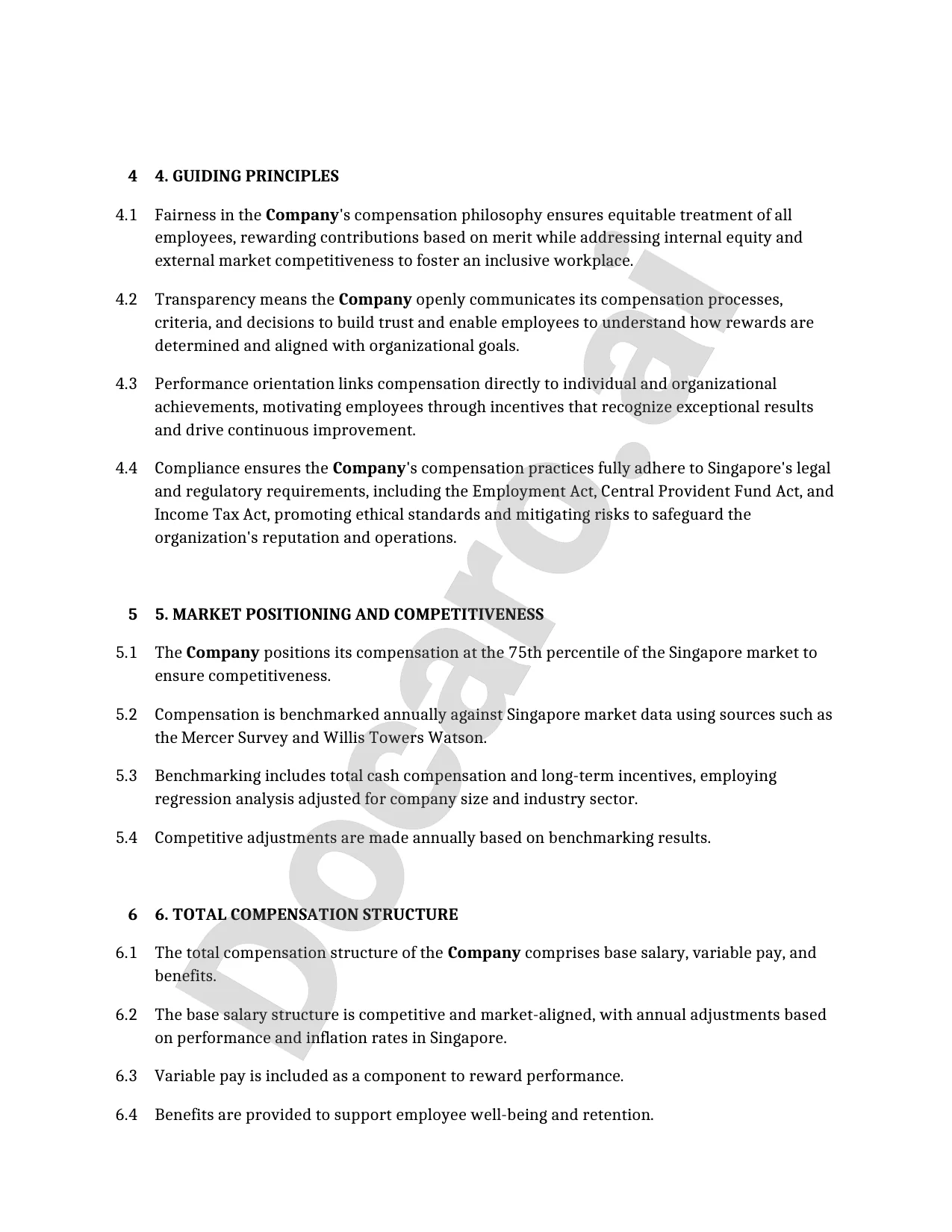
Below is a free template example of a Compensation Philosophy Statement for use in Singapore generated by our AI model.

The clauses in your actual Compensation Philosophy Statement will vary from this example as they will be entirely bespoke to your requirements as set out in the questionnaire you complete.
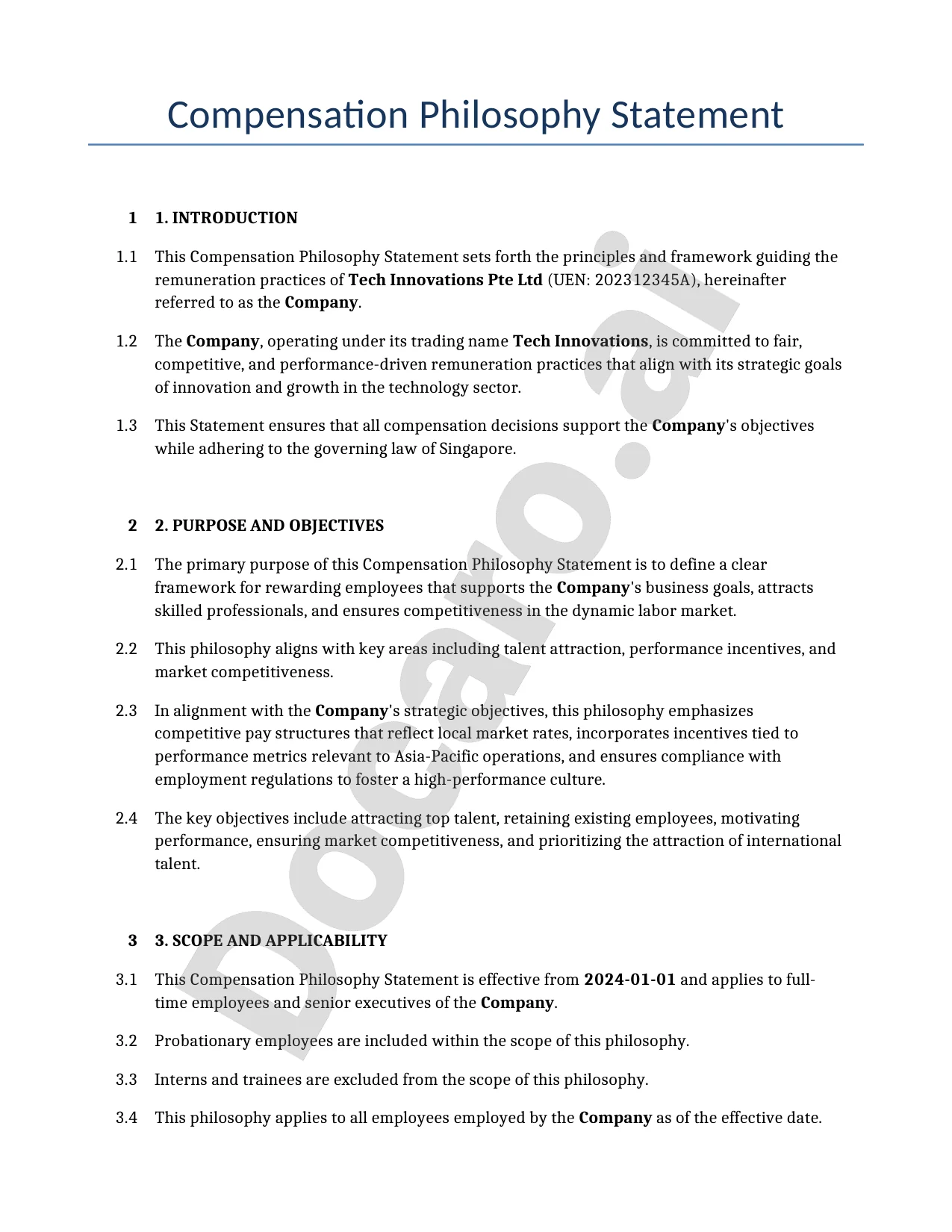
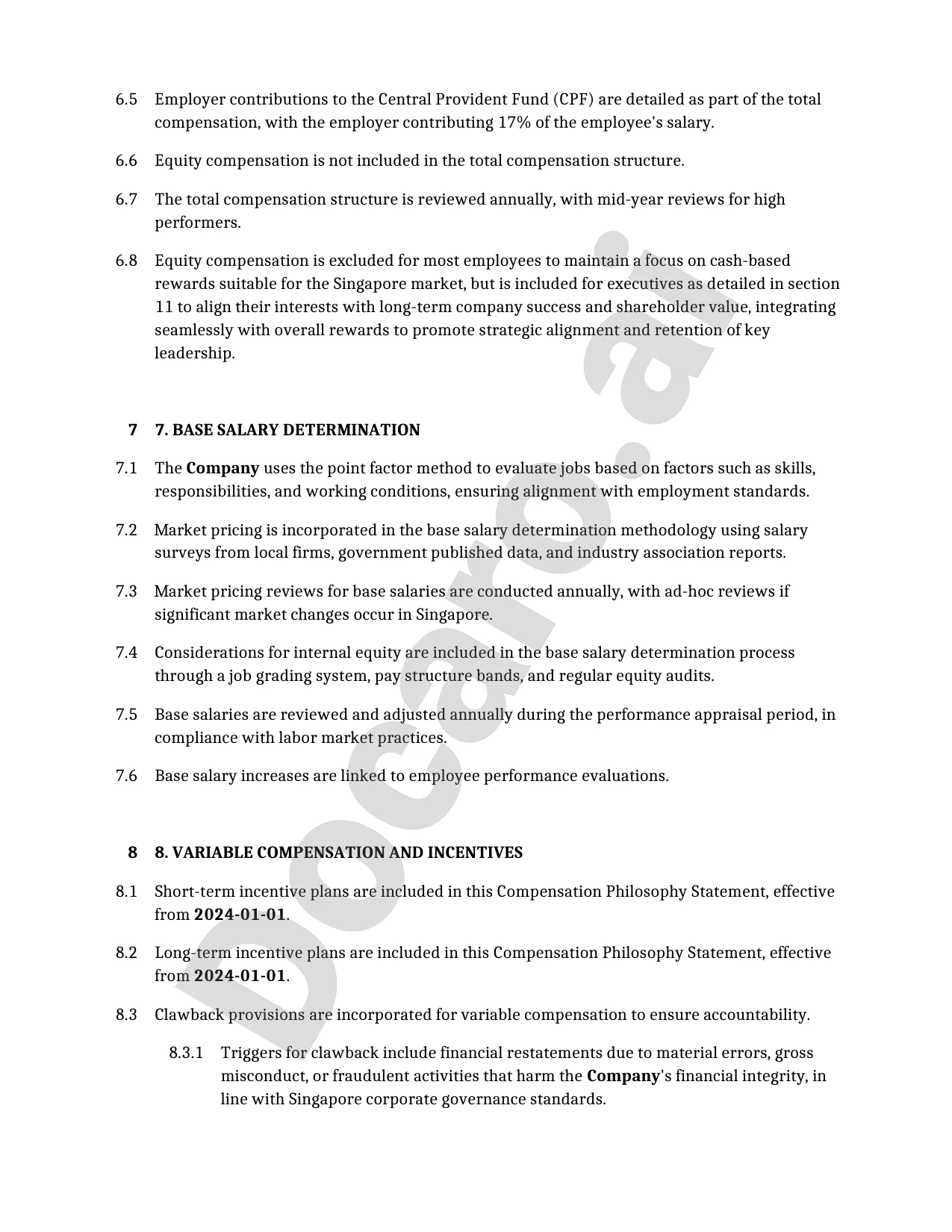
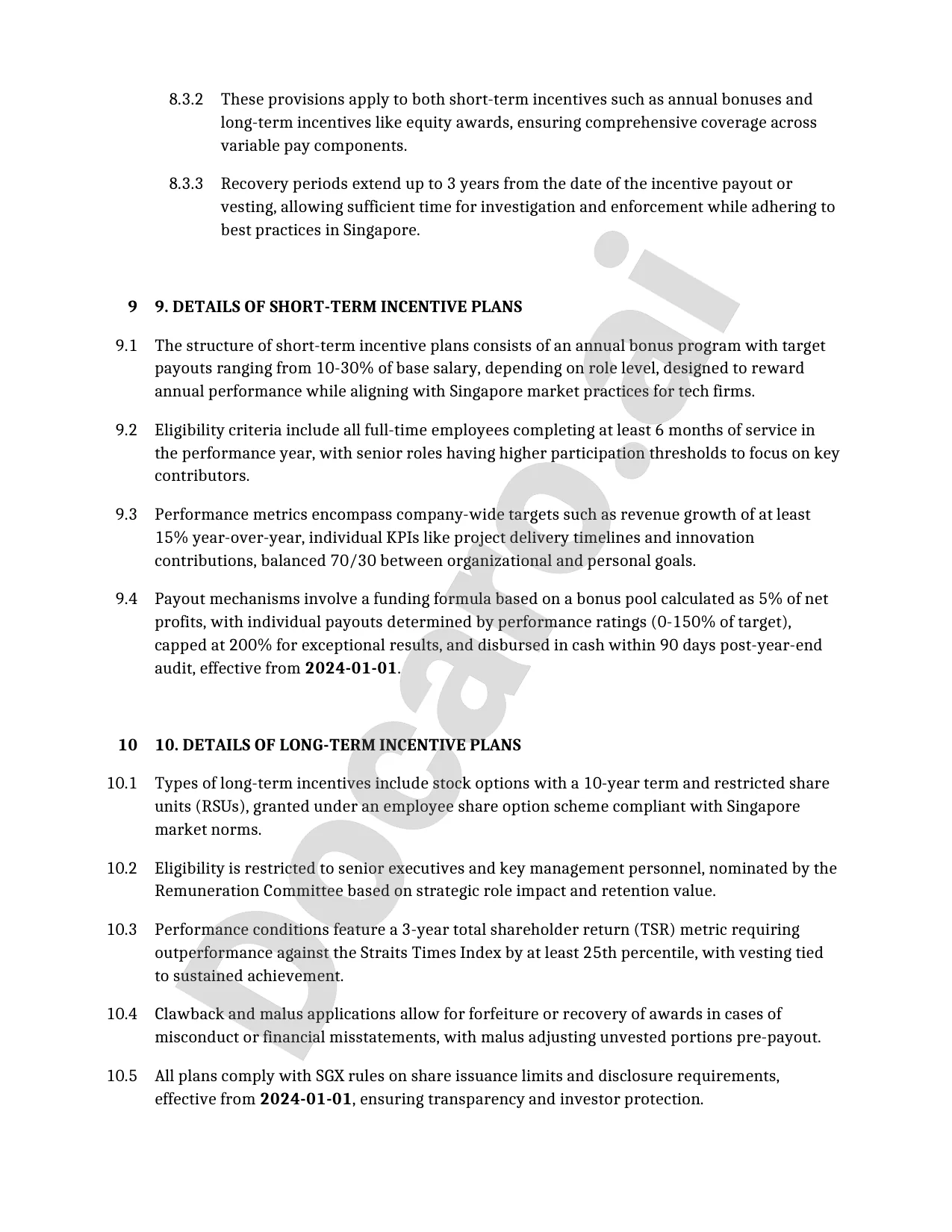
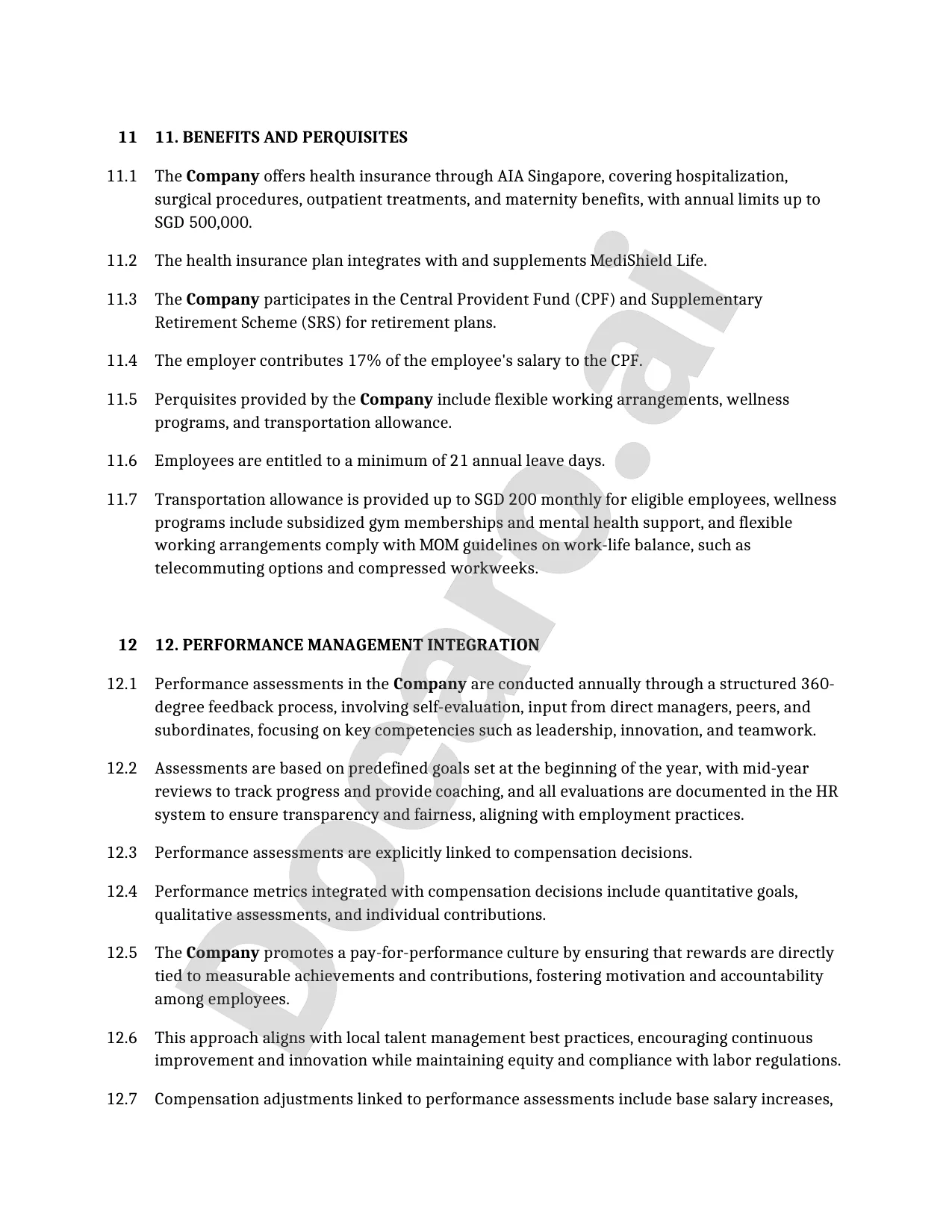
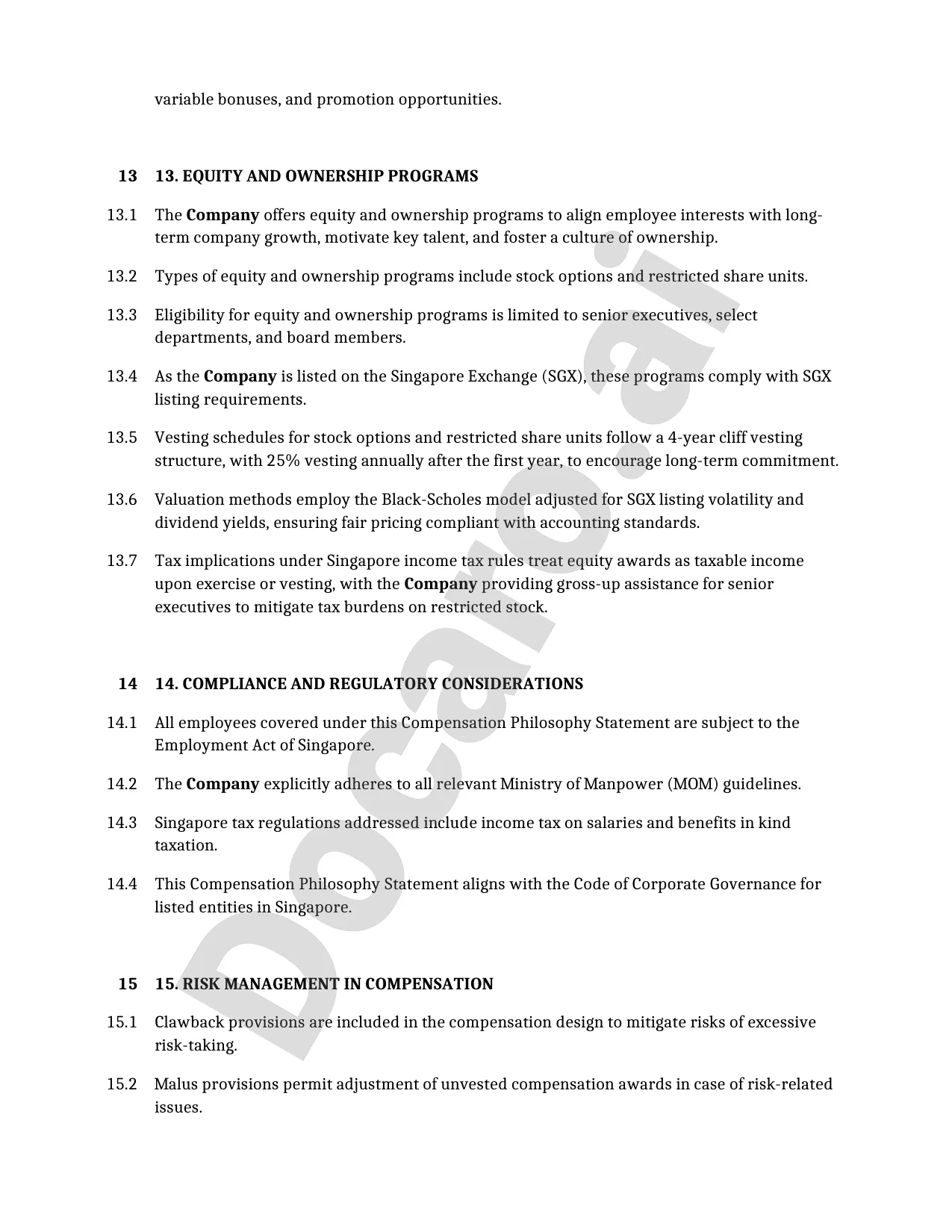
Page 1

Singapore Compliance Legislation

Your AI Generated Compensation Philosophy Statement will be checked for compliance against the following legislation and regulations:

What is a Compensation Philosophy Statement in the Singapore Corporate Context?

A Compensation Philosophy Statement is a foundational document that articulates an organization's guiding principles for rewarding employees, ensuring alignment with business objectives and market standards. In the context of Singapore corporate documents, it serves as a strategic blueprint, often integrated into HR policies and governance frameworks to promote transparency and fairness in talent management.

The primary purpose of a Compensation Philosophy Statement is to define how compensation structures support the company's long-term goals, such as attracting top talent in Singapore's competitive job market. It outlines key elements like pay equity, performance incentives, and benefits, helping businesses comply with local regulations from bodies like the Ministry of Manpower while fostering employee engagement and retention.

This statement guides compensation strategies by providing a clear framework for decisions on salary bands, bonuses, and equity awards, tailored to Singapore's dynamic economy. For instance, it might emphasize market-competitive pay to address talent shortages in sectors like finance and tech, ensuring strategies evolve with economic shifts such as those influenced by the Monetary Authority of Singapore.

  • Establishes internal equity to motivate staff across levels.
  • Aligns rewards with organizational values and performance metrics.
  • Supports benchmarking against Singapore salary surveys for competitiveness.

Businesses in Singapore are encouraged to develop bespoke Compensation Philosophy Statements using AI-generated tools like Docaro, allowing customization to unique needs without relying on generic templates. This approach ensures the document remains relevant and effective in navigating local employment laws and global influences.

Why Does Your Singapore Company Need One?

"In Singapore's dynamic business landscape, a well-crafted Compensation Philosophy Statement is essential for ensuring pay equity, attracting top talent, and sustaining a competitive edge. I recommend developing a bespoke version using Docaro to tailor it precisely to your organization's goals and values." – Dr. Lim Wei, HR Strategist at Apex Consulting

When Should You Use a Compensation Philosophy Statement?

A Compensation Philosophy Statement is essential for Singapore companies during business expansion, as it provides a structured framework to attract top talent in competitive markets like finance and technology. By clearly defining pay scales aligned with global standards, firms can scale operations without inconsistencies in remuneration.

For talent retention, such a statement ensures equitable and competitive compensation packages, reducing turnover in Singapore's high-stakes job market. It fosters employee loyalty by linking rewards to performance, helping companies retain skilled professionals amid labor shortages.

Regulatory compliance in Singapore mandates transparent pay practices under frameworks from the Ministry of Manpower; a Compensation Philosophy Statement helps meet these requirements while avoiding penalties. Companies can reference guidelines from Ministry of Manpower salary resources to align with local laws.

Aligning pay with business goals through this statement drives organizational success by motivating employees toward strategic objectives, such as innovation or market growth. For bespoke documents tailored to your needs, consider AI-generated corporate solutions from Docaro, ensuring precision without generic templates.

When Should You Avoid or Modify It?

In early-stage startups, a formal Compensation Philosophy Statement may not be suitable due to rapid changes in business priorities and limited funding, making rigid guidelines impractical. These organizations often prioritize flexibility over structured policies to attract talent quickly without predefined salary bands.

For small firms with limited resources in Singapore, developing and maintaining a comprehensive Compensation Philosophy Statement can strain budgets and administrative capacity. Instead, adapting it to a simplified version or using bespoke AI-generated corporate documents via platforms like Docaro allows for cost-effective customization tailored to local regulations, as outlined by the Ministry of Manpower.

In non-competitive industries such as certain manufacturing sectors in Singapore, a detailed statement might be unnecessary if market rates are stable and talent retention isn't a pressing issue. Potential drawbacks include overcomplicating internal processes, leading to employee confusion or compliance burdens without significant benefits, especially when adapting for unique local economic conditions.

What Are the Key Clauses in a Compensation Philosophy Statement?

A Compensation Philosophy Statement for Singapore corporations typically outlines the core principles guiding employee remuneration, ensuring alignment with business objectives and stakeholder expectations. Essential clauses include commitments to pay equity, where compensation is determined based on job roles, skills, and contributions rather than gender, race, or other protected characteristics, promoting fairness and inclusivity in line with Singapore's Tripartite Guidelines on Fair Consideration Framework.

Another key clause links performance to pay, establishing variable components like bonuses and incentives that reward individual and organizational achievements to drive motivation and productivity. This performance linkage often incorporates balanced scorecards or key performance indicators (KPIs), ensuring rewards reflect measurable outcomes while adhering to prudent risk management practices.

Market benchmarking is a critical clause, involving regular comparisons with industry peers in Singapore to set competitive salary ranges and attract top talent. For instance, corporations might reference data from sources like the Ministry of Manpower salary reports to position total compensation at the median or upper quartile, depending on the company's strategy.

Compliance with local laws forms the foundational clause, mandating adherence to Singapore's Employment Act, Central Provident Fund contributions, and variable payment regulations under the Employment of Foreign Manpower Act. Examples include clauses ensuring minimum wage compliance for certain sectors and transparent disclosure of compensation structures to meet corporate governance standards set by the Accounting and Corporate Regulatory Authority (ACRA).

To create a tailored Compensation Philosophy Statement, corporations should opt for bespoke AI-generated corporate documents using Docaro, allowing customization to specific industry needs and regulatory nuances in Singapore.

How Do These Clauses Impact Daily Operations?

1
Review Compensation Philosophy
Examine the Compensation Philosophy Statement to identify key clauses on pay equity, performance incentives, and market alignment for integration into practices.
2
Develop Bespoke Policies with Docaro
Use Docaro to generate customized AI-driven compensation policies that embed the key clauses, ensuring they fit your organization's unique structure and goals.
3
Train HR and Implement Practices
Train HR team on the new policies and roll out updated compensation processes, including salary reviews and bonus structures aligned with the philosophy.
4
Monitor and Adjust Implementation
Establish metrics to track adherence to the philosophy, conduct periodic audits, and refine practices based on feedback and outcomes.

What Recent Legal Changes Affect Compensation Philosophy Statements in Singapore?

Singapore's Employment Act saw updates in 2023 that extend coverage to more employees, including those earning up to S$2,600 monthly in non-managerial roles, influencing how companies craft Compensation Philosophy Statements to ensure compliance with fair pay practices.

Tripartism guidelines from the National Trades Union Congress (NTUC) and Ministry of Manpower emphasize fair compensation structures, with recent 2024 advisories promoting progressive wage models that tie pay to skills development, requiring organizations to align their statements with these equitable benchmarks.

Ongoing tax incentives under the Inland Revenue Authority of Singapore (IRAS) continue to favor deferred compensation plans like employee share options, encouraging transparent compensation philosophies that detail such benefits to optimize fiscal advantages.

For tailored Compensation Philosophy Statements, consider using Docaro's bespoke AI-generated corporate documents to meet Singapore's evolving legal landscape precisely.

What Key Rights and Obligations Do Parties Have Under This Document?

In Singapore, a Compensation Philosophy Statement outlines an organization's approach to fair pay, ensuring alignment with market standards and internal equity. Employers have the obligation to develop and implement this statement transparently, disclosing key elements like salary structures and benefits to employees, as guided by the Ministry of Manpower (MOM).

Employees' rights include access to fair pay based on the compensation philosophy, with protections against discrimination under the Employment Act. They are entitled to clear information on remuneration during hiring and reviews, fostering trust and compliance with Singapore's labor laws.

Other stakeholders, such as unions and shareholders, hold rights to review the statement for accountability, while their obligations involve advocating for equitable practices. Enforcement mechanisms are handled by MOM through inspections and dispute resolution, with penalties for non-compliance including fines up to SGD 5,000 per offense.

For tailored corporate documents like a Compensation Philosophy Statement, consider bespoke AI-generated solutions using Docaro to ensure they meet Singapore-specific requirements without relying on generic templates.

Are There Key Exclusions to Consider?

A Compensation Philosophy Statement often includes key exclusions to ensure clarity and compliance in Singapore employment practices. For instance, it may specify non-applicability to certain employee categories like independent contractors, interns, or expatriates on short-term assignments, as these groups fall outside standard employee benefits frameworks.

Exceptions for variable pay are another common exclusion, where the philosophy might limit fixed salary guidelines but allow flexibility for performance-based incentives or bonuses. This approach aligns with Singapore labor laws, which emphasize fair remuneration without mandating identical structures for all variable components.

Limitations based on Singapore labor laws must be highlighted, such as adherence to the Employment Act's provisions on overtime pay and minimum wage for applicable workers. Organizations should consult authoritative resources like the Ministry of Manpower salary guidelines to tailor exclusions precisely.

To create a customized Compensation Philosophy Statement with these exclusions, leverage bespoke AI-generated corporate documents via Docaro for compliance and relevance in Singapore.

How Can You Get Started with Drafting One?

1
Assess Company Needs
Evaluate organizational goals, employee demographics, and financial constraints to identify key compensation priorities for alignment with business objectives.
2
Consult Legal Experts
Engage Singapore employment law specialists to ensure compliance with local regulations on compensation and benefits.
3
Integrate with HR Strategy
Align compensation philosophy with broader HR initiatives, including talent retention and performance management frameworks.
4
Draft Using Docaro
Utilize Docaro to generate a bespoke Compensation Philosophy Statement tailored to your company s unique requirements.

Where Can You Find More Resources?

To deepen your understanding of compensation philosophy for Singapore businesses, consider exploring tailored resources that address local market dynamics and regulatory needs.

For authoritative insights, refer to the Ministry of Manpower Singapore's guidelines on salary and employment practices, ensuring alignment with national standards.

Enhance your corporate documentation by using Docaro for bespoke AI-generated compensation philosophy statements customized to your Singapore business requirements.

Compensation Philosophy Statement FAQs

A compensation philosophy statement is a formal document that outlines an organization's approach to employee pay, benefits, and rewards in Singapore. It aligns compensation strategies with business goals, ensuring competitiveness in the local market while complying with Singapore's Employment Act and MOM guidelines.

Document Generation FAQs

Docaro is an AI-powered legal and corporate document generator that helps you create fully formatted, legally sound contracts and agreements in minutes. Just answer a few guided questions and download your document instantly.
You Might Also Be Interested In
A Document Outlining Company Policies, Employee Rights, And Workplace Rules.
A Document Outlining Expected Behaviors, Ethical Standards, And Rules For Individuals Or Organizations To Ensure Integrity And Compliance.
A Corporate Policy Outlining Commitments To Fostering Diverse Workplaces, Ensuring Equitable Opportunities, And Promoting Inclusive Practices.
A Corporate Policy Outlining Guidelines For Employees Working Remotely, In-office, Or In A Hybrid Model To Balance Flexibility And Productivity.
A Corporate Policy Outlining Rules For Appropriate Use Of IT Resources And Systems.
A Policy Outlining How An Organization Manages, Stores, And Disposes Of Data And Records To Ensure Compliance And Efficiency.
A Corporate Policy Outlining Procedures For Employees To Report Misconduct, Ensuring Confidentiality And Protection Against Retaliation.
A Policy Document Outlining Procedures For Handling Employee Misconduct And Workplace Complaints In Singapore Companies.
A Corporate Document Outlining Policies, Procedures, And Guidelines To Ensure Employee Safety And Compliance With Health Regulations In The Workplace.
A Document Outlining The Responsibilities, Duties, Required Skills, And Qualifications For A Specific Job Role.
A Performance Improvement Plan (PIP) Is A Formal Document Outlining An Employee's Performance Issues And A Structured Plan With Goals And Timelines To Help Them Improve, Often Used Before Potential Termination.
A Corporate Document Outlining The Rationale And Justification For Promoting An Employee, Including Performance Details And Business Needs.
A Form Used By Companies To Gather Feedback From Departing Employees About Their Experiences And Reasons For Leaving.
A Documented Set Of Instructions Detailing How To Perform Routine Operations Consistently And Efficiently In An Organization.
A Document Outlining Procedures For Detecting, Responding To, And Recovering From Security Incidents In An Organization.
A Strategic Document Outlining Procedures To Maintain Operations During Disruptions And Restore Systems After Disasters.
A Corporate Document Outlining Rules, Procedures, And Responsibilities To Protect An Organization's Information Systems From Cyber Threats.
A Document Outlining Procedures And Standards To Ensure Product Or Service Quality In An Organization.
A Corporate Document Outlining A Company's Performance And Initiatives In Environmental, Social, And Governance Areas To Demonstrate Sustainability And Ethical Practices.

Related Articles

Learn how to craft an effective compensation philosophy statement tailored for Singapore businesses. Discover key elements, best practices, and benefits to attract top talent in a competitive market.
Discover the essential key elements of an effective compensation philosophy in Singapore. Learn how to align pay structures with business goals, attract talent, and comply with local regulations for optimal HR strategies.
Discover why a robust compensation philosophy statement is essential for your Singapore company. Learn how it drives talent retention, ensures compliance, and aligns with business goals in a competitive market.