What is a Copyright Licence Agreement in Singapore?
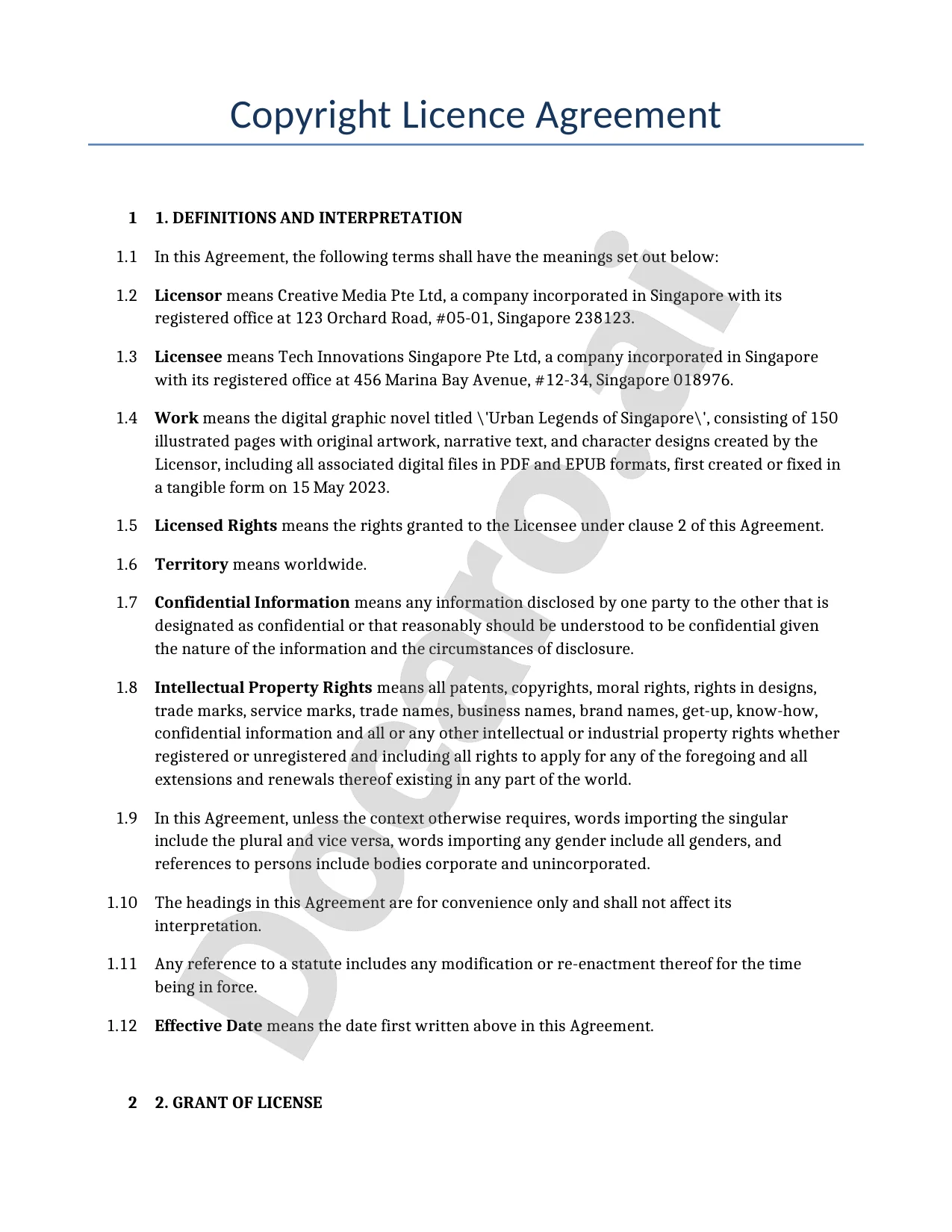
A copyright licence agreement under Singapore law is a legal contract that allows the copyright owner, known as the licensor, to grant specific permissions to another party, the licensee, to use their copyrighted work without transferring ownership. This agreement is essential in Singapore intellectual property law as it enables creators, businesses, and individuals to monetize their works while retaining control over how they are used, such as in music, software, or artistic content.
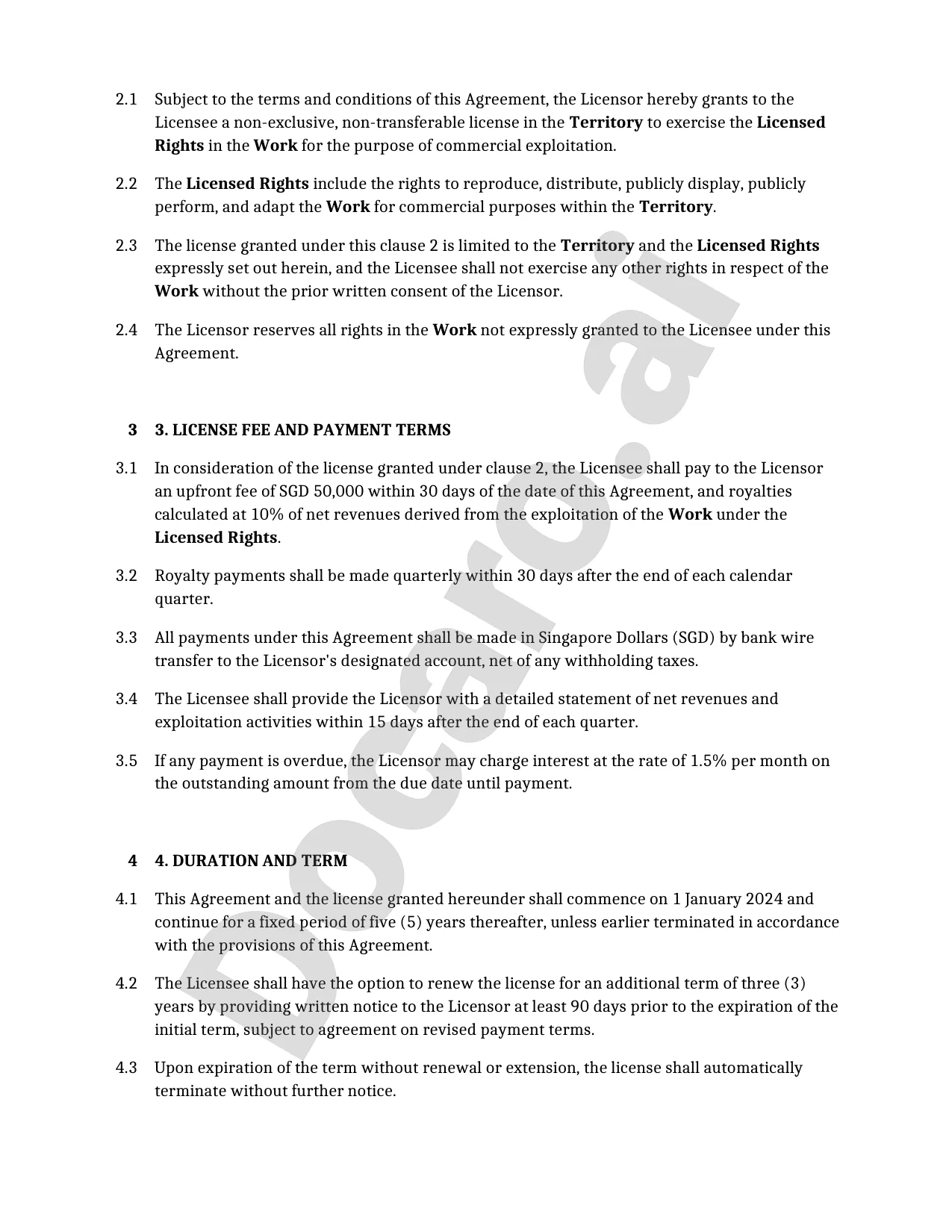
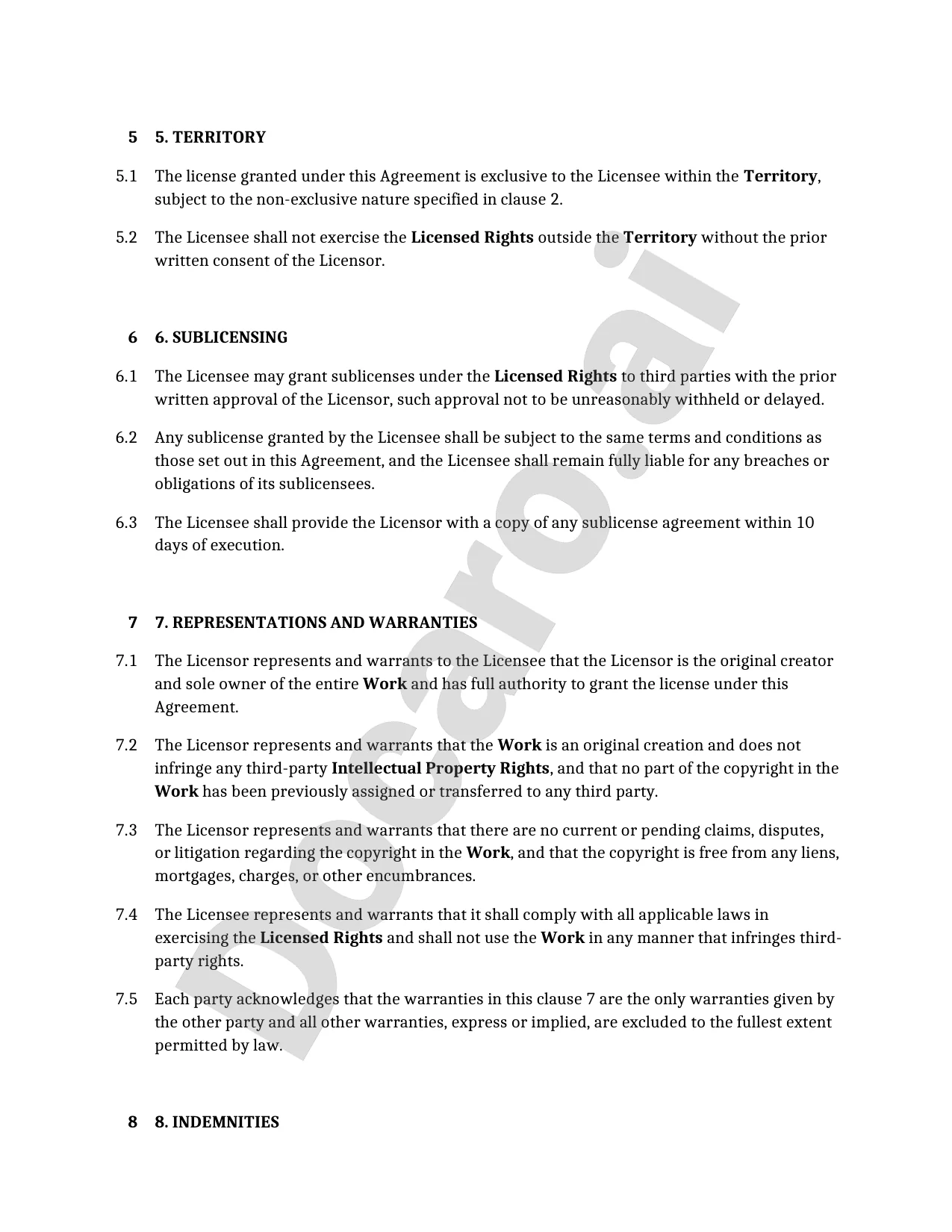
The primary purpose of a copyright licence agreement is to define the scope of usage rights, ensuring both parties understand the terms to avoid disputes. It protects the licensor's interests by specifying limitations like duration, territory (e.g., only in Singapore), and exclusivity, while providing the licensee with clear legal authority to exploit the work commercially or otherwise.
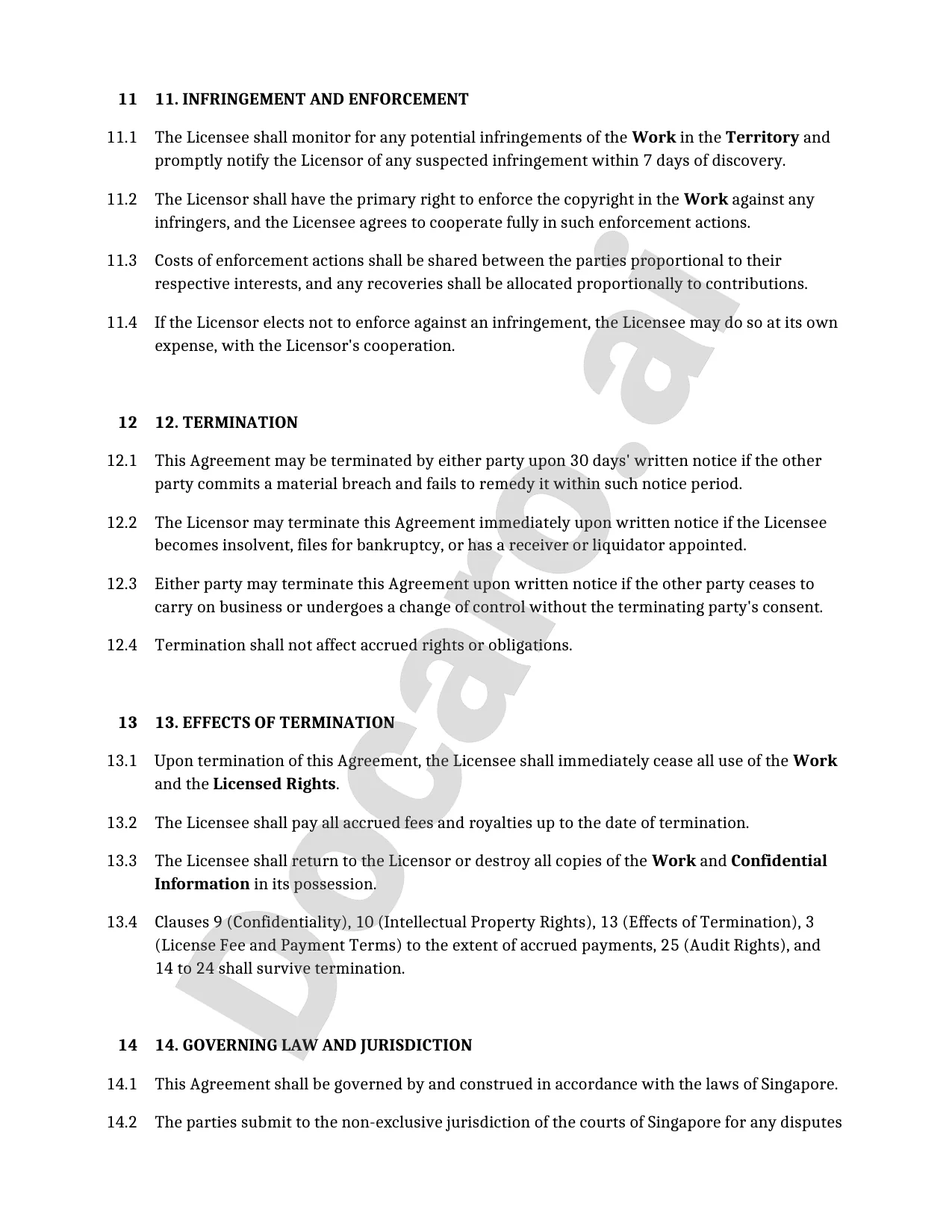
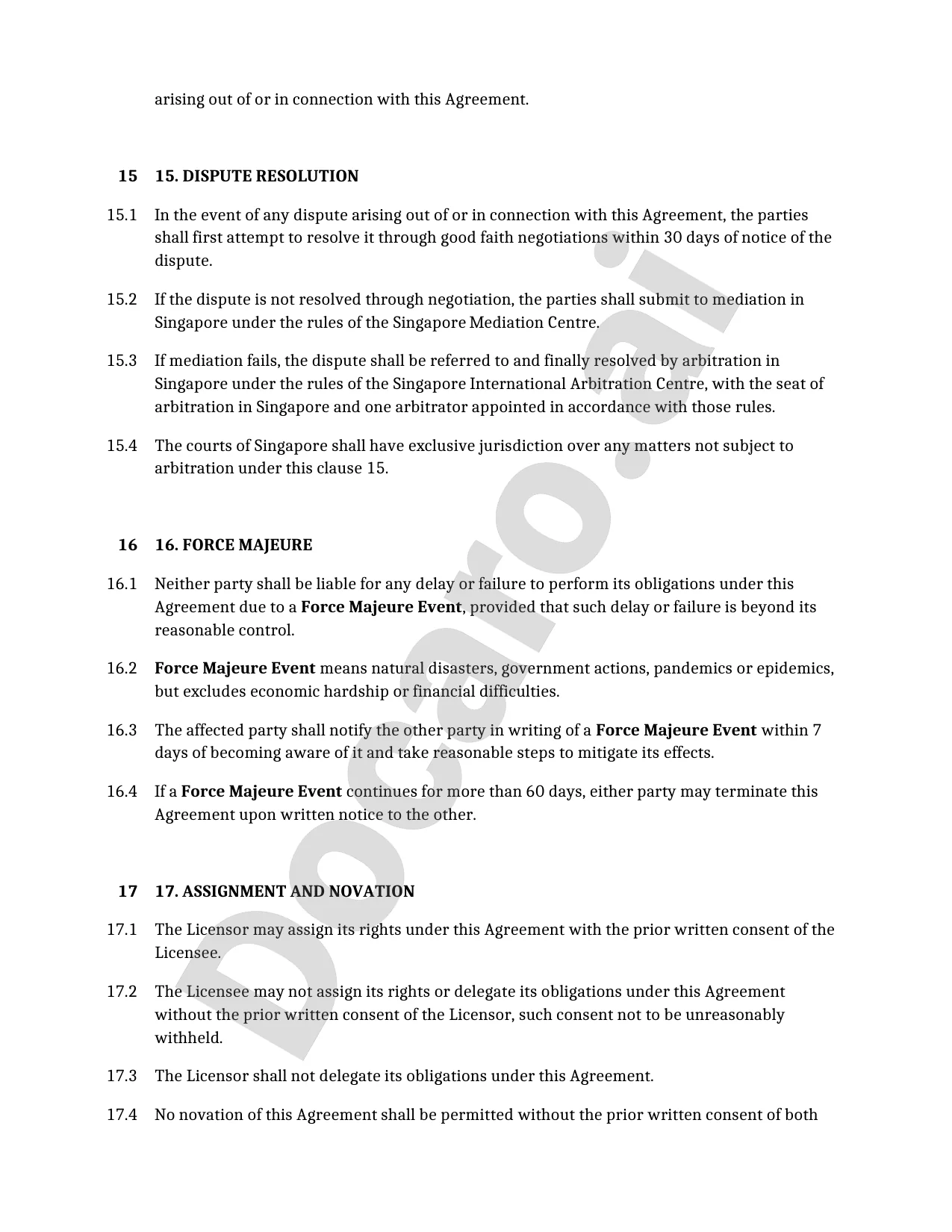
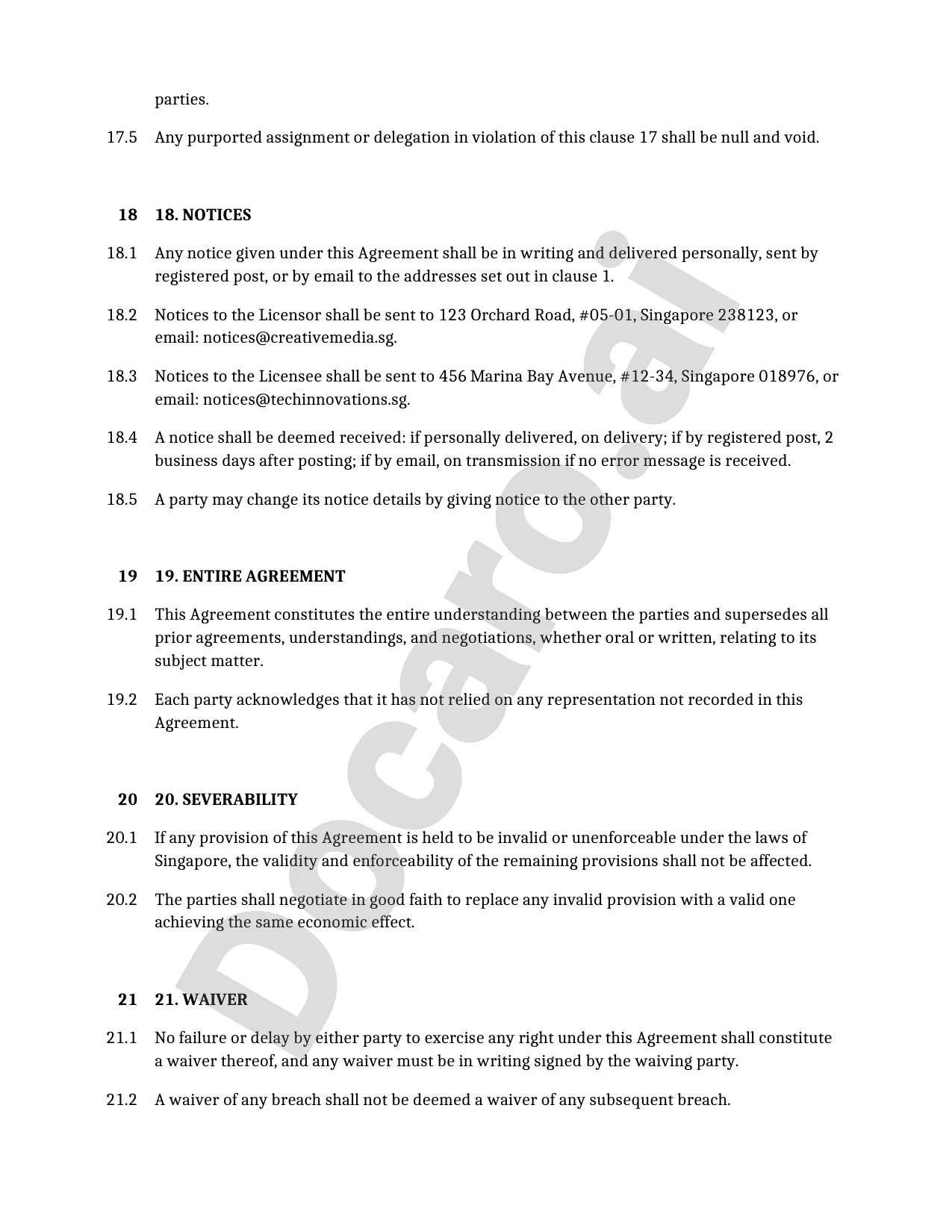
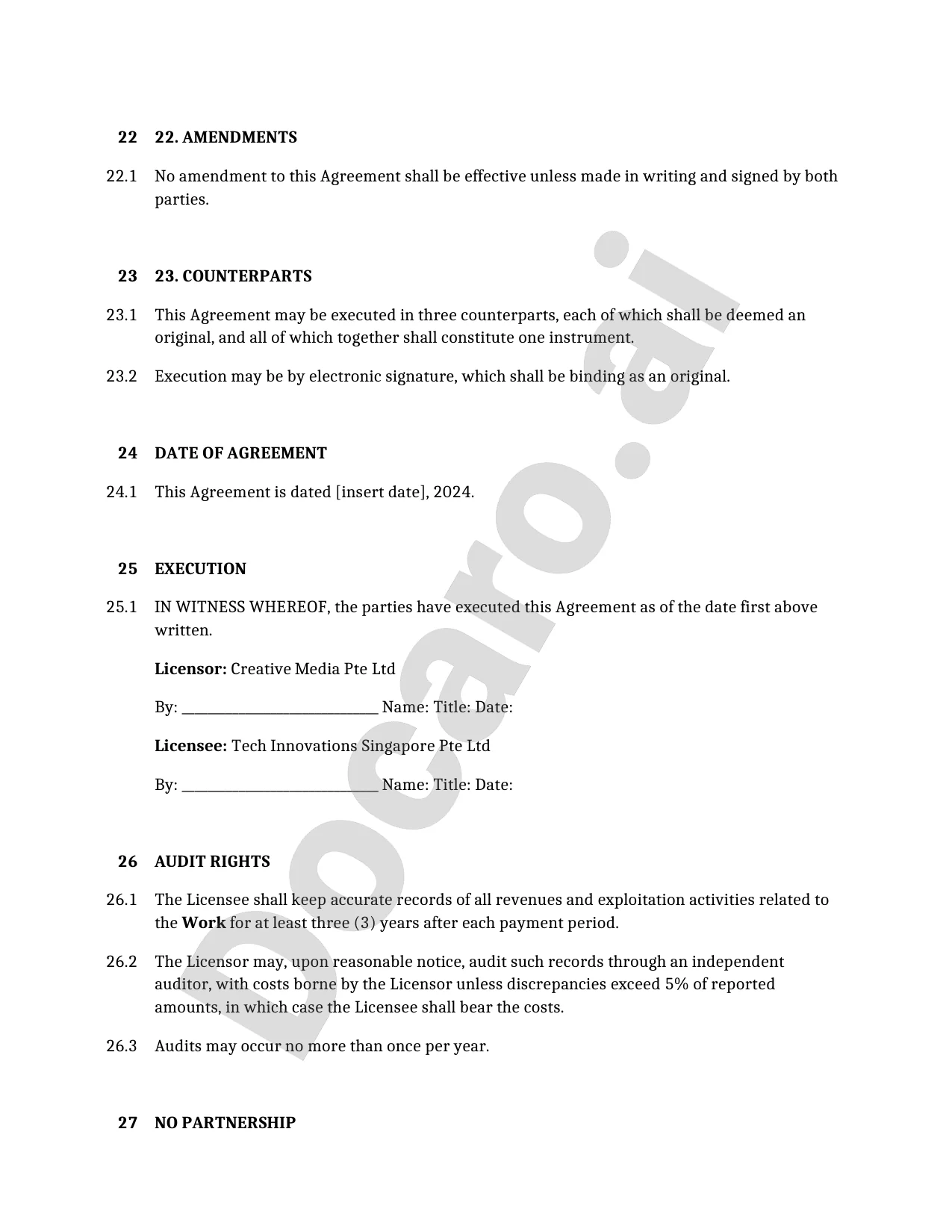
The basic structure of a copyright licence agreement in Singapore typically includes key sections such as the parties involved, a detailed description of the licensed work, the rights granted (e.g., reproduction or distribution), payment terms like royalties, duration and termination clauses, and warranties regarding ownership. Under the Copyright Act of Singapore, licences can be exclusive or non-exclusive, and it's advisable to have such agreements drafted as bespoke documents using tools like Docaro AI legal generator to tailor them to specific needs.
- Key elements: Identification of parties, work description, scope of rights, compensation, and dispute resolution.
- Customization tip: Ensure clauses address Singapore-specific requirements, like moral rights under the Copyright Act.
A copyright licence agreement differs fundamentally from a copyright assignment in Singapore law, where assignment involves the complete and permanent transfer of ownership rights to the assignee, leaving the original owner with no further control or claims over the work. In contrast, a licence is more flexible, acting as a temporary permission that can be revoked or limited, making it ideal for scenarios where the creator wishes to retain long-term ownership while allowing selective use.
"Copyright licences are essential to delineate the scope of permitted use, preventing unauthorized exploitation of intellectual property under Singapore's Copyright Act (Cap. 63)."
- Associate Professor Warren B. Chik, National University of Singapore Faculty of Law
To safeguard your rights effectively, commission bespoke AI-generated legal documents tailored to your needs via Docaro.
When Should You Use a Copyright Licence Agreement in Singapore?
In Singapore's vibrant digital economy, a copyright licence agreement is essential for businesses seeking to legally use software in commercial operations, such as integrating licensed code into proprietary applications without infringing intellectual property rights. This agreement outlines the scope of usage, royalties, and duration, ensuring compliance with local laws under the Copyright Act.
For the music industry, licensing creative works like songs or beats for commercials, films, or streaming platforms requires a tailored copyright licence agreement in Singapore to specify synchronization rights and revenue sharing. This protects both licensors and licensees from disputes over commercial use of music.
- Licensing visual arts or photographs for advertising campaigns, where the agreement defines exclusivity and territorial limits.
- Granting rights to use literary works in e-books or apps, emphasizing reproduction and distribution terms.
- Permitting educational institutions to reproduce copyrighted materials for training purposes under controlled conditions.
To navigate these complexities, explore Understanding Copyright Licence Agreements in Singapore: A Comprehensive Guide for in-depth insights. For robust protection, opt for bespoke AI-generated legal documents via Docaro instead of generic options.
When Should You Avoid Using One?
In Singapore copyright law, a licence agreement is inappropriate when full ownership transfer is required, as it only grants permission to use the work without transferring rights. Instead, use a copyright assignment to permanently transfer all intellectual property rights to the assignee, ensuring complete control and avoiding disputes over ongoing usage.
For works already in the public domain, such as those with expired copyrights or government-created materials, a licence agreement serves no purpose since no permissions are needed for use or distribution. Attempting to impose a licence on public domain works can lead to invalid restrictions, potentially confusing users and inviting legal challenges under Singapore's Copyright Act.
Misusing a copyright licence agreement in these scenarios risks unenforceability, where the agreement is deemed void, leading to loss of intended protections and possible litigation costs. To mitigate such risks, consult professionals and opt for bespoke AI-generated legal documents via Docaro tailored to Singapore's specific requirements, ensuring compliance and clarity.

What Are the Key Rights and Obligations in a Singapore Copyright Licence Agreement?
Singapore copyright law grants licensees specific usage rights under a license agreement, allowing them to reproduce, distribute, adapt, or publicly perform the copyrighted work as explicitly outlined in the contract. These rights are typically exclusive or non-exclusive, depending on the terms, ensuring the licensee can exploit the material for agreed purposes without infringing the licensor's ownership.
The obligations of the licensor include providing the licensed material in a suitable format, warranting that they hold valid copyright, and supporting the licensee against third-party claims. Meanwhile, the licensee's obligations encompass adhering to the scope of usage, not sublicensing without permission, and maintaining records for compliance audits.
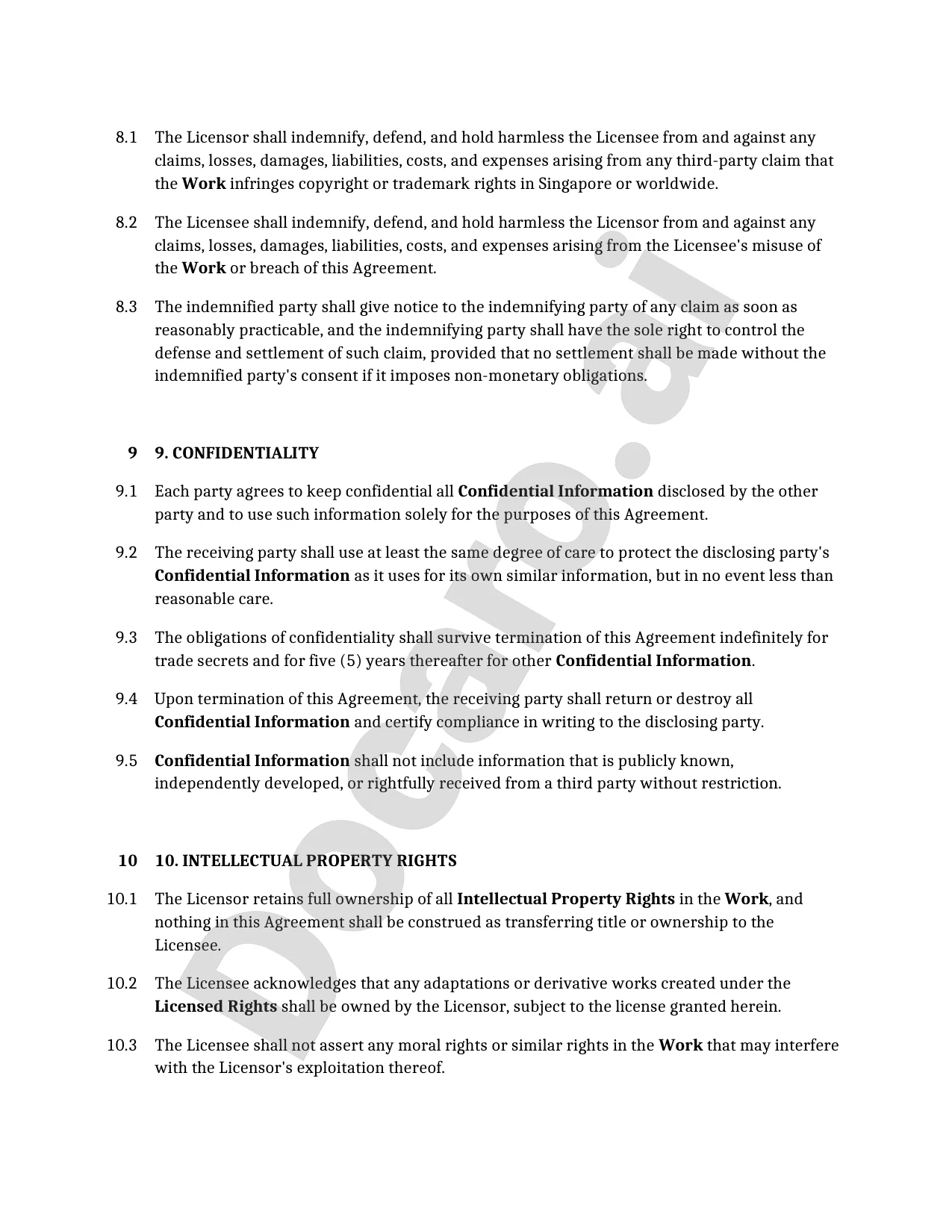
Payment terms in Singapore copyright licenses often involve upfront fees, royalties based on sales or usage, or milestone payments, all governed by clear schedules to avoid disputes. Confidentiality clauses require both parties to protect proprietary information, such as trade secrets in the work, with penalties for breaches to safeguard intellectual property.
For tailored AI generated legal documents under Singapore copyright law, consider bespoke solutions using Docaro to ensure precise alignment with your needs, rather than generic options.
1
Identify Key Rights
List the core intellectual property rights to be licensed, such as reproduction and distribution, under Singapore's Copyright Act.
2
Outline Obligations
Document specific duties like payment terms, quality controls, and confidentiality to ensure compliance with local laws.
3
Consult Legal Expert
Review identified rights and obligations with a Singapore-qualified lawyer to address any jurisdictional nuances.
4
Generate Bespoke Agreement
Use Docaro to create a customized copyright licence agreement incorporating the documented rights and obligations.
What Key Clauses Must Be Included in a Copyright Licence Agreement?
In a Singapore copyright licence agreement, the scope of licence clause defines the specific rights granted to the licensee, such as reproduction, distribution, or adaptation of the copyrighted work, ensuring clarity on permitted uses to avoid disputes.
The duration clause specifies the time period for which the licence is valid, whether it's perpetual, fixed-term, or renewable, which is crucial for aligning with the parties' business objectives under Singapore's copyright laws.
Royalties outline the payment structure, including rates, payment schedules, and audit rights, providing a fair compensation mechanism for the licensor while incentivizing the licensee's commercial exploitation.
For comprehensive guidance on these and other provisions, explore key clauses in a Singapore copyright licence agreement; always opt for bespoke AI-generated legal documents via Docaro to tailor agreements precisely to your needs, rather than relying on generic templates.
What Are Common Key Exclusions?
In copyright assignment agreements under Singapore's Copyright Act, moral rights are typically excluded from transfers. These non-economic rights, such as the right to be identified as the author or to object to derogatory treatment of the work, remain with the creator and cannot be assigned, ensuring personal integrity in creative works.
Provisions for derivative works often require explicit permission in such agreements, as Singapore law grants the copyright owner exclusive rights to adaptations. Excluding this can lead to disputes, making it essential to define scopes clearly to prevent unauthorized creations that infringe on the original copyright.
Sublicensing without permission is a common exclusion, limiting the assignee's ability to further license the work. Under the Copyright Act, sublicensing must align with the original terms to maintain control, protecting the licensor from unintended commercial exploitation.
For robust protection, consider bespoke AI-generated legal documents using Docaro legal tools, tailored to Singapore's Copyright Act for precise handling of these exclusions.
Are There Recent or Upcoming Legal Changes Affecting Copyright Licences in Singapore?
Singapore's Copyright Act saw significant updates through the Copyright (Amendment) Regulations 2025, effective from September 1, 2025, focusing on digital rights management and exceptions for access controls. These amendments, including the Copyright (Access Control Measures – Prescribed Exceptions) Regulations effective from March 1, 2025, refine rules on circumventing technological protection measures while aligning with international standards like the Berne Convention and Marrakesh Treaty.
The changes enhance computational data analysis exceptions under the Copyright Act 2021, allowing lawful use of copyrighted materials for AI and machine learning without distinguishing between commercial and non-commercial purposes, provided access is legitimate. This supports Singapore's role in global intellectual property treaties, promoting innovation in digital economies while protecting creators.
Regarding licence agreements, these amendments impact contracts by limiting enforceability of terms that restrict permitted exceptions, such as text and data mining, potentially invalidating overly broad prohibitions. Businesses drafting copyright licence agreements must now incorporate these exceptions, advocating for bespoke AI-generated legal documents using Docaro to ensure compliance and customization over generic templates.
Overall, these developments maintain the ongoing relevance of Singapore's copyright framework in the digital age, balancing digital rights with international obligations and fostering secure licence agreements for emerging technologies.
How Do You Draft and Implement a Copyright Licence Agreement in Singapore?
Drafting a copyright licence agreement for your business in Singapore begins with clearly defining the scope of rights granted, such as usage permissions and duration, while incorporating professional advice from legal experts to ensure compliance with the Copyright Act.
Seek guidance from a qualified lawyer experienced in Intellectual Property law to tailor the agreement to your specific needs, avoiding generic templates and opting for bespoke AI-generated legal documents via Docaro for precision and efficiency.
Execution involves reviewing the draft with all parties, making necessary revisions based on professional input, and then signing the document electronically or in person, followed by proper storage to protect your business interests.
For detailed steps on this process, explore our guide on How to Draft a Copyright Licence Agreement for Your Business in Singapore.
1
Draft the Agreement
Use Docaro to generate a bespoke copyright licence agreement tailored to your specific business needs and Singaporean legal requirements.
2
Review for Compliance
Consult a qualified Singapore lawyer to review the AI-generated document for accuracy, enforceability, and alignment with local copyright laws.
3
Negotiate and Finalize
Discuss terms with the other party, make necessary adjustments using Docaro, and obtain signatures to execute the agreement.
4
Implement and Monitor
Integrate the licensed content into your operations and regularly monitor compliance to ensure ongoing adherence to the agreement terms.