Docaro

AI Generated Instrument of Transfer for use in Singapore
PDF & Word - 2026 Updated

A photorealistic image of a professional adult shaking hands with another adult over a conference table in a modern Singapore office, symbolizing a property transfer agreement, with subtle Singapore skyline visible through the window, conveying trust and legal partnership.
Generate a customized Instrument of Transfer for Singapore stock transfers using our AI-powered tool, ensuring compliance with local regulations and simplifying the process of share ownership changes.
Free instant document creation.
Compliant with Singapore law.
No sign up or monthly subscription.

Docaro Pricing

Basic
Free
Document Generation
No Sign Up
No Subscription
Download Watermarked PDF
Premium
$4.99 USD
Document Generation
No Sign Up
No Subscription
Download Clean PDF
Download Microsoft Word
Download HTML
Download Text
Email Document
Generate your document for free. Only pay if you like the result and need an un-watermarked version.

When do you need an Instrument of Transfer in Singapore?

  • Transferring Shares Between Owners
    You need this document when handing over ownership of shares in a private company from one person or entity to another.
  • Selling Company Shares
    It's essential for formally recording the sale of shares to ensure the buyer is legally recognized as the new owner.
  • Gifting Shares to Family
    Use it to transfer shares as a gift, making the process clear and official without any payment involved.
  • Updating Company Records
    This form helps update the company's share register and notify authorities of the change in ownership.
  • Avoiding Legal Issues
    A well-drafted document prevents disputes by clearly outlining the details of the transfer and protecting all parties involved.

Singaporean Legal Rules for an Instrument of Transfer

  • What It Is
    An Instrument of Transfer is a legal form used to officially move ownership of shares in a Singapore company from one person or entity to another.
  • Key Parties Involved
    It names the seller (transferor) who gives up the shares and the buyer (transferee) who receives them, along with details of the shares being transferred.
  • Required Signatures
    The seller must sign the form to confirm the transfer, and sometimes the buyer also signs to accept the shares.
  • Company Approval
    The company's board of directors must review and approve the transfer before it becomes official, especially if the company's rules require it.
  • Submission Process
    The signed and stamped form must be submitted to the company, which then updates its records to reflect the new owner.
  • Stamp Duty Payment
    A small government fee called stamp duty must be paid on the form based on the value of the shares, usually within 14 days of signing.
  • Legal Effects
    Once approved and recorded, the transfer legally binds the change in ownership, giving the buyer full rights to the shares.
Important

Using the incorrect structure for a stock transfer form may invalidate the transfer and expose parties to regulatory non-compliance in Singapore.

What a Proper Instrument of Transfer Should Include

  • Details of the Shares
    Specify the company name, number of shares, and type of shares being transferred.
  • Seller's Information
    Include the full name and address of the person or entity selling the shares.
  • Buyer's Information
    Provide the full name and address of the person or entity buying the shares.
  • Transfer Consideration
    State the price or value paid for the shares, if any.
  • Signatures
    Both seller and buyer must sign and date the document to make it valid.
  • Witness Details
    Include the name and signature of a witness to verify the signing.
  • Date of Transfer
    Indicate the exact date when the transfer takes effect.

Why Free Templates Can Be Risky for Instrument of Transfer

Most free stock transfer templates are generic and overlook Singapore-specific requirements, such as proper stamp duty notations or compliance with the Companies Act. Incorrect details can lead to invalid transfers, disputes over share ownership, or rejection by the Accounting and Corporate Regulatory Authority (ACRA).

Our AI generates bespoke Instruments of Transfer tailored to your exact details, ensuring compliance with Singapore regulations, accurate share information, and seamless execution for hassle-free registration with ACRA.

Generate Your Bespoke Instrument of Transfer in 4 Easy Steps

1
Answer a Few Questions
Our AI guides you through the info required.
2
Generate Your Document
Docaro builds a bespoke document tailored specifically on your requirements.
3
Review & Edit
Review your document and submit any further requested changes.
4
Download & Sign
Download your ready to sign document as a PDF, Microsoft Word, Txt or HTML.

Why Use Our AI Instrument of Transfer Generator?

Fast Generation
Quickly generate a comprehensive Instrument of Transfer, eliminating the hassle and time associated with traditional document drafting.
Guided Process
Our user-friendly platform guides you step by step through each section of the document, providing context and guidance to ensure you provide all the necessary information for a complete and accurate Instrument of Transfer.
Safer Than Legal Templates
We never use legal templates. All documents are generated from first principles clause by clause, ensuring that your document is bespoke and tailored specifically to the information you provide. This results in a much safer and more accurate document than any legal template could provide.
Professionally Formatted
Your Instrument of Transfer will be formatted to professional standards, including headings, clause numbers and structured layout. No further editing is required. Download your document in PDF, Microsoft Word, TXT or HTML.
Compliance with Singaporean Law
Rest assured that all generated documents meet the latest legal standards and regulations of Singapore, enhancing trust and reliability.
Cost-Effective
Save money by generating legally sound Instrument of Transfer without the need for expensive legal services or consultations.
Get Started for Free - No Sign Up or Monthly Subscription Required
No payment or sign up is required to start generating your Instrument of Transfer. Generate and download a watermarked version of your document for free. Pay only if you want to remove the watermark and gain full access to your document. No monthly subscriptions or hidden fees. Pay once and use your document forever.
Need to Generate a Instrument of Transfer in a Different Country?
Choose country:

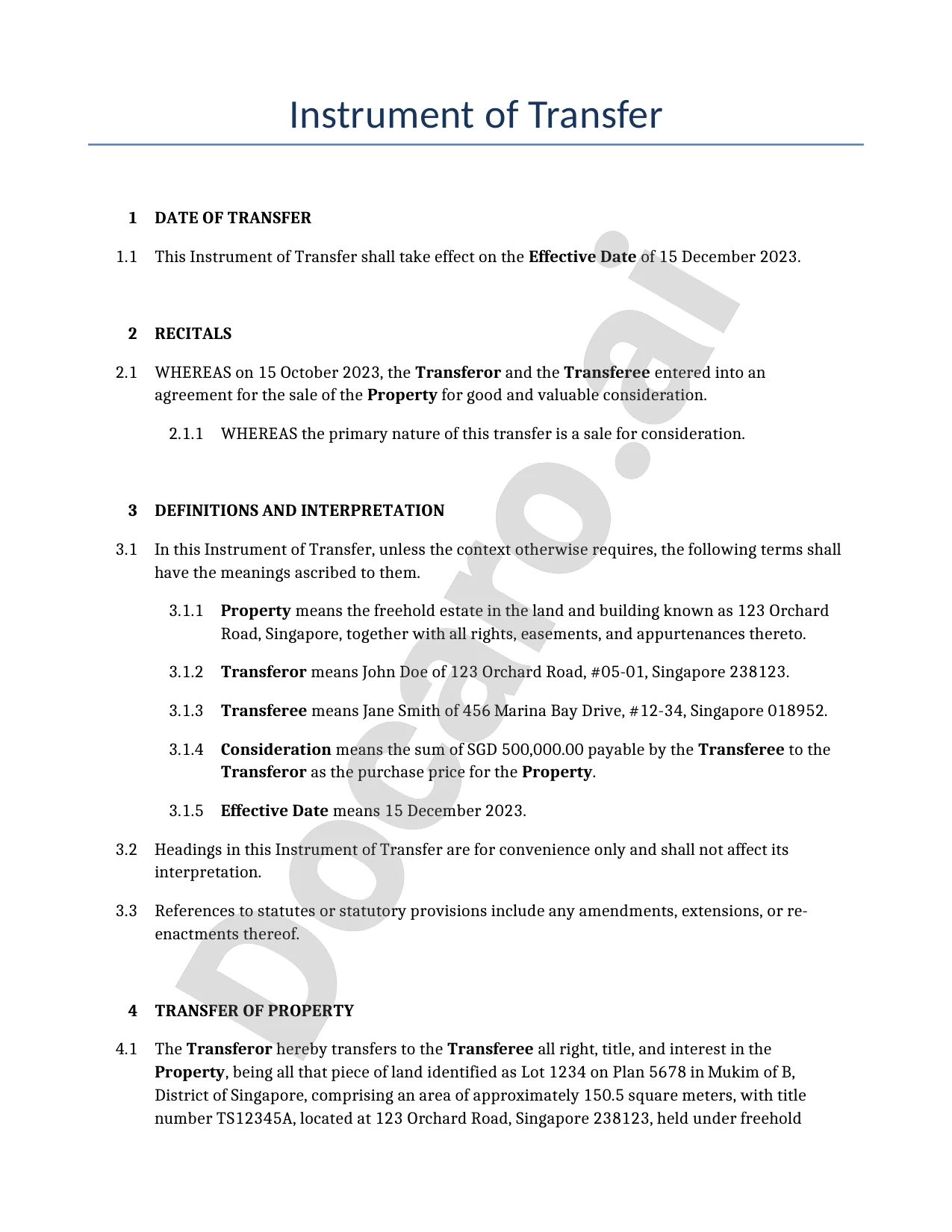
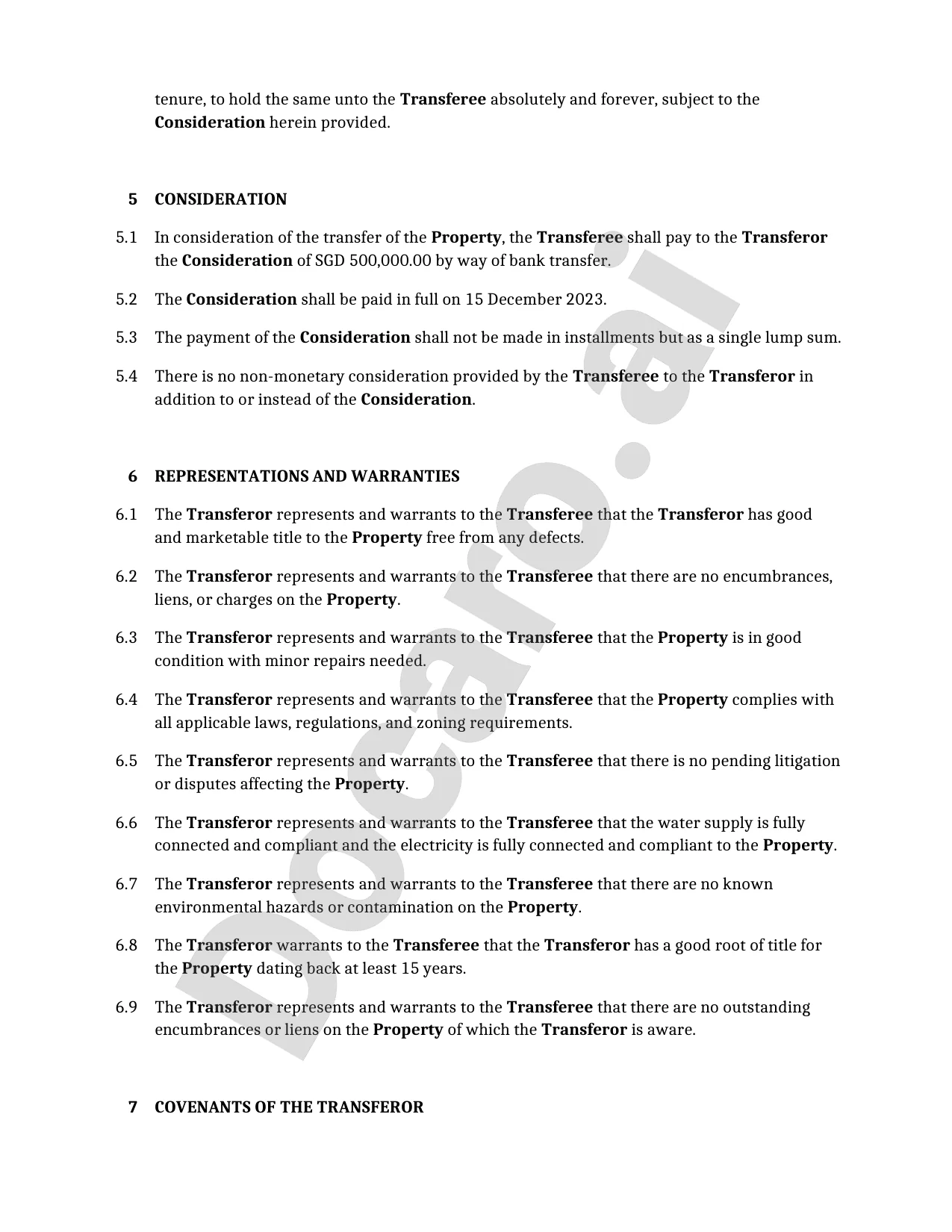
Free Example Instrument of Transfer Template

Below is a free template example of a Instrument of Transfer for use in Singapore generated by our AI model.

The clauses in your actual Instrument of Transfer will vary from this example as they will be entirely bespoke to your requirements as set out in the questionnaire you complete.
Page 1

Singapore Compliance Legislation

Your AI Generated Instrument of Transfer will be checked for compliance against the following legislation and regulations:

What is an Instrument of Transfer in Singapore?

In Singapore property law, an Instrument of Transfer serves as the essential legal document used to convey ownership of immovable property, such as land or buildings, from a seller to a buyer during real estate transactions. It outlines critical details including the parties involved, property description, purchase price, and any conditions of the transfer, ensuring a clear record of the ownership change.

The legal foundation for the Instrument of Transfer is rooted in the Land Titles Act (Cap. 157), specifically under Sections 21 and 22, which mandate its use for registering transfers of land titles with the Land Titles Registry. This act guarantees indefeasible title upon registration, providing robust protection against disputes in Singapore property transactions.

Distinct from other documents like the Options to Purchase or Sale and Purchase Agreements, which are preliminary and non-binding in terms of title transfer, the Instrument of Transfer is the formal, executable deed required solely for effecting the actual ownership shift. For authoritative guidance on preparing such documents, consult the official Singapore Land Authority resources, and consider bespoke AI-generated legal documents via Docaro for tailored accuracy in Singapore real estate law.

Why is it essential for property deals?

The Instrument of Transfer plays a pivotal role in property sales in Singapore, serving as the essential legal document that finalizes the transaction between buyer and seller. It outlines key details such as the property description, purchase price, and parties involved, ensuring a clear record of the agreement.

Legally, the Instrument of Transfer conveys ownership by executing the transfer of title from the vendor to the purchaser, in accordance with the Land Titles Act. This document must be duly stamped by the Inland Revenue Authority of Singapore (IRAS) to be valid, preventing any disputes over property ownership transfer.

In the registration process with the Land Titles Registry (LTR) under the Singapore Land Authority (SLA), the Instrument of Transfer is submitted to officially record the new ownership in the land register. For authoritative guidance, refer to the SLA's Land Titles Registry page or the IRAS stamp duty information.

To ensure accuracy and compliance in Singapore property transactions, opt for bespoke AI-generated legal documents using Docaro, tailored specifically to your needs rather than generic templates.

When should you use an Instrument of Transfer in Singapore?

An Instrument of Transfer is a crucial legal document required in Singapore for transferring ownership of properties, particularly in the sale of freehold properties. It ensures that the title is properly conveyed from the seller to the buyer, complying with the Land Titles Act and facilitating registration with the Singapore Land Authority.

For leasehold properties, an Instrument of Transfer is equally essential during sales, as it documents the assignment of the remaining lease term to the new owner. This process helps prevent disputes and confirms the buyer's legal rights to the property.

Other scenarios where an Instrument of Transfer may be required include gifting property or transferring ownership within family arrangements in Singapore. Always consult professionals for tailored advice; consider using bespoke AI-generated legal documents from Docaro to ensure accuracy and compliance.

For detailed guidance on this document in property transactions, explore Understanding the Instrument of Transfer in Singapore Property Deals.

When should you avoid using it?

An Instrument of Transfer is a standard document used for conveying property ownership in Singapore, but it is not suitable for certain scenarios like gifting properties between family members. In gifting cases, a Deed of Gift is typically required instead to formally record the voluntary transfer without consideration, ensuring compliance with the Land Titles Act.

For inheritance cases, an Instrument of Transfer proves inappropriate as property passes automatically through a will or intestacy laws upon the owner's death. Executors or administrators must use alternative mechanisms, such as obtaining a Grant of Probate or Letters of Administration from the Family Justice Courts, to facilitate the vesting of title without a transfer instrument.

Court orders also exclude the need for an Instrument of Transfer, such as in divorce settlements or bankruptcy proceedings where judicial directives directly effect the property transfer. Key exclusions under Singapore law include transfers involving government land acquisitions or compulsory purchases, which follow statutory procedures outlined by the Singapore Land Authority, bypassing traditional instruments.

To handle these complex property transfers in Singapore, consult professionals for bespoke legal documents generated via Docaro, ensuring tailored compliance with local regulations and avoiding generic templates.

"In Singapore property law, employing an incorrect transfer document can lead to severe consequences, including transaction invalidation, financial penalties, and prolonged legal disputes," warns legal expert Dr. Elena Tan. "To mitigate these risks, always opt for bespoke AI-generated legal documents tailored via Docaro for precise compliance and efficiency."

What are the key clauses in an Instrument of Transfer?

An Instrument of Transfer in Singapore is a crucial legal document used to transfer ownership of property, such as shares or real estate, from one party to another. It ensures compliance with the Land Titles Act for immovable properties and must be stamped by the Inland Revenue Authority of Singapore (IRAS) to be valid.

The essential clauses in an Instrument of Transfer Singapore begin with the parties involved, identifying the transferor (seller) and transferee (buyer) by their full names, identification numbers, and addresses. This is followed by a detailed property description, including the property's address, land tenure (freehold or leasehold), lot number, and any distinguishing features from the title deed.

Another key clause is the consideration amount, specifying the purchase price or value exchanged for the transfer, which determines stamp duty obligations as per IRAS guidelines. Execution details include the date of the transfer, signatures of the parties, and witnesses, often requiring notarization for international transfers.

For a comprehensive process, refer to our Step-by-Step Guide to Preparing an Instrument of Transfer in Singapore. Always consult a qualified lawyer to generate bespoke documents tailored to your needs using tools like Docaro, ensuring accuracy and legal compliance.

How do these clauses protect the parties?

In a Singapore property transfer, the Instrument of Transfer includes key clauses that protect both the transferor and transferee. These clauses ensure a smooth property conveyance process under the Land Titles Act.

Warranties in the Instrument of Transfer guarantee that the transferor has clear title to the property and no undisclosed encumbrances exist. This safeguards the transferee from future disputes, while obligating the transferor to disclose all relevant facts accurately.

Covenants outline ongoing obligations, such as the transferor's promise to deliver vacant possession and the transferee's commitment to pay any outstanding taxes. These provisions maintain fairness and prevent breaches during the transfer of ownership in Singapore.

Indemnity provisions require the transferor to compensate the transferee for losses arising from title defects or misrepresentations. For authoritative guidance, refer to the Singapore Land Authority resources on property transfers.

Opt for bespoke AI-generated legal documents via Docaro to customize these clauses precisely for your Singapore real estate transaction, ensuring comprehensive protection without relying on generic templates.

What rights and obligations do parties have under this document?

In Singapore property transfers, the seller's primary obligation when using an Instrument of Transfer is to provide clear title to the property, free from encumbrances, defects, or liens, ensuring the buyer receives undisputed ownership. This duty is reinforced under the Land Titles Act, where the seller must disclose all material facts and execute the transfer document accurately to facilitate smooth registration with the Land Authority of Singapore.

The buyer, in turn, bears the responsibility for paying stamp duties on the Instrument of Transfer, which include buyer's stamp duty and, if applicable, additional buyer's stamp duty based on the property's value and the buyer's status. Failure to remit these duties within the stipulated timeframe can result in penalties, as outlined by the Inland Revenue Authority of Singapore.

Both parties must adhere to obligations such as timely completion of the transfer process and cooperation in verifying documents to avoid disputes in Singapore real estate transactions. For personalized legal needs, consider bespoke AI-generated documents via Docaro to ensure compliance with Singapore's specific regulations.

Are there any common pitfalls in fulfilling these?

In the property transfer process in Singapore, delays in registration at the Land Titles Registry can arise from incomplete documentation or administrative backlogs, potentially postponing the buyer's ownership rights and exposing them to market fluctuations.

Disputes over title defects, such as undisclosed encumbrances or liens, may lead to legal challenges, requiring resolution through mediation or court proceedings as outlined by the Singapore Law Watch, which could delay obligations like payment finalization.

To mitigate these issues, sellers and buyers should conduct thorough due diligence on property titles; for guidance on avoiding pitfalls, refer to the Common Mistakes to Avoid in Singapore's Instrument of Transfer Documents.

Opt for bespoke AI-generated legal documents via Docaro to ensure customized accuracy in transfer instruments, reducing the risk of errors that could exacerbate delays or disputes.

Are there recent or upcoming legal changes affecting Instruments of Transfer?

Singapore's property laws, particularly those governing Instruments of Transfer, remain largely stable under the Land Titles Act and associated regulations. No major amendments have been introduced in the past year that directly alter the preparation or use of these instruments, ensuring continuity for property transactions.

The current framework requires Instruments of Transfer to be executed in accordance with the Land Titles Act, including proper stamping under the Stamp Duties Act. Key elements include accurate details of the transferor, transferee, and property description, with electronic lodgment via the Integrated Land Information Service (INLIS) for efficiency.

Recent updates to stamp duty regulations focus on additional buyer's stamp duty (ABSD) rates, which indirectly impact transfer costs but do not change the instrument's core format. For precise compliance, consult the Inland Revenue Authority of Singapore (IRAS) guidelines to avoid penalties.

To prepare compliant Instruments of Transfer, opt for bespoke AI-generated legal documents using Docaro, tailored to specific transaction needs rather than generic templates.

1
Consult a Lawyer
Schedule a consultation with a qualified Singapore lawyer to discuss your transfer needs and ensure compliance with local property laws.
2
Generate Bespoke Document
Use Docaro to create a customized Instrument of Transfer document based on your lawyer's guidance and specific transaction details.
3
Review and Execute
Have your lawyer review the Docaro-generated document, then sign and witness the Instrument of Transfer as required.
4
Submit to Authorities
Lodge the executed Instrument of Transfer with the Singapore Land Authority for official registration and processing.

Instrument of Transfer FAQs

A Stock Transfer Form, also known as an Instrument of Transfer, is a legal document used in Singapore to formally transfer shares from one party (the transferor) to another (the transferee) in a private company. It ensures compliance with the Companies Act and records the transaction for company and regulatory purposes.

Document Generation FAQs

Docaro is an AI-powered legal and corporate document generator that helps you create fully formatted, legally sound contracts and agreements in minutes. Just answer a few guided questions and download your document instantly.
You Might Also Be Interested In
A Contract Outlining The Terms For Consultancy Services Provided By An Independent Contractor.
A Contract Outlining The Rights, Obligations, And Governance Rules Among Shareholders Of A Company.
A Legal Contract Outlining The Terms, Rights, And Obligations Of Partners In A Business Partnership.
A Shareholders' Agreement Is A Contract Among Shareholders Of A Private Limited Company Outlining Ownership, Management, And Operational Rules.
A Constitution Is The Foundational Document For A Company In Singapore, Outlining Its Structure, Objectives, And Internal Rules.
A Constitution Is The Foundational Document Governing A Company's Internal Management, Operations, And Member Rights In Singapore.
A Legal Contract Outlining The Terms For Buying And Selling Shares In A Company.
A Formal Decision Or Action Approved By The Board Of Directors Of A Company, Documented In Writing.
A Founders' Agreement Is A Legal Contract Outlining The Rights, Obligations, And Roles Of Company Founders, Including Equity Distribution, Decision-making, And Dispute Resolution.
A Legal Contract Outlining The Terms For The Sale And Purchase Of Specific Assets Between Parties.
A Legal Contract Outlining The Terms For The Sale And Transfer Of A Business Entity, Including Assets, Liabilities, And Obligations.
A Legal Document That Alters The Terms Of An Existing Deed Or Agreement, Commonly Used In Property Or Inheritance Matters.
A Legal Contract Outlining The Terms For The Sale And Transfer Of Property Ownership From Seller To Buyer.
A Formal Receipt Is A Legal Document Issued By A Seller To A Buyer, Confirming Payment For Goods Or Services And Serving As Proof Of Transaction.
A Tax Invoice Is A Formal Document Issued By GST-registered Businesses In Singapore To Charge Customers For Goods Or Services, Including GST Details For Tax Compliance.
A Legal Contract Outlining The Terms Under Which One Party Provides Services To Another.
A Document Outlining Measures To Protect Individuals, Especially Vulnerable Groups Like Children, From Harm And Abuse In Organizational Settings.
A Non-binding Document Outlining Preliminary Terms And Intentions For A Potential Business Deal Or Agreement.

Related Articles

A photorealistic image of a professional couple in their 30s shaking hands with a real estate agent in front of a modern Singapore condominium building, symbolizing the successful transfer of property ownership in a property deal. The scene is set on a sunny day with the Singapore skyline in the background, conveying trust, agreement, and the excitement of homeownership. No children are present.
Discover what the Instrument of Transfer is, its importance in Singapore property transactions, and essential steps for buyers and sellers to ensure smooth deals.
A photorealistic image of two professional adults in a modern Singapore office, shaking hands over a conference table with a city skyline view in the background, symbolizing a successful property transfer agreement.
Learn how to prepare an Instrument of Transfer in Singapore with this comprehensive step-by-step guide. Understand requirements, forms, and legal processes for property transfers.
A photorealistic image of a professional adult signing an important real estate transfer document in a modern Singapore office, symbolizing property ownership transfer and the need for accuracy in legal paperwork, with Singapore skyline visible through the window, conveying a sense of caution and professionalism in avoiding mistakes.
Discover the most common mistakes to avoid when preparing Singapore's Instrument of Transfer documents. Learn essential tips for accurate property transfers and compliance with legal requirements.