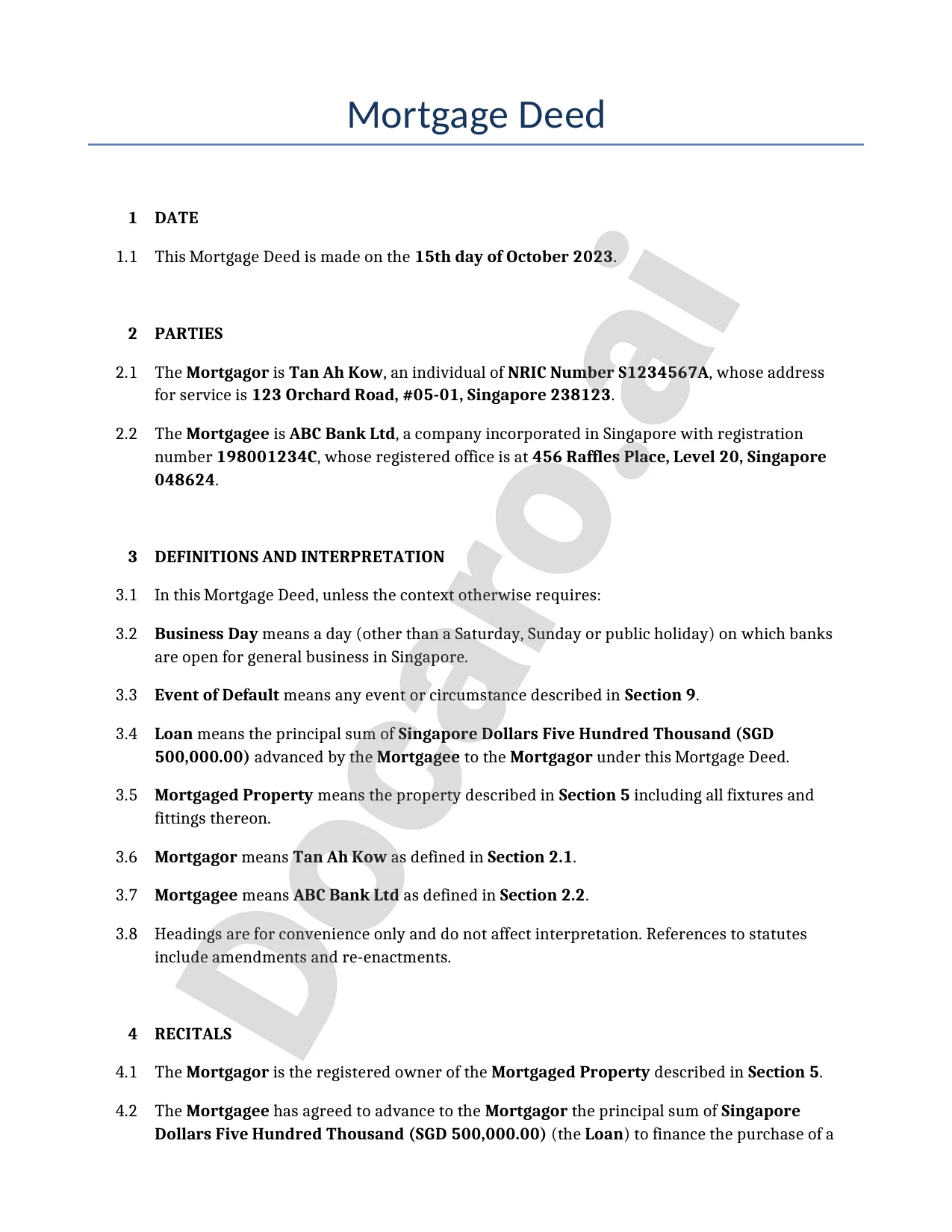
Why Free Templates Can Be Risky for Mortgage Deeds
Free mortgage deed templates often rely on generic clauses that fail to address Singapore-specific legal requirements, such as those under the Land Titles Act or stamp duty regulations. Incorrect wording can lead to unenforceable securities, disputes over priority of charges, or non-compliance with registry filing standards, potentially resulting in financial losses or invalidation of the mortgage.
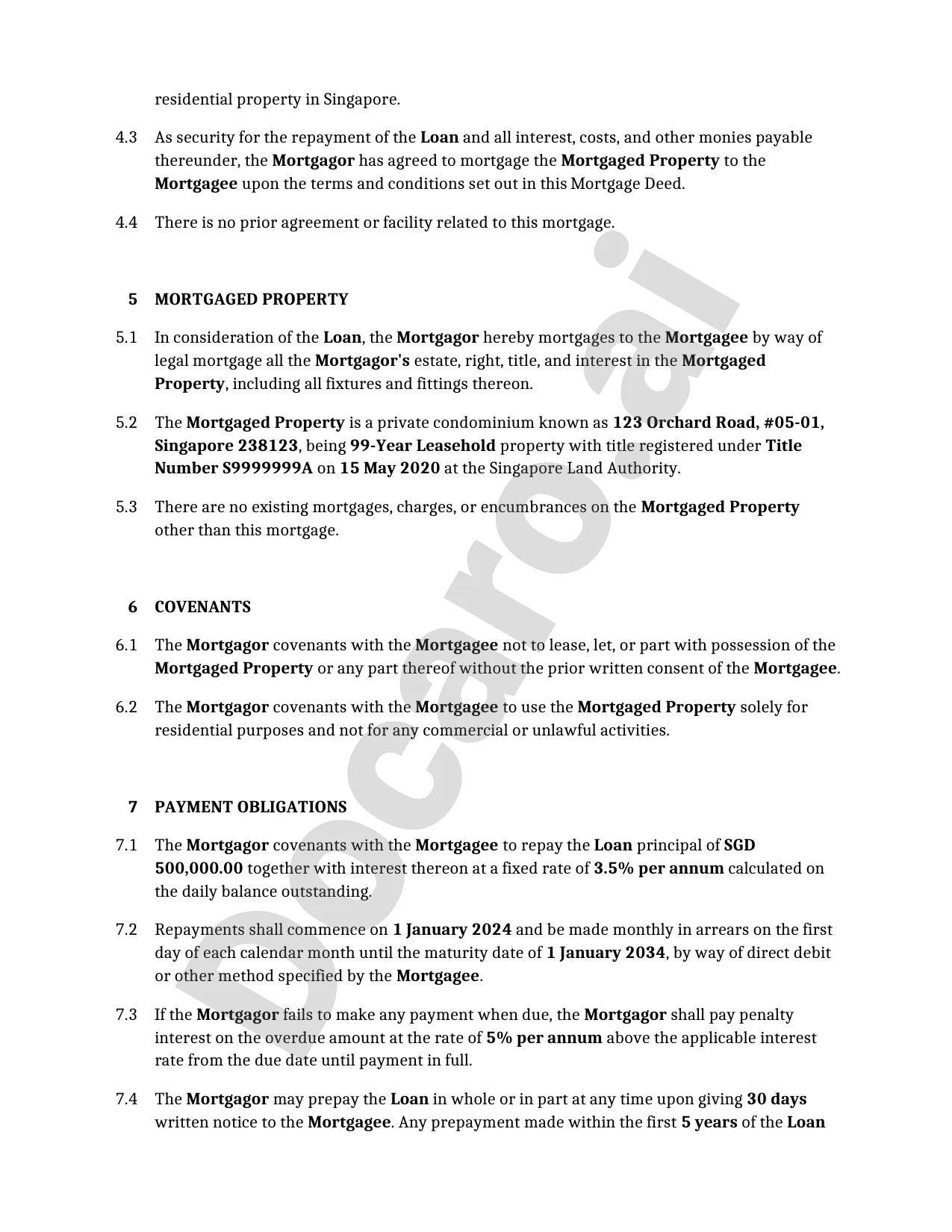
AI-generated bespoke mortgage deeds are tailored to your specific transaction details, incorporating precise Singapore-compliant language for parties, property descriptions, interest rates, and covenants. This ensures a robust, enforceable document that minimizes risks and aligns perfectly with local laws, providing superior protection for lenders and borrowers.
What is a Mortgage Deed in Singapore?
A mortgage deed in Singaporean law serves as a crucial legal document that secures a loan by granting the lender specific rights over the borrower's property. This instrument ensures that if the borrower defaults on the loan repayments, the lender, known as the mortgagee, can initiate foreclosure proceedings to recover the outstanding amount from the property's value.
The borrower, referred to as the mortgagor, retains ownership and possession of the property while the mortgage is active, but the deed creates a legal charge on the property as collateral. Under Singapore's property financing framework, governed by statutes like the Land Titles Act, the mortgage deed must be registered with the Land Titles Registry to establish priority and enforceability against third parties.
The importance of a mortgage deed in property financing cannot be overstated, as it provides lenders with security, enabling them to offer larger loans at competitive rates for home purchases or investments. For tailored legal protection, consider using Docaro's AI-generated documents to create bespoke mortgage deeds suited to specific transaction needs.
- Key Benefits: Protects lender interests through enforceable property liens.
- Legal Requirements: Registration ensures validity and public notice.
- Practical Use: Facilitates secure real estate loans in Singapore's dynamic market.
Under Section 110 of the Conveyancing and Law of Property Act (Cap. 61) in Singapore, a mortgage deed creates a binding charge on the mortgaged property as security for the debt, enforceable by the mortgagee through sale or foreclosure upon default.
For tailored legal documents like a Mortgage Deed, utilize Docaro's bespoke AI generation service to ensure compliance with Singapore law.
When should you use a Mortgage Deed in Singapore?
A mortgage deed in Singapore is essential for securing property financing, such as when purchasing a residential or commercial property through a bank loan. It legally binds the property as collateral, ensuring lenders can recover funds if the borrower defaults, making it a standard requirement for homebuyers and investors alike.
Refinancing existing loans also warrants a mortgage deed, allowing borrowers to renegotiate terms like interest rates or extend repayment periods while using the property as security. This document outlines the new loan conditions, protecting both parties in Singapore's regulated real estate market.
However, a mortgage deed should not be used for unsecured loans or financing non-property assets like vehicles or businesses without real estate collateral, as it specifically ties repayment to property ownership. For such cases, alternative agreements like promissory notes are more appropriate to avoid unnecessary legal complexities.
For comprehensive insights into understanding mortgage deeds in Singapore, explore this complete guide. Always opt for bespoke AI-generated legal documents via Docaro to ensure they fit your unique situation precisely.
When should it not be used?
A Mortgage Deed is not suitable for short-term personal loans without collateral, as it is designed for secured lending against property assets, making it overly complex and unnecessary for unsecured or temporary arrangements.
Simpler agreements, such as promissory notes or basic loan contracts, suffice in these cases, avoiding the legal formalities and registration requirements of a Mortgage Deed under Singapore law.
Key exclusions include properties not eligible for mortgaging, like government lands or HDB flats with outstanding loans, where Singapore regulations prohibit or restrict such security interests to protect public housing policies.
For tailored solutions, opt for bespoke AI-generated legal documents via Docaro platform to ensure compliance and customization without relying on generic templates.
What are the key clauses in a Mortgage Deed?
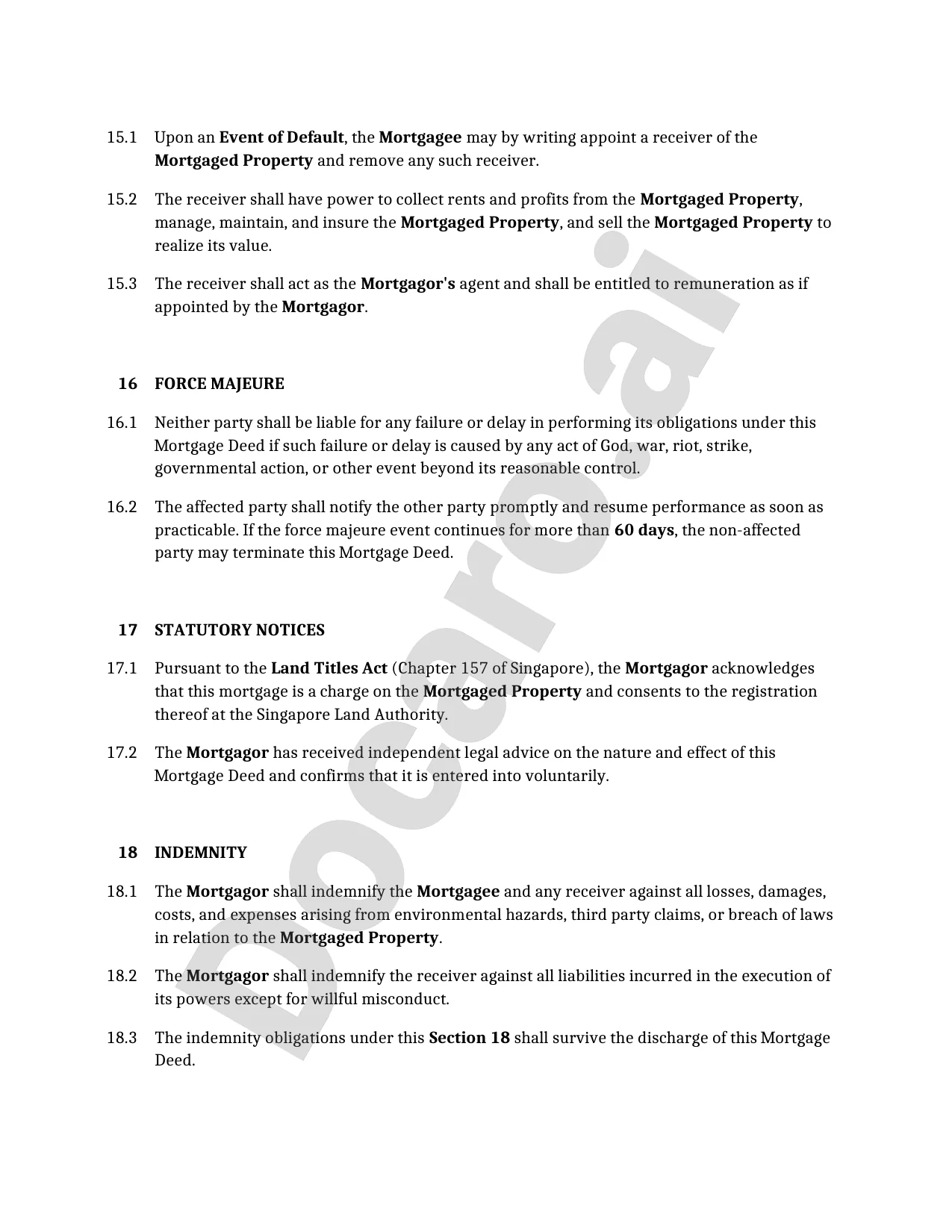
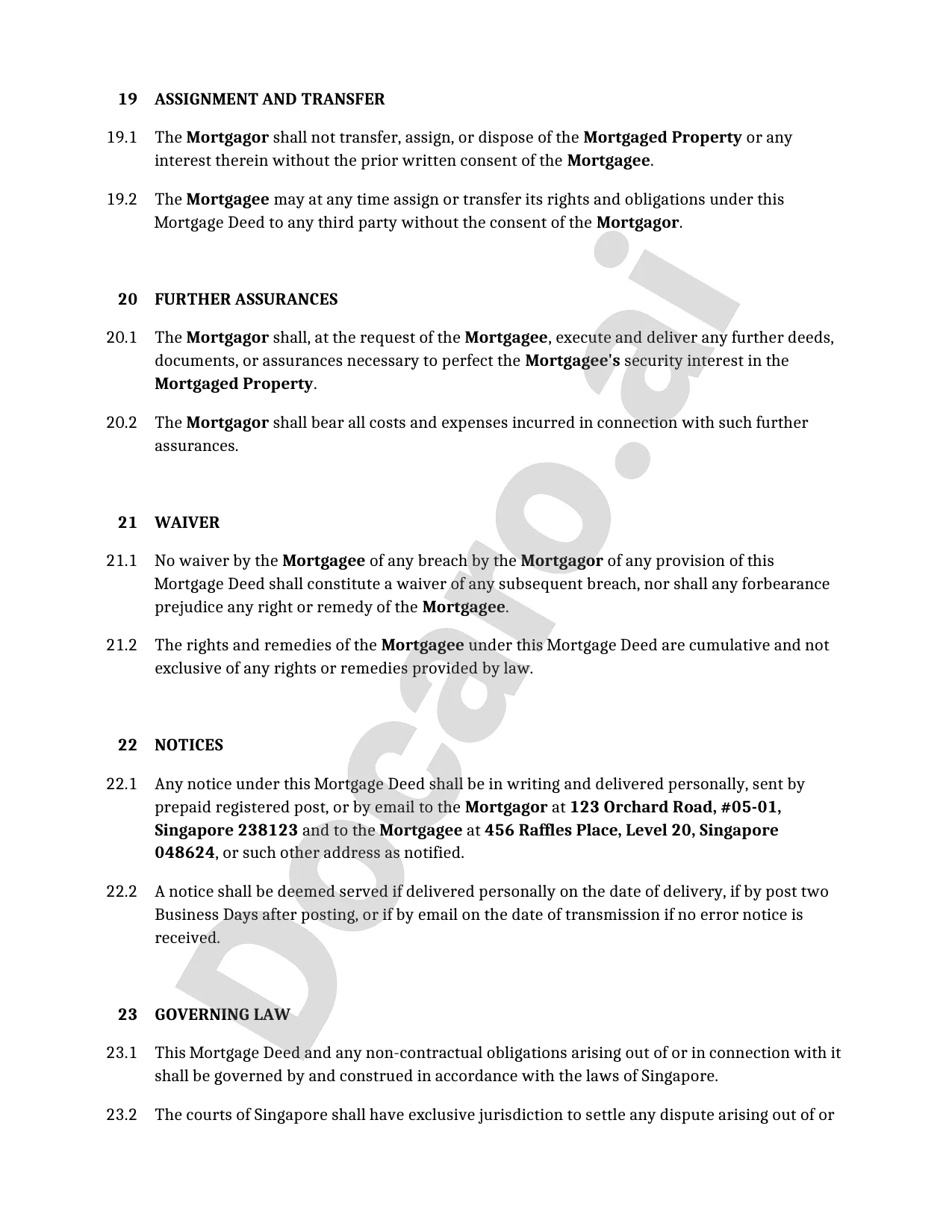
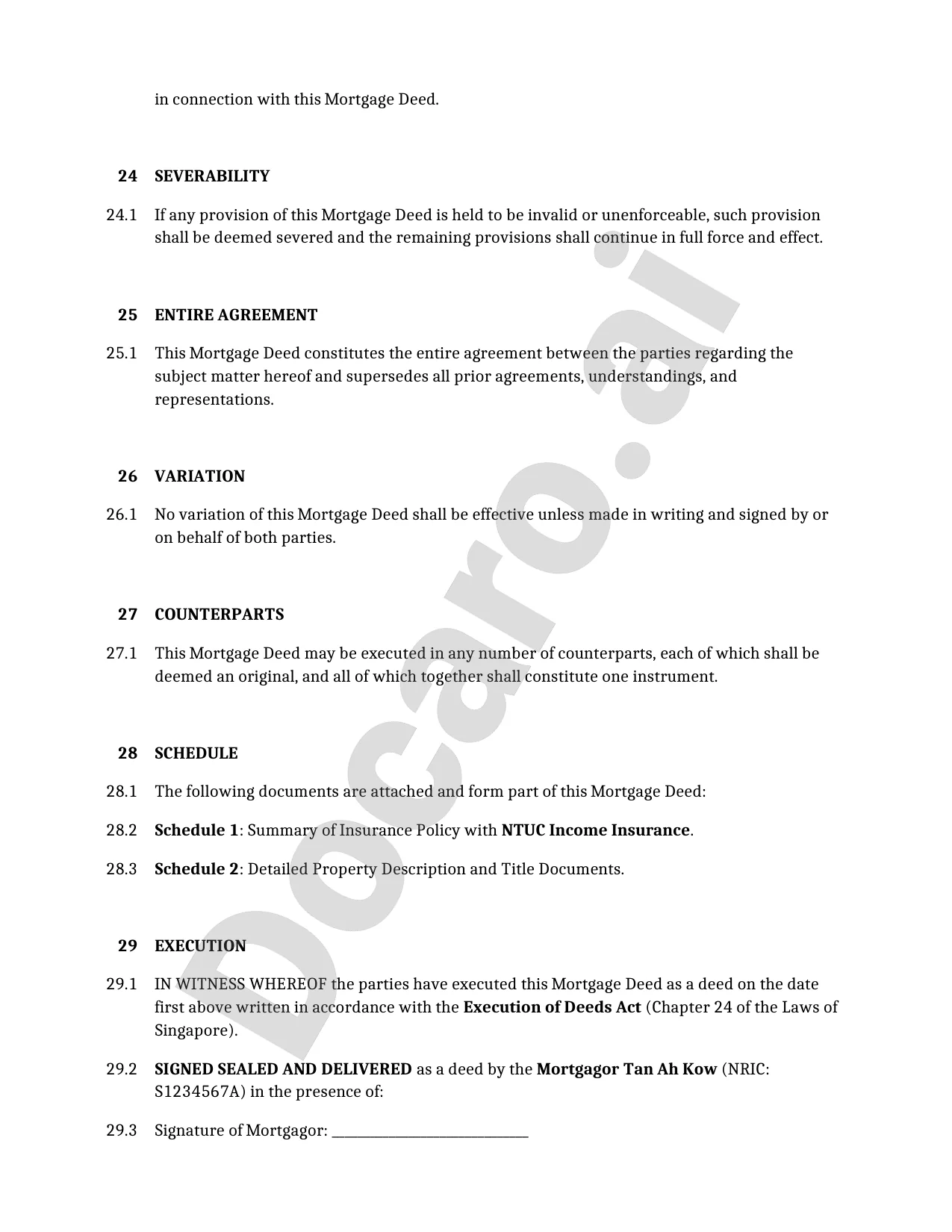
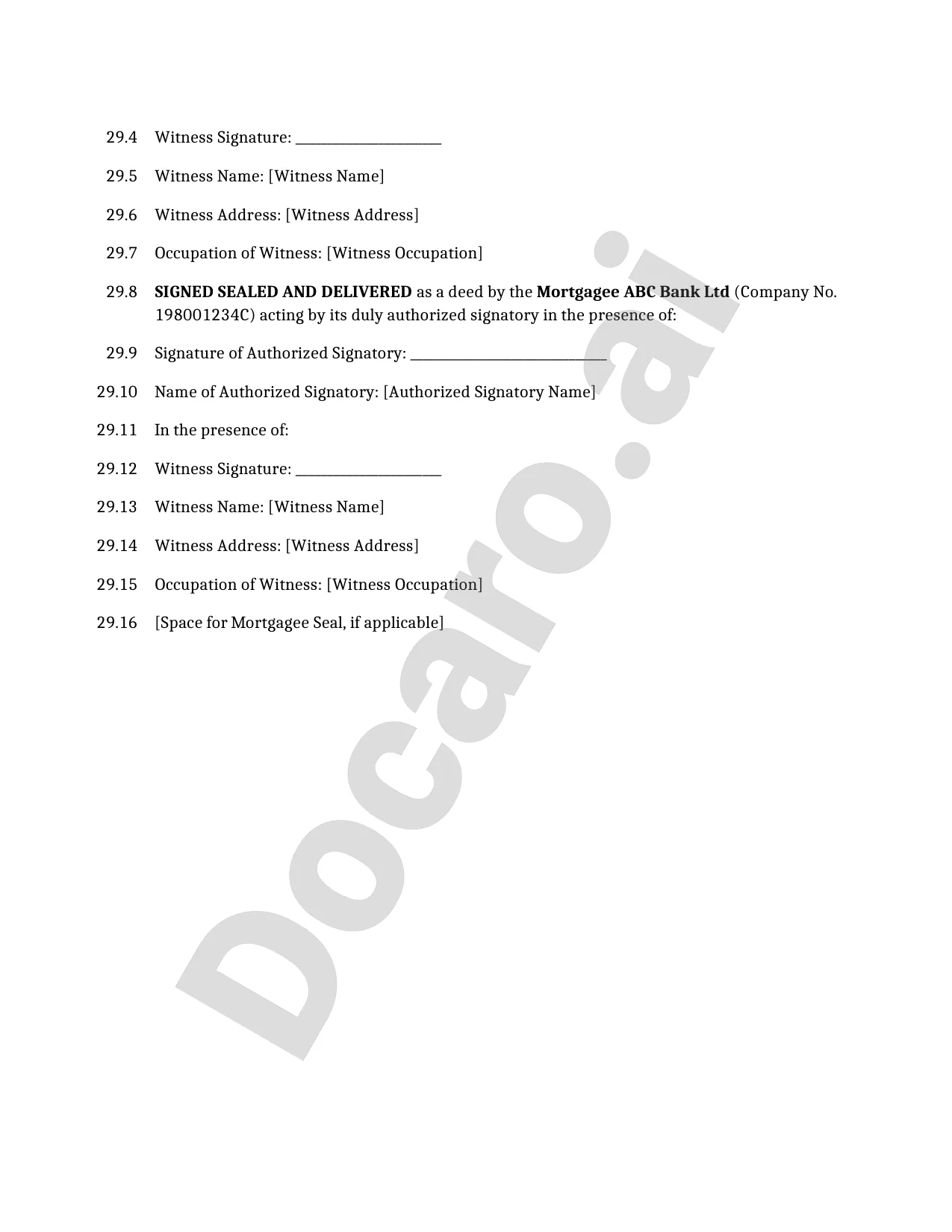
A Singapore Mortgage Deed is a critical security document that outlines the terms under which a borrower pledges property as collateral for a loan. Essential clauses include a detailed description of the secured property, specifying its location, boundaries, and title details to ensure clear identification and enforceability under Singapore law.
The repayment terms clause in a Singapore Mortgage Deed typically specifies the loan principal, installment schedule, and maturity date, ensuring structured debt servicing. Interest rates are detailed next, covering fixed or variable rates, calculation methods, and any penalties for late payments, which protect the lender's financial interests.
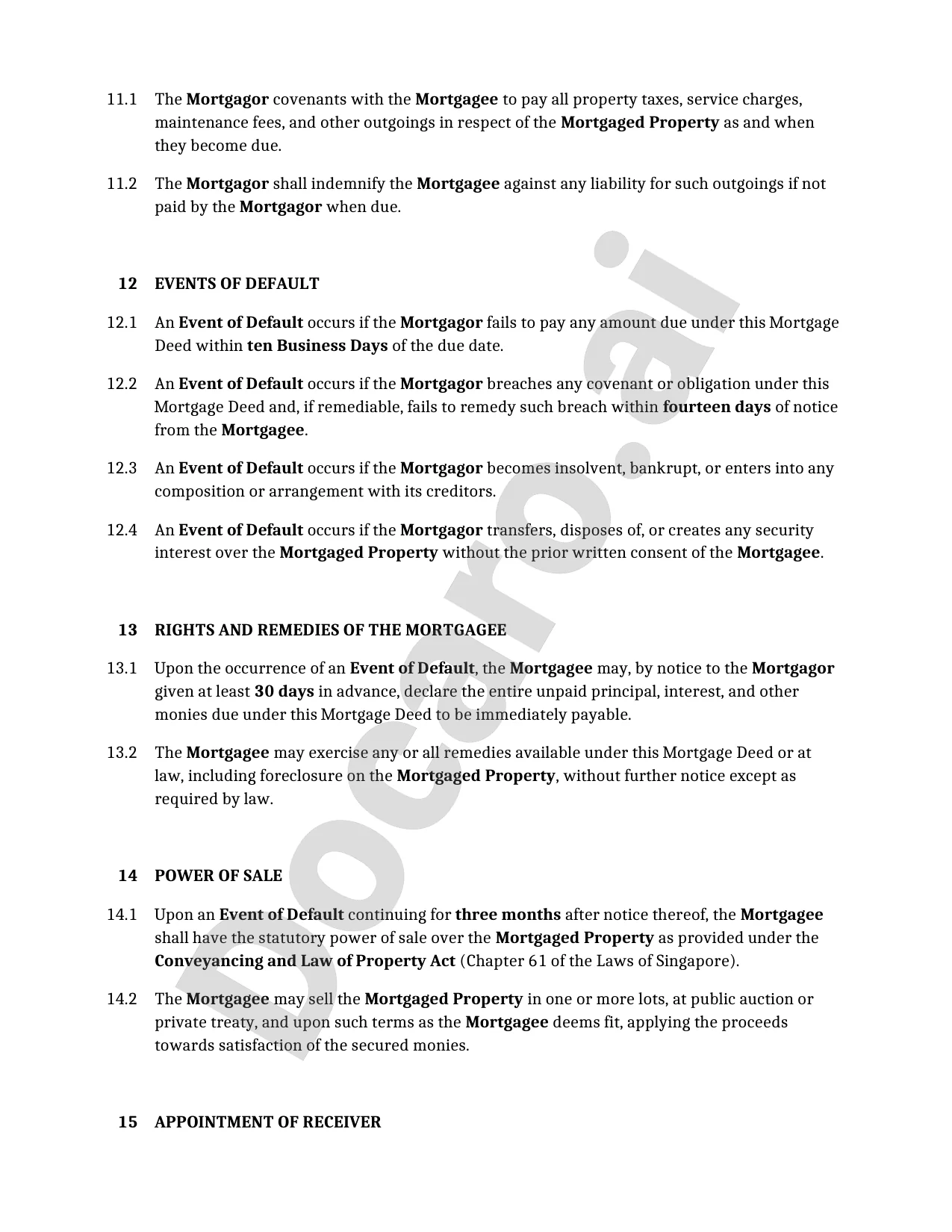
Default provisions form a key protective element, defining events like missed payments or property misuse that trigger remedies such as acceleration of the loan or foreclosure. For comparisons with other security documents like charges or pledges, refer to Key Differences Between Mortgage Deeds and Other Security Documents in Singapore.
To ensure compliance and customization, opt for bespoke AI-generated legal documents via Docaro rather than generic templates, tailoring the Mortgage Deed to specific transaction needs in Singapore.
What are the key rights and obligations of the parties?
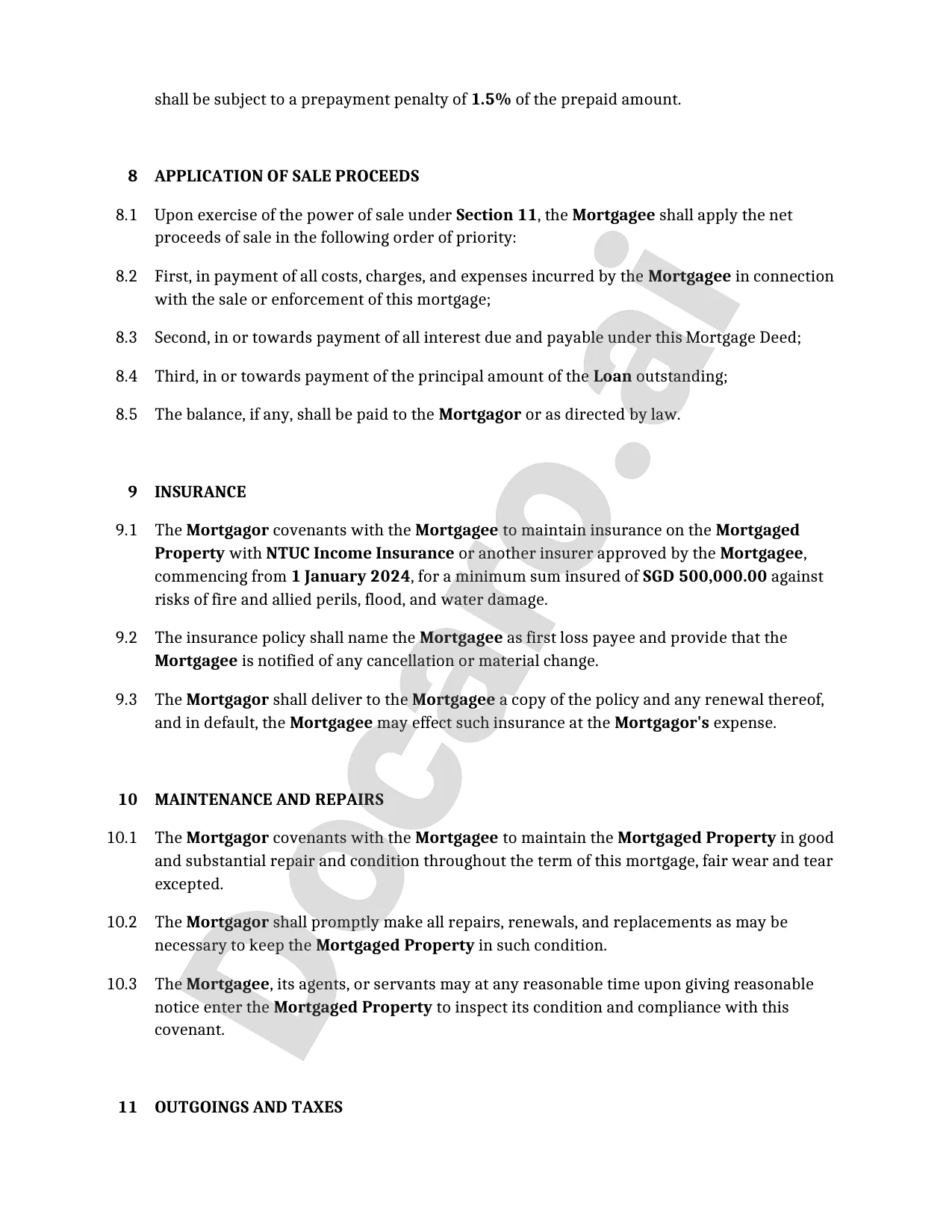
In a Singapore Mortgage Deed, the mortgagor (borrower) holds primary obligations to ensure the security of the loan, including the duty to make timely payments of principal and interest as per the agreed schedule. Additionally, the mortgagor must maintain the property in good condition, pay all applicable taxes, insurance premiums, and comply with relevant laws to prevent any deterioration that could affect the mortgagee's interest.
The mortgagee (lender) enjoys specific rights to protect their investment, such as the ability to inspect the property periodically and receive detailed financial updates from the mortgagor. Upon the mortgagor's default, which includes missed payments or breaches of covenants, the mortgagee can enforce remedies like accelerating the full loan repayment or appointing a receiver to manage the property.
A key right of the mortgagee in cases of prolonged default is the power to foreclose on the property, allowing them to sell it through judicial or statutory processes under Singapore's Land Titles Act to recover outstanding amounts. Borrowers should consult professionals for bespoke AI-generated legal documents using Docaro to tailor mortgage agreements to their specific needs, ensuring clarity on these rights and obligations.

Are there any recent or upcoming legal changes affecting Mortgage Deeds in Singapore?
In 2025, Singapore introduced significant amendments through the Electronic Conveyancing and Other Matters Act, updating the Land Titles Act and related legislation to facilitate digital property transactions. These changes enable electronic execution of mortgage deeds and other conveyancing documents via prescribed electronic transaction systems, marking a shift from traditional wet-ink signatures to secure digital processes.
The new Digital Conveyancing Portal (DCP), developed by the Singapore Land Authority, streamlines mortgage registration and payments, reducing paperwork and processing times for banking and property sectors. This includes mandatory digital registration requirements for deeds securing mortgage payments, enhancing efficiency while maintaining legal validity under the updated Electronic Transactions Act.
Banking laws saw no major direct amendments to mortgage-related provisions in 2025, with stability in core regulations like loan-to-value ratios and anti-money laundering rules. For complex mortgage deeds, professionals should opt for bespoke AI-generated legal documents using Docaro to ensure compliance with these evolving digital standards.
How do you register a Mortgage Deed in Singapore?
1
Prepare Documents
Use Docaro to generate bespoke mortgage deed and related documents, ensuring all parties' details and terms are accurately included. Gather supporting IDs and titles.
2
Pay Fees
Calculate and pay the required stamp duty and registration fees via the Singapore Land Authority's online portal or authorized channels.
3
Lodge Application
Submit the prepared documents and proof of payment electronically through the Integrated Land Information Service (INLIS) system.
4
Verify Registration
Monitor the application status online and collect the registered mortgage deed once approved by the Singapore Land Authority. For full details, see [How to Register a Mortgage Deed in Singapore: Step-by-Step Process](/en-sg/a/register-mortgage-deed-singapore-steps).
You Might Also Be Interested In
A Legal Contract Outlining The Terms Of A Loan Between A Lender And Borrower, Including Repayment And Interest Details.
A Written Promise By One Party To Pay A Specified Sum Of Money To Another Party At A Predetermined Future Date Or On Demand.
A Legal Contract Where A Debtor Grants A Creditor A Security Interest In Collateral To Secure A Debt Or Obligation.
A Legal Document Where An Individual Agrees To Be Personally Liable For Another's Debt Or Obligation If The Primary Party Defaults.
A Legal Contract Where A Debtor And Creditor Agree To Settle An Outstanding Debt For A Reduced Amount Or Revised Terms.
A Contract Allowing A Borrower To Access A Revolving Credit Facility Up To A Specified Limit, Repayable And Reusable As Needed.