Why Free Templates Can Be Risky for Workplace Safety and Health Manuals
Relying on free templates for your workplace safety and health manual can expose your organization to significant risks. These generic documents often fail to address the unique aspects of your operations, industry, or location-specific regulations in Singapore. As a result, they may contain outdated information, overlook critical hazards relevant to your workplace, or omit essential compliance requirements under local laws like the Workplace Safety and Health Act. This can lead to non-compliance, increased liability, and potential accidents due to inadequate guidance for employees.
Opt for an AI-generated bespoke health and safety manual tailored specifically to your business needs. Our advanced AI analyzes your inputs to create a customized document that incorporates current Singapore regulations, your company's specific risks, and best practices for your industry. This ensures comprehensive coverage, up-to-date compliance, and practical relevance, helping you maintain a safer work environment while demonstrating due diligence to authorities.
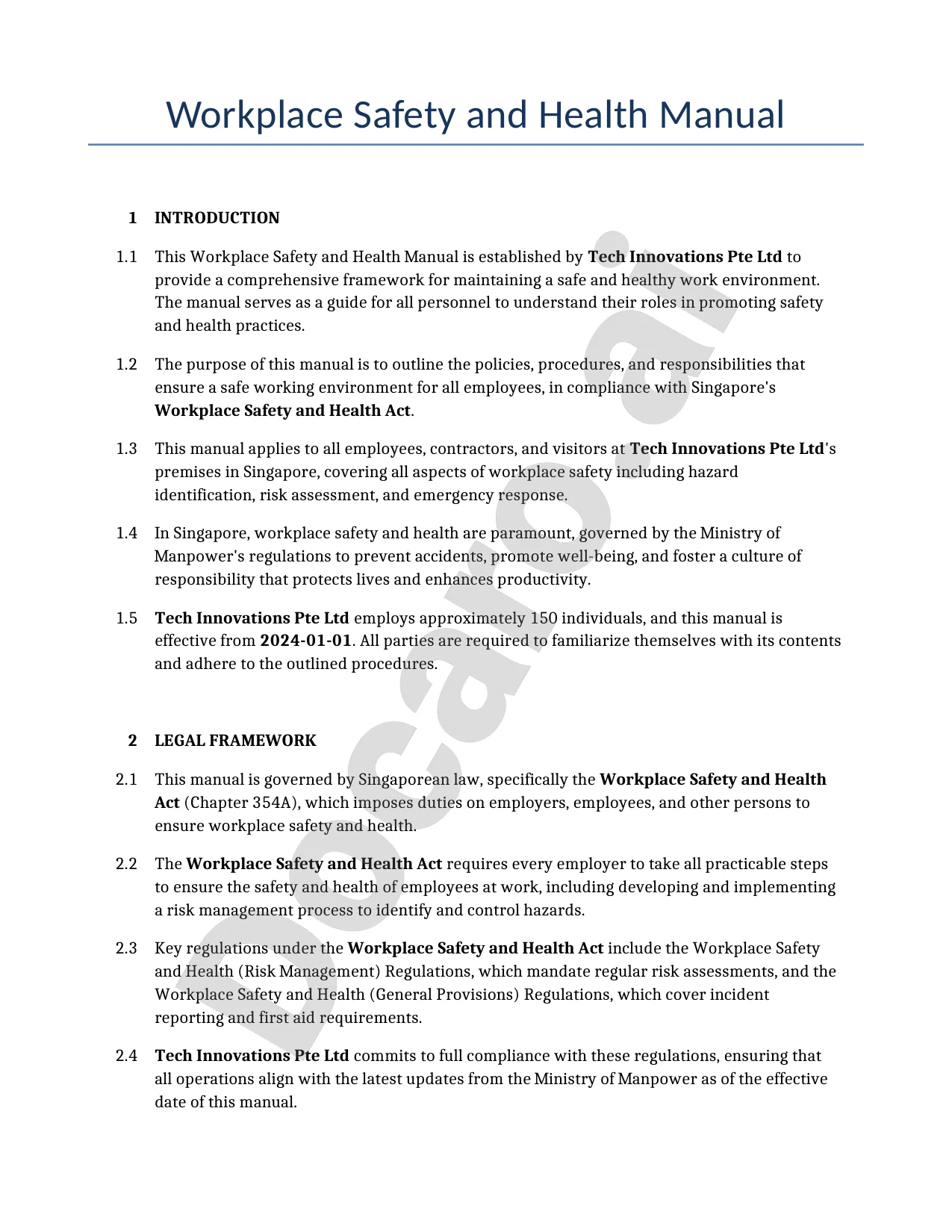
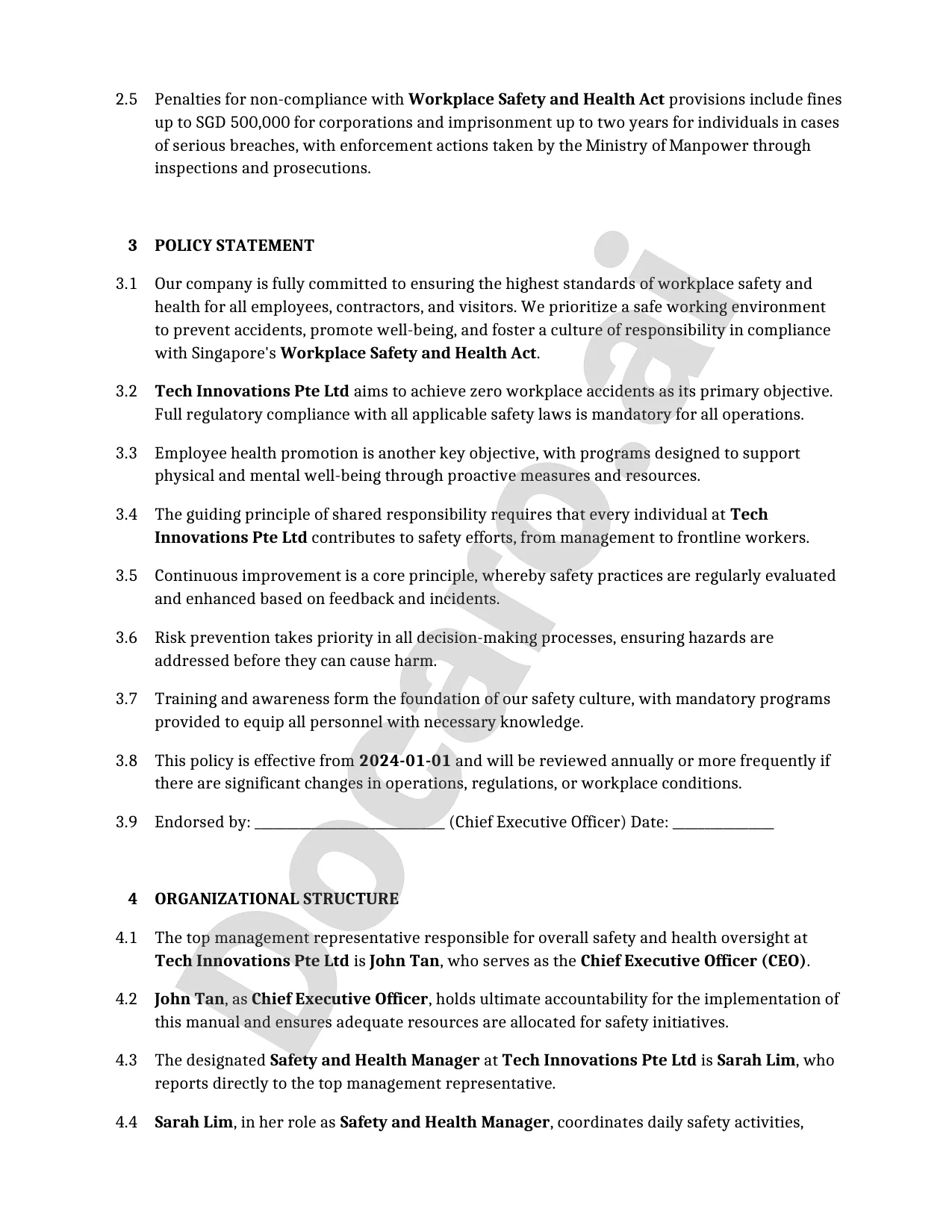
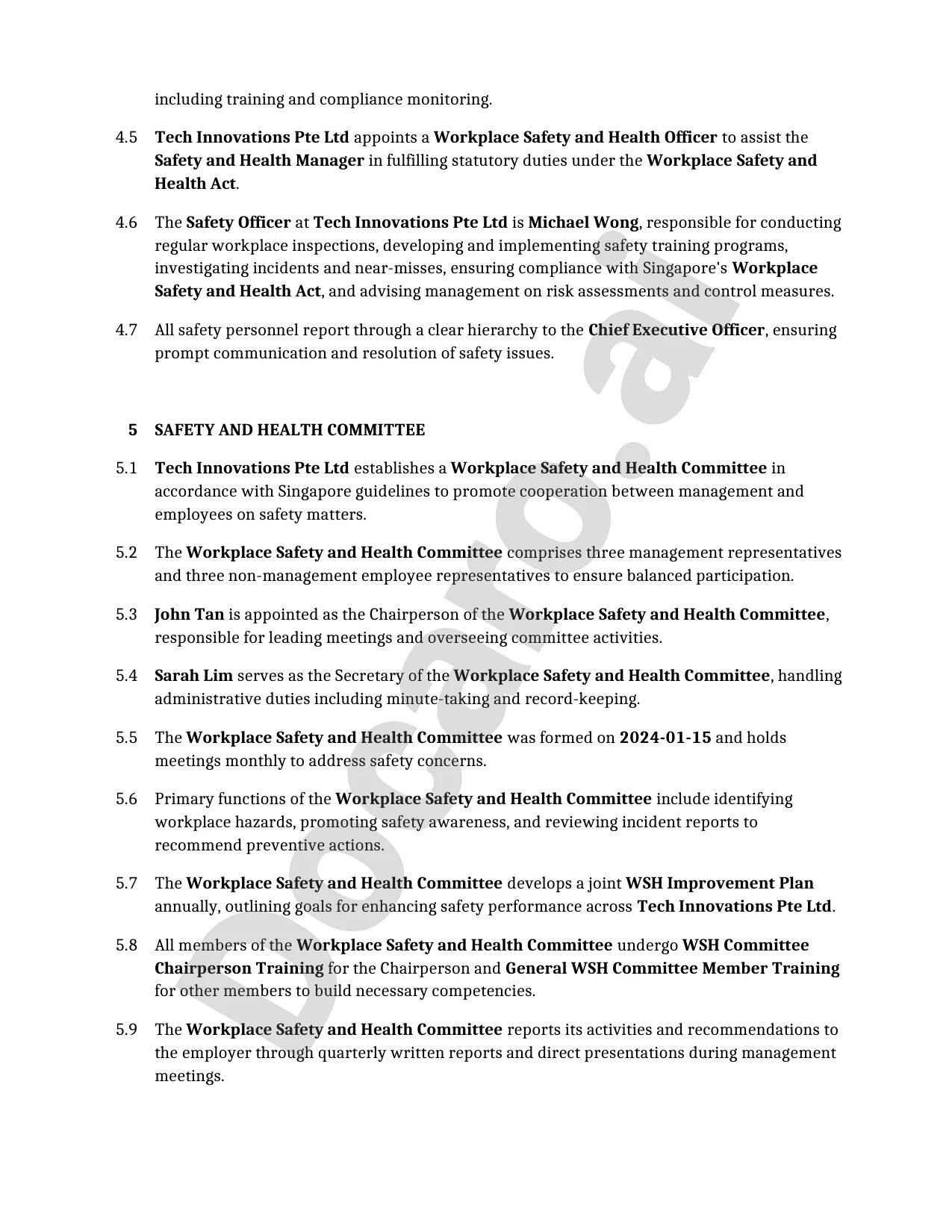
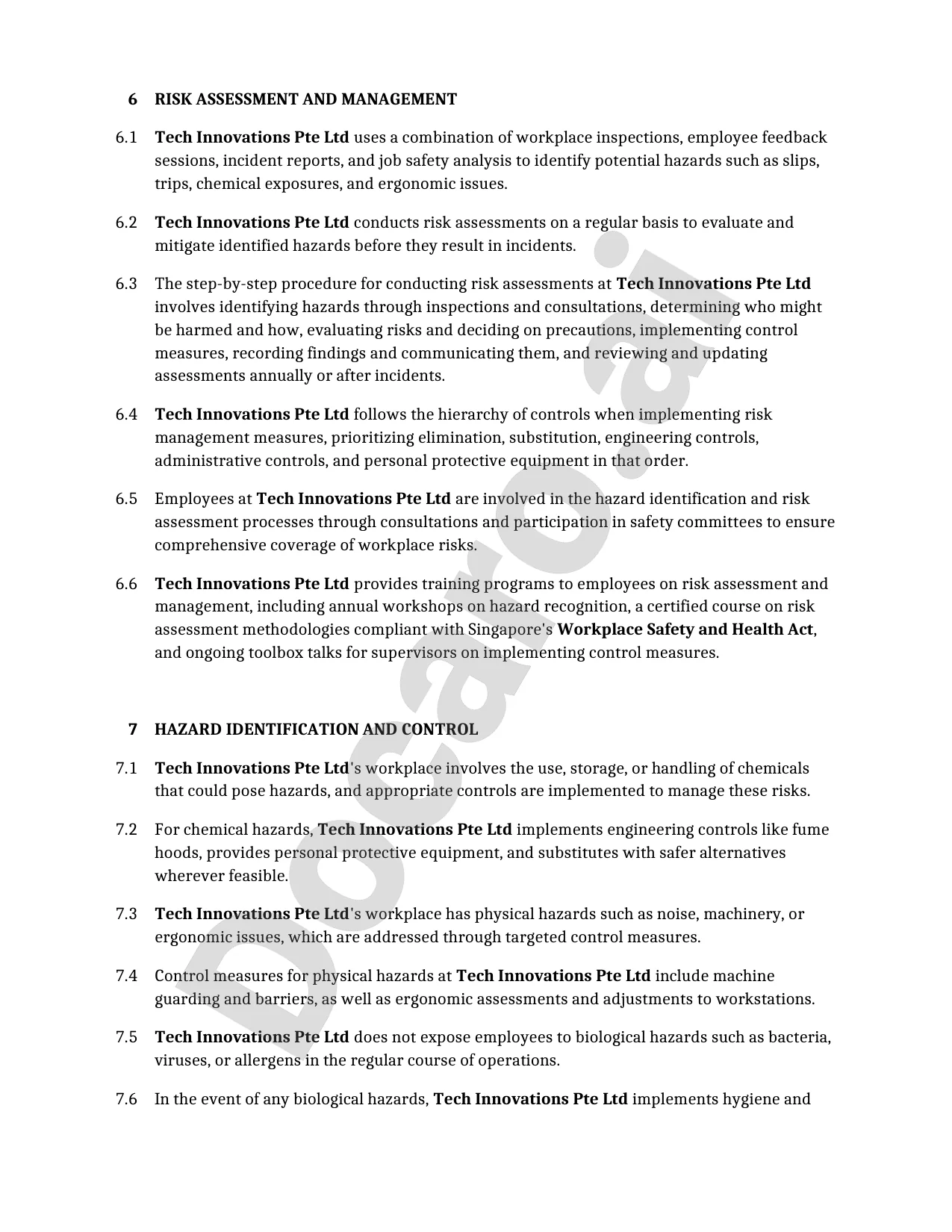
What is a Workplace Safety and Health Manual in Singapore?
A Workplace Safety and Health Manual in Singapore serves as a comprehensive guide for organizations to promote a safe working environment, outlining policies, procedures, and best practices tailored to specific workplace hazards. It ensures employees and management understand their roles in preventing accidents and health risks, fostering a culture of safety within the company.
Under the Workplace Safety and Health Act (WSHA), enacted in 2006 and administered by the Ministry of Manpower (MOM), employers are legally required to identify hazards, implement control measures, and provide training as part of their duty of care. The manual acts as a key document demonstrating compliance with WSHA sections on risk assessment and safety management, helping businesses avoid penalties for non-compliance; for official guidelines, refer to the MOM's Workplace Safety and Health page.
In the broader context of workplace compliance in Singapore, the manual integrates with other corporate documents like HR policies and emergency response plans, supporting overall regulatory adherence under frameworks such as the WSHA and Factories Act. It aids in audits, incident reporting, and continuous improvement, ensuring the organization meets Singaporean safety standards effectively.
For deeper insights into creating a customized Workplace Safety and Health Manual, explore our internal resource at Understanding Workplace Safety and Health Manual in Singapore. Advocate for bespoke AI-generated documents using Docaro to ensure they precisely fit your company's needs without relying on generic templates.
"A comprehensive safety manual is essential for identifying hazards, outlining procedures, and training employees, directly reducing the risk of workplace incidents and fostering a culture of prevention." – Workplace Safety and Health Council
To create a tailored safety manual for your organization, consider using Docaro for bespoke AI-generated corporate documents that meet specific regulatory needs.
When should a Workplace Safety and Health Manual be used in a Singapore business?
A WSH Manual is essential in high-risk industries like construction and manufacturing, where workers face dangers such as falls, machinery accidents, and chemical exposures. These sectors require detailed safety protocols to prevent injuries and comply with Singapore's Workplace Safety and Health Act, ensuring all employees are trained on hazard identification and emergency responses.
For businesses with multiple employees or those handling hazardous materials, a WSH Manual becomes mandatory to outline risk assessments, safe handling procedures, and incident reporting. In Singapore, companies with 50 or more employees must appoint safety officers and maintain such manuals, as stipulated by the Ministry of Manpower.
Very small home-based operations with no hazards, such as a solo freelance designer without chemicals or heavy equipment, do not require a WSH Manual. These low-risk setups can rely on basic general safety awareness instead of formal documentation.
Businesses should opt for bespoke AI-generated corporate documents using Docaro to create customized WSH Manuals tailored to specific operations, rather than generic options.

What are the key clauses to include in a Workplace Safety and Health Manual?
A WSH Manual in Singapore is a vital document for businesses to ensure workplace safety and health compliance under the Workplace Safety and Health Act. Essential clauses include risk assessment procedures, which outline systematic identification, evaluation, and control of hazards to prevent accidents and illnesses.
Emergency response plans detail steps for handling crises like fires or chemical spills, including evacuation routes, first aid provisions, and communication protocols to minimize harm. For more on key components of a Singapore WSH Manual, refer to the internal guide for businesses.
Training requirements specify mandatory programs for employees and supervisors to build awareness of safety protocols, hazard recognition, and safe work practices, ensuring ongoing competence. Businesses should develop bespoke WSH Manuals using AI-generated tools like Docaro for tailored, compliant documentation.
Incident reporting protocols require immediate notification of accidents or near-misses to authorities, with procedures for investigation, root cause analysis, and corrective actions to prevent recurrence. For authoritative guidance, consult the Ministry of Manpower's incident reporting page.
1
Identify Workplace Hazards
Conduct a thorough assessment of the workplace to identify potential hazards, such as chemical, physical, and ergonomic risks, specific to your operations.
2
Draft Risk Control Clauses
Use Docaro to generate bespoke clauses outlining preventive measures and controls tailored to the identified hazards for your WSH Manual.
3
Incorporate Training and Procedures
Develop sections on employee training, emergency procedures, and responsibilities using Docaro's AI for customized, corporate-specific content.
4
Review for Compliance
Examine the drafted manual against WSH regulations, consult experts, and revise to ensure full legal and operational compliance.
What recent or upcoming legal changes affect Workplace Safety and Health Manuals in Singapore?
The Workplace Safety and Health (WSH) Act in Singapore has seen targeted amendments focusing on mental health provisions to address psychosocial risks in workplaces. In 2023, updates emphasized integrating mental well-being into risk assessments, requiring employers to identify and mitigate factors like stress and burnout, as outlined by the Ministry of Manpower (MOM).
Regarding digital reporting requirements, recent changes mandate electronic submission of incident reports through the iReport system for faster processing and better data analytics. This streamlines compliance and enhances enforcement, with full implementation across high-risk industries by early 2024.
Upcoming enhancements include increased penalties for non-compliance, effective from mid-2024, raising fines up to SGD 500,000 and imprisonment terms for serious breaches to deter violations. For detailed guidelines, refer to the MOM's WSH resources.
In the absence of major overhauls, ongoing enforcement trends show a rise in proactive inspections and awareness campaigns, with MOM reporting a 15% increase in compliance audits in 2023 to promote a total safety culture.
What are the key rights and obligations under a Workplace Safety and Health Manual?
In a WSH Manual under Singapore's Workplace Safety and Health framework, employers bear primary obligations to provide a safe working environment, including conducting risk assessments, implementing control measures, and ensuring access to necessary personal protective equipment. Employees must adhere to these protocols by following safe work practices, using provided equipment correctly, and cooperating with safety training to prevent accidents.
Contractors have duties similar to employees when working on-site, such as complying with the principal employer's safety rules and reporting any unsafe conditions immediately. All parties share mutual obligations for reporting hazards, fostering a collaborative approach to maintain workplace safety as emphasized in the Ministry of Manpower guidelines.
To ensure compliance with these WSH rights and obligations, organizations should develop bespoke AI-generated corporate documents using Docaro, tailored specifically to their operations for optimal protection and efficiency.
Workplace safety is a shared responsibility between employers and employees, as outlined in Singapore's Workplace Safety and Health Act. Employers must ensure a safe working environment, while employees are required to take reasonable care for their own safety and that of others. To fulfill this, conduct regular risk assessments and provide necessary training to prevent accidents and foster a culture of vigilance. For customized corporate safety policies, generate bespoke documents using Docaro to tailor them precisely to your organization's needs.
Are there key exclusions or limitations in a Workplace Safety and Health Manual?
A WSH Manual in Singapore often includes exclusions for low-risk activities that do not pose significant hazards, such as routine office work or administrative tasks without heavy machinery. These exclusions ensure the manual focuses on high-risk operations, aligning with the Workplace Safety and Health Act guidelines from the Ministry of Manpower.
Common limitations in a WSH Manual address third-party actions, where the organization is not liable for incidents caused by external contractors or suppliers outside its direct control. Such clauses protect the company while emphasizing the need for clear contracts with third parties to maintain overall workplace safety.
For precise application, businesses should consult legal experts familiar with Singapore's WSH regulations to tailor exclusions appropriately. Consider using bespoke AI-generated corporate documents via Docaro for customized compliance solutions.
How can you implement a Workplace Safety and Health Manual effectively in your Singapore workplace?
Rolling out a WSH manual in your Singapore workplace requires a structured approach to ensure compliance with local safety regulations. Begin by developing a rollout plan that includes clear timelines, assigned responsibilities, and communication strategies to engage all employees effectively.
Training sessions are essential for successful implementation; schedule interactive workshops to explain the manual's key elements, using real-world examples from Singapore's workplace safety guidelines. For detailed practical tips on conducting these sessions, refer to the WSH manual implementation guidelines.
Regular audits help maintain adherence; conduct internal reviews quarterly to assess compliance and identify improvement areas, aligning with standards from the Ministry of Manpower. Encourage feedback during audits to foster a culture of continuous safety enhancement.
For creating bespoke corporate documents like your WSH manual, leverage Docaro's AI-generated solutions tailored to Singapore's regulatory needs, ensuring precision without relying on generic templates.
1
Disseminate WSH Policy
Distribute the bespoke WSH Manual generated via Docaro to all employees through internal channels, ensuring everyone acknowledges receipt.
2
Conduct Training Sessions
Organize mandatory training workshops using the Docaro-generated manual to educate staff on WSH policies and procedures.
3
Implement Compliance Checks
Establish regular audits and reporting mechanisms to verify adherence to the WSH Manual guidelines across operations.
4
Monitor and Review
Track compliance metrics ongoing and update the Docaro-generated manual based on feedback and incidents for continuous improvement.
You Might Also Be Interested In
A Document Outlining Company Policies, Employee Rights, And Workplace Rules.
A Document Outlining Expected Behaviors, Ethical Standards, And Rules For Individuals Or Organizations To Ensure Integrity And Compliance.
A Corporate Policy Outlining Commitments To Fostering Diverse Workplaces, Ensuring Equitable Opportunities, And Promoting Inclusive Practices.
A Corporate Policy Outlining Guidelines For Employees Working Remotely, In-office, Or In A Hybrid Model To Balance Flexibility And Productivity.
A Corporate Policy Outlining Rules For Appropriate Use Of IT Resources And Systems.
A Policy Outlining How An Organization Manages, Stores, And Disposes Of Data And Records To Ensure Compliance And Efficiency.
A Corporate Policy Outlining Procedures For Employees To Report Misconduct, Ensuring Confidentiality And Protection Against Retaliation.
A Policy Document Outlining Procedures For Handling Employee Misconduct And Workplace Complaints In Singapore Companies.
A Document Outlining The Responsibilities, Duties, Required Skills, And Qualifications For A Specific Job Role.
A Performance Improvement Plan (PIP) Is A Formal Document Outlining An Employee's Performance Issues And A Structured Plan With Goals And Timelines To Help Them Improve, Often Used Before Potential Termination.
A Corporate Document Outlining The Principles And Approach To Employee Compensation, Including Pay Structures, Incentives, And Alignment With Business Goals.
A Corporate Document Outlining The Rationale And Justification For Promoting An Employee, Including Performance Details And Business Needs.
A Form Used By Companies To Gather Feedback From Departing Employees About Their Experiences And Reasons For Leaving.
A Documented Set Of Instructions Detailing How To Perform Routine Operations Consistently And Efficiently In An Organization.
A Document Outlining Procedures For Detecting, Responding To, And Recovering From Security Incidents In An Organization.
A Strategic Document Outlining Procedures To Maintain Operations During Disruptions And Restore Systems After Disasters.
A Corporate Document Outlining Rules, Procedures, And Responsibilities To Protect An Organization's Information Systems From Cyber Threats.
A Document Outlining Procedures And Standards To Ensure Product Or Service Quality In An Organization.
A Corporate Document Outlining A Company's Performance And Initiatives In Environmental, Social, And Governance Areas To Demonstrate Sustainability And Ethical Practices.