Why Free Templates Can Be Risky for Party Wall Agreements
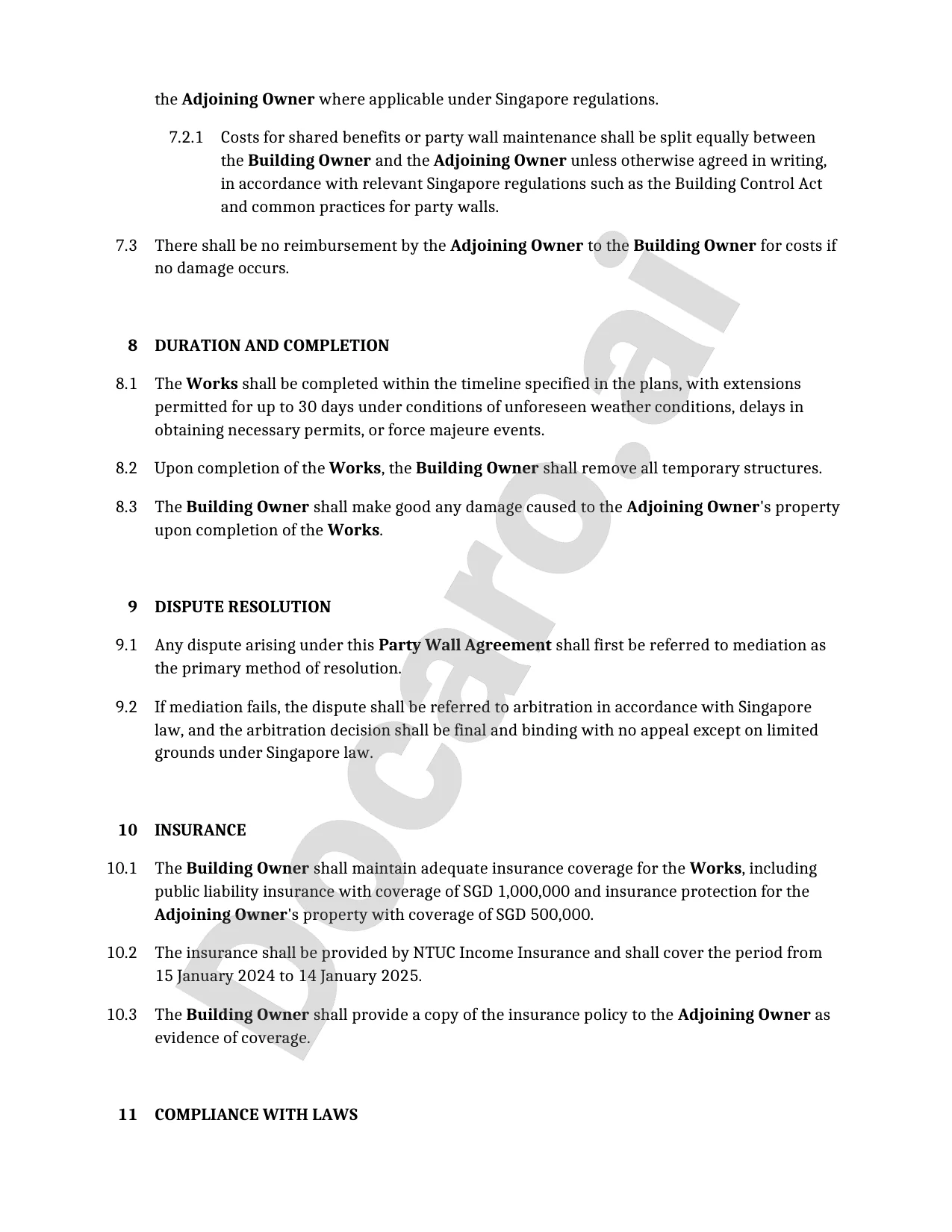
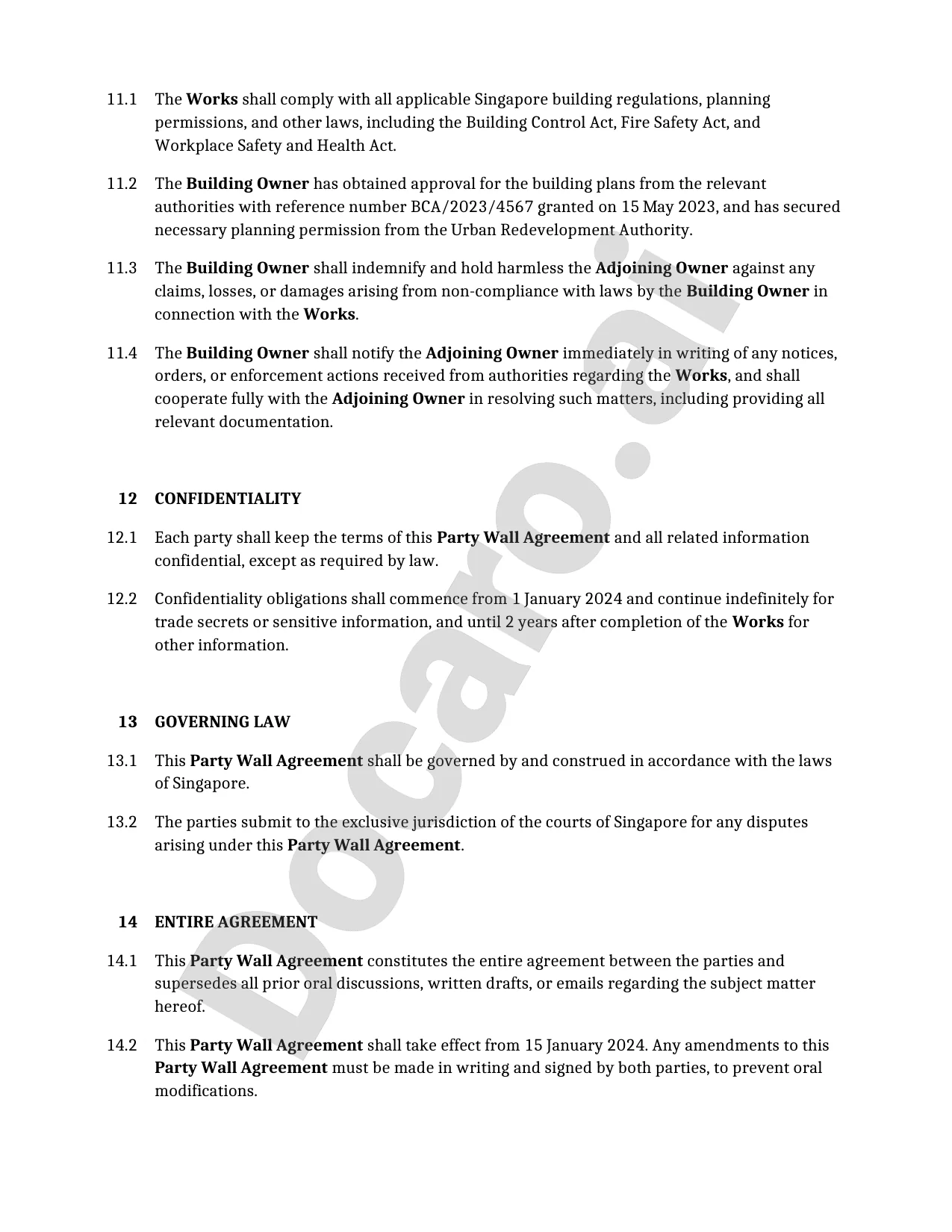
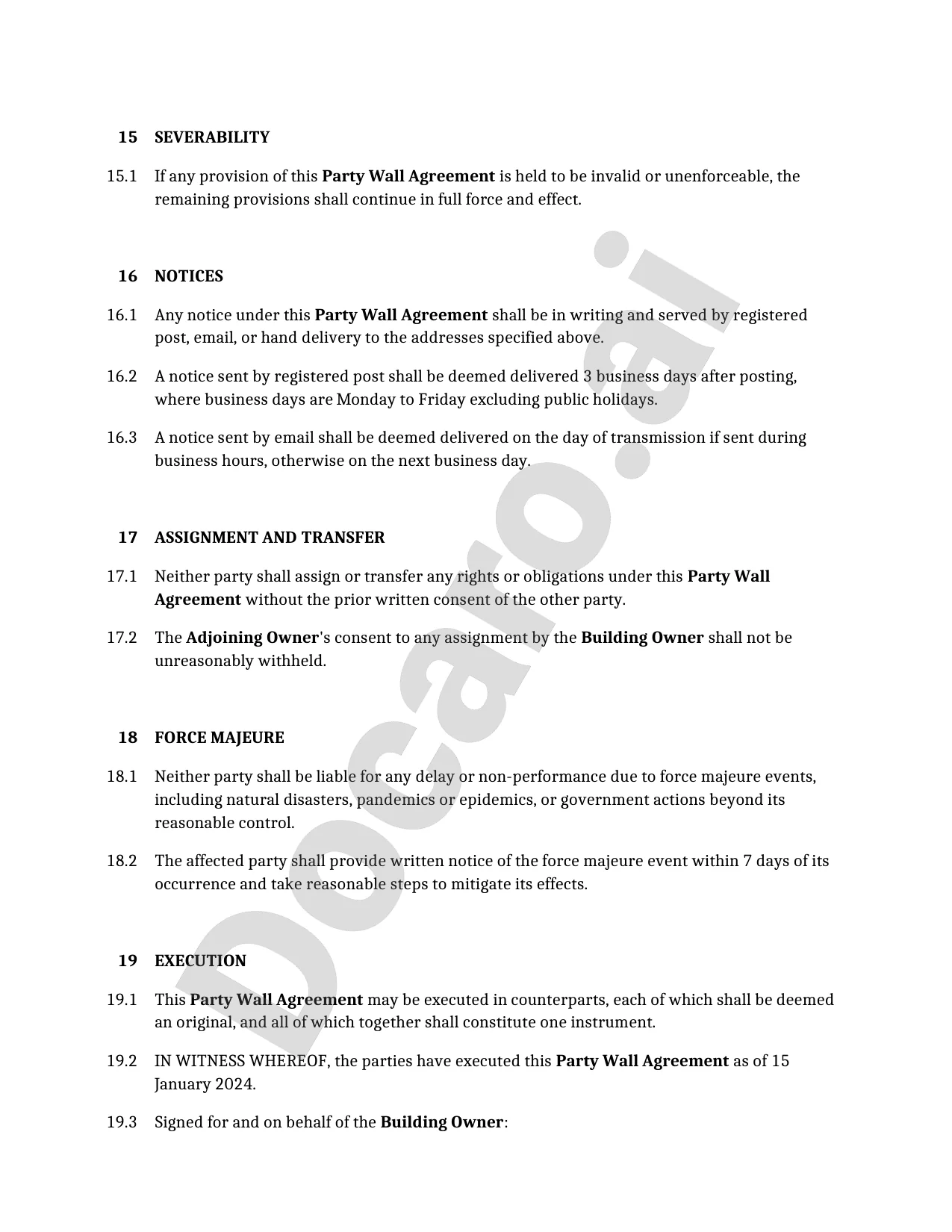
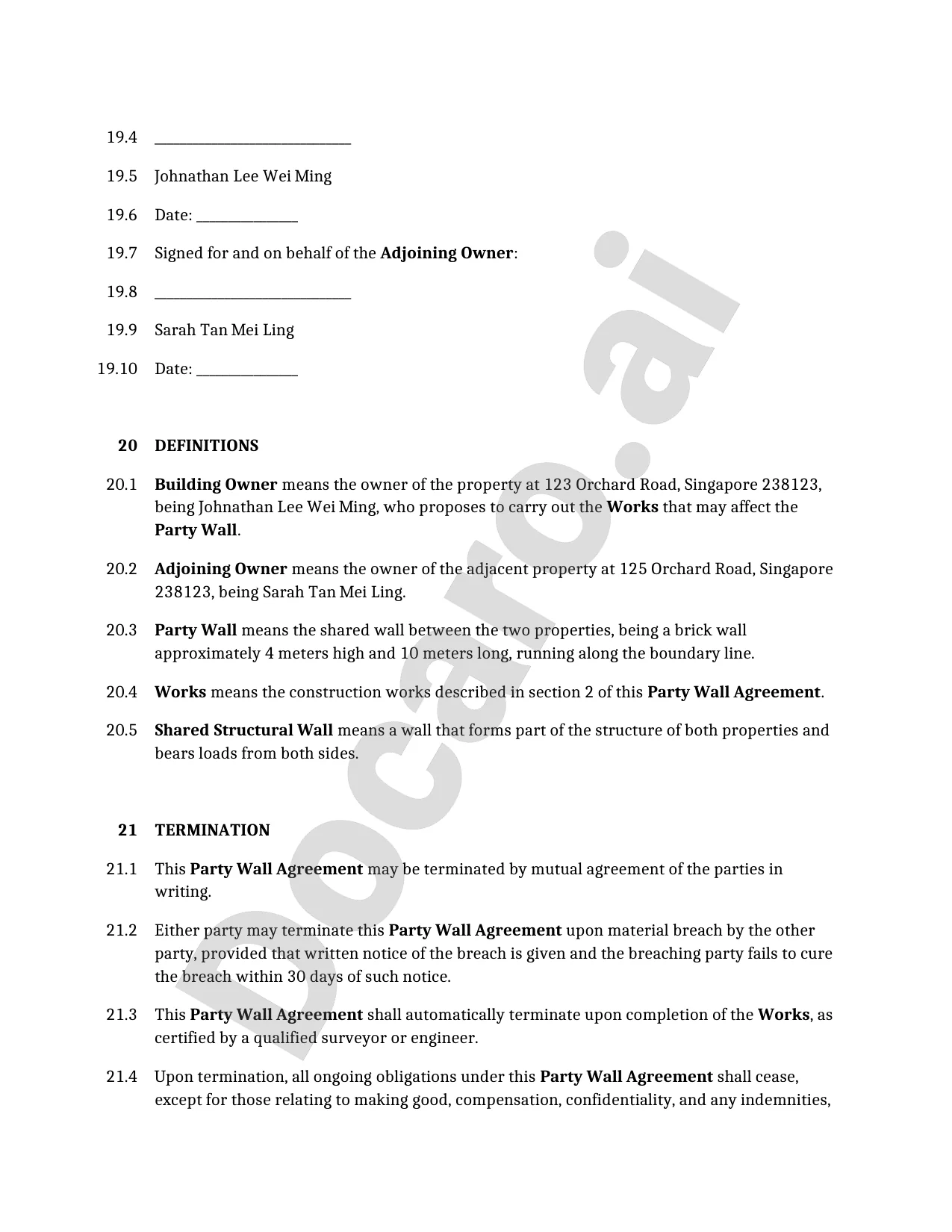
Generic party wall templates often overlook Singapore-specific regulations under the Building Control Act, using outdated or jurisdictionally mismatched clauses that fail to address local requirements for notifying adjoining owners, surveyors' appointments, or dispute resolution mechanisms. This can lead to invalid agreements, escalated disputes, costly legal challenges, or non-compliance with authorities, potentially halting construction projects.
Our AI generates bespoke party wall agreements tailored precisely to your Singapore-based project details, incorporating current legal standards, customized terms for your property boundaries, works description, and timelines, ensuring a robust, enforceable document that minimizes risks and facilitates smooth neighbor relations.
What is a Party Wall Agreement in Singapore?
In Singaporean property law, a Party Wall Agreement is a legal document that governs the shared walls between adjacent properties, ensuring clear rights and responsibilities for owners. This agreement is essential for properties like terraced or semi-detached houses where walls form part of the boundary, preventing disputes over maintenance, alterations, or usage.
The primary purpose of a Party Wall Agreement in Singapore is to protect property owners by defining ownership shares, repair obligations, and rules for modifications. It helps maintain harmony between neighbors and avoids costly legal battles, as outlined in the Land Titles Act and related regulations from the Singapore Land Authority.
For more detailed insights, explore our guide on What is a Party Wall Agreement in Singapore?. When drafting such agreements, opt for bespoke AI-generated legal documents via Docaro to ensure they are tailored to your specific needs and compliant with Singapore law.
When should you use a Party Wall Agreement in Singapore?
A Party Wall Agreement in Singapore is essential when renovations or extensions involve shared walls between adjacent properties, ensuring that structural changes do not compromise neighboring structures. For instance, during home extensions like adding a balcony or floor that affects the common boundary wall, both parties must agree to prevent disputes and comply with building regulations outlined by the Urban Redevelopment Authority (URA).
In multi-story developments or HDB flat modifications, a Party Wall Agreement becomes necessary if works such as installing new beams or altering load-bearing walls impact shared elements, safeguarding against potential damage or legal issues. This agreement is particularly crucial in dense urban settings where properties are closely interconnected, promoting harmonious neighbor relations and adherence to the Building and Construction Authority (BCA) standards.
The benefits of obtaining a Party Wall Agreement include clear delineation of responsibilities for repairs, cost-sharing for any damages, and legal protection against future claims, ultimately facilitating smoother project approvals. For a detailed process, refer to our step-by-step guide on obtaining a Party Wall Agreement in Singapore, and consider using Docaro for bespoke AI-generated legal documents tailored to your specific needs.
When should you avoid using one?
In Singapore, a Party Wall Agreement is not required for minor internal works that do not affect the structural integrity or shared boundary of the adjoining wall, such as simple repainting or non-invasive renovations within your own property lines. These activities fall outside the scope of the Land Titles (Strata) Act, allowing homeowners to proceed without formal neighbor consent, provided no shared elements are impacted.
Alternative legal mechanisms, like the Building and Construction Authority (BCA) guidelines, may apply instead of a Party Wall Agreement for works involving temporary access or minor encroachments, where a simple license agreement suffices under Singapore's property laws. For instance, if the project qualifies under minor works classifications, BCA approvals can bypass the need for a full party wall document, streamlining the process for low-risk alterations.
Pursuing an unnecessary Party Wall Agreement in Singapore carries risks such as unneeded legal costs and potential disputes if neighbors misinterpret the agreement's terms, leading to delays in your construction timeline. To mitigate these, opt for bespoke AI-generated legal documents via Docaro for tailored alternatives that ensure compliance without excess formality; for official guidance, refer to the BCA website.
What are the key clauses in a Party Wall Agreement?
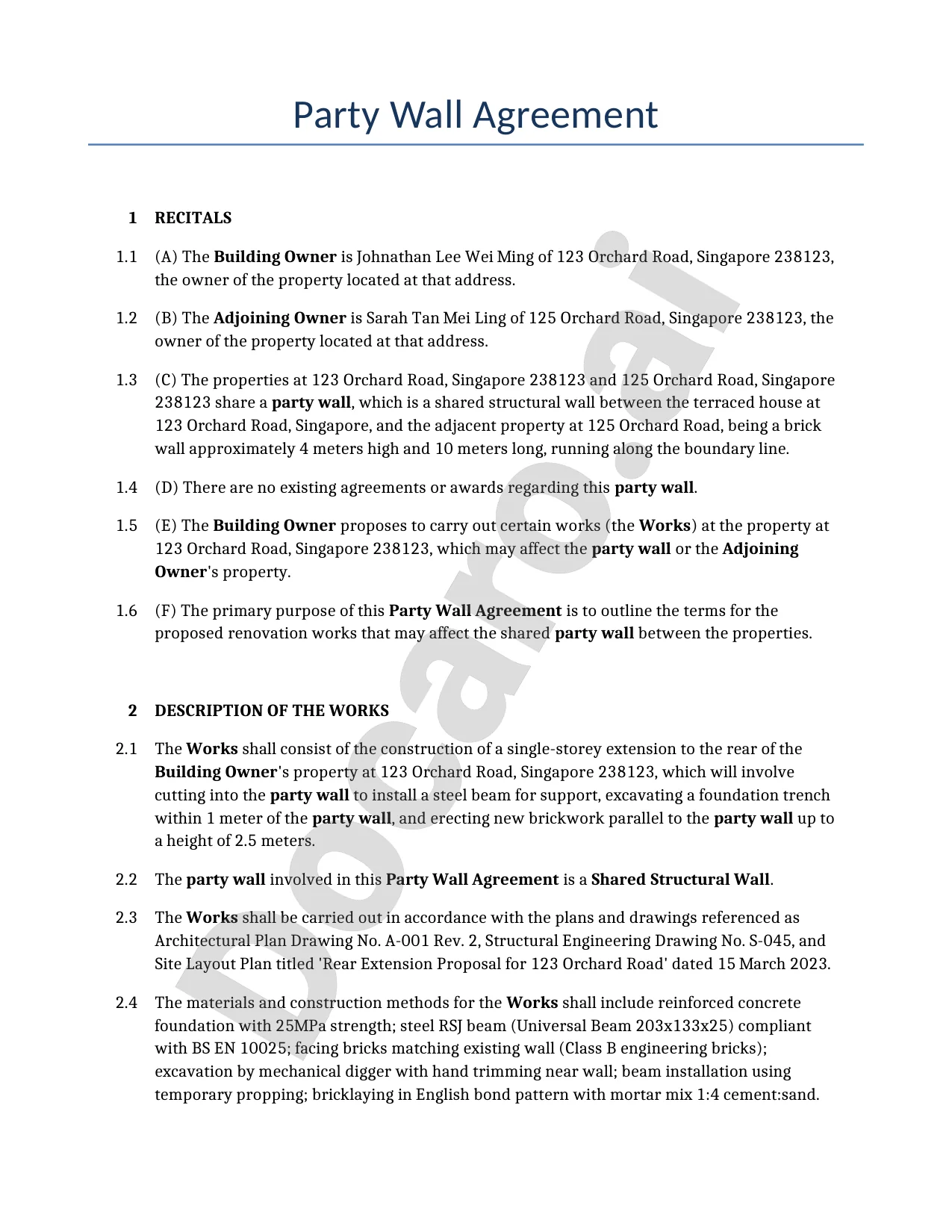
A Party Wall Agreement in Singapore is a crucial legal document that outlines the terms under which adjoining property owners can undertake construction or renovation works affecting a shared boundary wall. Essential clauses typically include a detailed description of works, specifying the scope, nature, and extent of any alterations, excavations, or additions to ensure both parties understand the project's impact on the party wall.
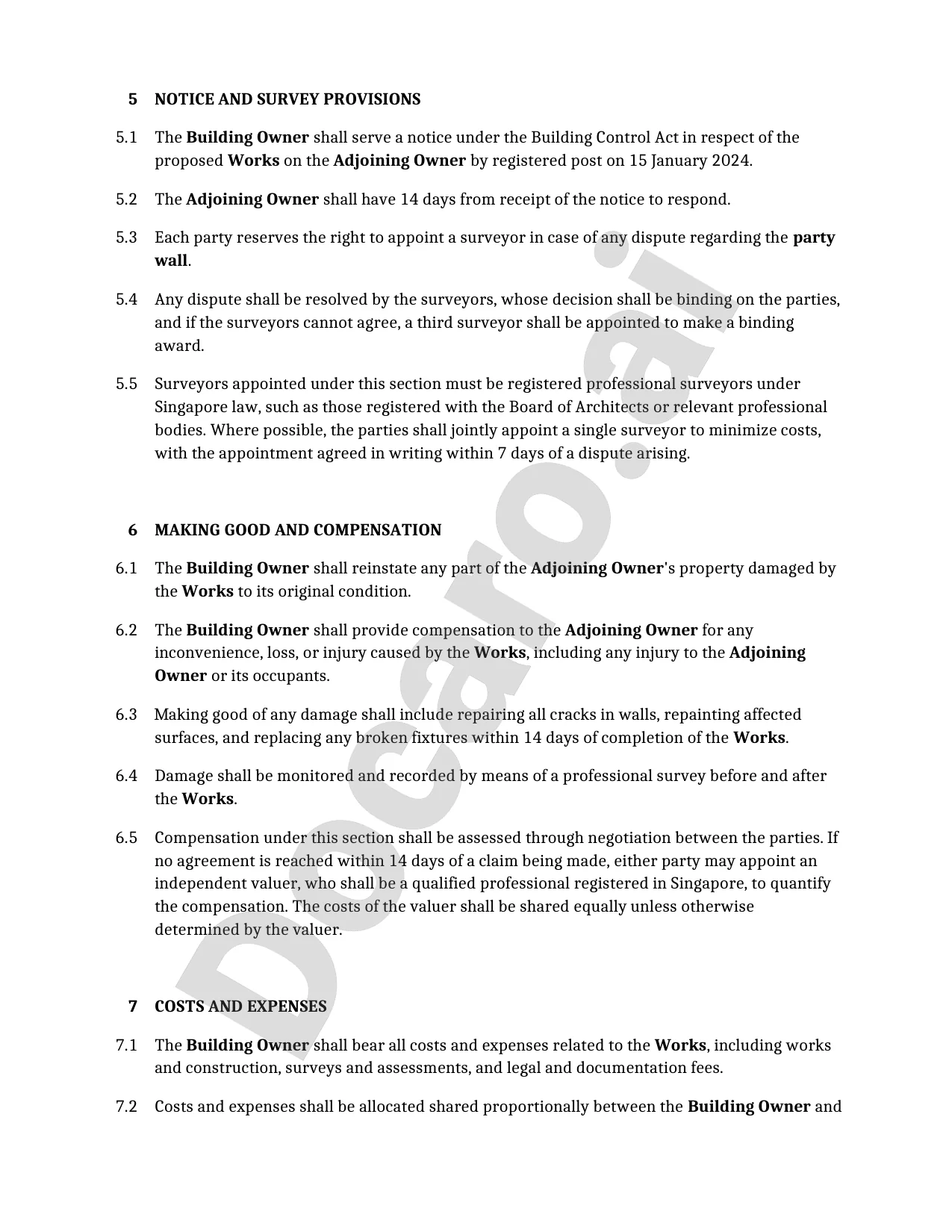
Timelines form another key clause, setting out the commencement and completion dates for the works to minimize disruptions and provide certainty for affected owners. Cost-sharing provisions are vital, detailing how expenses for surveys, reinforcements, or repairs will be divided, often based on the benefiting party's responsibility under Singapore's Building and Construction Authority guidelines.
Dispute resolution mechanisms in a Party Wall Agreement Singapore commonly include escalation procedures, such as mediation or arbitration through bodies like the Singapore Mediation Centre. For authoritative guidance, refer to the Building and Construction Authority resources on boundary works.
To ensure compliance and customization, owners should opt for bespoke AI-generated legal documents using Docaro, tailored to specific circumstances rather than generic forms. This approach helps avoid potential legal pitfalls in Singapore's property law framework.
"Clear cost allocation clauses in Party Wall Agreements are essential to prevent costly disputes; I recommend using bespoke AI-generated legal documents via Docaro for tailored precision in Singaporean property matters." - Dr. Lim Wei, Senior Partner, Singapore Law Firm.
What rights and obligations do parties have under this agreement?
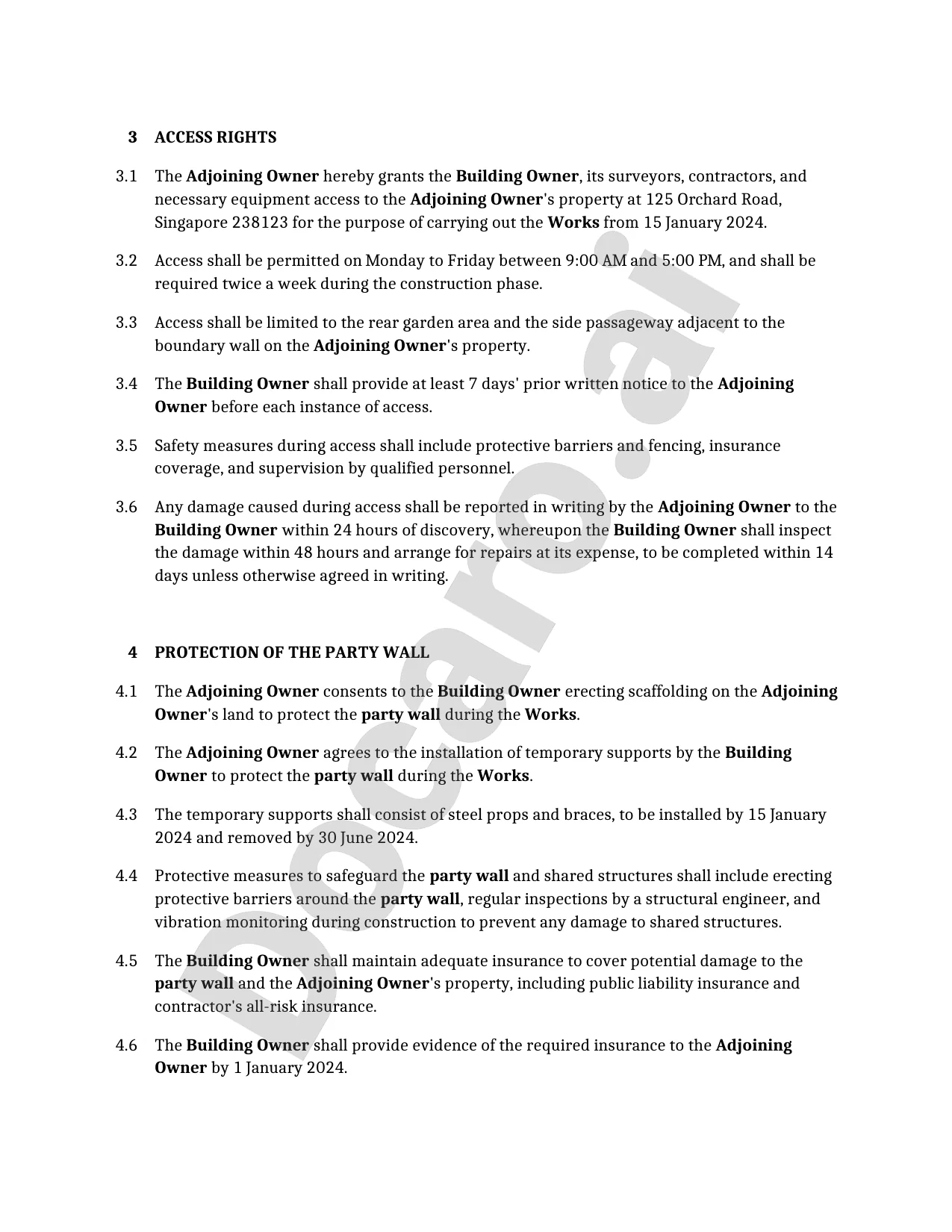
In a Singapore Party Wall Agreement, building owners and adjoining owners share key rights and obligations to ensure harmonious property development. These agreements, governed by Singapore's Building and Construction Authority (BCA) guidelines, outline access rights allowing the building owner to enter the adjoining property for necessary works, provided prior notice is given and precautions are taken to minimize disruption.
Maintenance duties require both parties to uphold the structural integrity of the party wall, with the building owner responsible for repairs arising from their construction activities. Adjoining owners must permit reasonable access for inspections and maintenance, fostering mutual cooperation in preserving the shared boundary.
Regarding liability for damages, the building owner is typically accountable for any harm caused to the adjoining property during works, including compensation for losses as per the agreement. For authoritative guidance on party wall regulations in Singapore, refer to the BCA's protecting adjoining buildings resource.
To create a tailored Party Wall Agreement, consider using bespoke AI-generated legal documents from Docaro, ensuring compliance with Singapore-specific laws without relying on generic templates.

Are there any key exclusions to be aware of?
Party Wall Agreements in Singapore are essential for neighboring property owners undertaking construction works, but they come with key exclusions to manage risks and liabilities. These agreements, governed by common law principles and the Singapore Land Authority, typically limit the scope of works to avoid disputes over unauthorized alterations.
One major exclusion is the limitation on the scope of works, where the agreement only covers specified activities like structural reinforcements or excavations adjacent to the shared wall, excluding unrelated renovations such as internal fittings. Unforeseen damages, such as those from natural disasters or third-party negligence, are often not covered, requiring owners to secure separate insurance policies for comprehensive protection.
Additionally, Party Wall Agreements do not apply to certain property types, including standalone detached houses without shared boundaries or government-owned lands, as outlined in Singapore's building regulations. For strata-titled properties, these agreements may be superseded by bylaws from the Building and Construction Authority, emphasizing the need for tailored legal advice.
To ensure compliance and customization, consider using bespoke AI-generated legal documents from Docaro, which adapt to specific Singaporean contexts without relying on generic templates.

What recent or upcoming legal changes affect Party Wall Agreements in Singapore?
There have been no significant amendments to Singapore's Building and Construction Authority (BCA) regulations or property laws specifically impacting Party Wall Agreements in recent years. The core framework under the Building Control Act and related guidelines remains focused on ensuring structural integrity and neighborly cooperation during construction, without notable updates since the last major revisions in 2019.
Current regulations emphasize mediation through the Strata Titles Boards or courts for disputes involving shared walls in multi-ownership properties. Property owners are advised to consult professionals for compliance, with no immediate changes altering the need for mutual consent in boundary works.
Upcoming reforms may arise from ongoing reviews of the Land Titles Act, potentially streamlining property boundary definitions, but nothing directly tied to Party Wall Agreements has been announced. For the latest official guidance, refer to the BCA website or the Singapore Land Authority.
When drafting agreements, opt for bespoke AI-generated legal documents via Docaro to ensure they are tailored to Singapore's specific regulations, promoting accuracy and efficiency over generic options.
How can you avoid common mistakes in Party Wall Agreements?
1
Consult a Professional
Schedule a consultation with a qualified surveyor or lawyer in Singapore to assess your party wall needs and discuss using Docaro for bespoke AI-generated legal documents.
2
Notify the Neighbor
Formally notify your adjacent property owner about the proposed party wall works, outlining the scope and timeline, using a customized document generated by Docaro.
3
Prepare and Exchange Documentation
Draft and exchange the Party Wall Agreement via Docaro's AI tools, ensuring all terms are tailored to your situation. For pitfalls, see [Common Mistakes to Avoid in Party Wall Agreements in Singapore](/en-sg/a/common-mistakes-party-wall-agreements-singapore).
4
Finalize and Register
Review, sign, and register the bespoke agreement with relevant authorities to make it legally binding.
Drafting a Party Wall Agreement in Singapore requires clear, precise terms to avoid disputes, as vague language can lead to costly misunderstandings. Always prioritize obtaining explicit neighbor consent early, consulting authoritative guidelines from the Council for Estate Agencies to ensure compliance with local property laws.
Common pitfalls include ignoring structural surveys or underestimating timelines for approvals, which can delay construction projects significantly. To mitigate these, use bespoke AI-generated legal documents via Docaro for tailored agreements that address specific property boundaries and responsibilities.
- Define shared wall usage and maintenance duties explicitly to prevent future conflicts.
- Incorporate clauses for dispute resolution, referencing Singapore's Building and Construction Authority standards.
- Secure written consent from all adjacent owners before any work begins.
By avoiding these errors, as highlighted in common Party Wall Agreement mistakes, property owners can protect their investments and foster good neighbor relations under Singapore's regulatory framework.
You Might Also Be Interested In
A Legal Contract Between A Landlord And Tenant Outlining The Terms For Renting A Residential Property In Singapore.
A Legal Contract Outlining The Terms For Renting A Specific Room Within A Shared Property, Including Rent, Duration, And Tenant Responsibilities.
A Legal Contract Outlining The Terms Under Which A Lodger Rents A Room In The Landlord's Home, Including Rent, Duration, And Responsibilities.
A Legal Document That Extends The Term Of An Existing Residential Tenancy Between Landlord And Tenant Under Singapore Law.
A Formal Notice Served By A Landlord To Terminate A Tenancy And Require The Tenant To Vacate The Premises.
A Formal Written Notification From A Landlord To A Tenant Announcing An Upcoming Increase In Rent Amount, Typically Specifying The New Rate And Effective Date.
A Document Acknowledging Receipt Of A Security Deposit, Typically Used In Rental Agreements To Protect Against Damages Or Unpaid Rent.
A Legal Document Recording The State Of A Rental Property At The Start And End Of A Tenancy To Protect Both Landlord And Tenant From Disputes Over Damages.
A Formal Notice Served By A Landlord Or Tenant To Terminate A Tenancy Agreement At The End Of The Lease Term.
A Legal Contract Outlining Terms For Sharing A Residential Property Among Co-tenants In Singapore.
A Document Used To Record The Condition Of A Rental Property At The Start And End Of A Tenancy To Assess Damages And Responsibilities.
A Form Submitted By Prospective Tenants To Apply For Renting A Residential Property, Including Personal And Financial Details For Landlord Review.
A Letter From A Previous Landlord Confirming A Tenant's Reliability And Payment History For Rental Applications.
A Corporate Document Outlining Internal Policies, Procedures, And Guidelines For Employees.