Why Free Templates Can Be Risky for Advance Medical Directive
Most free templates for Advance Medical Directives are generic and not tailored to Singapore's legal requirements under the Advance Medical Directive Act. Using incorrect wording can lead to ambiguities in your healthcare wishes, potential invalidation by medical professionals, or failure to be recognized in local hospitals and courts.
Our AI-generated bespoke Advance Medical Directive is customized to your specific circumstances and complies with Singapore's regulations, ensuring clear, precise language that accurately reflects your intentions and is legally enforceable for seamless implementation during medical emergencies.
What is an Advance Medical Directive in Singapore?
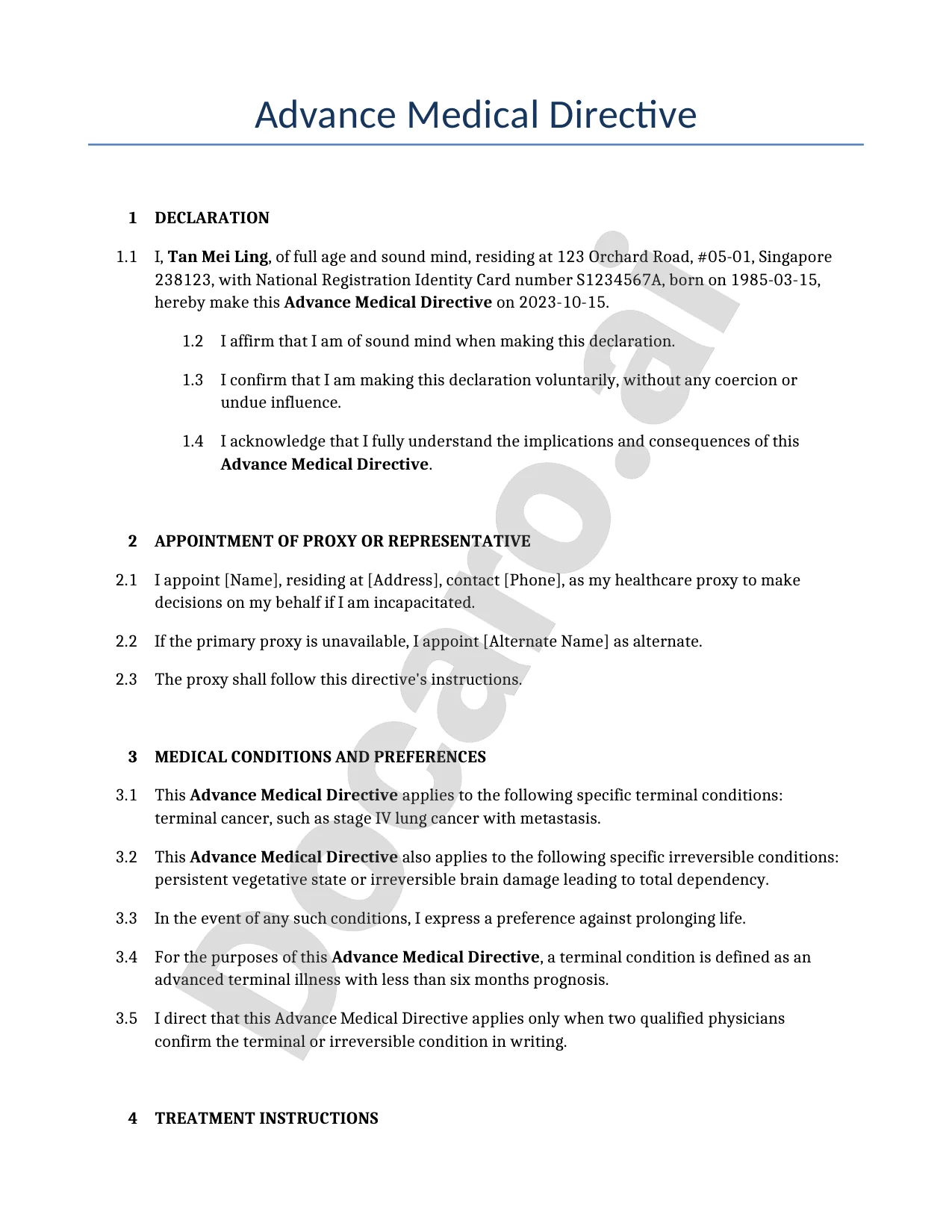
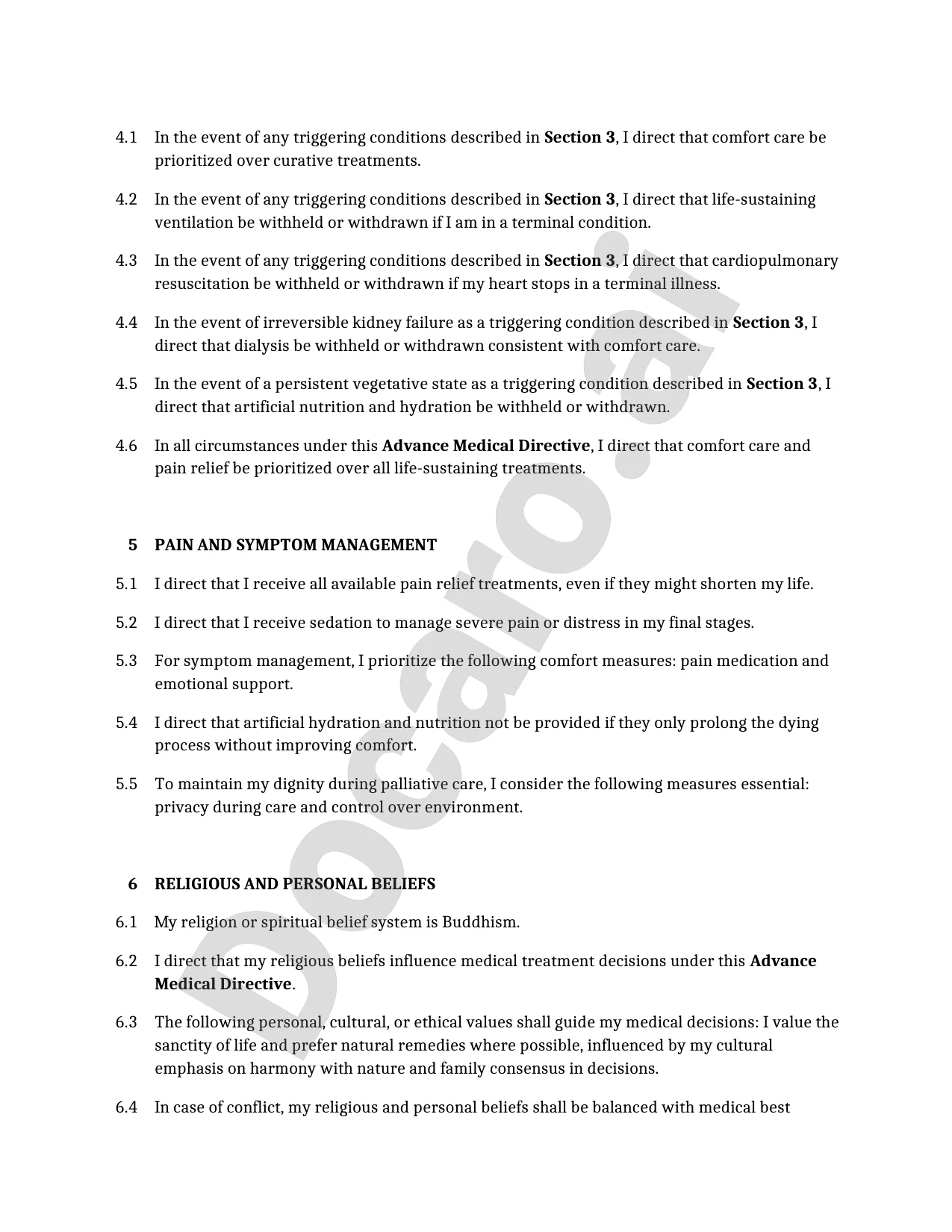
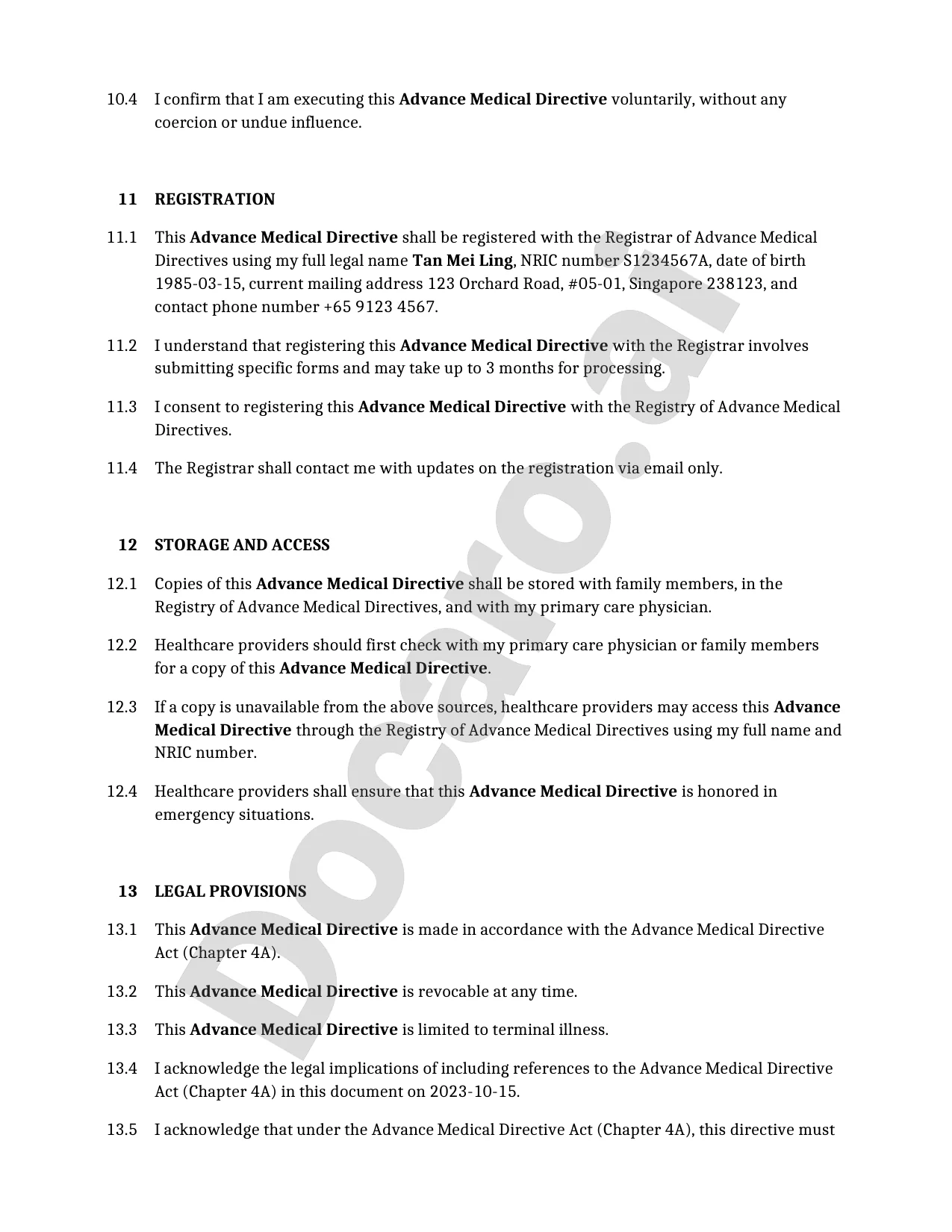
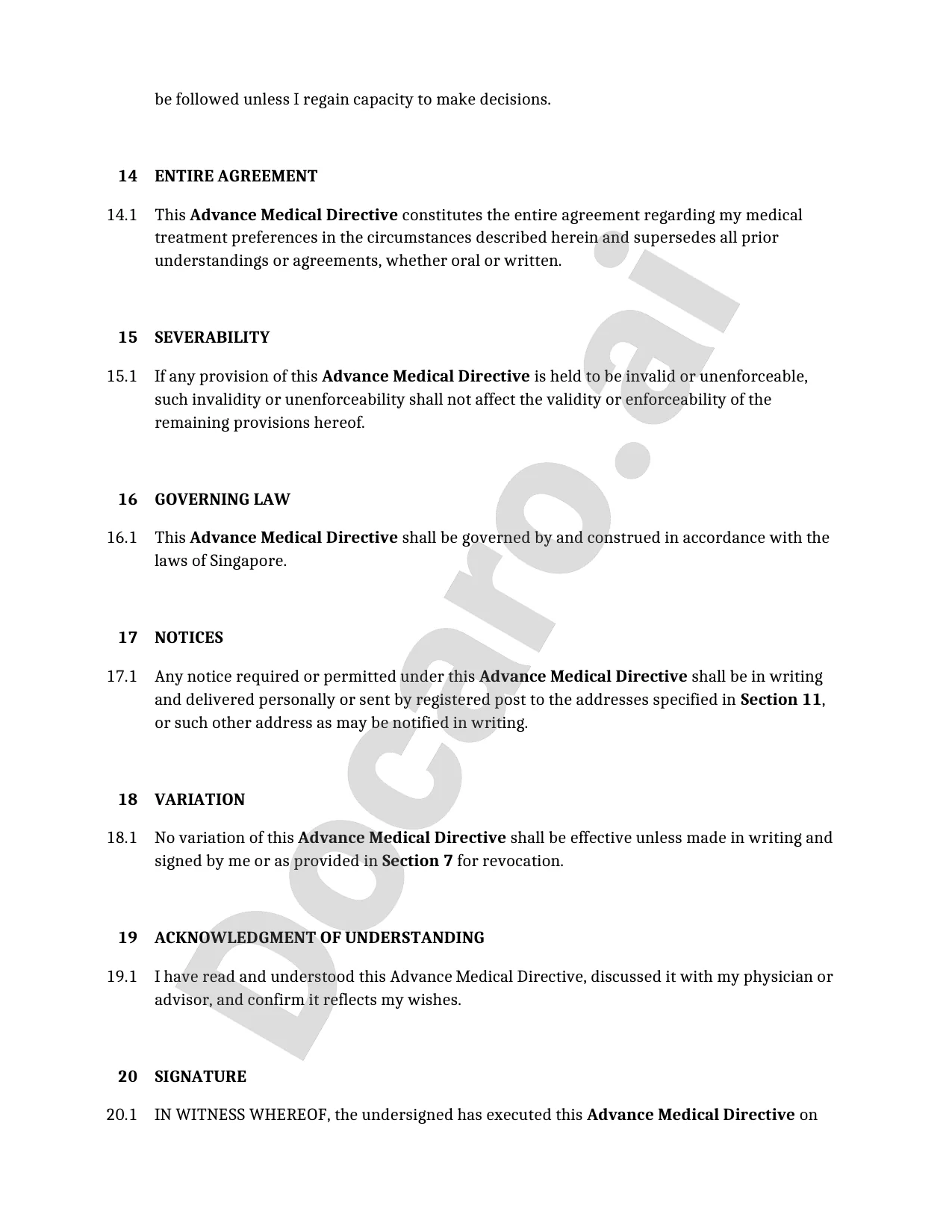
An Advance Medical Directive (AMD) in Singapore is a legal document that allows individuals to specify their preferences for medical treatment in situations where they become terminally ill and unable to make decisions. Under Singaporean law, particularly the Advance Medical Directive Act, it instructs doctors to withhold or withdraw extraordinary life-sustaining treatments, focusing instead on providing comfort care to ensure a dignified end-of-life experience.
The primary purpose of an AMD is to empower people to maintain control over their medical care during critical health declines, alleviating the burden on family members who might otherwise face difficult choices. It integrates seamlessly into broader end-of-life care planning by outlining wishes for scenarios like prolonged vegetative states, promoting personalized healthcare aligned with one's values.
Any mentally competent Singapore citizen or permanent resident aged 21 or older can make an AMD in Singapore, and it must be witnessed by a qualified medical practitioner and another non-beneficiary individual. For detailed guidance on creating one, explore What is an Advance Medical Directive in Singapore?.
- Ensure your AMD reflects your unique circumstances by using bespoke AI-generated legal documents through Docaro, tailored specifically to Singapore's regulations.
- Regularly review and update your AMD to account for changes in health or personal views, keeping it relevant for effective end-of-life planning.
"Advance medical directives are vital for upholding personal autonomy, allowing individuals to make informed choices about their end-of-life care in line with their values, as affirmed by Singapore's Advance Medical Directive Act." – Associate Professor Dr. Calvin Koh, National University of Singapore Medical Ethics Expert.
To ensure your AMD reflects your unique circumstances, use Docaro for bespoke AI-generated legal documents tailored to Singaporean law.
When should you use an Advance Medical Directive in Singapore?
An Advance Medical Directive (AMD), also known as a living will, is a crucial estate planning tool for outlining healthcare preferences when a person cannot communicate. It is particularly appropriate for individuals with terminal illnesses, allowing them to specify treatments like life support or palliative care to ensure their wishes are honored.
AMDs are also suitable for those wanting to avoid prolonged suffering, such as in cases of chronic debilitating conditions, by directing medical teams to focus on comfort rather than aggressive interventions. This empowers proactive end-of-life planning and reduces family burdens during crises.
However, an AMD should not be used for reversible conditions like temporary unconsciousness from surgery, as recovery is likely and rigid directives could lead to unnecessary harm. It is also inadvisable if the person might change their mind later, since AMDs are hard to update in emergencies, potentially overriding evolving preferences.
For personalized legal needs, consider bespoke AI-generated documents from Docaro to tailor an AMD to specific circumstances. Always consult healthcare professionals to ensure the directive aligns with current medical standards and personal values.
Key exclusions in Advance Medical Directives
Advance Medical Directives (AMDs) in Singapore provide individuals with the legal right to specify their preferences for withholding or withdrawing life-sustaining treatment in terminal illness scenarios. Governed by the Advance Medical Directive Act 1996, these directives empower patients but include key exclusions to balance autonomy with ethical and medical considerations.
Doctors may override an AMD if it is deemed invalid, such as when the directive was made under duress, without full comprehension, or if the patient's condition does not clearly meet the terminal illness criteria outlined in the Act. Ethical overrides are permitted in rare cases where continuing treatment aligns with overriding public health interests or if new medical evidence emerges that the patient would likely have considered.
Relevant legal provisions in Section 5 of the Act specify that A.MDs become operative only upon certification of inevitable death from terminal illness by two doctors, ensuring no hasty decisions. For invalidation or disputes, Section 7 allows judicial review, emphasizing the need for clear witnessing and registration with the Ministry of Health registry.
- Ensure your AMD is properly registered to avoid invalidation due to procedural errors.
- Consult professionals for bespoke AI-generated legal documents tailored to Singapore's AMD requirements.

What are the key clauses in an Advance Medical Directive?
An Advance Medical Directive (AMD) in Singapore is a legal document that allows individuals to specify their preferences regarding medical treatment in the event of terminal illness or irreversible coma. Essential clauses typically include a clear statement refusing life-sustaining treatment, such as mechanical ventilation or resuscitation, when the condition is deemed terminal and recovery is unlikely.
The document must define terminal illness as an incurable or irreversible condition resulting in death within a reasonable period, often within six months, as per Singapore's Advance Medical Directive Act. It also outlines conditions for withdrawing or withholding treatment, emphasizing that palliative care for comfort will continue, but aggressive interventions will cease to respect the patient's dignity.
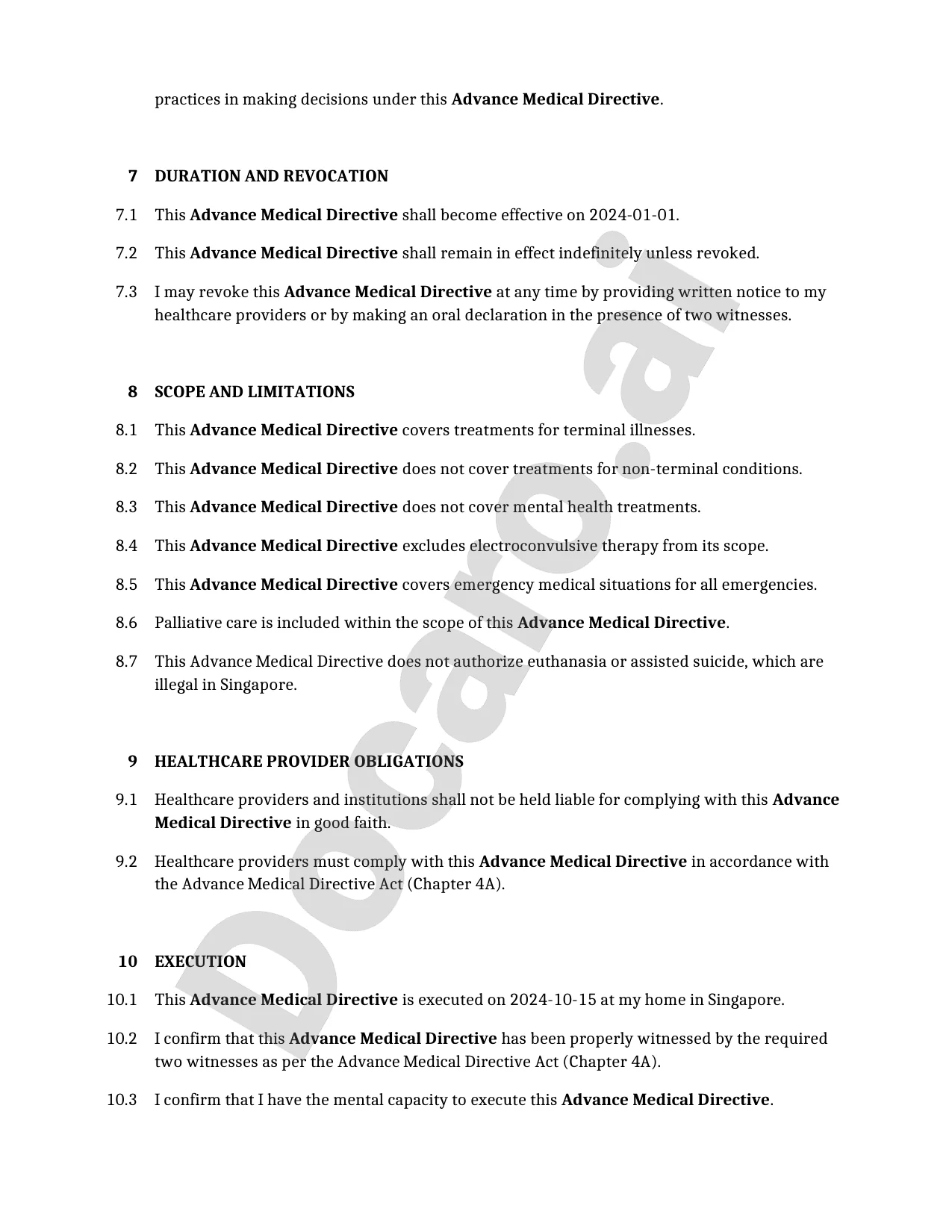
Witnessing requirements are crucial for validity: the AMD must be signed by the declarant in the presence of two witnesses who are not beneficiaries of the declarant's estate, and it should be registered with the Registry of Advance Medical Directives. For personalized and compliant AMD documents, consider using Docaro's AI-generated legal services to create bespoke versions tailored to individual needs.

What are the key rights and obligations under an Advance Medical Directive?
In Singapore, an individual creating an Advance Medical Directive (AMD) holds the fundamental right to refuse treatment, allowing them to specify in advance that they do not want life-sustaining treatments in situations of terminal illness or irreversible coma. This right empowers the person to maintain autonomy over their medical care, ensuring their wishes are respected even if they lose decision-making capacity.
Healthcare providers in Singapore have a legal obligation to honor a valid AMD, withholding or withdrawing specified treatments as directed, provided the directive is properly executed and witnessed under the Advance Medical Directive Act. Providers must also inform family members of the AMD's existence and implications, promoting transparency while adhering strictly to the patient's documented preferences.
Family members are not legally obligated to enforce or override an AMD in Singapore, but they must respect the patient's rights and cooperate with healthcare providers during end-of-life decisions. Legal protections under the Act safeguard against coercion, ensuring the AMD remains binding unless revoked by the individual while competent, and disputes can be resolved through ethical channels without court intervention in most cases.
- For personalized AMD documents, consider using Docaro's AI generation to create tailored legal forms compliant with Singapore's regulations.
Are there any recent or upcoming legal changes affecting Advance Medical Directives in Singapore?
The Advance Medical Directive Act in Singapore, enacted in 1996, has seen no recent amendments as of March 2026, with the most recent update to related guidelines occurring on 7 October 2025 by the Ministry of Health.
The witnessing process remains unchanged, requiring two witnesses: one must be a medical practitioner, and the other an adult over 21 years old who is not a family member, beneficiary, or holder of any interest in the directive maker's estate.
There are no upcoming changes or integrations with other healthcare directives like Lasting Power of Attorney, maintaining the law's stability for individuals planning end-of-life care.
For deeper insights into the benefits and legal implications of Advance Medical Directives in Singapore, explore this guide.
How do you create an Advance Medical Directive in Singapore?
1
Consult a Doctor
Discuss your medical wishes with a qualified doctor to understand options for an Advance Medical Directive (AMD) in Singapore.
2
Generate Document with Docaro
Use Docaro to create a bespoke AI-generated AMD document tailored to your specific needs and preferences.
3
Fill and Witness the Form
Complete the AMD form accurately, then have it witnessed by the doctor and another qualified witness as required.
4
Register with Registry of Wills
Submit the signed AMD to the Registry of Wills for official registration. Learn more in our [AMD Guide](/en-sg/a/how-to-create-advance-medical-directive-singapore-guide).
Creating an Advance Medical Directive (AMD) in Singapore involves consulting a qualified medical practitioner to discuss your healthcare preferences, followed by signing the document in the presence of two witnesses. The process ensures your wishes are clearly documented for end-of-life care, emphasizing the importance of personalized details to reflect your specific values and circumstances.
Potential costs for an AMD are generally low, with official forms available free of charge, though consultation fees with a doctor may range from S$50 to S$200 depending on the practitioner. For a more tailored approach, consider using Docaro to generate bespoke AI-assisted legal documents that complement the official template without replacing it.
Official AMD forms can be obtained from the Ministry of Health website or any public hospital in Singapore, such as Singapore General Hospital. Download the form directly from the Ministry of Health AMD page to start the process efficiently.
You Might Also Be Interested In
A Legal Document Specifying The Distribution Of A Person's Assets After Their Death.
A Legal Document Authorizing One Person To Act On Behalf Of Another In Specified Matters.
A Revocable Living Trust Is A Legal Arrangement Where A Person Transfers Assets Into A Trust During Their Lifetime, Retaining The Ability To Modify Or Revoke It, To Facilitate Asset Management And Avoid Probate.
A Legal Document Allowing Individuals To Specify Medical Treatments They Do Or Do Not Want If They Become Terminally Ill And Unable To Communicate.
A Codicil Is A Legal Document That Amends, Modifies, Or Supplements An Existing Will Without Revoking It Entirely.
A Legal Document Listing All Assets And Liabilities Of A Deceased Person's Estate For Probate And Administration Purposes.