Docaro

AI Generated Affidavit for use in Singapore
PDF & Word - 2026 Updated

A professional scene in a modern Singapore office building, showing a diverse group of adults, including a lawyer and a client, engaged in a serious discussion over a table with legal papers subtly in the background, symbolizing the preparation and signing of an affidavit for legal purposes.
Generate a customized AI affidavit for Singapore courts effortlessly, ensuring compliance with local legal standards and saving time on document preparation.
Free instant document creation.
Compliant with Singapore law.
No sign up or monthly subscription.

Docaro Pricing

Basic
Free
Document Generation
No Sign Up
No Subscription
Download Watermarked PDF
Premium
$4.99 USD
Document Generation
No Sign Up
No Subscription
Download Clean PDF
Download Microsoft Word
Download HTML
Download Text
Email Document
Generate your document for free. Only pay if you like the result and need an un-watermarked version.

When do you need an Affidavit in Singapore?

  • In Court Proceedings
    You need an affidavit to provide sworn facts or evidence to support your case in legal hearings or trials.
  • For Official Declarations
    Affidavits are required for making formal statements in matters like immigration, property disputes, or name changes.
  • In Business Matters
    Businesses use affidavits to confirm details in contracts, financial claims, or corporate registrations.
  • During Family Disputes
    In cases like divorce or child custody, affidavits help explain your side of the story to the court.
  • For Administrative Purposes
    Government agencies often require affidavits to verify information for licenses, permits, or benefits.
  • Importance of a Well-Drafted Affidavit
    A clear and accurate affidavit ensures your statements are taken seriously, avoids delays, and strengthens your legal position.

Singaporean Legal Rules for an Affidavit

  • What is an Affidavit?
    An affidavit is a written statement of facts that you swear or affirm to be true, used as evidence in legal proceedings.
  • Who Can Make It?
    Any person aged 21 or older who has personal knowledge of the facts can create an affidavit.
  • How to Swear or Affirm?
    You must swear on a holy book like the Bible or Quran, or make a non-religious affirmation, in front of an authorized person.
  • Who Can Witness It?
    A Commissioner for Oaths, notary public, or certain lawyers can witness and certify the affidavit.
  • Format Requirements
    The affidavit must be in the first person, clearly state the facts, and end with a jurat section for the witness's signature.
  • Language Used
    It must be written in English or officially translated if in another language.
  • Legal Consequences
    Making false statements in an affidavit is a criminal offense punishable by fines or imprisonment.
Important

Using the wrong format or structure for an affidavit can render it invalid or inadmissible in Singapore courts.

What a Proper Affidavit Should Include

  • Full Name and Identification
    State your complete name, address, and occupation to clearly identify yourself as the person making the statement.
  • True Statement Declaration
    Include a clear affirmation that everything in the affidavit is true to the best of your knowledge.
  • Detailed Facts
    Describe the relevant events or facts in a straightforward, chronological order without opinions or arguments.
  • Supporting Documents
    Mention and attach any exhibits like photos or letters that back up your statements, marking them clearly.
  • Signature and Date
    End with your signature, the date, and the place where you signed it.
  • Witness by Commissioner
    Have the affidavit witnessed and sworn before an authorized person, such as a commissioner for oaths in Singapore.

Why Free Templates Can Be Risky for Affidavits

Free affidavit templates often use generic language that doesn't comply with Singapore's specific legal requirements, such as those under the Oaths and Declarations Act. Inaccurate wording can lead to affidavits being rejected by courts, delayed proceedings, or even invalidated evidence in legal matters.

AI-generated bespoke affidavits are tailored to your exact situation, incorporating Singapore-specific legal standards, precise terminology, and customized details to ensure full compliance, reliability, and seamless acceptance in official proceedings.

Generate Your Bespoke Affidavit in 4 Easy Steps

1
Answer a Few Questions
Our AI guides you through the info required.
2
Generate Your Document
Docaro builds a bespoke document tailored specifically on your requirements.
3
Review & Edit
Review your document and submit any further requested changes.
4
Download & Sign
Download your ready to sign document as a PDF, Microsoft Word, Txt or HTML.

Why Use Our AI Affidavit Generator?

Fast Generation
Quickly generate a comprehensive Affidavit, eliminating the hassle and time associated with traditional document drafting.
Guided Process
Our user-friendly platform guides you step by step through each section of the document, providing context and guidance to ensure you provide all the necessary information for a complete and accurate Affidavit.
Safer Than Legal Templates
We never use legal templates. All documents are generated from first principles clause by clause, ensuring that your document is bespoke and tailored specifically to the information you provide. This results in a much safer and more accurate document than any legal template could provide.
Professionally Formatted
Your Affidavit will be formatted to professional standards, including headings, clause numbers and structured layout. No further editing is required. Download your document in PDF, Microsoft Word, TXT or HTML.
Compliance with Singaporean Law
Rest assured that all generated documents meet the latest legal standards and regulations of Singapore, enhancing trust and reliability.
Cost-Effective
Save money by generating legally sound Affidavit without the need for expensive legal services or consultations.
Get Started for Free - No Sign Up or Monthly Subscription Required
No payment or sign up is required to start generating your Affidavit. Generate and download a watermarked version of your document for free. Pay only if you want to remove the watermark and gain full access to your document. No monthly subscriptions or hidden fees. Pay once and use your document forever.
Need to Generate a Affidavit in a Different Country?
Choose country:

Free Example Affidavit Template

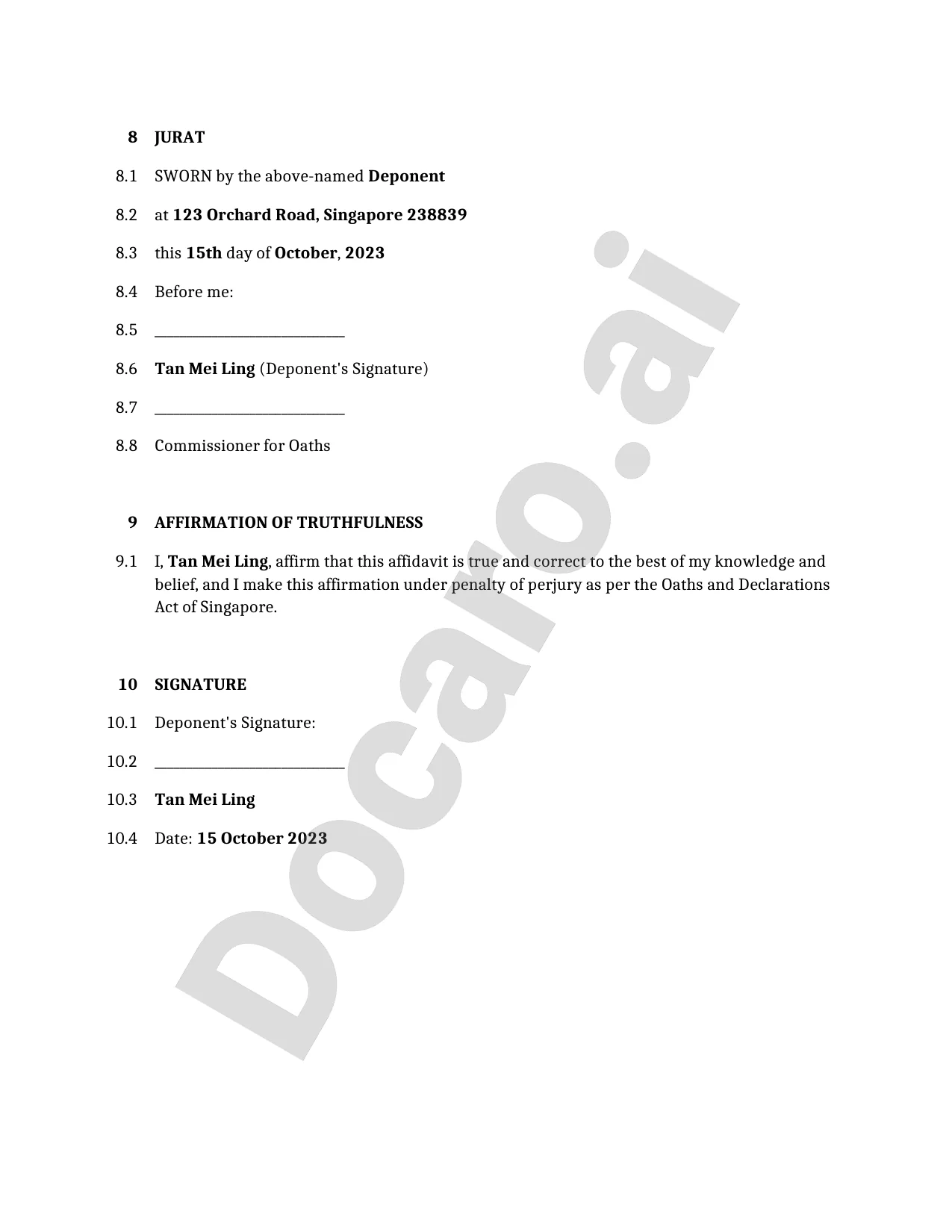
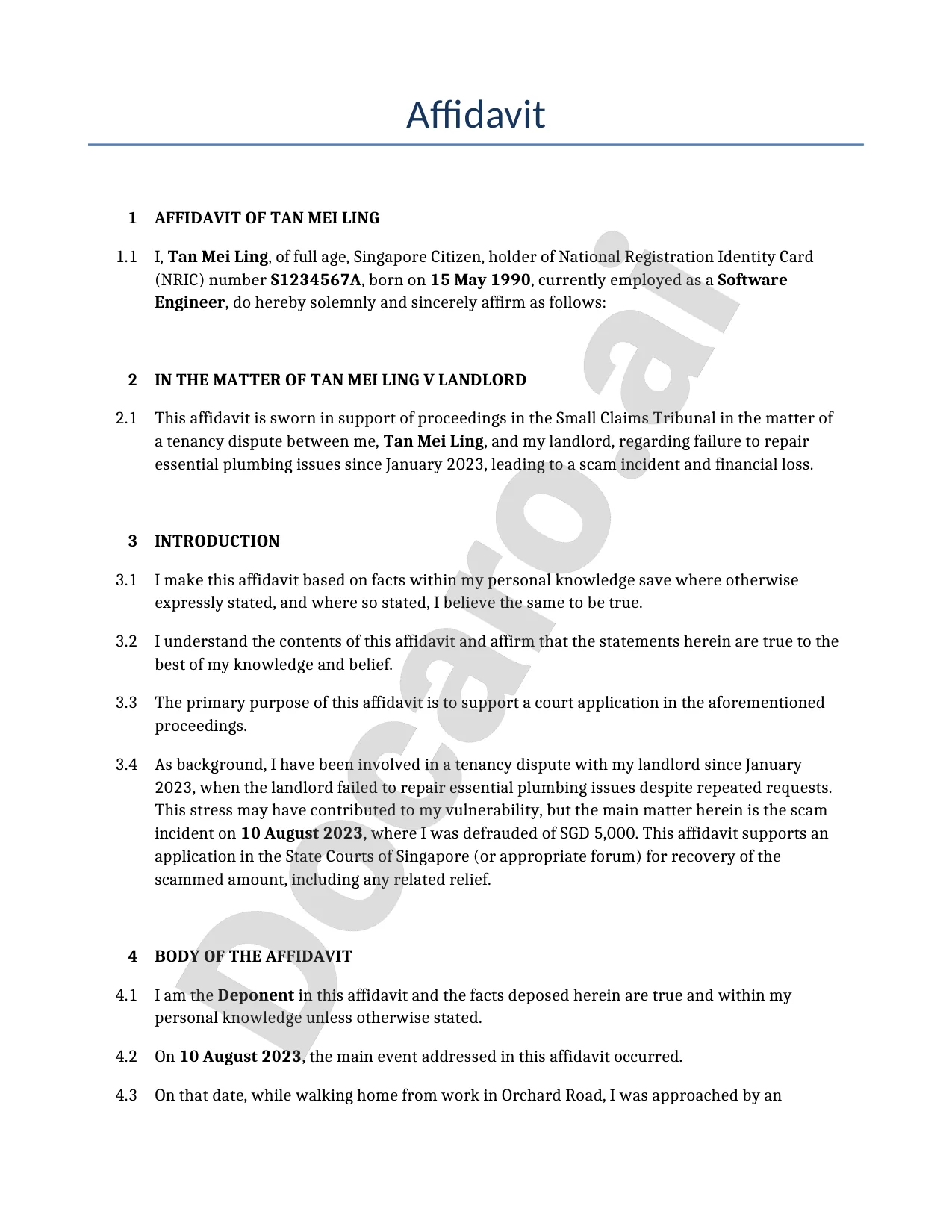
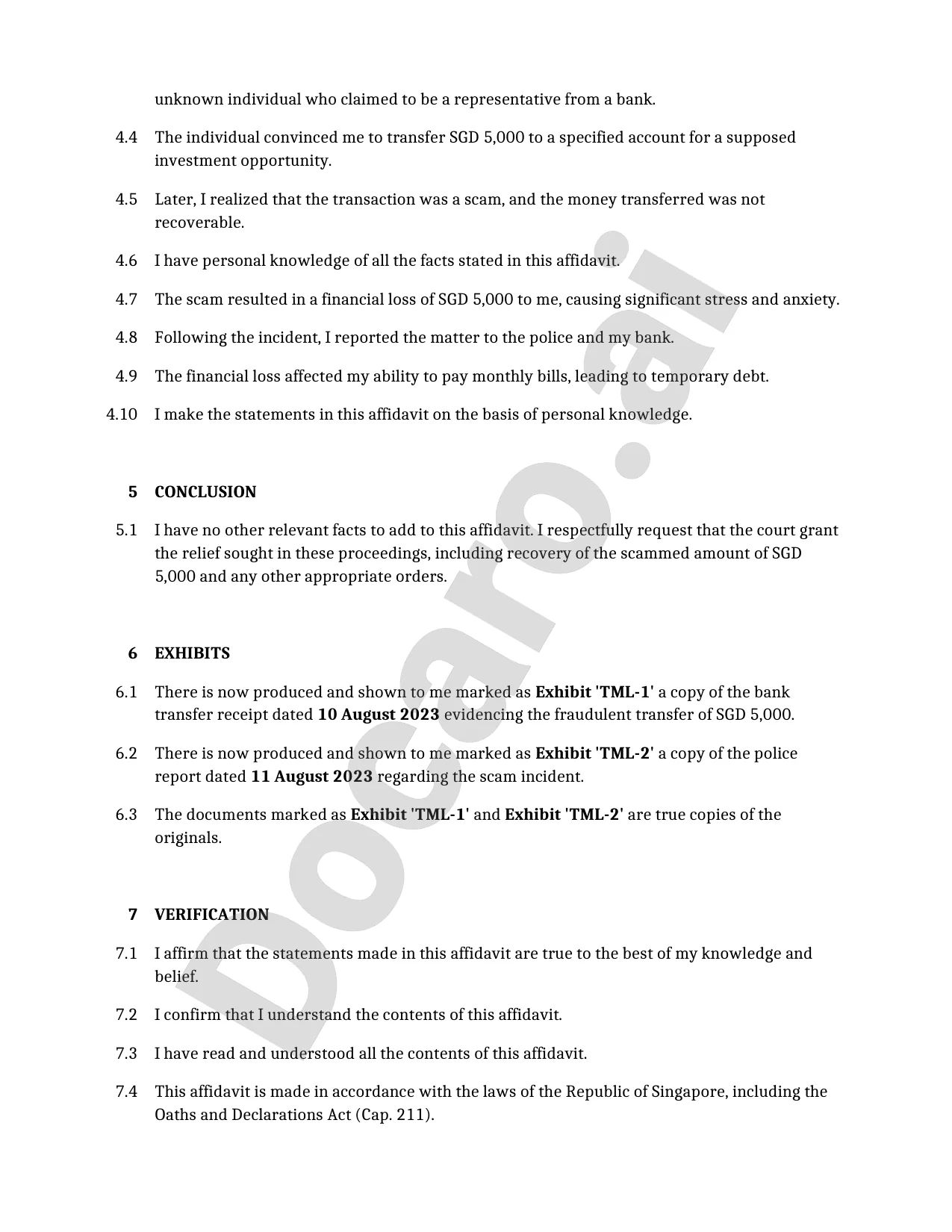
Below is a free template example of a Affidavit for use in Singapore generated by our AI model.

The clauses in your actual Affidavit will vary from this example as they will be entirely bespoke to your requirements as set out in the questionnaire you complete.
Page 1

Useful Resources When Considering a Affidavit in Singapore

JUDICIARY.GOV.SG
EPD2021-STATECOURTS.JUDICIARY.GOV.SG
EPD2021-SUPREMECOURT.JUDICIARY.GOV.SG

Singapore Compliance Legislation

Your AI Generated Affidavit will be checked for compliance against the following legislation and regulations:

What is an Affidavit in Singapore?

In Singapore law, an affidavit is a written statement of fact voluntarily made by an affiant or deponent under oath or affirmation, serving as verifiable evidence in legal proceedings. It is governed primarily by the Oaths and Declarations Act and is commonly used in courts, tribunals, and administrative matters to present sworn testimony without requiring the witness to appear in person.

The primary purpose of an affidavit in Singapore is to provide reliable, sworn information that can be relied upon by judges, lawyers, or authorities, ensuring the truthfulness of the contents through penalties for perjury. For instance, affidavits are essential in applications for injunctions, probate matters, or family law disputes, streamlining legal processes while maintaining evidentiary standards.

The basic structure of an affidavit typically includes a title indicating the court or proceeding, the affiant's full name and details, a numbered body containing the sworn facts in the first person, and a jurat section where the oath is administered by a commissioner for oaths or notary public. To understand how it differs from similar documents, read more in our guide on affidavit vs statutory declaration in Singapore.

For authoritative guidance on drafting affidavits, refer to the Oaths and Declarations Act on the Singapore Statutes Online portal. When preparing legal documents like affidavits, opt for bespoke AI-generated options through Docaro to ensure they are tailored precisely to your Singapore-specific needs.

When Should You Use an Affidavit in Singapore?

An affidavit in Singapore serves as a sworn written statement used to present facts under oath, often required in various legal contexts to support claims or evidence. It is particularly essential in court proceedings, where parties submit affidavits to outline facts for judges without oral testimony, as detailed on the Common Uses of Affidavits in Singapore Legal Proceedings page.

In property transactions, affidavits are commonly used to verify ownership details, declare marital status, or confirm no outstanding claims, ensuring smooth conveyancing processes under Singapore's land laws. For instance, buyers and sellers may need to file affidavits with the Singapore Land Authority to authenticate documents.

Immigration matters in Singapore frequently involve affidavits for applications like permanent residency or citizenship, where applicants swear to the truth of personal information and supporting facts. These are submitted to the Immigration & Checkpoints Authority to facilitate decisions on eligibility and compliance with residency requirements.

For all affidavit needs in Singapore, opt for bespoke AI-generated legal documents through Docaro to ensure they are tailored precisely to your situation, avoiding generic templates that may not meet specific legal standards.

When Should You Not Use an Affidavit?

An affidavit is a sworn statement used in legal proceedings, but it may not be suitable when the matter involves non-judicial purposes, such as personal declarations or administrative filings. In these cases, a statutory declaration is often preferred as it provides a formal but less court-oriented affirmation under penalty of perjury, commonly used for immigration or identity verification in Singapore.

For routine business or personal matters that do not require sworn testimony, simpler documents like letters or contracts suffice without the need for notarization. Opting for bespoke AI-generated legal documents via Docaro ensures tailored solutions that avoid unnecessary formalities while maintaining compliance.

When urgency or informality is key, such as in quick attestations for travel or employment, unsworn letters or emails may be adequate, bypassing the rigid structure of affidavits. Always consult authoritative Singapore resources, like the Singapore Judiciary guidelines on affidavits, to determine the appropriate document type for your needs.

"In Singaporean legal practice, affidavits should be reserved strictly for instances where sworn evidence is mandated by law, ensuring procedural integrity and avoiding unnecessary formalities," advises legal expert Prof. Tan Mei Ling. For tailored legal documents, consider bespoke AI-generated options via Docaro to meet your specific needs efficiently.
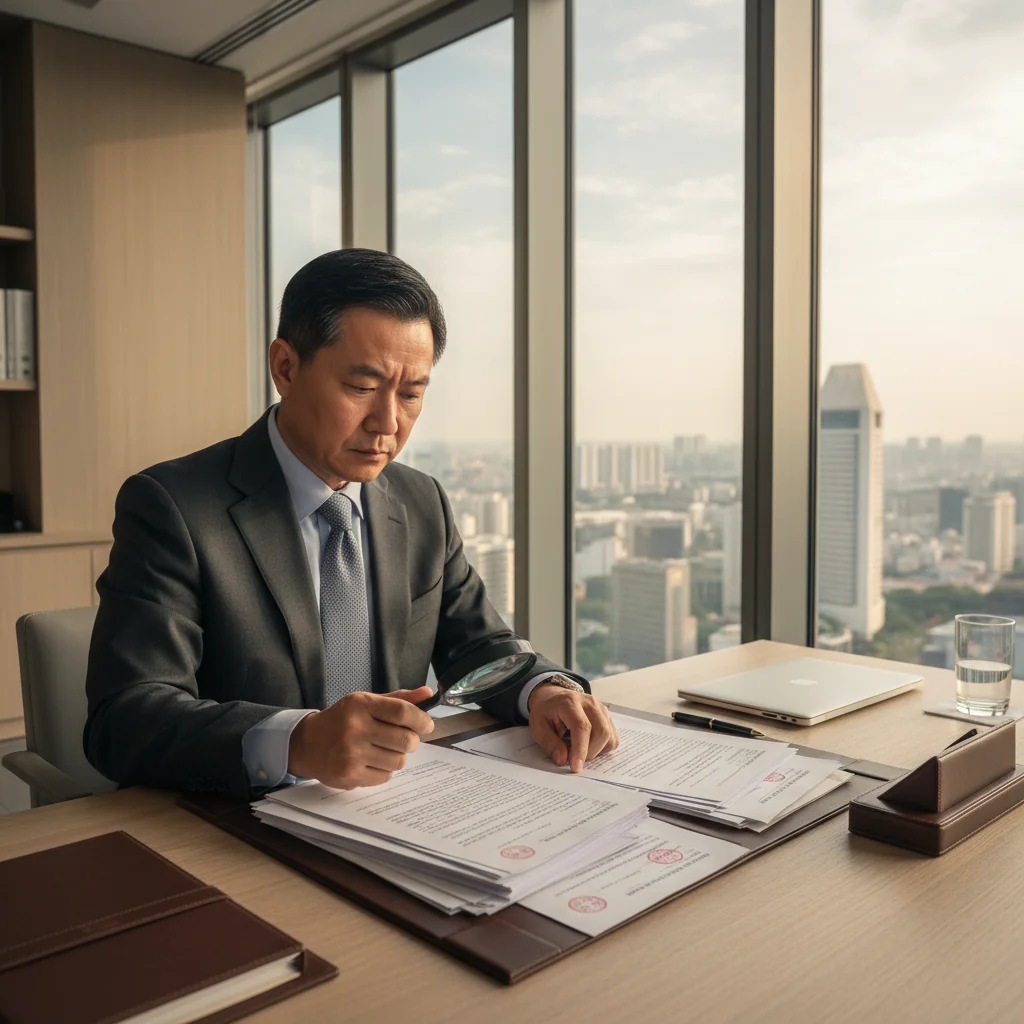
Singapore lawyer preparing affidavit

What Are the Key Clauses in a Singapore Affidavit?

An affidavit under Singapore law is a sworn written statement used in legal proceedings, and it must comply with the Oaths and Declarations Act. The essential clauses ensure its validity and admissibility in court, making it a key document in Singapore legal practice.

The deponent's details form the opening clause, identifying the person making the statement by including their full name, address, occupation, and a positive identification such as "I am the [role] in this matter." This section establishes the deponent's credibility and relevance, often followed by a statement confirming the truthfulness of the contents.

The body of the statement contains the substantive facts, presented in numbered paragraphs with clear, concise language in the first person, avoiding opinions unless qualified as such. For guidance on drafting, refer to the Oaths and Declarations Act on the Singapore Statutes Online website.

The jurat is the concluding clause, comprising the signature of the deponent, the date, and the certification by an authorized commissioner for oaths or notary public, attesting that the affidavit was sworn or affirmed. This formal verification is crucial for the document's legal enforceability in Singapore courts.

For creating customized affidavits tailored to specific needs, consider using bespoke AI-generated legal documents through Docaro, ensuring compliance with Singapore law while avoiding generic templates.

Key Rights and Obligations of the Deponent

The person making an affidavit in Singapore has a fundamental obligation to tell the truth, as sworn statements are made under oath or affirmation and subject to the laws against perjury. False information can lead to severe legal penalties, including fines or imprisonment, emphasizing the importance of accuracy in every detail provided.

Among the key rights of the affiant, there is the entitlement to seek legal advice before signing, ensuring the document aligns with personal circumstances and legal requirements. Consulting a qualified lawyer helps clarify any uncertainties and protects against unintended legal implications.

Affidavits must be properly executed, with the affiant's signature witnessed by an authorized person such as a Commissioner for Oaths. For detailed guidance on affidavit procedures in Singapore, refer to the Singapore Judiciary's official page on affidavits.

Signing affidavit in courtroom

Are There Key Exclusions in Affidavits?

Affidavits serve as sworn written statements in legal proceedings in Singapore, but they come with key exclusions and limitations to ensure reliability and admissibility. Primarily, affidavits must contain only facts within the personal knowledge of the deponent, excluding opinions, speculations, or irrelevant details that could undermine their evidentiary value.

One major limitation is the prohibition on hearsay evidence, which refers to out-of-court statements offered to prove the truth of the matter asserted. Hearsay is generally inadmissible unless specific exceptions apply, such as statements in public documents or those against the declarant's interest, as outlined in Singapore's Evidence Act.

Additionally, affidavits cannot include privileged information, like attorney-client communications, or defamatory content that could expose the deponent to liability. For authoritative guidance on affidavit requirements in Singapore, refer to the Evidence Act or consult resources from the State Courts of Singapore.

To create compliant affidavits, opt for bespoke AI-generated legal documents using Docaro, ensuring they are tailored to your specific case rather than relying on generic templates.

Notary witnessing affidavit signature

What Recent Legal Changes Affect Affidavits in Singapore?

Singapore has implemented significant updates to electronic filing for affidavits through the e-Litigation platform managed by the Supreme Court. These changes, effective from 2020, allow for the electronic submission and verification of affidavits, streamlining court processes and reducing paper usage while maintaining legal validity.

Amendments to the Oaths and Declarations Act in 2021 introduced provisions for remote witnessing of oaths via video conferencing, particularly in response to pandemic needs. This update enables affidavits to be sworn electronically, with guidelines available on the Supreme Court Rules of Court website.

For the latest on affidavit-related reforms, practitioners should consult the State Courts Practice Directions, which outline requirements for digital signatures and e-filing. These enhancements promote efficiency in Singapore's legal system, ensuring compliance with modern technological standards.

  • Key benefit: Faster processing times for electronic affidavits in civil proceedings.
  • Recommendation: Use bespoke AI-generated legal documents via Docaro for customized affidavit preparation tailored to Singapore law.

How Do You Get Started with Drafting an Affidavit in Singapore?

1
Consult a Lawyer and Review Guide
Schedule a consultation with a Singapore lawyer to understand affidavit requirements. Refer to the [How to Draft an Affidavit in Singapore: Step-by-Step Guide](/en-sg/a/how-to-draft-affidavit-singapore-step-by-step) for initial insights.
2
Gather Relevant Facts and Evidence
Collect all pertinent facts, documents, and evidence needed for your affidavit to ensure accuracy and completeness.
3
Use Docaro for Bespoke Drafting
Employ Docaro to generate a customized AI-powered affidavit draft based on your specific details and lawyer's advice.
4
Review and Finalize with Professional
Review the Docaro-generated draft with your lawyer, make necessary revisions, and prepare for swearing or affirmation.

Affidavit FAQs

An affidavit in Singapore is a sworn written statement of fact, voluntarily made by an individual known as the deponent or affiant. It is used as evidence in legal proceedings and must be witnessed by a Commissioner for Oaths or notary public to ensure its validity under Singapore law.

Document Generation FAQs

Docaro is an AI-powered legal and corporate document generator that helps you create fully formatted, legally sound contracts and agreements in minutes. Just answer a few guided questions and download your document instantly.
You Might Also Be Interested In
A Legally Binding Contract Where Parties Resolve A Dispute Without Court Proceedings, Outlining Terms Of Compromise.
A Legally Binding Document Recording The Terms Of A Settlement Reached Through Mediation In Singapore.
A Contract Where Parties Agree To Resolve Disputes Through Arbitration Rather Than Litigation.
A Formal Legal Notice Requiring The Recipient To Stop An Alleged Illegal Activity And Refrain From Future Violations.
A Formal Letter Sent To Demand Payment, Compliance, Or Resolution Of A Dispute Before Pursuing Legal Action.
A Legal Document Where One Party Agrees To Waive Claims Against Another For Potential Damages Or Injuries.
A Legal Document Where Parties Mutually Agree To Release Each Other From Claims, Obligations, Or Liabilities.
A Formal Notice Sent To A Debtor Demanding Payment Or Resolution Of A Dispute Before Initiating Legal Proceedings.

Related Articles

A photorealistic image of a professional adult in a modern Singapore office, sitting at a desk with a focused expression while writing on a notepad, symbolizing the careful preparation of legal statements. The background includes subtle Singaporean elements like a city skyline view, ensuring no children are present and emphasizing trustworthiness and formality.
Learn how to draft an affidavit in Singapore with our detailed step-by-step guide. Understand the format, requirements, and legal tips for creating a valid affidavit for court or official use.
A photorealistic image of a professional adult lawyer in a modern Singapore courtroom, standing confidently and discussing a case with colleagues, symbolizing the use of affidavits in legal proceedings. The scene captures the essence of legal testimony and evidence without showing any documents.
Explore the common uses of affidavits in Singapore legal proceedings, including civil cases, family law, and court applications. Learn how sworn statements support evidence and streamline processes.
A photorealistic image of a professional adult in a modern Singapore office setting, thoughtfully reviewing important documents on a desk, symbolizing trust and legal affirmation in a formal context, with no children present.
Discover the key differences between an affidavit and a statutory declaration in Singapore. Learn their legal uses, requirements, and when to use each for your legal needs.