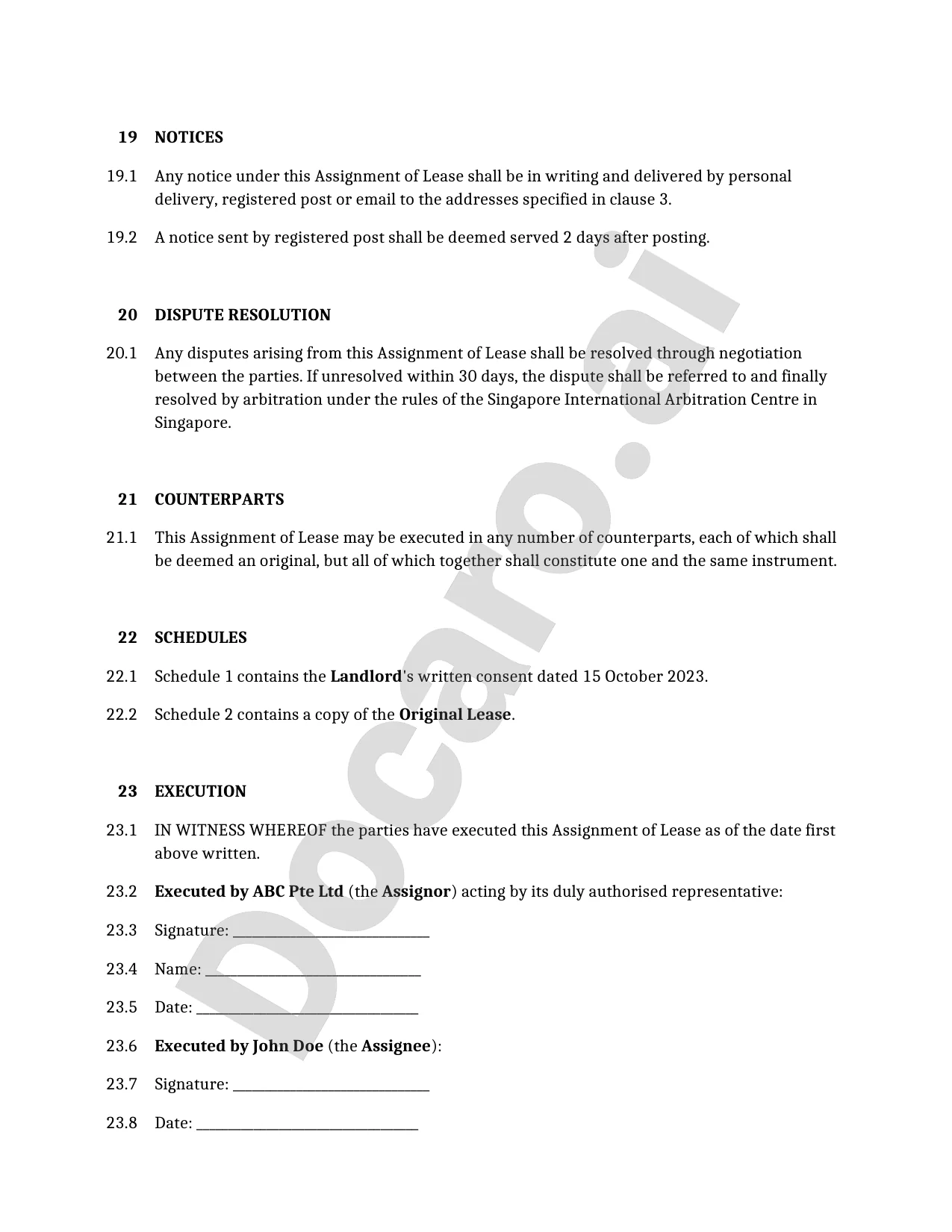
Why Free Templates Can Be Risky for Assignment of Lease
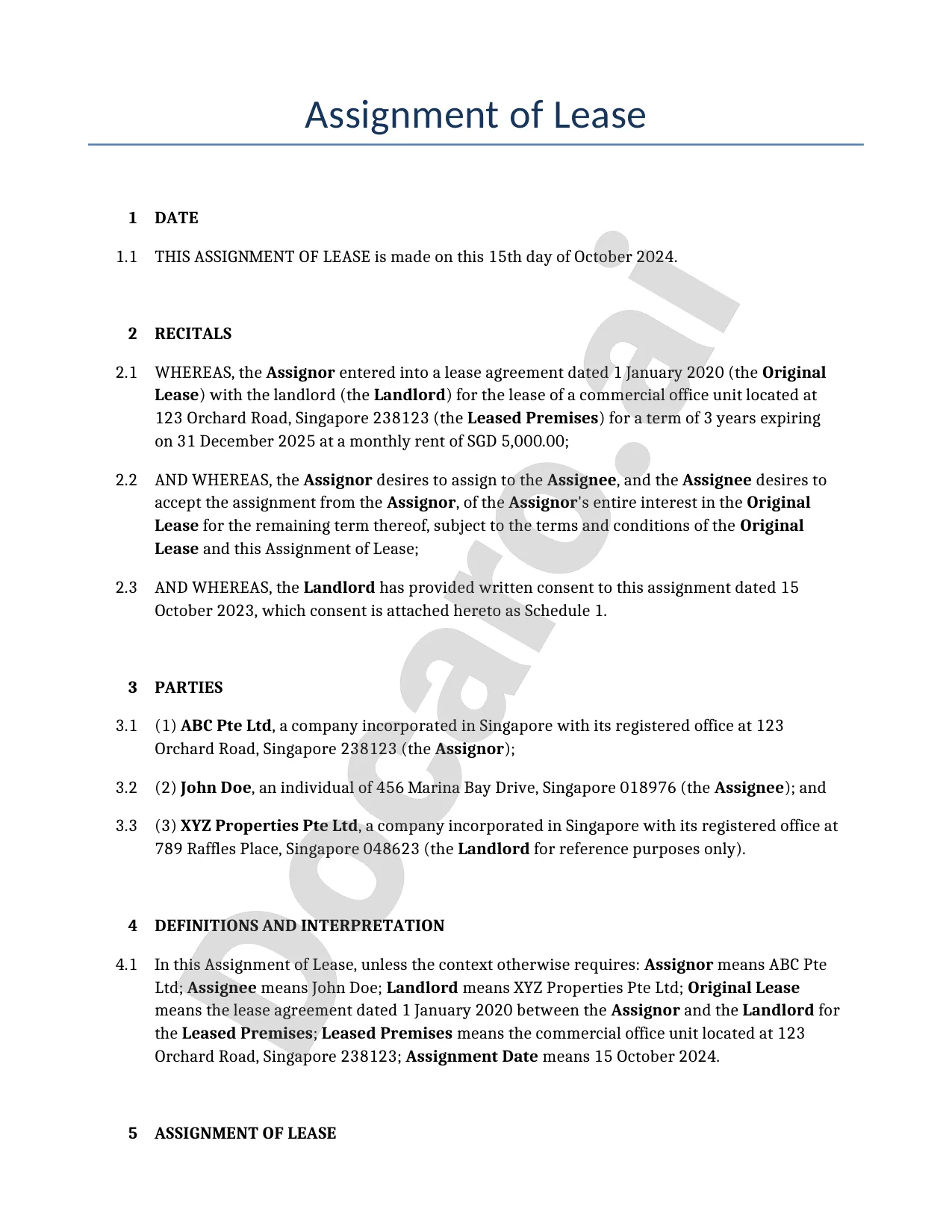
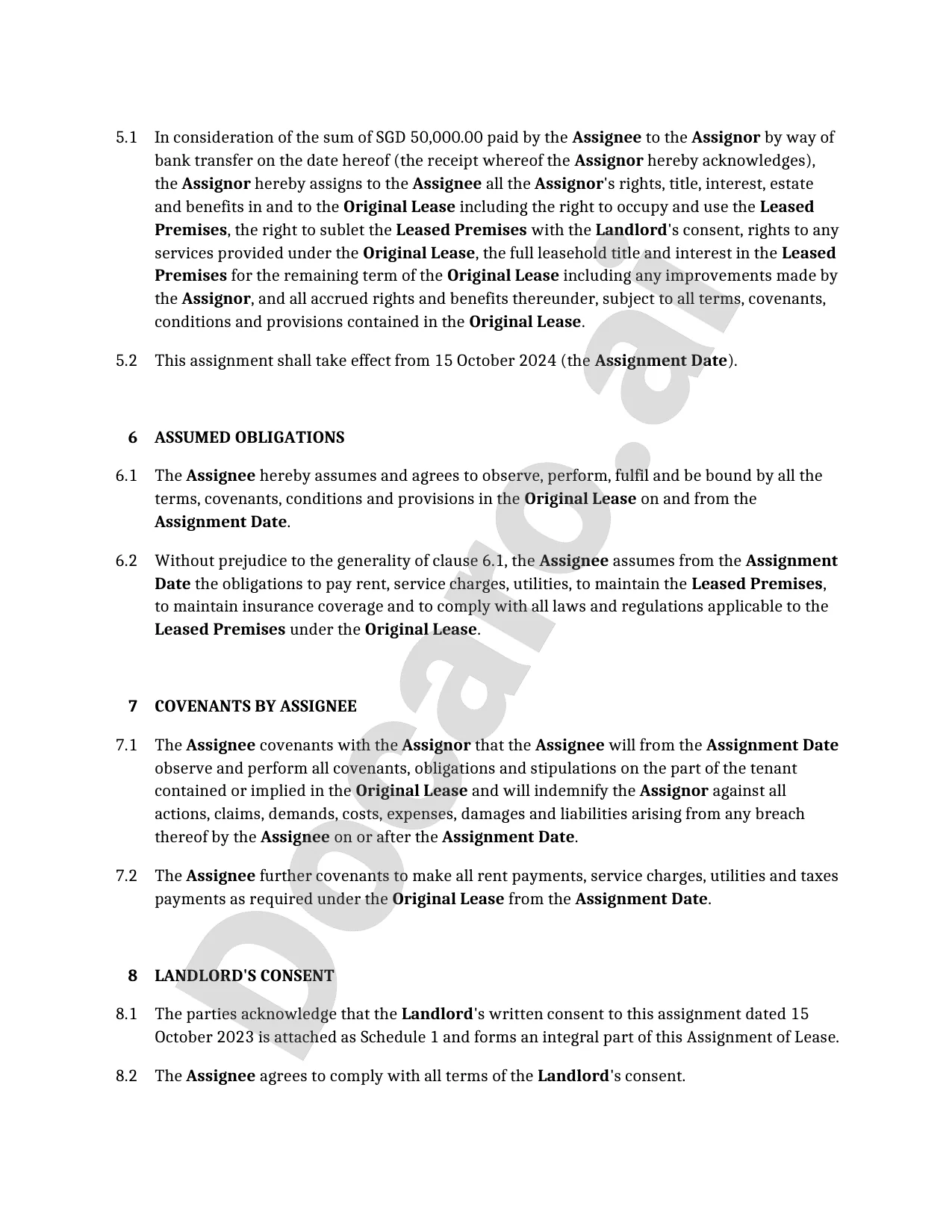
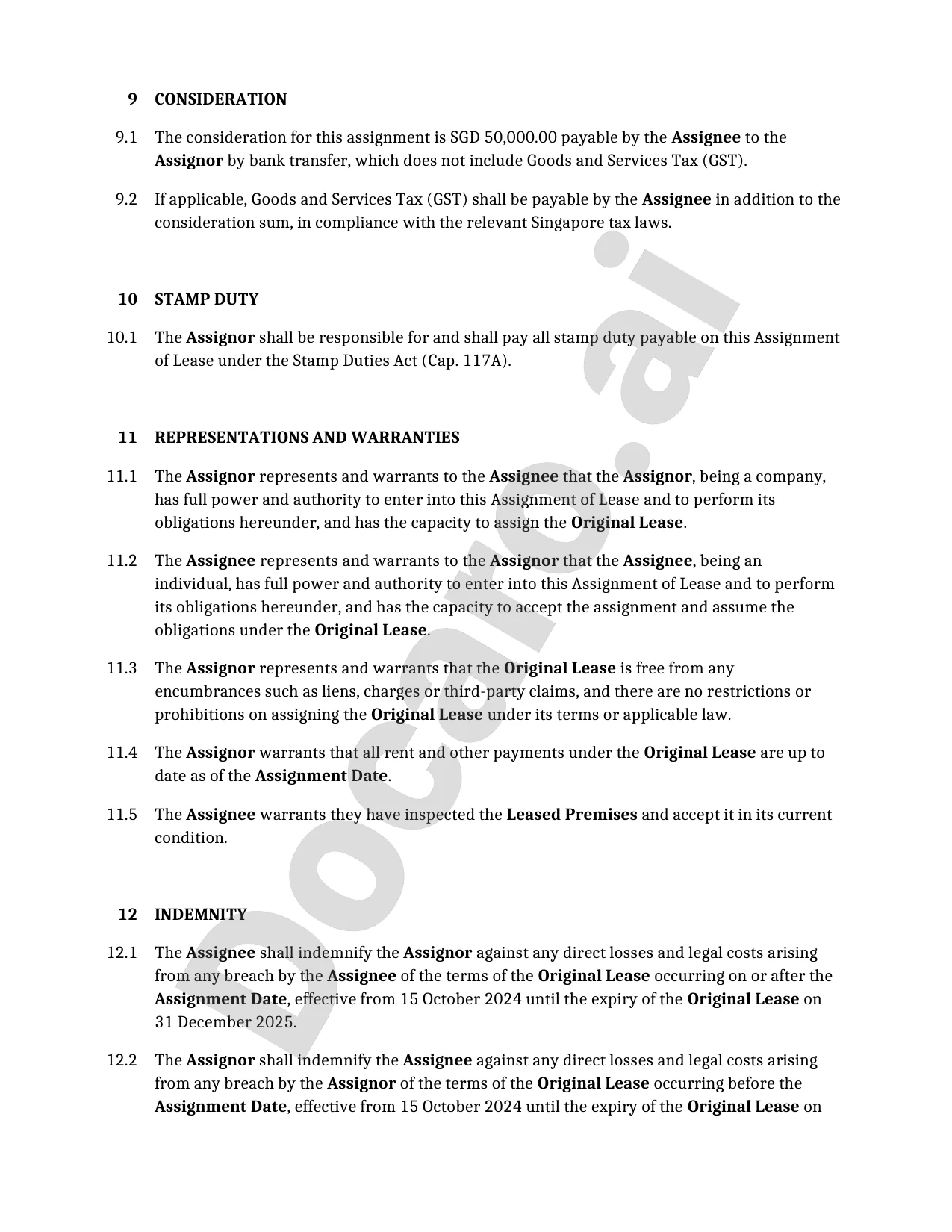
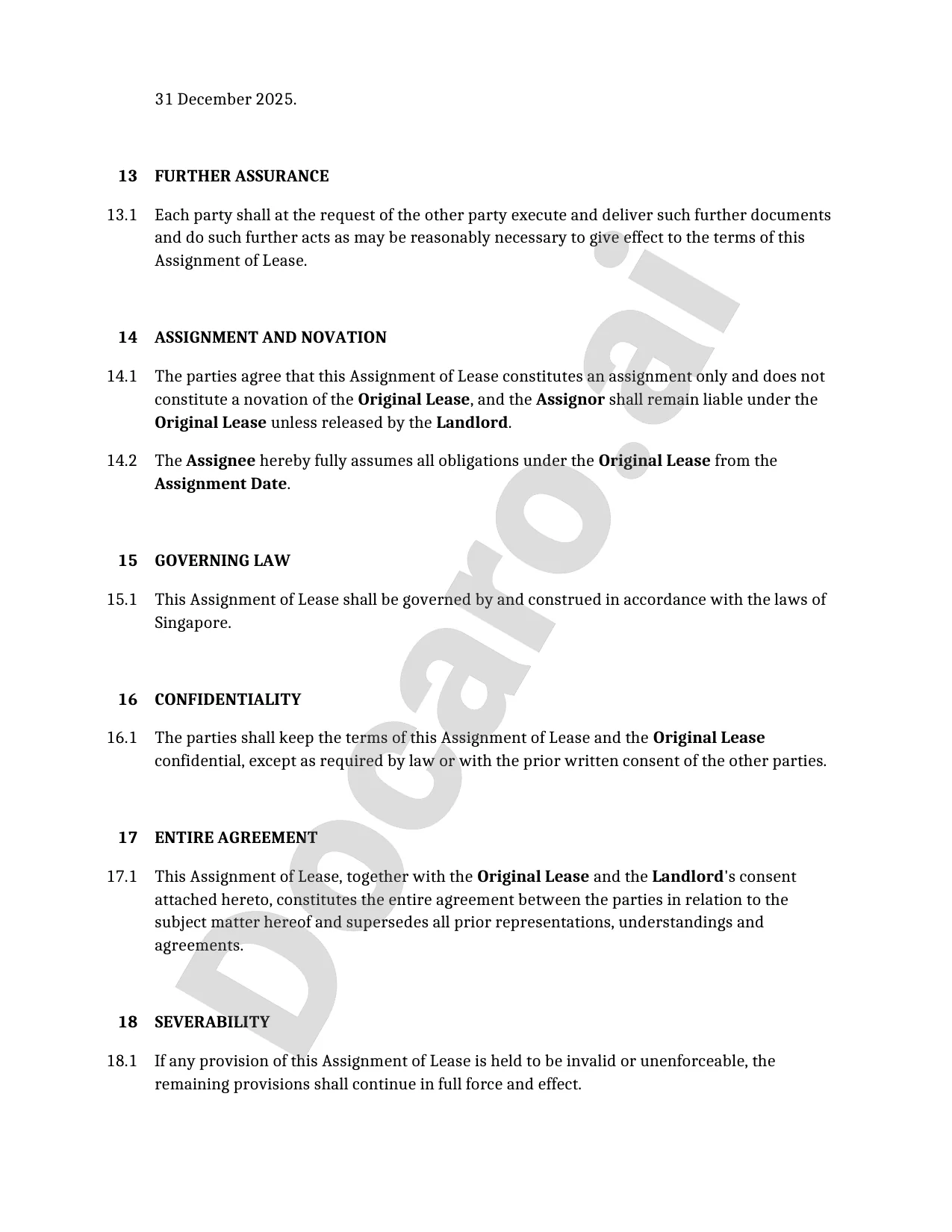
Free templates for lease assignments often overlook Singapore-specific laws on novation, landlord consents, and indemnity clauses. Using generic wording can lead to disputes over ongoing liabilities, invalid transfers, or non-compliance with the Conveyancing and Law of Property Act, exposing you to unexpected costs or legal challenges.
Our AI generates bespoke commercial lease assignment agreements tailored to your exact details and Singapore regulations, ensuring precise language for seamless novation, clear liability shifts, and full compliance, saving you time and reducing risks compared to one-size-fits-all templates.
What is an Assignment of Lease in Singapore?
In Singapore property law, an assignment of lease refers to the process where the current tenant, known as the assignor, transfers their entire interest in a lease agreement to a new tenant, called the assignee. This transfer effectively hands over the remaining lease term, allowing the assignee to step into the assignor's position as the tenant of the property.
The assignment of lease transfers all rights and obligations from the assignor to the assignee, including the right to occupy the property and the duty to pay rent and comply with lease terms. However, the original landlord must typically consent to the assignment, and the assignor may remain liable to the landlord for any breaches by the assignee unless a release is obtained.
To ensure a smooth lease assignment in Singapore, parties should review the lease agreement for any specific clauses on assignments and seek professional legal advice. For more details, refer to the Understanding Assignment of Lease in Singapore: A Comprehensive Guide.
- Key benefits include freeing the assignor from ongoing responsibilities while providing the assignee with immediate tenancy rights.
- Common pitfalls involve failing to secure landlord approval, which could invalidate the transfer.
- Advocate for bespoke AI-generated legal documents using Docaro to tailor agreements precisely to your needs, avoiding generic templates.
"Proper lease assignment is crucial to prevent disputes; always consult a qualified legal expert to ensure all terms are clearly documented and parties' rights are protected." - Dr. Lim Wei Shen, Senior Partner, Singapore Law Firm. For tailored solutions, generate bespoke AI-powered legal documents using [Docaro lease assignment](https://docaro.com/lease-assignment).
When Should You Use an Assignment of Lease Document in Singapore?
An assignment of lease is appropriate when a tenant needs to transfer their entire lease interest to another party, such as during a sudden relocation for a job opportunity in another city. This allows the original tenant to exit the lease obligations while ensuring the property remains occupied.
Business changes, like selling a company or downsizing operations, often necessitate a lease assignment to pass the rental agreement to a new entity or buyer. In these scenarios, the assignee assumes all rights and responsibilities under the lease terms.
Common situations also include financial hardships or personal circumstances where the tenant can no longer fulfill the lease, making assignment a viable option to avoid penalties. Always consult a real estate attorney or legal professional to navigate landlord approvals and ensure compliance with local laws.
For creating tailored lease assignment documents, consider using Docaro's AI-generated legal tools for customized solutions that fit your specific needs, rather than generic options.
When Should You Not Use It?
Assignment of a lease is not suitable in situations like short-term subletting, where the original tenant intends to temporarily transfer possession without permanently relinquishing their leasehold interest. In such cases, subletting allows the tenant to retain control and potential liability, making assignment inappropriate for brief arrangements.
Leases often include clauses that prohibit assignments without landlord consent, rendering assignment unsuitable if the tenant fails to obtain prior approval. These restrictions protect landlords from undesirable tenants and ensure lease terms remain intact, so bypassing them can lead to eviction or legal disputes.
Key exclusions in lease agreements may void assignments in certain cases, such as when the assignee's financial stability is inadequate or if the assignment occurs during a period of default by the original tenant. Review these provisions carefully to avoid invalidating the transfer and facing penalties.

What Are the Key Rights and Obligations in an Assignment of Lease?
In an assignment of lease, the assignee gains primary rights including possession and use of the property for the remaining lease term, allowing them to occupy and utilize the premises as the original tenant would.
The assignee assumes key obligations such as paying rent, adhering to lease covenants, and maintaining the premises in good condition to comply with the landlord's requirements.
The assignor may retain ongoing liability for lease performance if the landlord does not provide a full release, meaning they could be held responsible for any defaults by the assignee, such as unpaid rent or property damage.
For tailored assignment of lease agreements, consider using Docaro to generate bespoke AI-powered legal documents that fit your specific needs and jurisdiction.
1
Review Original Lease
Examine the original lease agreement to identify clauses on assignment, transfer restrictions, and any required consents from the landlord.
2
Analyze Rights and Obligations
Determine the assignor's rights to transfer the lease and the assignee's obligations to assume all terms, including rent and maintenance.
3
Document Using Docaro
Generate bespoke legal documents via Docaro AI to outline assignment terms, ensuring all parties' rights and duties are clearly specified.
4
Verify Compliance and Sign
Review the documented assignment for legal compliance, obtain necessary approvals, and have all parties sign the bespoke Docaro-generated agreement.
What Key Clauses Should Be Included in an Assignment of Lease Document?
In Singapore lease assignment agreements, the assignment clause is fundamental, outlining the transfer of the tenant's leasehold interest to a new assignee while ensuring the original tenant remains liable unless explicitly released under the State Lands Act or tenancy agreements. This clause must comply with Singapore's Conveyancing and Law of Property Act, requiring landlord consent to avoid invalidation, and should specify conditions like the assignee assuming all obligations to mitigate disputes.
The indemnity provisions protect parties by requiring the assignee to compensate the assignor for any breaches post-assignment, tailored to Singapore law which emphasizes clear contractual intent under the Misrepresentation Act. These provisions safeguard against future claims, such as unpaid rents or damages, and are crucial in commercial leases governed by the Landlord and Tenant Act to ensure financial security.
Landlord consent is a mandatory requirement in Singapore for valid lease assignments, as per standard clauses in tenancy agreements and reinforced by case law like Paragon Asia Ltd v Foo Peng Kwang, necessitating written approval to prevent the lease from being deemed a subletting. Parties should include provisions for obtaining this consent promptly, often with a fee, to facilitate smooth commercial property transfers in Singapore's real estate market.
Representations about lease status assure that the lease is valid, subsisting, and free from encumbrances, complying with Singapore's Land Titles Act by warranting no undisclosed defaults or disputes. These warranties, including confirmation of rent payments and compliance with lease terms, build trust and are essential for due diligence in Singapore property law, reducing litigation risks.
For comprehensive protection, opt for bespoke AI-generated legal documents via Docaro, ensuring clauses are customized to your specific Singapore lease assignment needs rather than relying on generic forms.
Are There Recent or Upcoming Legal Changes Affecting Lease Assignments in Singapore?
As of March 2026, there have been no major amendments to the Conveyancing and Law of Property Act (CLPA) specifically targeting lease assignments in Singapore since the last revisions in 2021 and minor rules updates in 2022.
The CLPA continues to govern key aspects of property transactions, including provisions under Section 17 that limit fines for landlord consent on assignments, ensuring no unreasonable sums beyond reasonable expenses are demanded for lease assignment approvals.
However, the recently enacted Electronic Conveyancing and Other Matters Act 2025, assented to in November 2025, introduces significant reforms by enabling electronic execution of deeds for property transfers, which will streamline lease assignments and other conveyancing processes once fully implemented.
For handling Singapore lease assignments, professionals are encouraged to use bespoke AI-generated legal documents via Docaro to ensure compliance with current regulations and upcoming digital changes.
What Is the Step-by-Step Process for Preparing an Assignment of Lease Document?
Assigning a lease in Singapore involves a structured preparation process to ensure a smooth transfer of tenancy rights from the current tenant to a new assignee. This begins with reviewing the original lease agreement for any assignment clauses and obtaining the landlord's consent, which is often mandatory under Singapore's tenancy laws.
For full guidance, refer to the Step-by-Step Process for Assigning a Lease in Singapore, which outlines key stages including due diligence on the assignee's financial stability and negotiation of terms. Preparation tips include conducting thorough background checks and documenting all communications to mitigate potential disputes.
When drafting lease assignment documents in Singapore, prioritize clarity and specificity to cover liabilities, deposit handling, and post-assignment obligations. Advocate for bespoke AI-generated legal documents using Docaro to tailor agreements precisely to your situation, ensuring compliance with local regulations without relying on generic templates.
- Verify the assignee's creditworthiness through references and financial statements.
- Include provisions for prorated rent and any outstanding fees in the assignment deed.
- Consult a legal professional to review the final draft before execution.
Common Pitfalls to Avoid
In Singapore, lease assignments require obtaining explicit consent from the landlord or property owner, as stipulated under the Conveyancing and Law of Property Act. Failure to secure this landlord consent can render the assignment invalid, exposing parties to potential eviction or legal disputes.
Another critical legal requirement is the proper stamping of the assignment deed within 14 days of execution to comply with the Stamp Duties Act, avoiding penalties up to 10 times the unpaid duty. Common pitfalls include overlooking implied covenants in the original lease, which may transfer liabilities like repairs or insurance to the assignee if not clearly addressed.
To navigate these complexities in lease assignments in Singapore, parties should ensure all necessary third-party consents, such as from mortgagees, are documented to prevent future challenges. For tailored solutions, opt for bespoke AI-generated legal documents via Docaro to mitigate risks effectively.
Explore detailed guidance on legal requirements and pitfalls in lease assignments in Singapore for comprehensive insights.
You Might Also Be Interested In
A Legal Contract Outlining The Terms For Renting Commercial Property In Singapore.
A Legal Contract Outlining The Terms For Leasing Retail Space To A Tenant For Commercial Use.
A Legal Document Allowing A Commercial Tenant To Lease Out Part Or All Of Their Rented Space To Another Party, With The Original Tenant Remaining Responsible To The Landlord.
A Legal Document That Extends Or Renews The Term Of An Existing Commercial Property Lease Between Landlord And Tenant.
A Preliminary Document Outlining The Key Terms And Intentions Of Parties For A Lease Agreement, Often Non-binding Except For Certain Clauses.
A Legal Contract Outlining The Terms For Renting Office Space, Including Duration, Rent, And Responsibilities Of Landlord And Tenant.
A Legal Contract Outlining The Terms For Leasing A Warehouse Space, Including Rent, Duration, And Responsibilities Of Landlord And Tenant.
A Legal Writ Issued By The Court In Singapore To Enforce The Eviction Of Tenants From Commercial Premises Following A Successful Possession Order.