Docaro

AI Generated Letter of Intent for use in Singapore
PDF & Word - 2026 Updated

A photorealistic image of two professional adults in business attire shaking hands across a modern conference table in a sleek Singapore office, symbolizing agreement and intent in a business deal, with a subtle view of the Singapore skyline through the window in the background, conveying trust and partnership without focusing on any documents.
Generate a customized AI-powered Letter of Intent tailored for Singapore business transactions, ensuring compliance with local legal standards and streamlining your agreement process.
Free instant document creation.
Compliant with Singapore law.
No sign up or monthly subscription.

Docaro Pricing

Basic
Free
Document Generation
No Sign Up
No Subscription
Download Watermarked PDF
Premium
$4.99 USD
Document Generation
No Sign Up
No Subscription
Download Clean PDF
Download Microsoft Word
Download HTML
Download Text
Email Document
Generate your document for free. Only pay if you like the result and need an un-watermarked version.

When do you need a Letter of Intent in Singapore?

  • Starting Business Deals
    Use it to outline the basics of a potential partnership or transaction before signing a full contract.
  • Buying or Selling Property
    It helps show serious interest in a real estate deal and sets out key terms like price and timeline.
  • Hiring New Employees
    Apply it to express intent to offer a job and highlight main conditions to attract top talent.
  • Negotiating Agreements
    It clarifies everyone's expectations early on, reducing the chance of misunderstandings later.
  • Why a Well-Drafted One Matters
    A clear and proper letter protects your interests, builds trust, and can prevent costly disputes in Singapore.

Singaporean Legal Rules for a Letter of Intent

  • Not Always Binding
    A letter of intent is usually not legally enforceable unless it clearly states that it creates a binding agreement.
  • Intent Matters Most
    Courts in Singapore look at the overall purpose and wording to decide if the letter creates legal obligations.
  • Clear Terms Help Avoid Issues
    Include specific details on what each party agrees to do in order to reduce the chance of misunderstandings.
  • Confidentiality Can Be Enforced
    If the letter includes a promise to keep information private, that part can be legally binding even if the rest is not.
  • Seek Legal Advice
    Always consult a Singapore lawyer to ensure the letter fits your specific situation and complies with local laws.
  • Governed by Contract Law
    Letters of intent follow general Singapore contract rules, which require clear agreement and consideration for binding effect.
Important

Using a letter of intent that is too binding may inadvertently create a legally enforceable contract instead of a non-binding preliminary agreement.

What a Proper Letter of Intent Should Include

  • Parties Involved
    Clearly state the names and details of the buyer and seller to identify everyone in the agreement.
  • Property Description
    Provide a simple description of the property, including its location and key features, to specify what is being discussed.
  • Purchase Price and Payment Terms
    Outline the agreed price and how and when payments will be made, such as deposits or instalments.
  • Key Conditions
    List any important requirements that must be met for the deal to proceed, like financing approval or inspections.
  • Timeline and Deadlines
    Set out the expected dates for steps like signing the final contract or completing the purchase.
  • Exclusivity Period
    Specify a time frame during which the seller agrees not to negotiate with others, giving the buyer priority.
  • Confidentiality
    Agree to keep the details of the discussions private to protect sensitive information.
  • Signatures
    Include spaces for both parties to sign and date, showing their commitment to the letter.

Why Free Templates Can Be Risky for Letter of Intent

Free templates for letters of intent often use generic language that fails to address Singapore-specific legal requirements, such as compliance with the Contracts Act or proper formation of binding agreements. This can lead to unenforceable terms, disputes over intent, or unintended obligations that expose parties to financial risks or litigation.

Our AI-generated bespoke letters of intent are customized to your specific details and tailored to Singapore's legal framework, ensuring precise wording that clearly defines intentions, minimizes ambiguities, and provides a robust foundation for negotiations or agreements.

Generate Your Bespoke Letter of Intent in 4 Easy Steps

1
Answer a Few Questions
Our AI guides you through the info required.
2
Generate Your Document
Docaro builds a bespoke document tailored specifically on your requirements.
3
Review & Edit
Review your document and submit any further requested changes.
4
Download & Sign
Download your ready to sign document as a PDF, Microsoft Word, Txt or HTML.

Why Use Our AI Letter of Intent Generator?

Fast Generation
Quickly generate a comprehensive Letter of Intent, eliminating the hassle and time associated with traditional document drafting.
Guided Process
Our user-friendly platform guides you step by step through each section of the document, providing context and guidance to ensure you provide all the necessary information for a complete and accurate Letter of Intent.
Safer Than Legal Templates
We never use legal templates. All documents are generated from first principles clause by clause, ensuring that your document is bespoke and tailored specifically to the information you provide. This results in a much safer and more accurate document than any legal template could provide.
Professionally Formatted
Your Letter of Intent will be formatted to professional standards, including headings, clause numbers and structured layout. No further editing is required. Download your document in PDF, Microsoft Word, TXT or HTML.
Compliance with Singaporean Law
Rest assured that all generated documents meet the latest legal standards and regulations of Singapore, enhancing trust and reliability.
Cost-Effective
Save money by generating legally sound Letter of Intent without the need for expensive legal services or consultations.
Get Started for Free - No Sign Up or Monthly Subscription Required
No payment or sign up is required to start generating your Letter of Intent. Generate and download a watermarked version of your document for free. Pay only if you want to remove the watermark and gain full access to your document. No monthly subscriptions or hidden fees. Pay once and use your document forever.
Need to Generate a Letter of Intent in a Different Country?
Choose country:

Free Example Letter of Intent Template

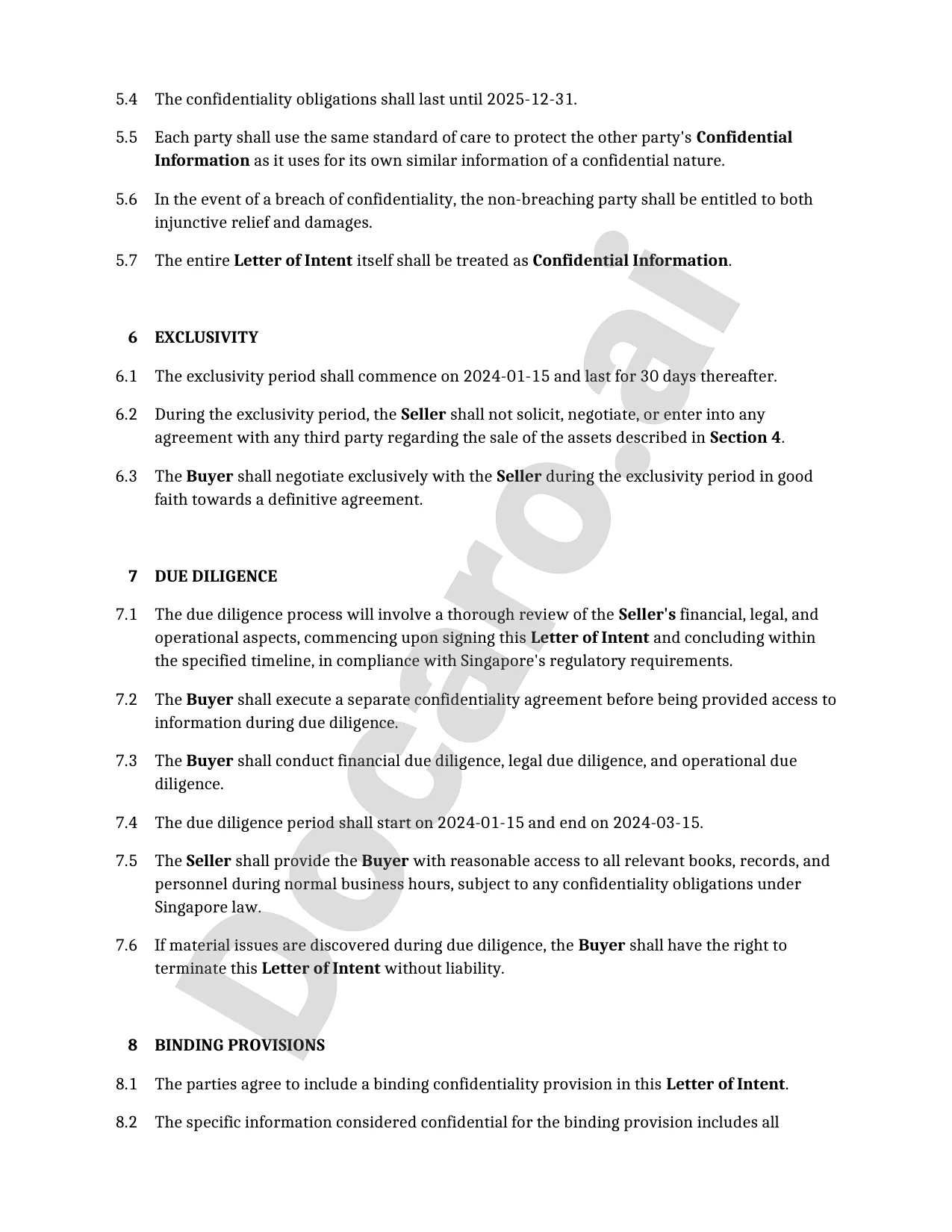
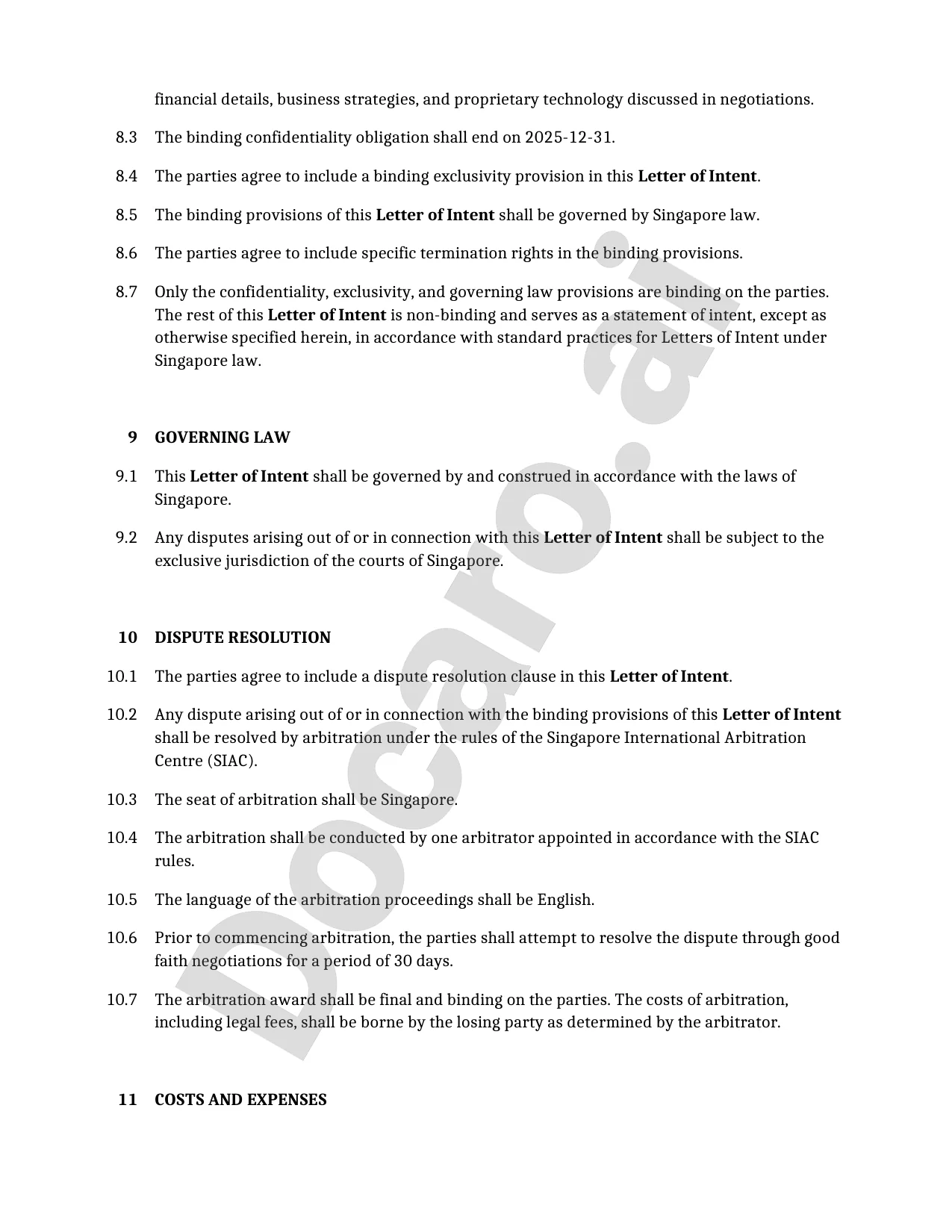
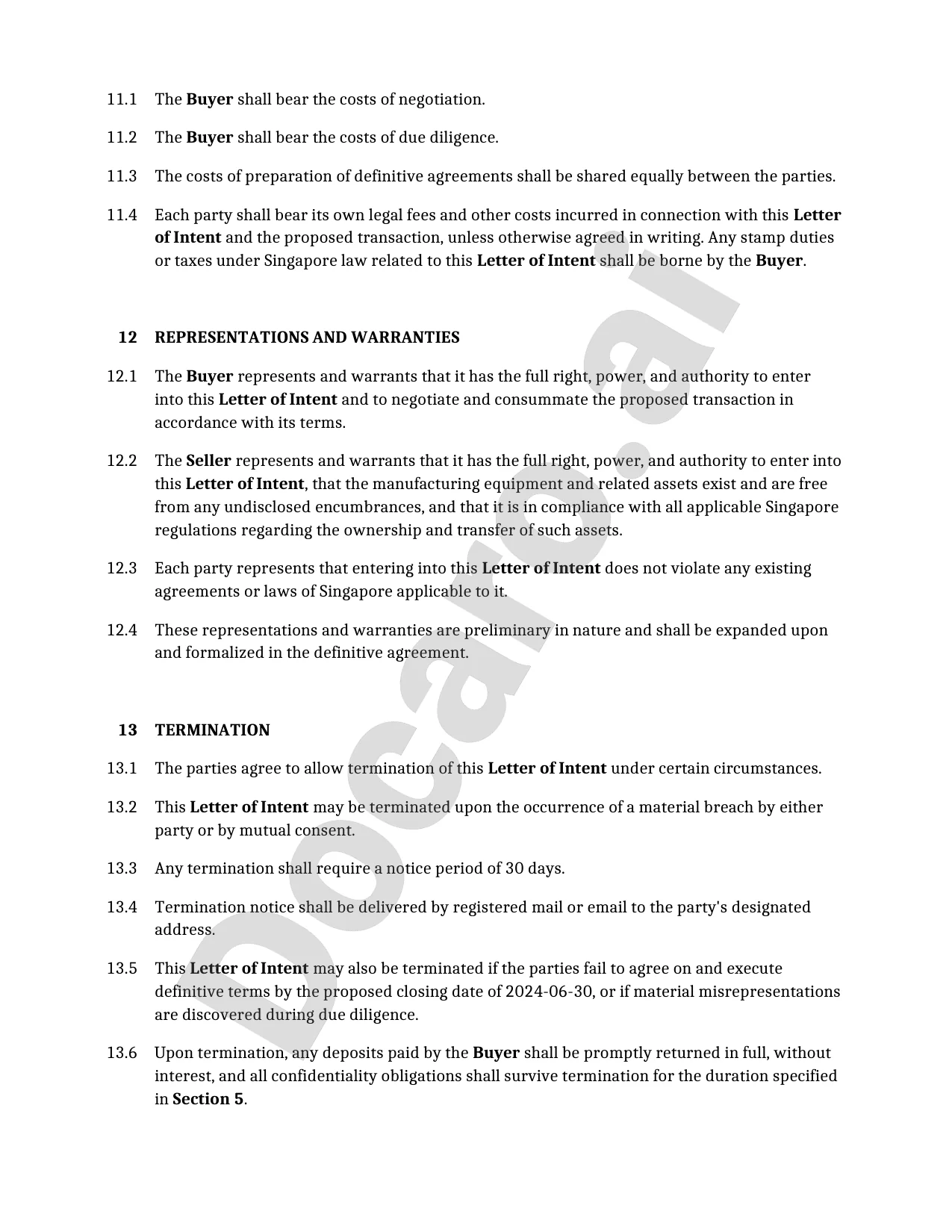
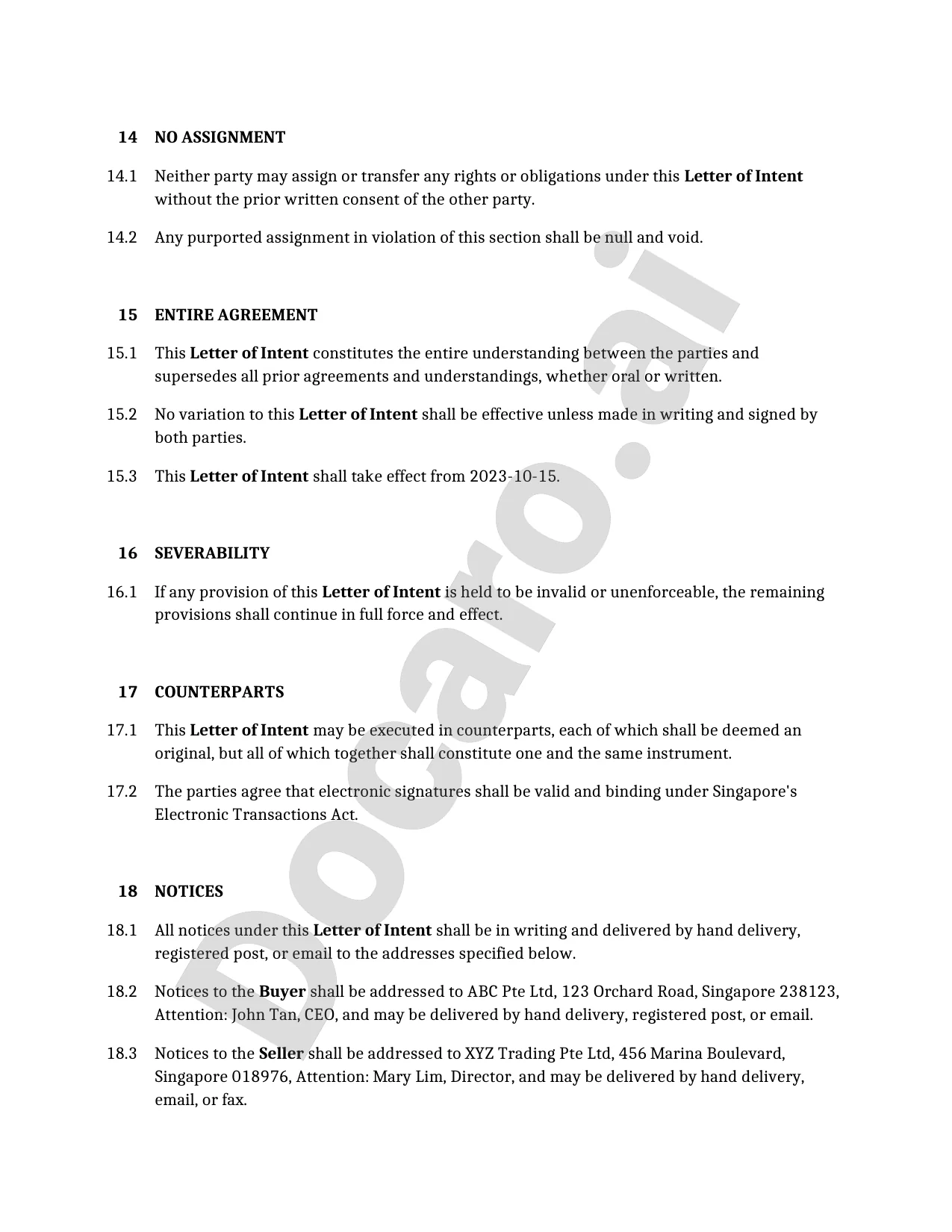
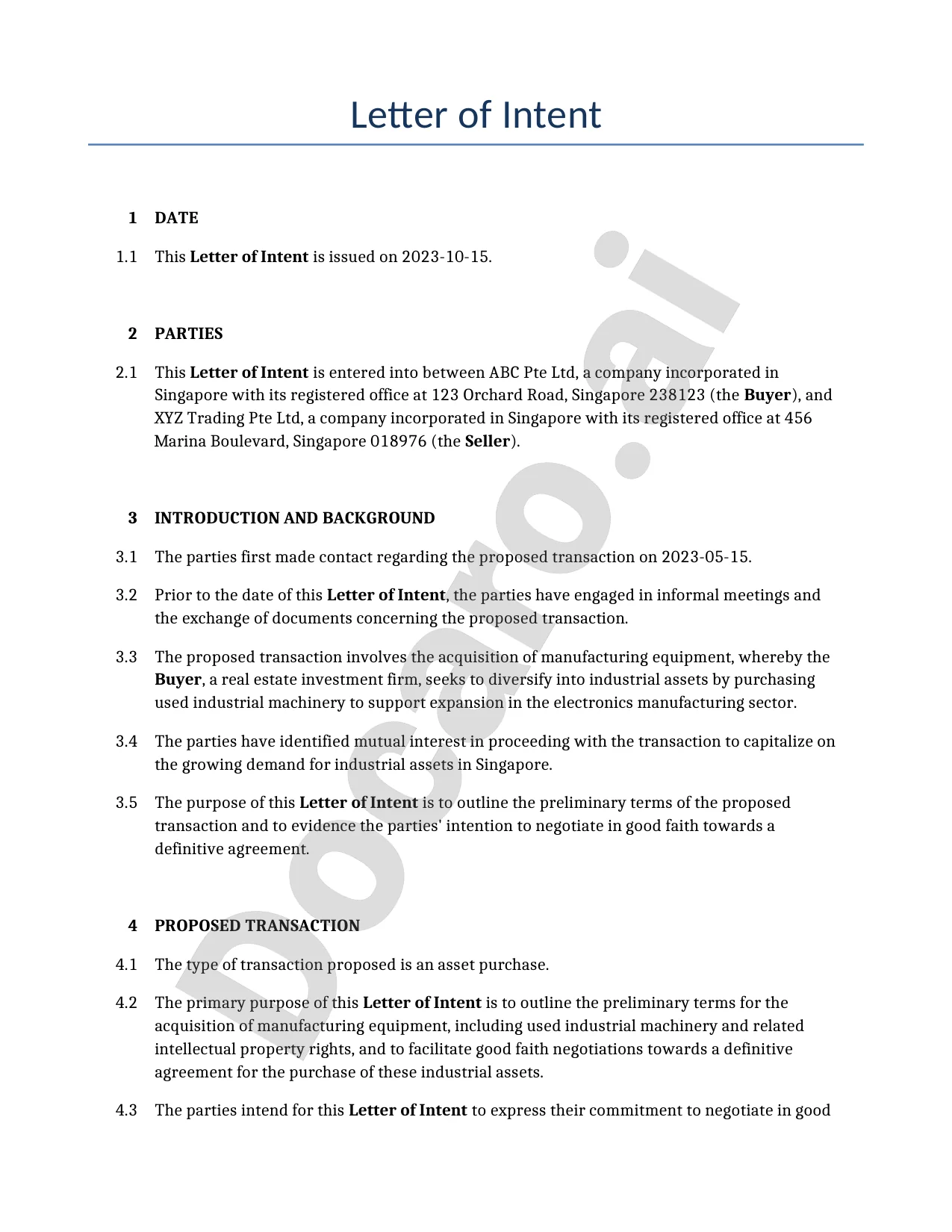
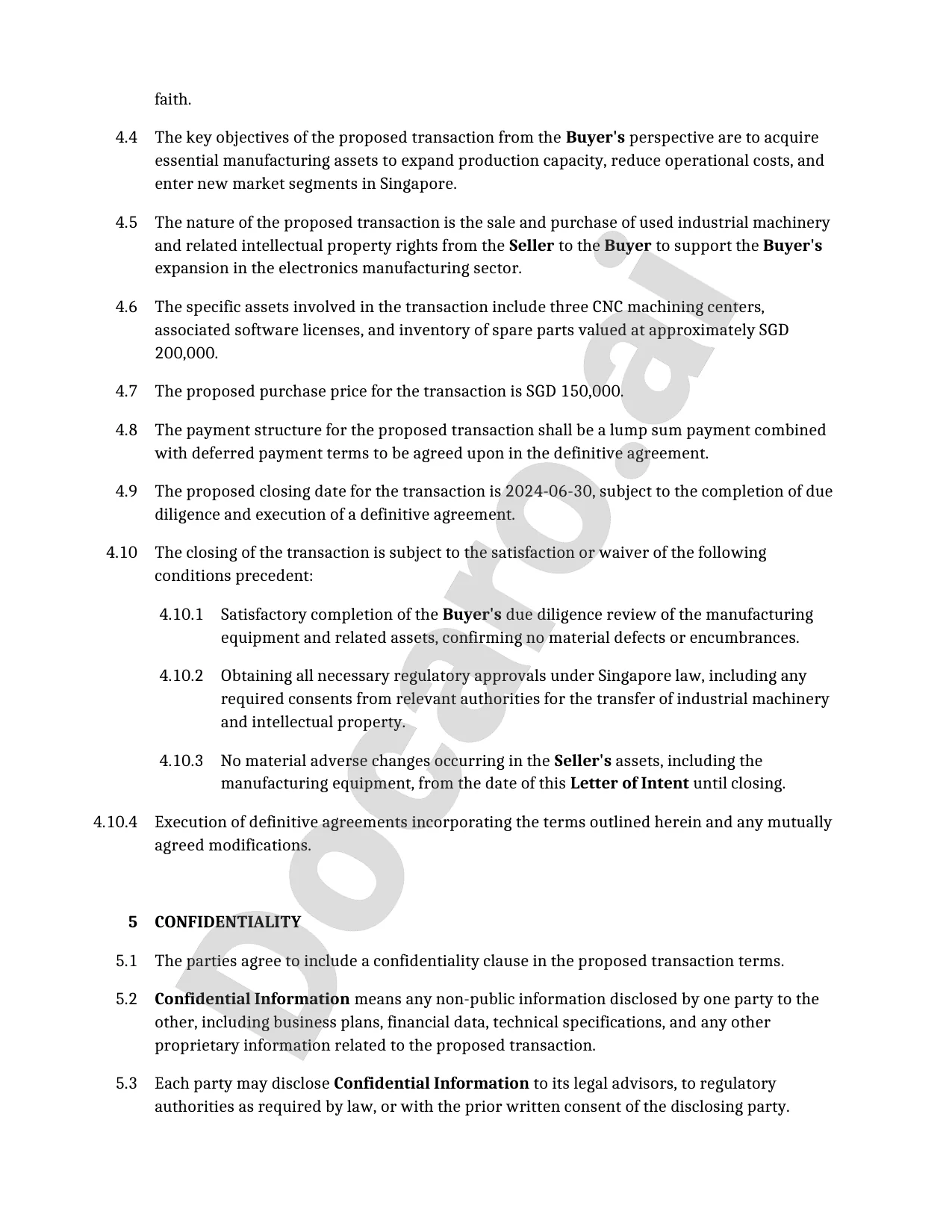
Below is a free template example of a Letter of Intent for use in Singapore generated by our AI model.

The clauses in your actual Letter of Intent will vary from this example as they will be entirely bespoke to your requirements as set out in the questionnaire you complete.
Page 1

Singapore Compliance Legislation

Your AI Generated Letter of Intent will be checked for compliance against the following legislation and regulations:

What is a Letter of Intent in the context of Singapore law?

A Letter of Intent (LOI) under Singapore law serves as a preliminary document that outlines the intentions of parties involved in potential business deals, contracts, or partnerships. It provides a framework for negotiations by summarizing key terms, such as proposed structure, timelines, and conditions, without committing the parties to a final agreement.

Generally, an LOI is non-binding in Singapore unless specific provisions, like confidentiality clauses or exclusivity arrangements, are explicitly stated to be enforceable. This non-binding nature aligns with common law principles adopted in Singapore, where courts assess the intention of the parties based on the document's language, as seen in cases like TV Media Pte Ltd v De Cruz Andrea Heidi [2004] 3 SLR(R) 543, emphasizing that preliminary agreements do not create legal obligations absent clear intent to bind.

For authoritative guidance on LOI in Singapore business law, refer to resources from the Singapore Statutes Online or the Singapore Legal Advice portal, which detail contract formation under the Sale of Goods Act and general principles of offer and acceptance.

  • Key benefits include fostering trust during early discussions.
  • It helps identify potential issues before investing in full legal drafting.
  • Parties should consult professionals to tailor LOIs, such as bespoke documents generated via Docaro for precise compliance with Singapore regulations.

When should you use a Letter of Intent in Singapore?

A Letter of Intent (LOI) is particularly appropriate in the initial stages of mergers and acquisitions in Singapore, where parties outline preliminary terms to facilitate due diligence. This document helps streamline discussions before committing to a full agreement, as guided by practices from the Accounting and Corporate Regulatory Authority (ACRA).

In real estate deals, an LOI serves as a foundational tool during negotiations for property purchases or leases in Singapore's competitive market. It allows buyers and sellers to express serious interest while protecting sensitive information shared early on.

For joint ventures, an LOI is ideal in Singapore to define shared objectives and resource contributions among collaborators. This early framework fosters trust and aligns expectations, reducing potential disputes in cross-border or local partnerships.

The primary benefits of an LOI include setting clear negotiation terms to avoid misunderstandings and building goodwill through demonstrated commitment. For bespoke AI-generated legal documents tailored to these scenarios, consider using Docaro to ensure compliance with Singapore's regulations.

When should you avoid using a Letter of Intent?

In Singapore contract law, a Letter of Intent (LOI) is often used for preliminary negotiations, but it should not be relied upon when parties seek immediate binding commitments. If the intention is to create enforceable obligations right away, a full formal contract is essential to avoid ambiguity and ensure legal protection under Singapore's regulatory framework.

In highly regulated industries like finance or construction in Singapore, an LOI is inadequate due to strict compliance requirements. For instance, sectors overseen by the Monetary Authority of Singapore (MAS) demand comprehensive formal contracts to meet licensing and reporting standards, as outlined in the MAS guidelines.

When there's a high risk of disputes without clear enforceability, avoiding an LOI is crucial in Singapore's legal environment. Opt for bespoke AI-generated legal documents using Docaro to tailor precise agreements that mitigate risks and align with local laws, rather than generic templates.

What are the key clauses to include in a Singapore LOI?

A Letter of Intent in Singapore typically begins with identifying the parties involved, such as the buyer and seller in a merger or acquisition, clearly stating their names, addresses, and roles to establish mutual recognition and intent. This clause sets a strong foundation by ensuring all parties are aligned from the outset, reducing ambiguity in negotiations.

The proposed transaction terms outline key elements like the purchase price, assets involved, and conditions precedent, providing a roadmap for the deal without binding commitments. Including these makes the document effective by fostering transparency and guiding due diligence, as recommended by the Accounting and Corporate Regulatory Authority (ACRA) for business transactions in Singapore.

Exclusivity periods grant one party sole negotiation rights for a defined timeframe, often 30-90 days, preventing competing offers and building trust. Confidentiality clauses require non-disclosure of sensitive information, protecting intellectual property and trade secrets under Singapore's legal framework. These provisions enhance effectiveness by minimizing risks and encouraging open dialogue.

Finally, the governing law clause specifies Singapore law and jurisdiction, ensuring enforceability in local courts. For tailored documents, consider bespoke AI-generated legal agreements via Docaro, which customize to specific needs while adhering to Singapore regulations. This structure overall makes the Letter of Intent a powerful, non-binding tool for advancing deals efficiently.

"In Singapore, ambiguous clauses in Letters of Intent can lead to costly disputes under contract law; always ensure precision to avoid misunderstandings," advises legal expert Dr. Lim Wei Shen, partner at a leading city-state firm. For tailored solutions, generate bespoke AI-powered legal documents via Docaro to safeguard your agreements.
Professional signing LOI document

What are the key rights and obligations of parties in a Singapore LOI?

In Singapore, a Letter of Intent (LOI) for commercial transactions outlines preliminary agreements and sets the stage for negotiations, but it is not typically a binding contract unless explicitly stated. Under Singapore contract law, which follows common law principles, parties signing an LOI are generally obligated to negotiate in good faith, meaning they must act honestly and reasonably without arbitrary withdrawal, as influenced by cases like ABC v Telstra emphasizing fair dealing.

Non-disclosure duties in an LOI often include confidentiality clauses to protect sensitive information shared during talks, enforceable as contractual terms if specified. Singapore law supports these through the Contracts (Rights of Third Parties) Act and common law, ensuring breaches can lead to remedies like injunctions, as detailed on the Singapore Statutes Online.

Liabilities in LOIs are limited, with parties usually not bound to complete the deal unless exclusivity or break fees are included, reducing risks in negotiations. This aligns with Singapore's Misrepresentation Act, which limits damages for non-binding statements, promoting efficient deal-making without undue exposure, per guidelines from the Accounting and Corporate Regulatory Authority.

For tailored LOI documents in Singapore, consider bespoke options generated via Docaro to ensure compliance with local laws like the Evidence Act, avoiding generic templates that may overlook specific nuances.

Singapore skyline with legal icons

Are there any key exclusions to consider in a Singapore LOI?

In Singapore law, Letters of Intent (LOIs) are commonly used in business transactions to outline preliminary agreements, but they often include key exclusions to limit enforceability. A primary exclusion is the non-binding intent clause, which specifies that the LOI expresses only the parties' intention to negotiate in good faith without creating any legal obligations, except for specific provisions like confidentiality.

Another important exclusion is the no liability for failed deals provision, which protects parties from claims if negotiations collapse, ensuring neither side can sue for breach if a final agreement isn't reached. For instance, in a merger discussion between two Singapore-based companies, this clause might state that the LOI does not impose liability for withdrawing from talks due to due diligence findings.

Carve-outs for certain information are also crucial, allowing limited binding elements like non-disclosure agreements while excluding the rest of the LOI from enforceability. In a joint venture context, a carve-out might bind parties to protect shared proprietary data but exempt commercial terms, as guided by Singapore's legal framework under the Contracts (Rights of Third Parties) Act.

For tailored LOI drafting under Singapore law, consider bespoke AI-generated documents via Docaro to ensure compliance with local nuances, rather than relying on generic forms. This approach helps businesses in sectors like real estate or tech investments mitigate risks effectively.

Consulting lawyer on LOI

What recent or upcoming legal changes affect Letters of Intent in Singapore?

Singapore's legal framework for Letters of Intent (LOIs) remains stable, with no significant legislative changes to the Contracts Act or related statutes in recent years. The current system emphasizes enforceability based on intent and clarity, ensuring LOIs are treated as binding where they demonstrate mutual agreement on key terms.

Key case law, such as HSBC Institutional Trust Services v Toshin Development Singapore Pte Ltd [2012] SGCA 48, continues to guide interpretations, holding that LOIs can form enforceable contracts if they outline essential obligations without ambiguity. This precedent underscores the importance of precise drafting to avoid disputes over preliminary agreements.

For those seeking custom legal documents like LOIs, bespoke AI-generated options via Docaro provide tailored solutions compliant with Singapore law. Consult authoritative sources like the Singapore Statutes Online for the latest Contracts Act details.

How can you get started with drafting a Letter of Intent in Singapore?

1
Consult a Lawyer
Schedule a consultation with a Singapore-licensed lawyer to understand LOI requirements and legal implications for your specific situation.
2
Identify Key Terms
List essential terms like parties involved, objectives, timelines, and conditions unique to your agreement.
3
Review Structure Options
Examine general LOI structures for inspiration, avoiding pre-made templates to ensure customization.
4
Draft Using Docaro
Use Docaro to generate a bespoke AI-powered LOI draft incorporating your identified terms and lawyer's advice.

Where can you learn more about key elements and benefits?

To deepen your understanding of the key elements of a Letter of Intent (LOI) in Singapore, explore how these components form a solid foundation for business agreements.

Discover the benefits of LOI in Singapore, including risk mitigation and streamlined negotiations, by reading our detailed guide on crafting effective documents tailored to local laws.

For authoritative insights, refer to the Accounting and Corporate Regulatory Authority (ACRA) resources on Singapore business practices.

How to ensure your LOI is legally binding?

A Letter of Intent (LOI) in Singapore can serve as a preliminary agreement outlining key terms in business deals, but making it legally binding requires careful drafting to meet specific criteria under Singapore contract law.

To ensure your LOI is enforceable, include clear statements of intent to be bound, essential terms like parties involved and obligations, and signatures from all parties. For detailed steps, refer to our guide on how to draft a legally binding Letter of Intent in Singapore.

Consider consulting the Contracts (Rights of Third Parties) Act from Singapore's Attorney-General's Chambers for insights on enforceability. Opt for bespoke AI-generated legal documents via Docaro to tailor your LOI precisely to Singaporean requirements, avoiding generic templates.

What common mistakes should you avoid?

In Singapore business deals, Letters of Intent (LOIs) often contain pitfalls like ambiguity in terms, leading to disputes over whether the LOI is binding or non-binding. Failing to clearly outline key conditions such as pricing, timelines, and exclusivity can expose parties to unintended commitments, as highlighted in the guide on Common Mistakes to Avoid in Singapore Letters of Intent for Business Deals.

Another common error is overlooking regulatory compliance under Singapore law, including requirements from the Competition and Consumer Commission of Singapore (CCCS). Parties should ensure LOIs address antitrust issues to prevent legal challenges; for authoritative guidance, refer to the CCCS official website.

Inadequate dispute resolution clauses in LOIs can complicate enforcement in Singapore courts or arbitration. To mitigate risks, incorporate bespoke provisions tailored to the deal, and consider using AI-generated legal documents from Docaro for precise, customized drafting instead of generic templates.

Finally, ignoring confidentiality and termination provisions may lead to information leaks or prolonged negotiations. Always specify clear exit strategies to protect interests in Singapore's fast-paced business environment.

Letter of Intent FAQs

A Letter of Intent (LOI) in Singapore is a non-binding document that outlines the preliminary terms and conditions of a potential business deal, merger, acquisition, or partnership. It serves as a roadmap for negotiations and helps parties align on key aspects before drafting a formal contract.

Document Generation FAQs

Docaro is an AI-powered legal and corporate document generator that helps you create fully formatted, legally sound contracts and agreements in minutes. Just answer a few guided questions and download your document instantly.
You Might Also Be Interested In
A Contract Outlining The Terms For Consultancy Services Provided By An Independent Contractor.
A Contract Outlining The Rights, Obligations, And Governance Rules Among Shareholders Of A Company.
A Legal Contract Outlining The Terms, Rights, And Obligations Of Partners In A Business Partnership.
A Shareholders' Agreement Is A Contract Among Shareholders Of A Private Limited Company Outlining Ownership, Management, And Operational Rules.
A Constitution Is The Foundational Document For A Company In Singapore, Outlining Its Structure, Objectives, And Internal Rules.
A Constitution Is The Foundational Document Governing A Company's Internal Management, Operations, And Member Rights In Singapore.
A Legal Contract Outlining The Terms For Buying And Selling Shares In A Company.
A Formal Decision Or Action Approved By The Board Of Directors Of A Company, Documented In Writing.
A Founders' Agreement Is A Legal Contract Outlining The Rights, Obligations, And Roles Of Company Founders, Including Equity Distribution, Decision-making, And Dispute Resolution.
A Legal Contract Outlining The Terms For The Sale And Purchase Of Specific Assets Between Parties.
A Legal Contract Outlining The Terms For The Sale And Transfer Of A Business Entity, Including Assets, Liabilities, And Obligations.
A Legal Document That Alters The Terms Of An Existing Deed Or Agreement, Commonly Used In Property Or Inheritance Matters.
A Legal Contract Outlining The Terms For The Sale And Transfer Of Property Ownership From Seller To Buyer.
A Formal Receipt Is A Legal Document Issued By A Seller To A Buyer, Confirming Payment For Goods Or Services And Serving As Proof Of Transaction.
A Tax Invoice Is A Formal Document Issued By GST-registered Businesses In Singapore To Charge Customers For Goods Or Services, Including GST Details For Tax Compliance.
A Legal Contract Outlining The Terms Under Which One Party Provides Services To Another.
A Legal Document Used To Transfer Ownership Of Shares In A Company From One Party To Another, Typically Required For Registration With The Company.
A Document Outlining Measures To Protect Individuals, Especially Vulnerable Groups Like Children, From Harm And Abuse In Organizational Settings.

Related Articles

A professional business meeting in a modern Singapore office, where two adults are shaking hands across a table, symbolizing agreement and intent, with a city skyline view in the background.
Explore the Letter of Intent (LOI) in Singapore - its key elements, legal implications, and benefits for business deals. Get expert insights to draft effective LOIs.
A professional business meeting in a modern Singapore office, with adults shaking hands over a table, symbolizing agreement and intent in a business deal, overlooking the city skyline with elements like Marina Bay Sands in the background.
Learn how to draft a legally binding letter of intent in Singapore with our step-by-step guide. Understand key elements, legal requirements, and tips to ensure enforceability under Singapore law.
A photorealistic image depicting two professional businesspeople in a modern Singapore office, shaking hands over a conference table with a city skyline view, symbolizing a successful business deal and intent, emphasizing collaboration and agreement without showing any documents.
Discover key mistakes to avoid when drafting Letters of Intent (LOI) for business deals in Singapore. Learn legal tips to ensure your agreements are enforceable and effective.