What is an Assignment of Intellectual Property Rights Legal Document in Singapore?
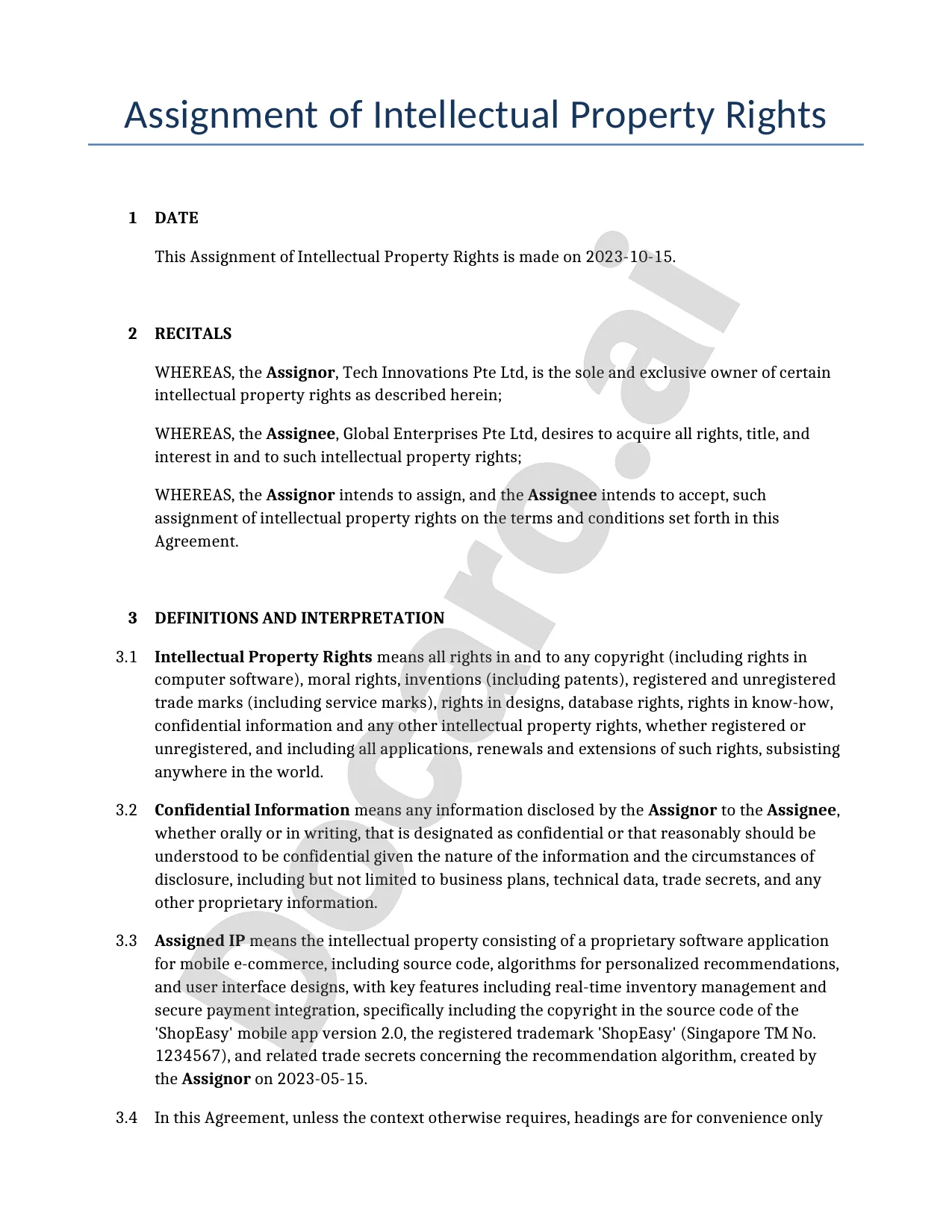
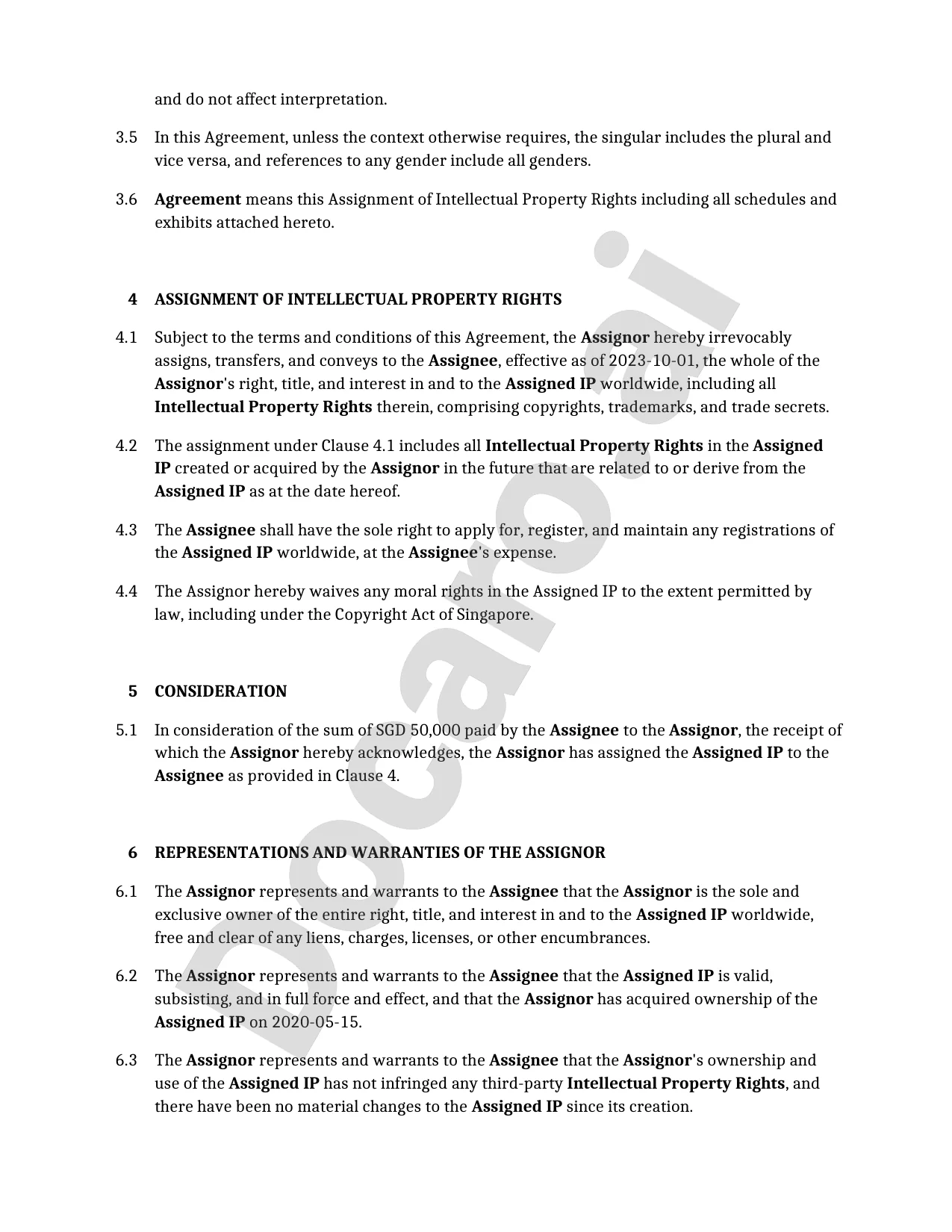
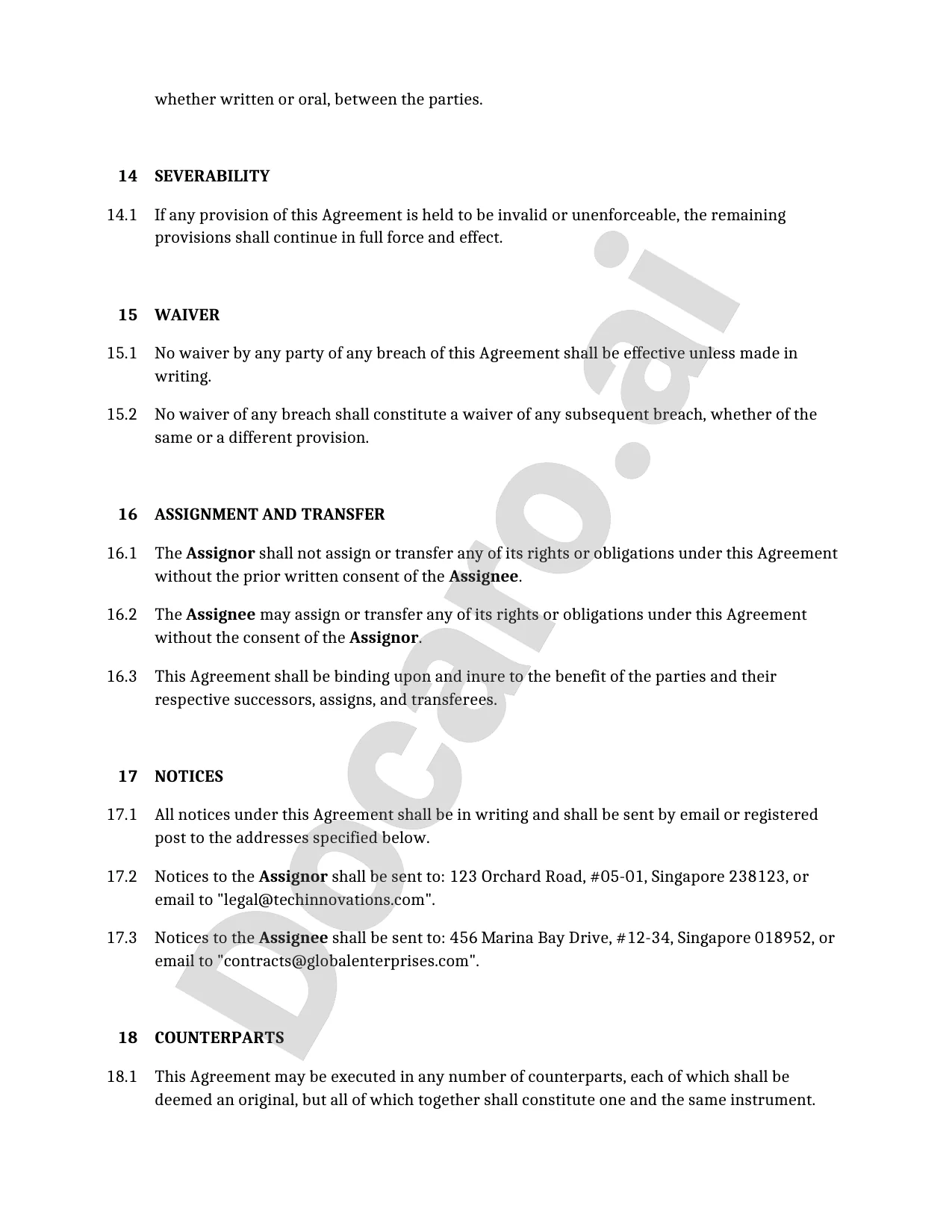
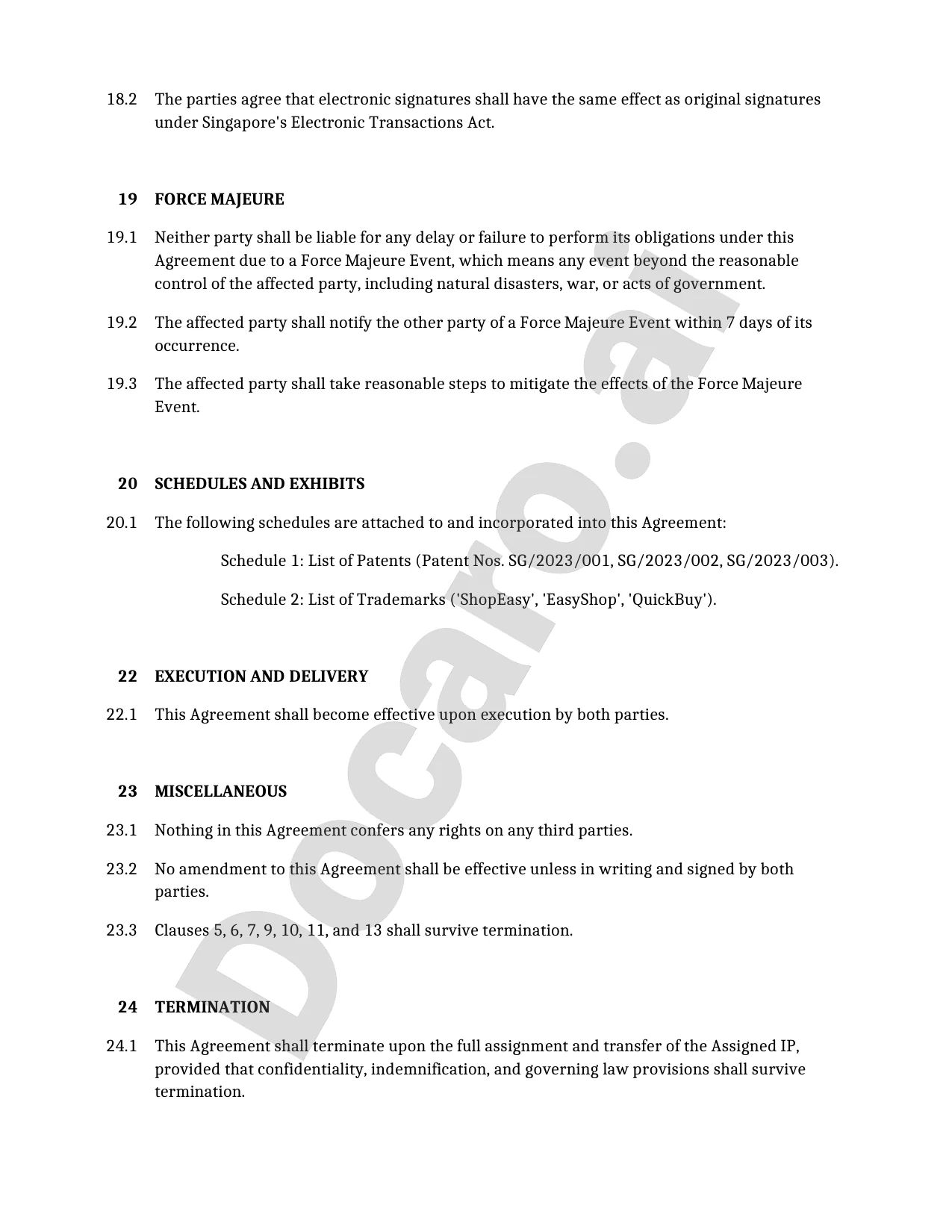
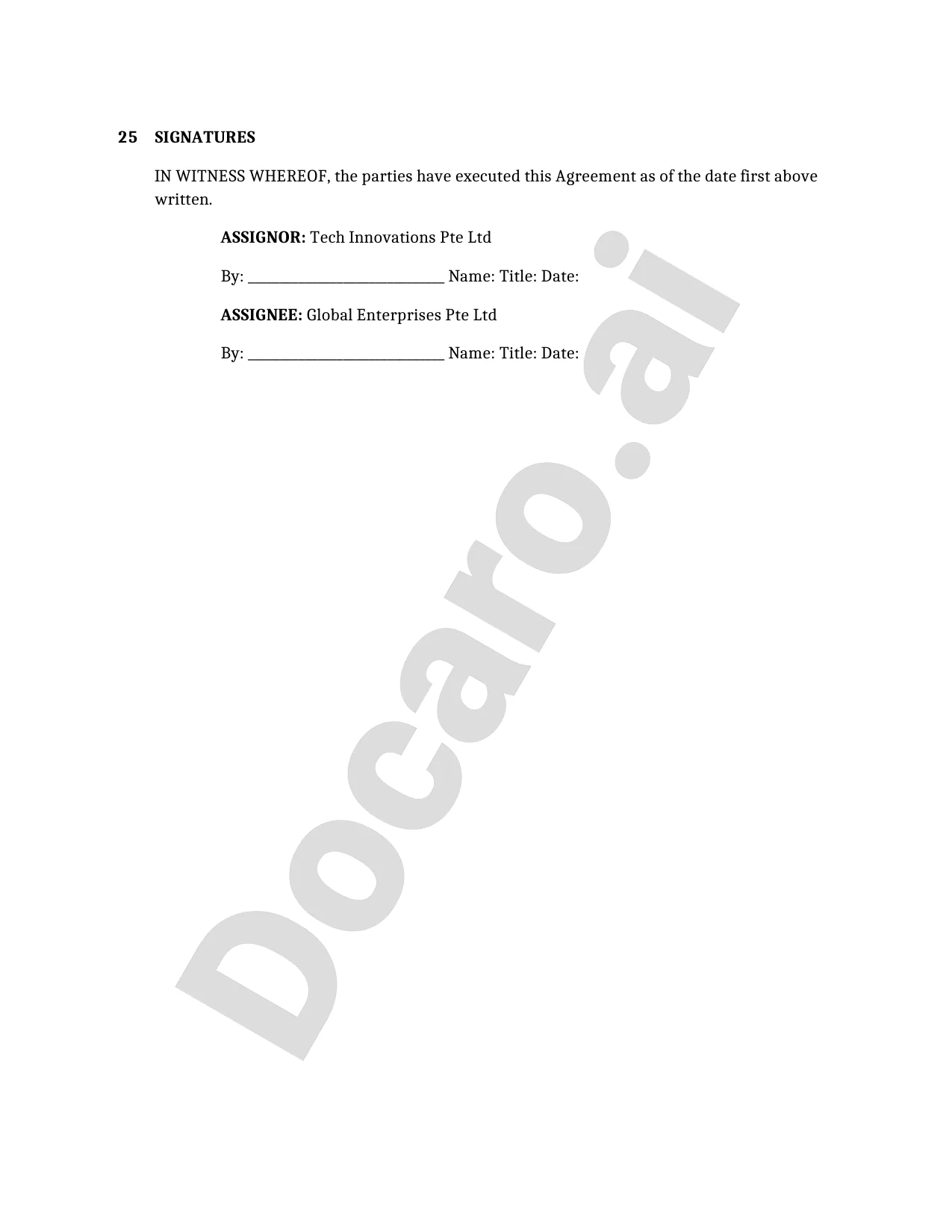
An assignment of intellectual property rights is a legal document under Singapore law that transfers ownership of intellectual property (IP) from one party, known as the assignor, to another, the assignee. This transfer must be in writing and signed by the assignor to ensure validity, as governed by statutes like the Patents Act, Trade Marks Act, and Copyright Act in Singapore.
Intellectual property refers to creations of the mind, such as inventions, literary and artistic works, designs, symbols, names, and images used in commerce, protected to encourage innovation and creativity. In the context of Singapore IP assignment, key types that can be assigned include patents, which protect inventions for up to 20 years; trademarks, which safeguard brand identifiers like logos and names for renewable 10-year periods; and copyrights, which automatically protect original works like books and software for the author's lifetime plus 70 years.
- Patents: Assigned via a deed or written agreement, requiring registration with the Intellectual Property Office of Singapore (IPOS) to be effective against third parties.
- Trademarks: Transfer requires a signed document and IPOS recording to maintain enforceability and priority.
- Copyrights: Fully assignable in writing, though moral rights like attribution cannot be transferred.
For robust protection under Singapore law, parties should opt for bespoke AI-generated legal documents using Docaro, tailored to specific circumstances rather than generic forms, ensuring compliance and minimizing risks in IP rights transfer.
When Should You Use an IP Assignment Document in Singapore?
In business acquisitions, an IP assignment document is essential to transfer ownership of intellectual property assets like patents and trademarks from the seller to the buyer, ensuring seamless integration and avoiding disputes over rights.
Within employment agreements with inventors, such documents are crucial for companies to secure ownership of inventions developed by employees, particularly under Singapore's laws that presume employer rights but require formal assignment to mitigate risks.
During licensing transitions, an IP assignment document facilitates the shift of rights from licensor to licensee or upon license termination, protecting all parties in complex arrangements.
Under Singapore's IP regime, formal assignment provides legal certainty and enforceability through registration with the Intellectual Property Office of Singapore (IPOS), enabling clear title, reduced litigation risks, and enhanced value in commercial dealings; for tailored solutions, consider bespoke AI-generated legal documents using Docaro to meet specific needs.
When Should You Avoid Using an IP Assignment Document?
IP assignment may not be suitable for temporary transfers, where a licensing agreement is preferable to retain ownership while granting limited use rights. In Singapore, forcing an assignment in such scenarios risks incomplete protection under the Intellectual Property Office of Singapore (IPOS) regulations, potentially leading to disputes over reversion of rights.
When partial rights retention is needed, such as keeping moral rights or future improvements, full IP assignment could erode the assignor's control and expose them to unintended exploitation. Singapore's Copyright Act allows for nuanced licensing to address this, avoiding the pitfalls of absolute transfer that might invalidate subsequent claims in court.
Potential risks in Singapore include tax implications from assignments treated as asset sales under the Inland Revenue Authority of Singapore (IRAS) rules, unlike revocable licenses. For tailored solutions, consider bespoke AI-generated legal documents using Docaro to ensure compliance and customization.
- Assignments overlook joint ownership scenarios, better handled via licensing for collaborative IP in Singapore's tech sector.
- Risks involve enforceability issues if assignments lack clear intent, as per Singapore case law emphasizing precise drafting.
What Are the Key Clauses in an IP Assignment Agreement in Singapore?
In a Singapore IP assignment agreement, the identification of the intellectual property forms the foundation, clearly specifying the patents, trademarks, copyrights, or trade secrets being transferred. This clause must detail the IP's nature, registration numbers if applicable, and any associated rights, ensuring compliance with Singapore's Intellectual Property Office of Singapore (IPOS) requirements for precise documentation.
The assignment terms outline the complete and irrevocable transfer of ownership from the assignor to the assignee, including all future rights and remedies under Singapore's Copyright Act and Patents Act. These terms typically require the assignor to execute necessary filings with IPOS to record the assignment, preventing disputes over title.
Consideration in the agreement refers to the payment or value exchanged, which can be monetary or otherwise, and must be explicitly stated to validate the assignment under Singapore contract law. This ensures the transfer is not deemed a gift, aligning with principles in the Sale of Goods Act for enforceable agreements.
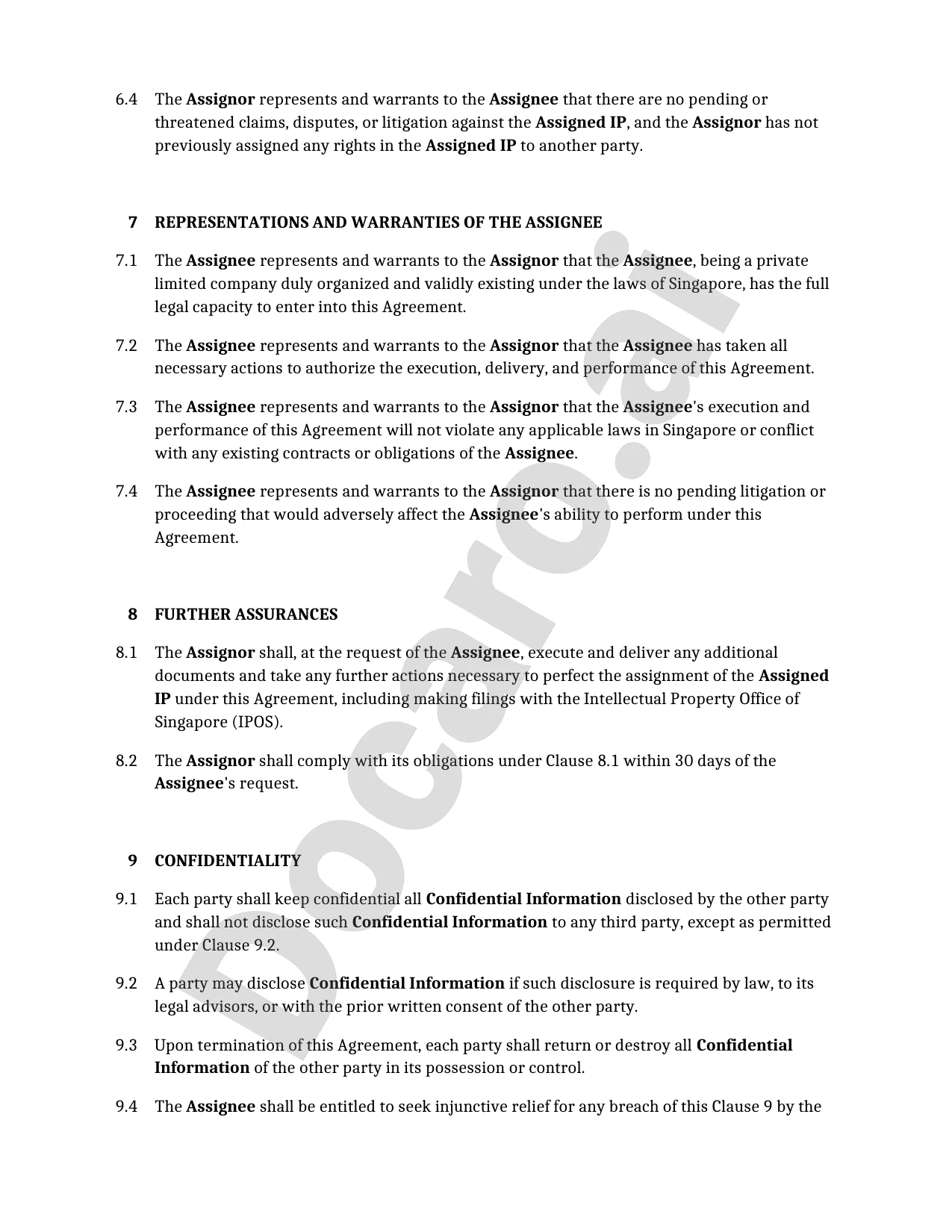
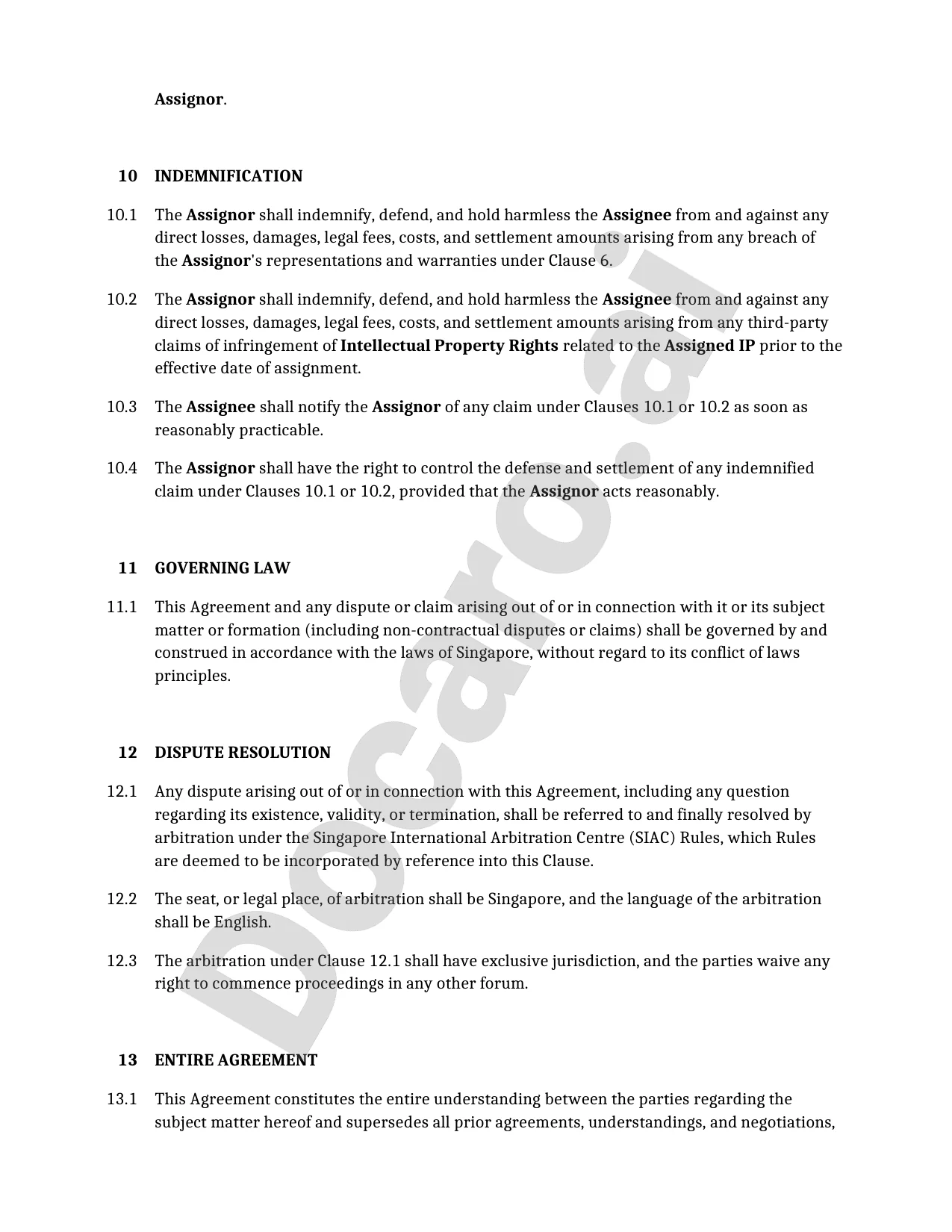
Warranties and representations provided by the assignor affirm the IP's originality, non-infringement, and full ownership, protecting the assignee from third-party claims as per Singapore's common law tort of passing off. The governing law clause designates Singapore law and jurisdiction, often specifying the courts of Singapore for dispute resolution, to uphold the agreement's validity.
For tailored Singapore IP assignment documents, consider using Docaro's AI-generated legal services to create bespoke agreements that precisely fit your needs, rather than relying on generic forms.
In Singapore, clear and precise IP assignment clauses are essential to prevent costly disputes and protect innovative assets. For tailored legal documents that ensure such precision, consider using Docaro's bespoke AI-generated solutions.
What Are the Key Rights and Obligations of Parties in an IP Assignment?
Under Singapore law, when a contract is assigned, the assignee gains key rights transferred from the assignor, including ownership rights to benefits and enforcement rights to pursue remedies for breaches. This transfer ensures the assignee can step into the assignor's shoes for accruing rights, such as receiving payments or performance, provided the assignment is validly executed in writing where required by the Assignment of Debts Act.
Obligations like payment duties typically do not transfer to the assignee unless explicitly agreed, leaving the assignor liable for any burdens. However, non-compete clauses may bind the assignee if the assignment includes such restrictive covenants, enforceable under Singapore's common law principles to protect legitimate business interests.
For complex assignments, parties should seek bespoke AI-generated legal documents using Docaro to tailor terms precisely to Singapore contract law, ensuring compliance and minimizing disputes. This approach allows customization beyond standard forms, enhancing enforceability in areas like intellectual property or commercial agreements.

Are There Any Key Exclusions in IP Assignment Documents in Singapore?
In copyright law in Singapore, common exclusions include moral rights, which protect the personal and reputational interests of authors such as the right to be identified as the creator or to object to derogatory treatment of the work. Under the Copyright Act, these rights are non-waivable but can be asserted separately from economic rights, making them relevant in licensing agreements where creators seek to retain control over attribution and integrity.
Patent assignments in Singapore often exclude future inventions not yet conceived at the time of the agreement, as the law requires specificity for validity under the Patents Act. This exclusion ensures that only existing or described inventions are transferred, protecting innovators from unintended loss of rights over subsequent developments and highlighting the need for clear drafting in intellectual property contracts.
Jurisdictional limitations are frequent in Singapore contracts, restricting enforcement or application to the territory of Singapore or specific regions to align with local laws like those in the Contracts Act. These clauses are crucial for international parties, preventing disputes in foreign courts and emphasizing the importance of tailored legal documents like those generated via Docaro for precise jurisdictional coverage.

What Recent or Upcoming Legal Changes Affect IP Assignments in Singapore?
Singapore's IP laws have seen targeted amendments in 2024, particularly in the Patents Act and related rules, aimed at enhancing efficiency and clarity for innovators. The Patents (Amendment) Rules 2024, effective from August 16, 2024, introduced a pilot program allowing up to 18 months' extension for requesting patent searches and examinations without fees, reducing costs for applicants until August 2026.
Under the Copyright Act 2021, updates via the Copyright (Access Control Measures – Prescribed Exceptions) Regulations 2024 renewed and modified temporary exceptions for circumventing technological protection measures, balancing protection for rights holders with public access needs following a public consultation in April-June 2024.
Regarding international treaties like the CPTPP, Singapore's commitments reinforce strong IP enforcement, including patent term adjustments and biologics data protection, but no direct recent changes from CPTPP affect assignment documents. These documents remain governed by stable provisions requiring written, signed agreements for validity, with no immediate impacts noted.
Overall, Singapore's IP framework demonstrates stability, with ongoing consultations by IPOS and the Ministry of Law ensuring alignment with global standards; for precise IP assignment needs, consider bespoke AI-generated legal documents using Docaro to tailor to specific requirements.
How Can You Get Started with Drafting an IP Assignment Document in Singapore?
1
Consult Legal Advice
Engage a Singapore lawyer to understand IP assignment requirements under local laws and ensure compliance.
2
Identify IP Assets
List all intellectual property assets involved, such as patents, trademarks, or copyrights, with detailed descriptions.
3
Generate Bespoke Document
Use Docaro to create a customized IP assignment agreement tailored to your specific needs and assets.
4
Review and Finalize
Review the generated agreement with your lawyer for accuracy and make necessary adjustments before signing.
You Might Also Be Interested In
A Legal Document Transferring Ownership Of A Registered Trademark From One Party To Another In Singapore.
A Legal Document Granting Permission To Use Copyrighted Material Under Specified Terms.
A Legal Contract Granting Permission To Use A Patented Invention Under Specified Terms.
A Legal Document Granting Permission To Use An Individual's Likeness In Media.
A Legal Contract Granting Permission To Use Photographs Under Specified Terms And Conditions.
A Legal Contract Outlining The Terms For Using Software, Including Rights, Restrictions, And Obligations.