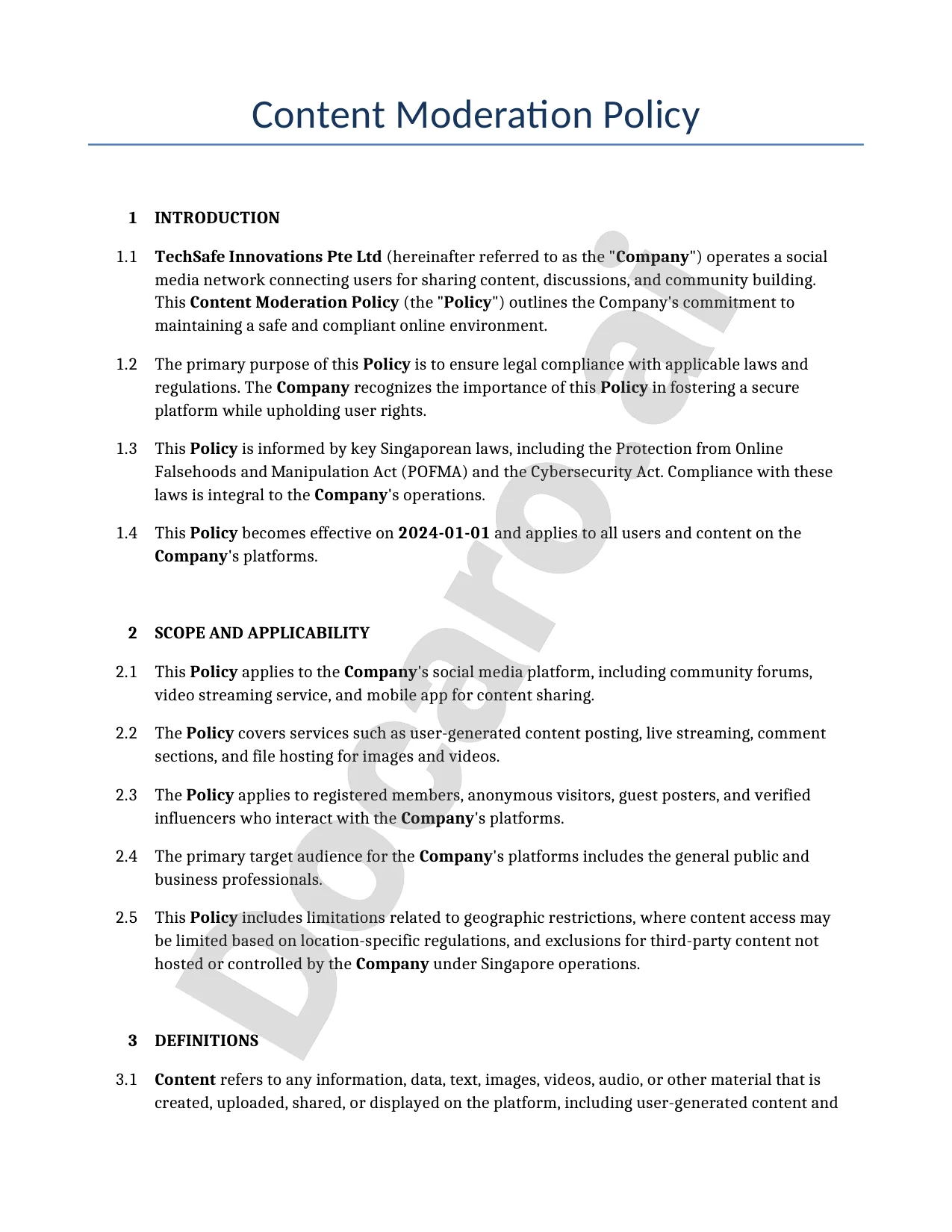
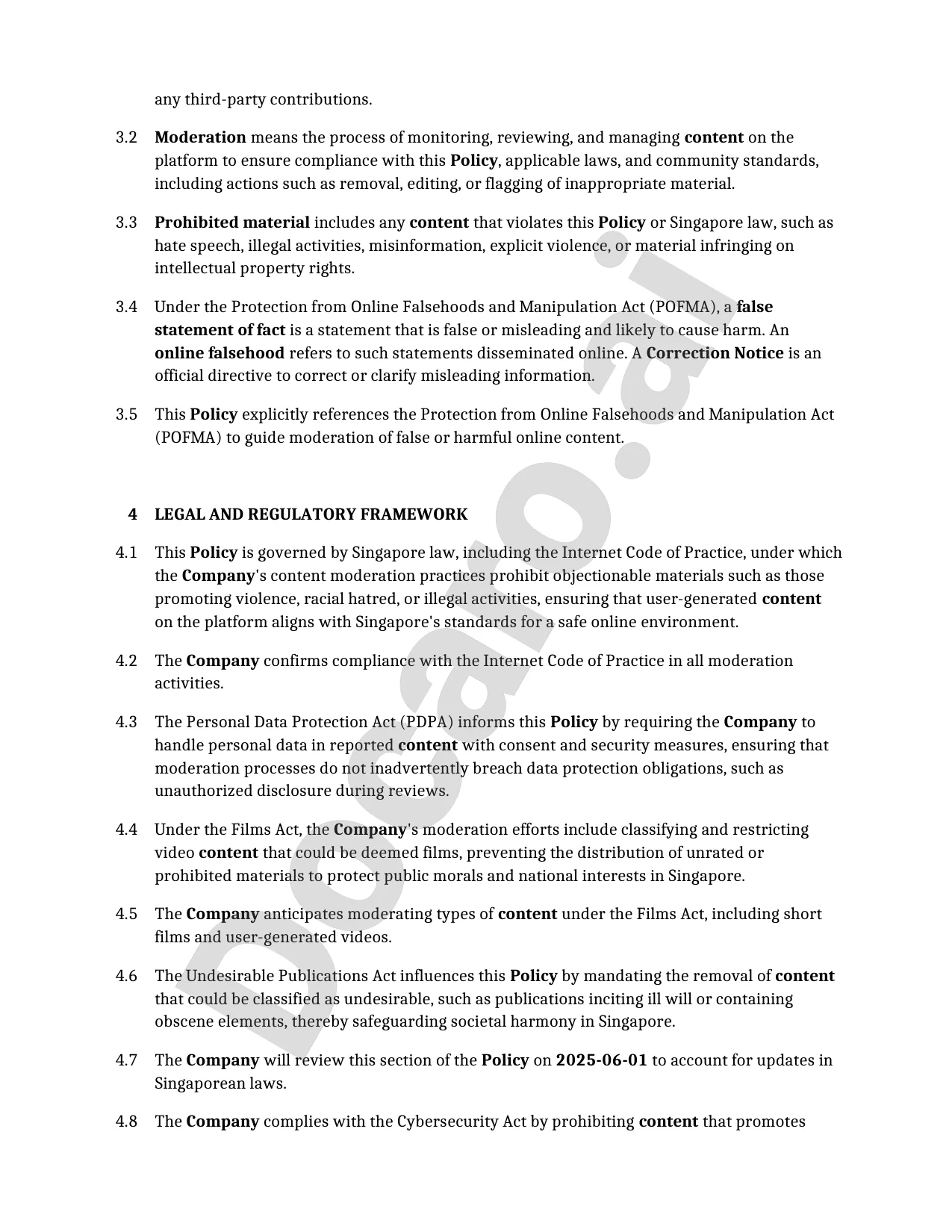
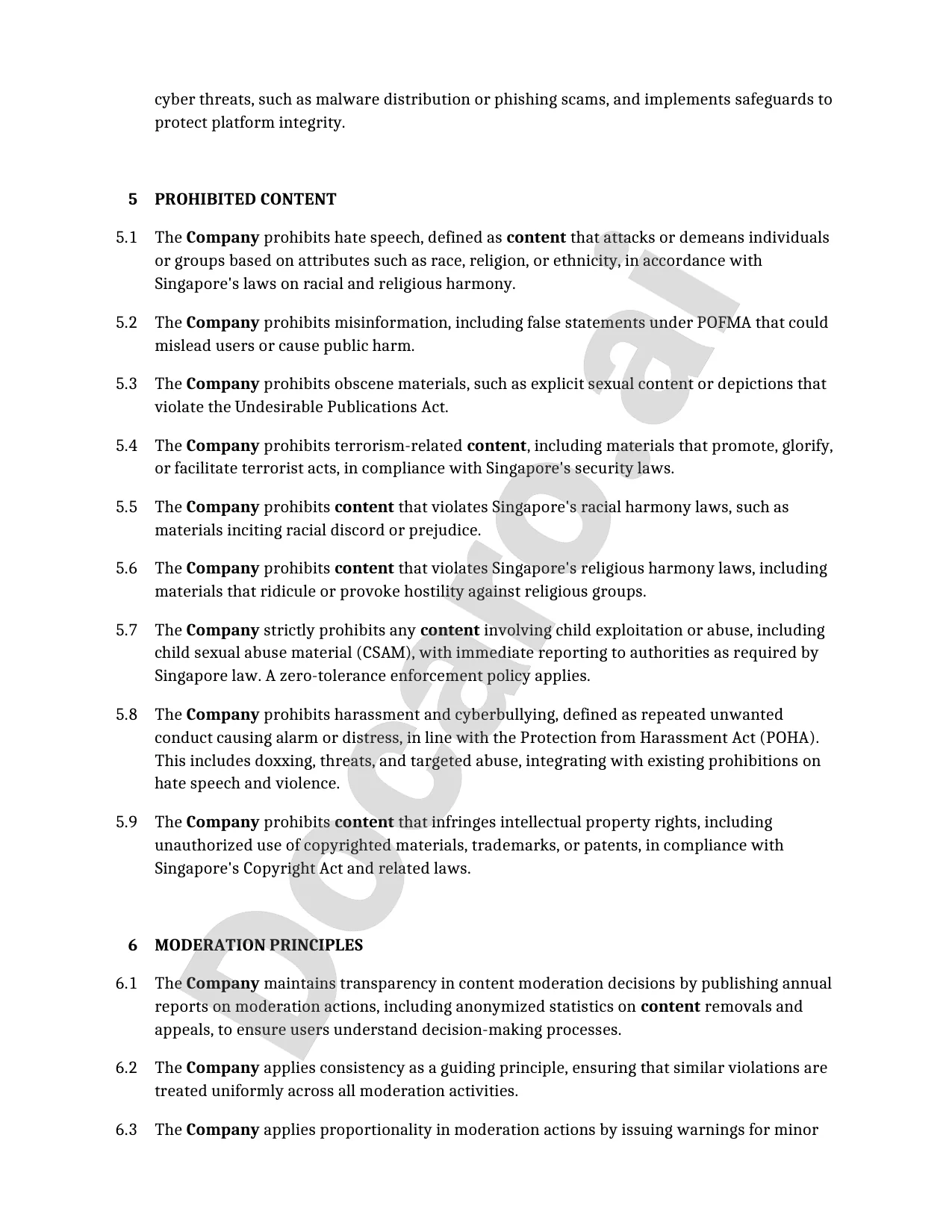
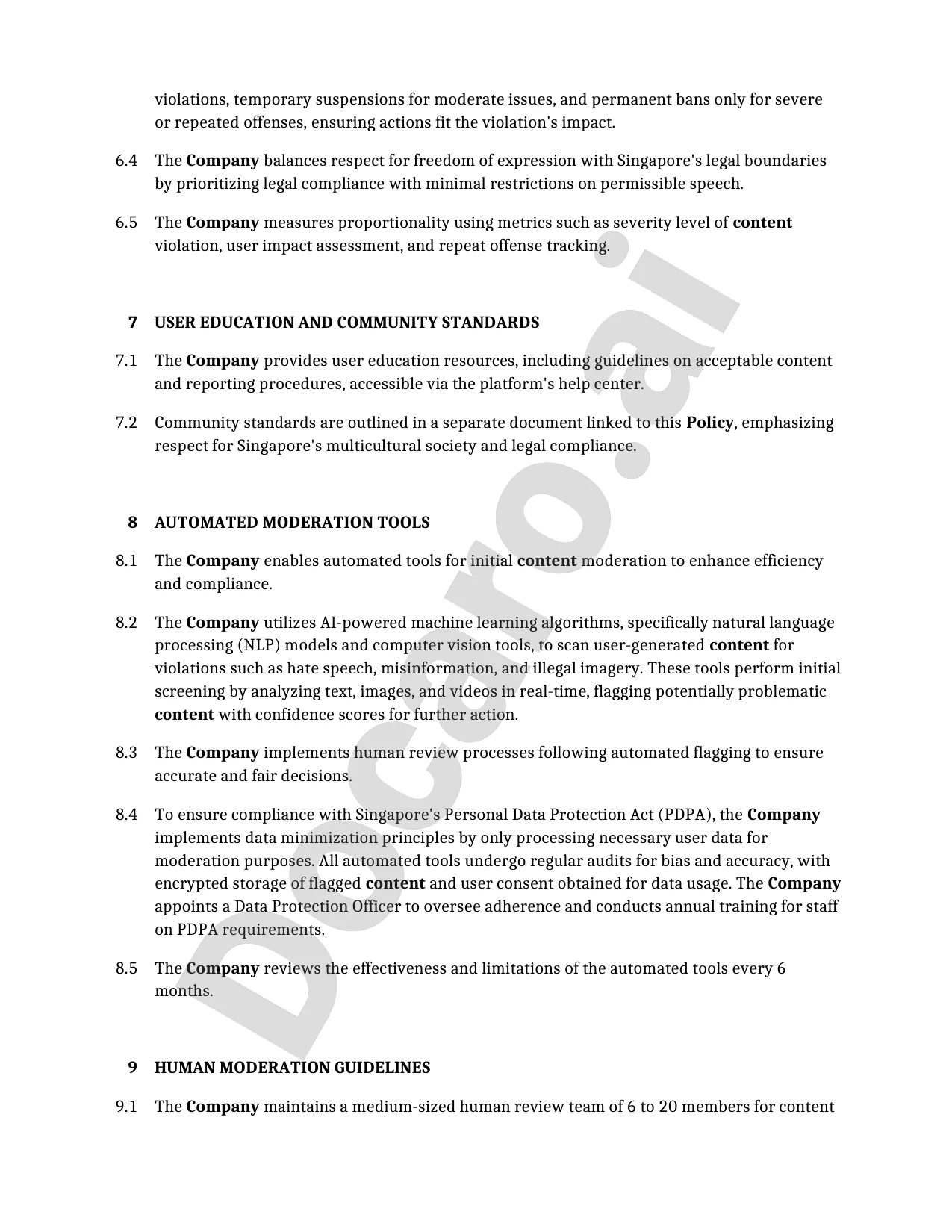
What is a Content Moderation Policy in Singapore Corporate Documents?
A content moderation policy in Singapore's corporate landscape serves as a vital framework for businesses managing online platforms or user-generated content, ensuring compliance with local laws like the Protection from Online Falsehoods and Manipulation Act (POFMA). Its primary purpose is to safeguard users from harmful material, such as misinformation, hate speech, or illegal content, while promoting a safe digital environment that aligns with Singapore's emphasis on responsible online conduct.
The scope of such a policy typically encompasses guidelines for identifying, reviewing, and removing inappropriate content, along with procedures for user reporting and platform enforcement. Businesses operating in Singapore must tailor these policies to address user-generated content risks, including data privacy under the Personal Data Protection Act (PDPA), making it essential for e-commerce sites, social media platforms, and forums to implement robust moderation tools and trained teams.
For companies handling online interactions, a well-defined content moderation policy not only mitigates legal liabilities but also enhances user trust and brand reputation in Singapore's competitive digital market. To create effective, customized policies, consider using bespoke AI-generated corporate documents via Docaro, which ensures relevance to local regulations without relying on generic templates. For authoritative guidance, refer to the IMDA content standards or the POFMA Office resources.
When Should You Implement a Content Moderation Policy in Singapore?
Content moderation policies are crucial for Singapore-based social media companies to comply with the Internet Code of Practice enforced by IMDA, ensuring user-generated content does not promote hate speech, misinformation, or illegal activities. For instance, these policies should activate during viral posts inciting racial tensions, where swift removal prevents public harm and legal penalties under the Protection from Online Falsehoods and Manipulation Act (POFMA).
In e-commerce platforms operating in Singapore, robust content moderation is essential to filter out fraudulent listings, counterfeit goods, or explicit material that could violate consumer protection laws. Examples include moderating product descriptions that deceive buyers or forums where sellers promote prohibited items like unregulated health supplements, safeguarding brand reputation and avoiding fines from the Competition and Consumer Commission of Singapore (CCCS).
Forums and discussion boards hosted by Singapore corporations require content moderation policies to maintain civil discourse and adhere to cybersecurity regulations, such as blocking cyberbullying or doxxing attempts. This is vital during high-traffic events like national elections, where unmoderated debates could escalate into defamation cases under the Penal Code.
However, for purely internal communication tools without public access, such as enterprise chat apps used solely within a Singapore-based corporation, content moderation policies may not be necessary, as they fall outside public regulatory scrutiny and focus on productivity rather than external compliance. In these cases, basic guidelines suffice to foster a professional environment without the need for automated or extensive moderation systems.
"Robust content moderation policies are essential for Singapore-based platforms to comply with the Protection from Online Falsehoods and Manipulation Act (POFMA) and other regulatory frameworks, ensuring swift removal of harmful or illegal content to avoid severe penalties," states Professor Tan Cheng-Han, a leading expert in Singapore corporate and media law. For tailored corporate documents to implement such policies, utilize Docaro's bespoke AI generation services.
What Are the Key Clauses in a Content Moderation Policy?
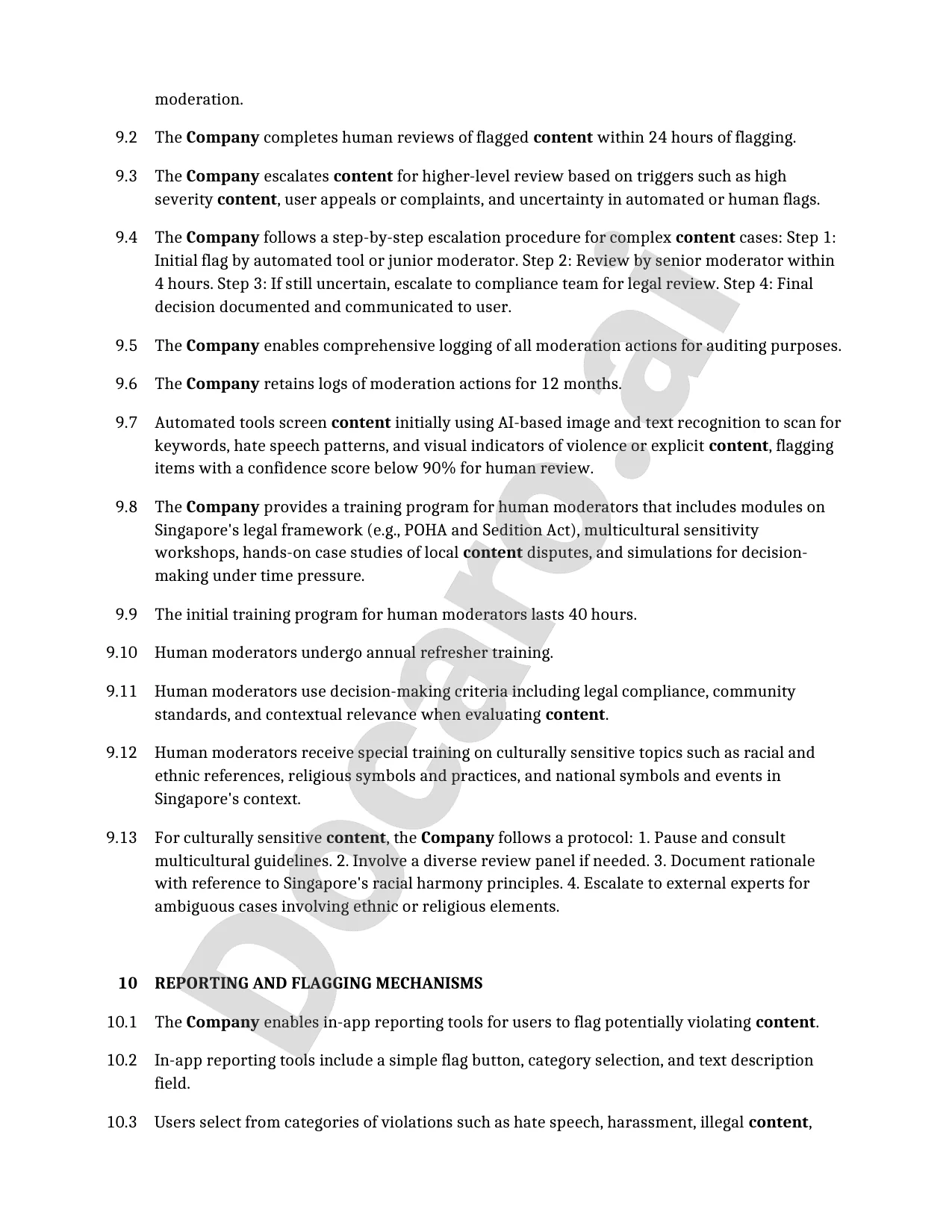
A content moderation policy for Singapore corporations must begin with clear definitions of prohibited content, outlining categories such as hate speech, illegal activities, misinformation, and content violating Singapore's laws like the Protection from Harassment Act. This clause ensures alignment with local regulations, including those from the Infocomm Media Development Authority (IMDA), by specifying examples like defamatory material or content promoting violence, helping corporations mitigate legal risks in the digital landscape.
Moderation procedures form the operational backbone, detailing how content is reviewed, such as through automated tools, human moderators, or a combination, with timelines for action like immediate removal of urgent violations. For Singapore-based entities, these procedures should incorporate compliance with the Personal Data Protection Act (PDPA) for handling user data during moderation, ensuring efficient and transparent processes to maintain platform integrity.
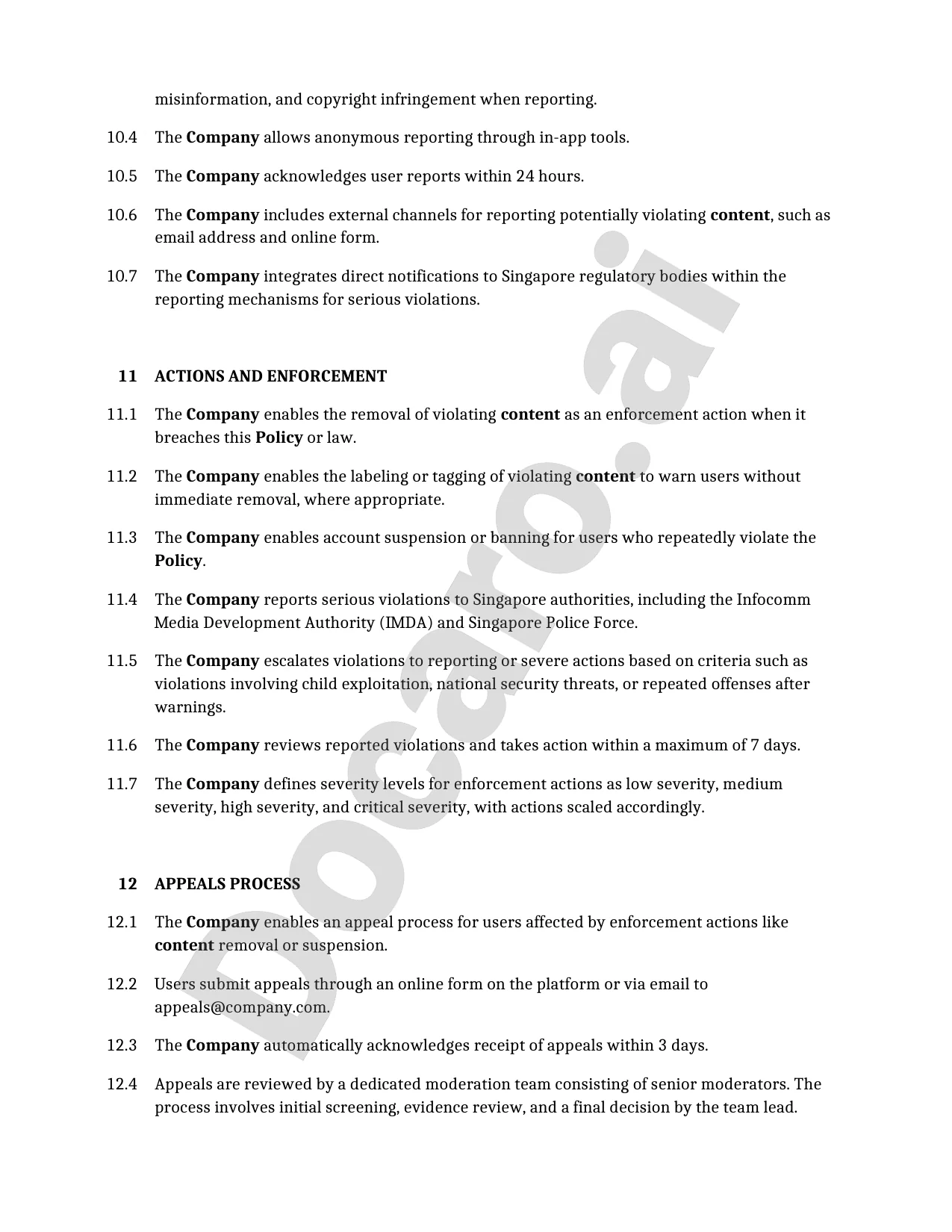
An essential appeal process allows users to challenge moderation decisions, typically within a set timeframe, involving an independent review by a designated team or external arbitrator. This clause promotes fairness and trust, adhering to Singapore's emphasis on due process, and should include notification requirements to users, fostering accountability in content governance.
Reporting mechanisms enable easy user submissions of violations via in-app forms or email, with internal logging for tracking and escalation to authorities if needed, such as reporting to the Cyber Security Agency of Singapore (CSA) for cyber threats. Corporations should integrate these with training for staff on handling reports confidentially, ensuring robust IMDA guidelines are followed to support a safe online environment.
To create a tailored content moderation policy suited to your Singapore corporation's unique needs, consider using bespoke AI-generated documents via Docaro for precision and compliance without relying on generic options.

How Do Recent Legal Changes Affect Content Moderation Policies in Singapore?
Singapore's Protection from Online Falsehoods and Manipulation Act (POFMA) continues to evolve, with recent enforcement actions in 2023 targeting misinformation on platforms like social media, emphasizing stricter content moderation policies. These updates require online service providers to swiftly correct false statements, influencing corporate documents such as terms of service and compliance manuals to incorporate mandatory fact-checking protocols.
The forthcoming Online Safety Act, slated for implementation in 2025, aims to combat harmful online content including cyberbullying and non-consensual intimate images, building on POFMA's framework. This legislation mandates platforms to assess and mitigate risks, compelling businesses to update their internal compliance requirements with detailed risk management frameworks and reporting obligations.
These legal developments necessitate bespoke corporate documents tailored to Singapore's regulatory landscape, where tools like Docaro can generate customized policies for POFMA compliance and online safety measures. For authoritative guidance, refer to the Ministry of Communications and Information resources on digital regulations.

What Key Exclusions Should Be Considered in These Policies?
Content moderation policies for Singapore corporations must align with the Protection from Online Falsehoods and Manipulation Act (POFMA) and the Online Safety Act, which mandate platforms to remove harmful content while allowing relevant exclusions for specific categories. These exclusions include journalistic content from licensed media, academic discussions in educational settings, and private communications not intended for public dissemination, ensuring that legitimate expressions are not unduly restricted.
Exclusions are important because they safeguard freedom of expression and support Singapore's vibrant media and academic landscapes, preventing overreach that could stifle innovation or public discourse. For instance, journalistic exemptions under POFMA protect reporting on public interest matters, as outlined by the POFMA Office, while academic exclusions foster research without fear of censorship.
To incorporate these exclusions legally, corporations should draft bespoke policies that clearly define exempted categories and reference applicable laws, consulting legal experts for compliance. Use tailored AI-generated corporate documents via Docaro to create precise, jurisdiction-specific guidelines that integrate these exclusions seamlessly into moderation frameworks.
What Are the Key Rights and Obligations Under a Content Moderation Policy?
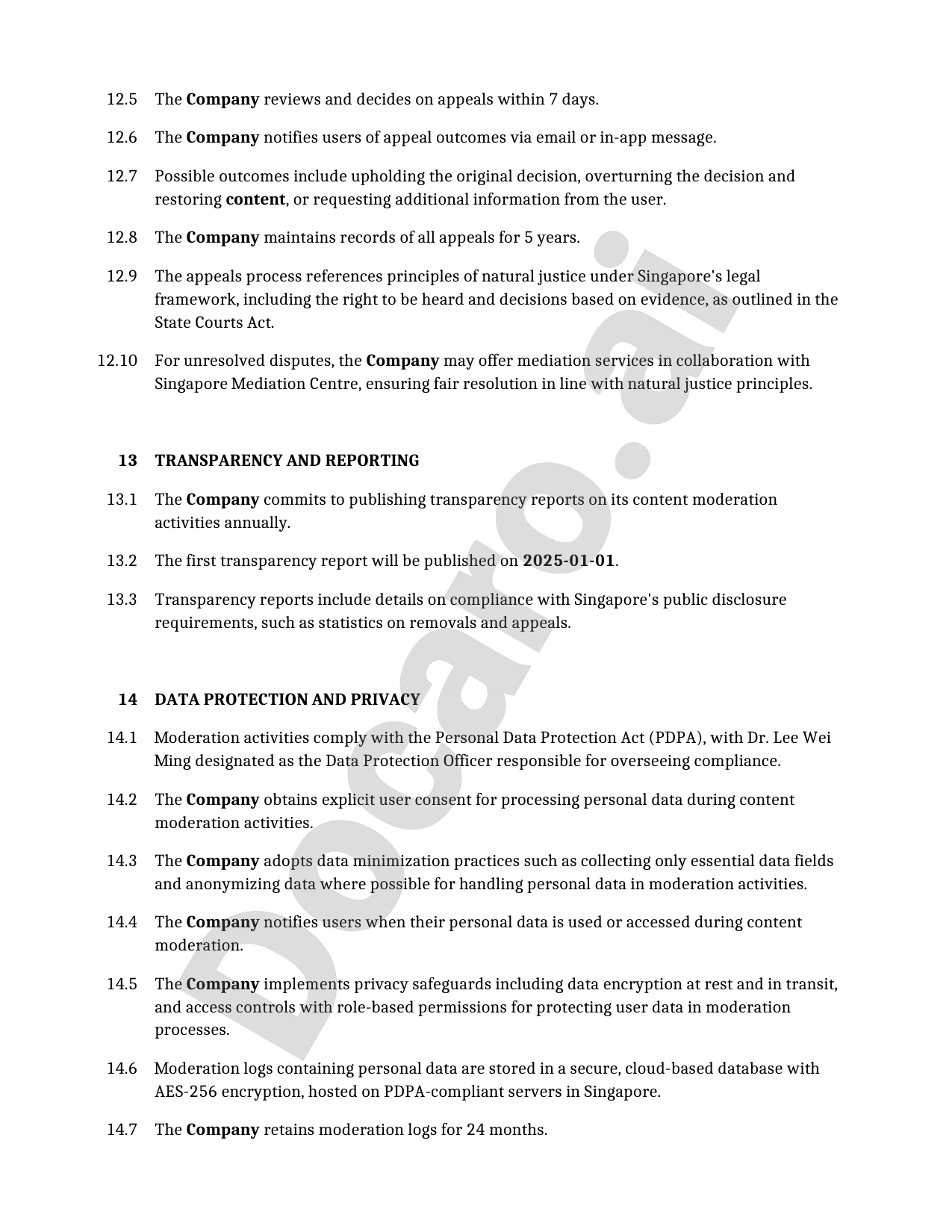
In a Singapore content moderation policy, platform operators bear primary corporate responsibilities for ensuring compliance with local laws, including the Protection from Online Falsehoods and Manipulation Act (POFMA). They must implement robust systems to detect and remove illegal content such as hate speech or misinformation, while maintaining transparency by publicly disclosing moderation practices and annual reports on content actions taken.
Users on Singapore platforms have key rights, including the ability to appeal moderation decisions through a clear, timely process that respects due process under the Personal Data Protection Act (PDPA). Additionally, users are obligated to report suspected illegal content, such as child exploitation material, to authorities via platforms like the Singapore Police Force's i-Witness portal, fostering a collaborative environment for safe online spaces.
Moderators, as designated agents of platform operators, must adhere to obligations for impartial enforcement of community guidelines and legal standards in Singapore. Their role includes documenting decisions for audits and undergoing training on cultural sensitivities to handle diverse content effectively, ensuring accountability in content moderation processes.
1
Consult Legal Experts
Engage Singapore legal specialists to identify compliance requirements under PDPA, Copyright Act, and other relevant laws for content moderation.
2
Draft Policy with Docaro
Use Docaro to generate a bespoke AI-assisted content moderation policy tailored to your corporation's needs and legal insights.
3
Implement and Train Staff
Roll out the policy across platforms, train employees on moderation guidelines, and integrate tools for enforcement.
4
Conduct Ongoing Reviews
Regularly audit policy effectiveness, update for new regulations, and gather feedback to refine content moderation practices.
How Can You Stay Compliant with Singapore's Content Moderation Framework?
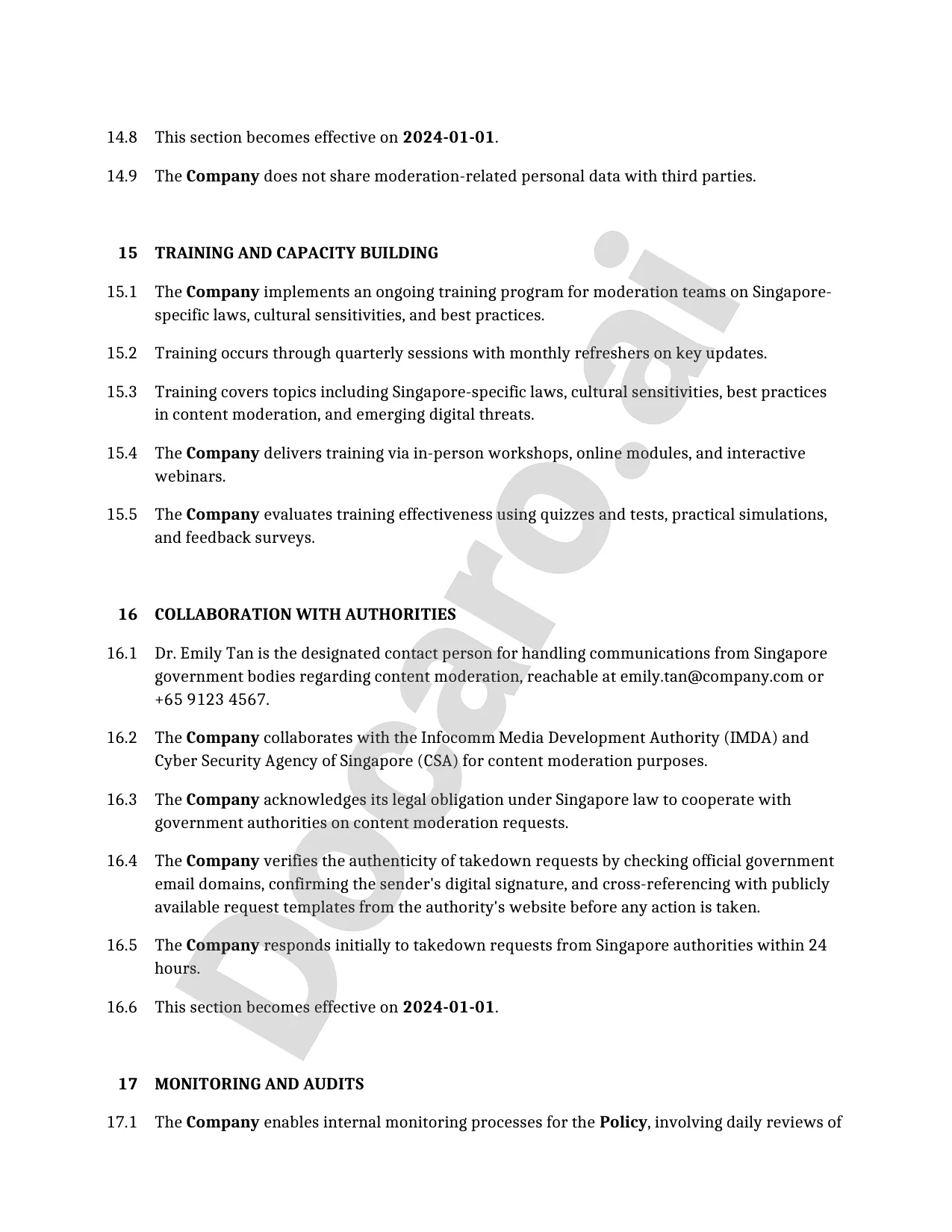
Maintaining compliance in Singapore's content moderation landscape requires regular policy audits to ensure alignment with evolving regulations. Organizations should conduct these audits quarterly, reviewing internal guidelines against updates from the Infocomm Media Development Authority (IMDA), accessible via their official site at IMDA Singapore.
Training for moderators is essential for effective content moderation compliance, focusing on recognizing prohibited content under Singapore's laws. Implement ongoing sessions that incorporate practical scenarios and updates from resources like Understanding Singapore's Content Moderation Framework.
Integrate content moderation with broader Singapore regulations, such as the Protection from Online Falsehoods and Manipulation Act (POFMA), by embedding checks into workflows. For deeper insights, refer to Key Elements of Singapore's Online Content Policy and Navigating Content Moderation Rules in Singapore, and consult authoritative guidance at Ministry of Law Singapore.
To support compliance efforts, advocate for bespoke AI-generated corporate documents using Docaro, tailored specifically to your organization's needs in Singapore's regulatory environment.
You Might Also Be Interested In
A Legal Document Outlining How An Organization Collects, Uses, And Protects Personal Data.
A Legal Agreement Outlining The Rules, Rights, And Obligations For Users Accessing And Using A Website.
A Contract Between A Data Controller And Processor Outlining Data Handling Responsibilities Under Privacy Laws.
A Legal Document Explaining How A Website Uses Cookies To Collect And Manage User Data.
A Legal Contract Outlining Terms For Subscribing To Cloud-based Software Services, Including Access Rights, Fees, And Usage Conditions.
A Legal Contract Between The Software Developer And The User Outlining Terms For Software Usage And Restrictions.
A Corporate Document Outlining Rules And Expected Behaviors For Users In A Community Or Platform.