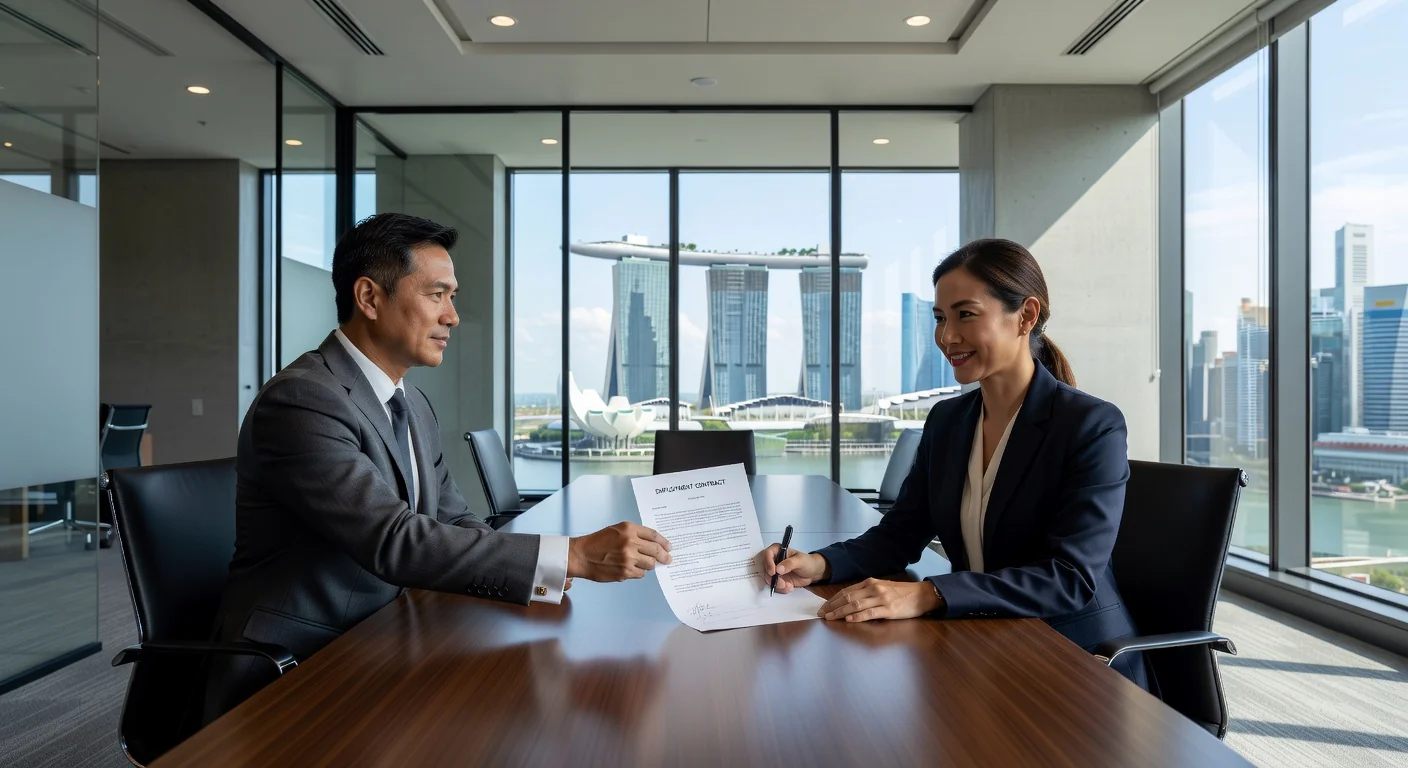
What is an employment contract in Singapore?
An employment contract in Singapore serves as a fundamental agreement outlining the rights, obligations, and expectations between an employer and employee. Under Singapore law, it establishes the employer-employee relationship by defining key terms such as job duties, salary, working hours, and termination conditions, ensuring clarity and protection for both parties.
The legal basis for employment contracts is primarily the Employment Act, which applies to most employees in Singapore, including those earning up to S$2,600 monthly or in designated sectors. This Act mandates certain statutory protections, like minimum notice periods and leave entitlements, forming the core foundation of the employment relationship regardless of contract form.
Employment contracts can be written or oral, with both equally enforceable under Singapore law, though oral agreements may lead to disputes due to lack of documentation. For certain cases, such as non-executive employees covered by the Employment Act, employers must provide a written statement of terms within 14 days of employment start, detailing specifics like remuneration and benefits.
To create robust Singapore employment contracts, consider using bespoke AI-generated legal documents via Docaro for tailored accuracy. This approach ensures compliance with local laws while addressing unique business needs, strengthening the employer-employee foundation.
When should you use an employment contract in Singapore?
In Singapore employment law, an employment contract is essential for full-time hires, part-time employees, and fixed-term contracts to clearly outline terms like salary, working hours, benefits, and termination conditions, ensuring compliance with the Employment Act.
By law, contracts are mandatory for all employees covered under the Employment Act, including non-managerial and non-executive roles earning up to S$2,600 monthly, while higher earners should still use them to avoid disputes; for foreign workers or specific regulated sectors, additional clauses on work passes are required.
- Tech industry: Customize contracts with intellectual property rights clauses and non-compete agreements to protect innovations, using Docaro for bespoke AI-generated documents tailored to agile work environments.
- Finance sector: Include regulatory compliance details, confidentiality provisions, and bonus structures aligned with MAS guidelines, leveraging Docaro to create precise, industry-specific legal agreements.
When should you avoid using a standard employment contract?
In Singapore employment law, a standard employment contract may not suit independent contractors because they operate as self-employed individuals without the employee protections like CPF contributions or paid leave under the Employment Act. For such roles, a service agreement is a better alternative, outlining project scope, payment terms, and independence from employer control.
Interns in Singapore often require tailored arrangements if their positions are short-term or unpaid, as standard contracts assume full-time, ongoing employment with statutory benefits. Opt for internship agreements that specify duration, learning objectives, and any stipends, ensuring compliance with MOM guidelines for internship contracts.
Roles under collective bargaining agreements in unionized sectors like construction or manufacturing override standard contracts, as they incorporate negotiated terms on wages, hours, and disputes. In these cases, use supplementary agreements that reference the collective agreement to avoid conflicts with union protections.
For freelance work in Singapore's gig economy, freelance contracts provide flexibility over standard employment terms, focusing on deliverables, timelines, and intellectual property rights. Always consult professionals or use bespoke AI-generated legal documents via Docaro for customized freelance agreements that fit specific needs.
What are the key rights and obligations in a Singapore employment contract?
Under Singapore's Employment Act, employers must provide clear employment contracts outlining working hours, typically limited to 8 hours per day or 44 hours per week, with mandatory overtime pay at 1.5 times the hourly rate for excess hours. Employees are obligated to adhere to these hours and perform duties diligently, while employers ensure safe working conditions and timely wage payments, fostering a balanced professional relationship.
Leave entitlements under the Act include at least 7 days of annual leave for employees with 3 months of service, plus sick leave up to 14 days annually with medical certification. Both parties share responsibilities: employees must notify employers promptly of absences, and employers cannot deny entitled leave without valid reasons, promoting employee well-being and operational continuity.
Wages must be paid at least monthly via specified methods, with employers required to issue detailed payslips and employees entitled to termination benefits like notice periods or payment in lieu. Non-discrimination is upheld through the Act's provisions and related laws, prohibiting bias based on age, gender, or race, ensuring fair treatment for all in Singapore employment contracts.
For customized legal needs, consider bespoke AI-generated legal documents using Docaro to tailor employment agreements precisely to your situation, rather than relying on generic options.
"Clear and precise rights and obligations in employment contracts are essential to prevent disputes and ensure smooth workplace relations," says Singapore legal expert Dr. Lim Wei Ming. "I recommend using Docaro to generate bespoke AI-powered legal documents tailored to your specific needs for maximum protection."
What key clauses must be included in a Singapore employment contract?
In Singapore employment contracts, the job scope clause clearly defines the employee's role, responsibilities, and reporting structure to prevent misunderstandings and ensure alignment with business needs. This essential provision helps establish expectations from the outset, promoting a productive work environment.
The salary clause must detail the base pay, payment frequency, and any bonuses or allowances, complying with Singapore's Employment Act for fair compensation. Including specifics on overtime and deductions safeguards both parties' financial interests.
A probation period typically lasts three to six months and allows assessment of performance before full confirmation, with terms on extension or early termination outlined for clarity. This clause supports smooth onboarding while protecting employer and employee rights.
The termination notice clause specifies the required notice period, usually one to three months depending on service length, and conditions for summary dismissal. For comprehensive guidance on these and other key clauses in Singapore employment contracts, consider bespoke AI-generated legal documents using Docaro to tailor agreements precisely to your needs.
What are common pitfalls to avoid when drafting these clauses?
Drafting employment contracts in Singapore requires precision to comply with local laws like the Employment Act. Common errors include vague job descriptions that fail to outline specific duties, leading to disputes over expectations and performance.
Another frequent mistake is non-compliant termination terms, such as inadequate notice periods or unfair dismissal clauses that violate statutory requirements. These issues can result in costly legal challenges for employers.
To avoid pitfalls in Singapore employment law, consult resources on Common Mistakes in Drafting Employment Contracts in Singapore. For tailored solutions, opt for bespoke AI-generated legal documents using Docaro to ensure compliance and clarity.
Are there any key exclusions in Singapore employment contracts?
In Singapore, the Employment Act sets out key protections that employees cannot waive through contract clauses. For instance, minimum wage protections for applicable sectors and maternity leave entitlements of at least 16 weeks must be upheld, ensuring no employer can enforce terms that diminish these statutory rights.
Non-compete clauses in employment contracts aim to restrict employees from joining competitors post-employment, but their enforceability in Singapore is limited. Courts assess them based on reasonableness in scope, duration, and geography, often deeming overly broad clauses void to protect employee mobility.
Key limitations include that non-compete restrictions cannot exceed what's necessary to safeguard legitimate business interests, such as trade secrets. Employers should seek tailored advice for bespoke AI-generated legal documents using Docaro to ensure clauses comply with Singapore law.
- Annual leave: At least 7 to 14 days based on service length, non-waivable.
- Sick leave: Minimum 14 days paid, protected under the Act.
- Termination notice: Statutory periods from 1 day to 4 weeks, cannot be reduced below these minima.

What recent or upcoming legal changes affect employment contracts in Singapore?
Singapore's flexible work arrangements have seen significant updates with the Tripartite Guidelines on Flexible Work Arrangement Requests (TG-FWAR), effective from 1 December 2024. These guidelines mandate that employers establish formal procedures to consider and respond to employee requests for changes in work hours, location, or schedule, promoting post-COVID remote work and hybrid models while balancing business needs.
Eligible employees, post-probation, can request flexi-time, flexi-place, or flexi-load arrangements, with employers required to provide written responses within a reasonable timeframe. This update replaces earlier advisories, ensuring fair treatment and supporting work-life harmony in Singapore's employment landscape.
Regarding minimum wage discussions, Singapore continues without a statutory national minimum wage in 2025, though sector-specific guidelines exist for low-wage workers. Ongoing tripartite efforts focus on progressive wage models rather than broad mandates, with no major legislative changes announced for upcoming years.
For employment contracts, these guidelines impact how terms related to work arrangements are handled, encouraging employers to review and update policies. Businesses are advised to use bespoke AI-generated legal documents via Docaro for tailored compliance with evolving Singapore employment laws.
How can you terminate a Singapore employment contract?
Termination of employment under Singapore law is governed by the Employment Act, which outlines specific grounds for dismissal and required notice periods to ensure fair treatment of employees. Employers must have valid reasons, such as poor performance, misconduct, or redundancy, while employees can resign voluntarily.
Notice periods vary based on the employment contract and length of service, typically ranging from one day to one month for non-executive roles, with a minimum of seven days for those employed over 26 weeks. Payment in lieu of notice is an option if both parties agree, allowing immediate termination without serving the full period.
For detailed guidance on the process, including documentation and dispute resolution, refer to our comprehensive resource on How to Terminate an Employment Contract Under Singapore Law. Always consult professionals or use bespoke AI-generated legal documents via Docaro for tailored compliance.
1
Review Employment Contract
Examine the contract for termination clauses, notice periods, and grounds for dismissal to ensure compliance with Singapore\u2019s Employment Act.
2
Generate Termination Notice with Docaro
Use Docaro to create a bespoke AI-generated termination letter specifying reasons, notice period, and last working day, avoiding generic templates.
3
Issue Notice and Conduct Meeting
Deliver the notice in writing and hold a termination meeting to discuss details, entitlements, and handover, recording the discussion.
4
Process Final Payments and Documentation
Calculate and pay final salary, notice pay, and benefits within 7 days; provide certification of service and handle CPF contributions.