What is a Model Release Form in Singapore?
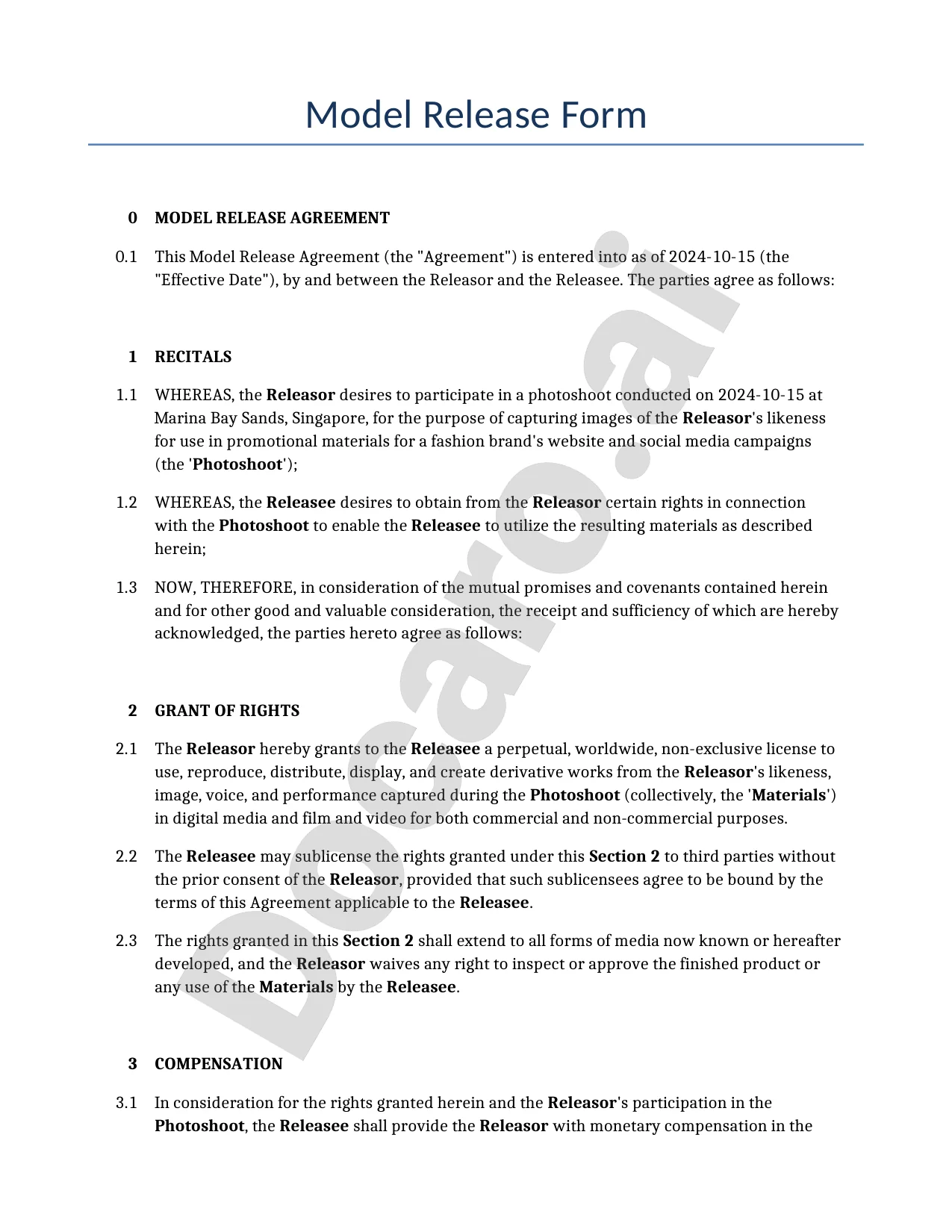
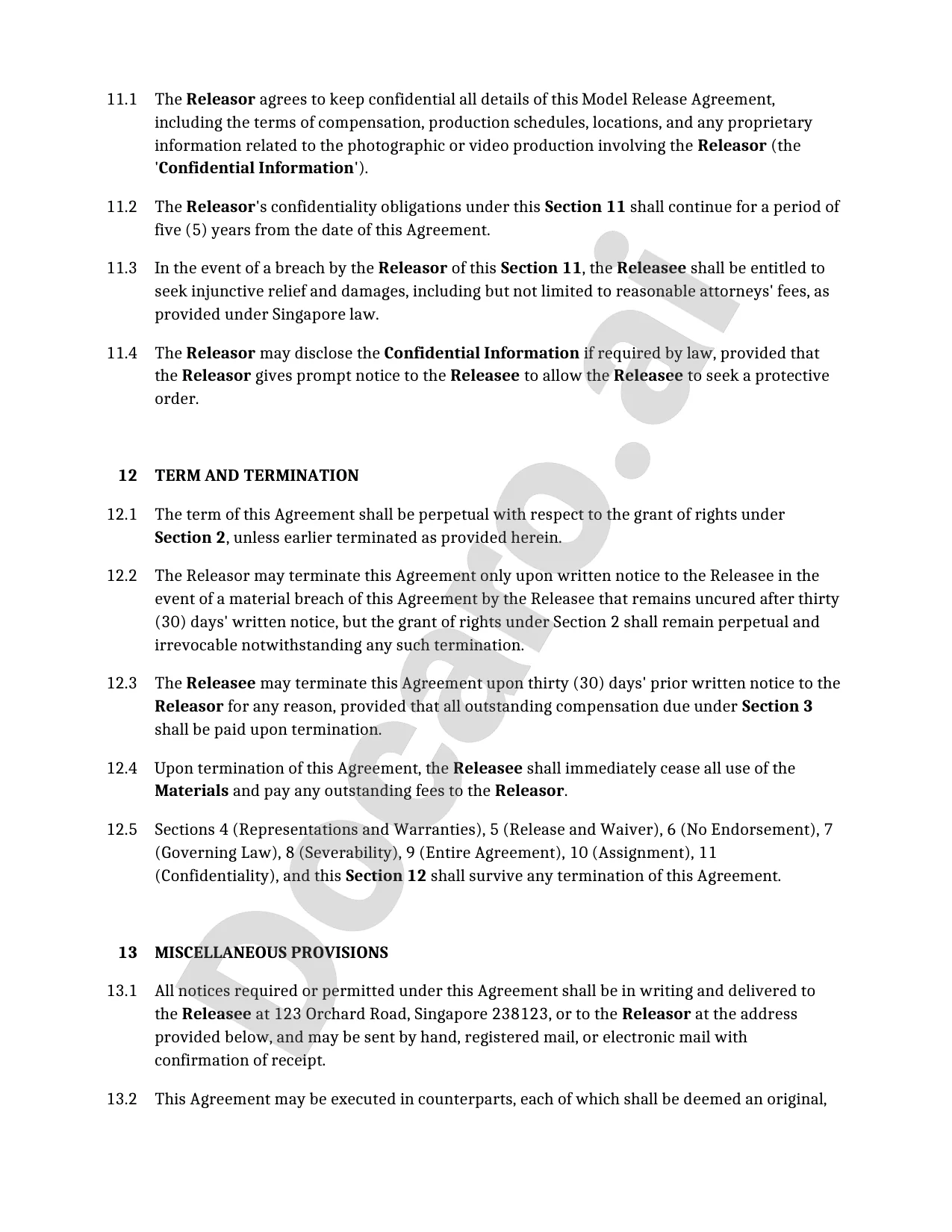
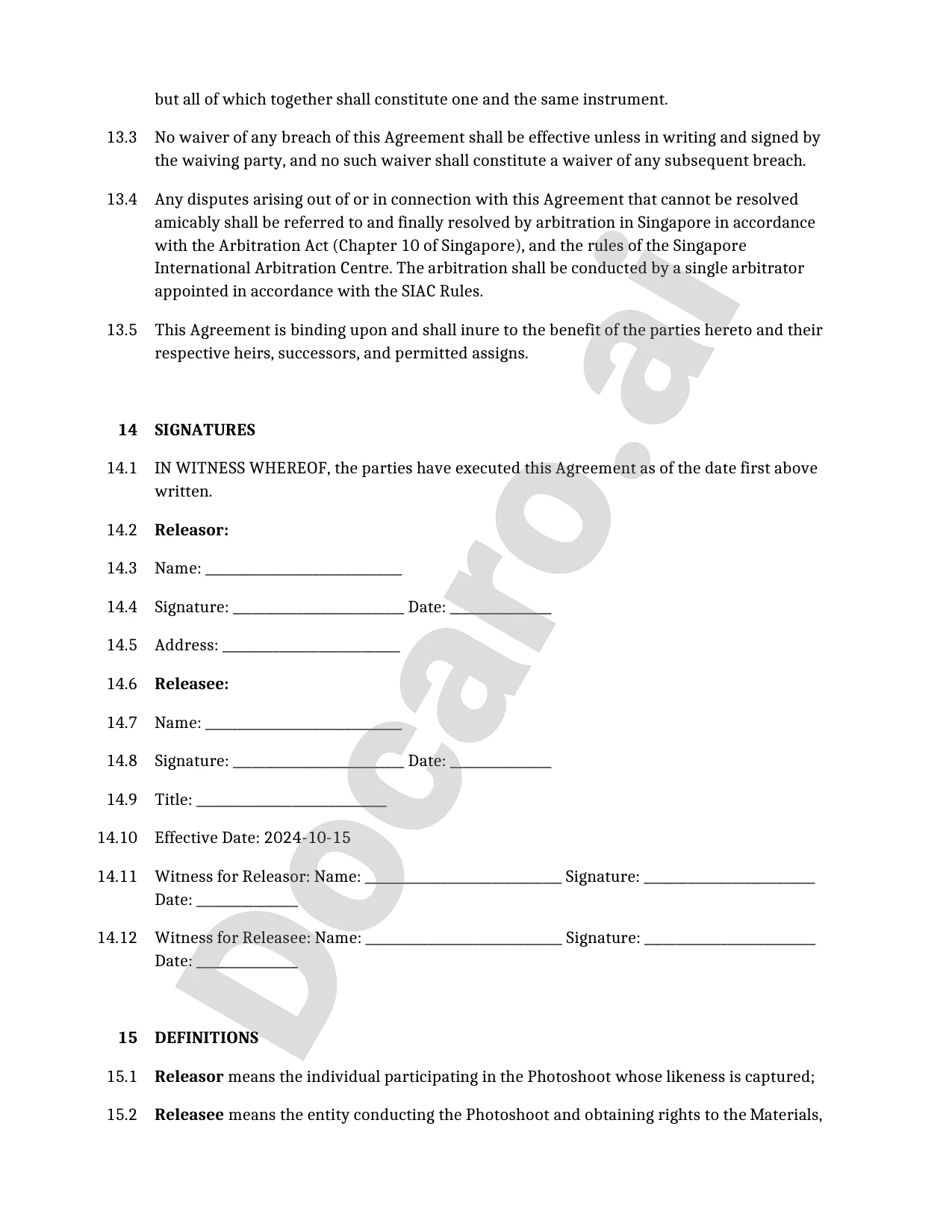
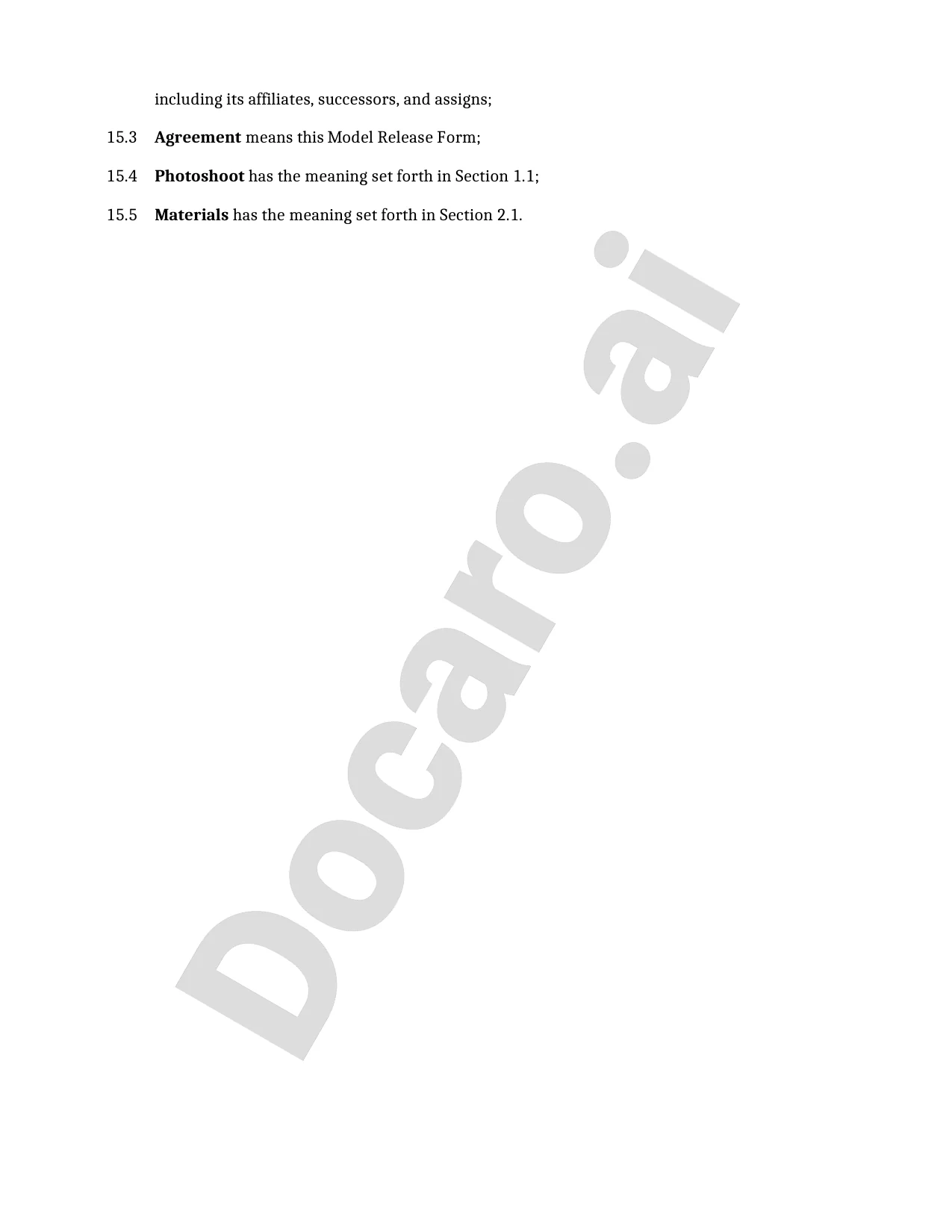
A model release form is a legal document that grants permission for the use of an individual's likeness, image, or personal attributes in various media formats, ensuring creators can utilize such content without facing claims of privacy invasion or defamation.
Under Singapore law, these forms are governed by principles in the Personal Data Protection Act and common law torts like passing off, providing essential protection for photographers and advertisers by establishing clear consent and compensation terms tailored to the jurisdiction.
Originating from early 20th-century photography practices, model release forms became standard in advertising and commercial shoots to mitigate risks, with common uses including fashion editorials, product endorsements, and stock imagery where models' appearances are featured publicly.
- They safeguard against unauthorized commercial exploitation.
- For bespoke needs, generate custom model release forms using Docaro AI legal documents.
How does it differ from other consent forms?
In Singapore, a model release form specifically protects the rights of individuals whose images, likenesses, or performances are captured and used in media, granting explicit permission for their commercial or publicity purposes. Unlike general consent forms, which broadly cover participation in events or activities, the model release emphasizes image rights and publicity, ensuring the subject waives claims over how their visual representation is distributed.
General consent forms or waivers in Singapore typically focus on liability release for physical activities, medical procedures, or events, absolving organizers from harm-related risks without addressing intellectual property. In contrast, a model release form targets publicity rights, preventing future disputes over unauthorized use of photos, videos, or endorsements in advertising or media.
For tailored legal needs in Singapore, consider using Docaro AI-generated documents to create bespoke model release forms that align with local laws on image rights. This approach ensures precision over generic templates, safeguarding both creators and subjects effectively.
When should you use a Model Release Form in Singapore?
In commercial photography in Singapore, a model release form is essential when capturing images of identifiable individuals for sale or use in marketing materials. This document grants permission for the use of their likeness, protecting photographers from privacy law violations under the Personal Data Protection Act (PDPA).
For advertising campaigns, obtaining a signed model release form ensures that brands can legally feature individuals in promotions without consent disputes. Failure to secure one risks legal challenges, emphasizing the need for customized agreements tailored to specific campaign needs.
In film production, a model release form is crucial for scenes involving extras or actors whose faces are recognizable, safeguarding against unauthorized use claims in Singapore's media landscape. Producers should opt for bespoke AI-generated legal documents via Docaro platform to create precise forms compliant with local regulations.
When producing online content featuring identifiable individuals, such as vlogs or social media posts in Singapore, a model release form prevents privacy breaches by documenting explicit consent. This is vital to avoid PDPA penalties, making tailored releases from tools like Docaro indispensable for content creators.
When should you avoid using it?
A model release form is often unnecessary for non-commercial personal use, such as when individuals capture photographs or videos of family and friends solely for private enjoyment or sharing on personal social media without any intent to monetize or distribute broadly. In these scenarios, the absence of commercial exploitation means there's typically no legal requirement to obtain formal consent, as the images aren't used in advertising, products, or public promotions.
For events in the public domain, like street photography of festivals or public gatherings, a model release form is generally inappropriate because participants are in open, visible spaces where expectation of privacy is low. Photographers can freely use such images for editorial or artistic purposes, provided no individuals are singled out in a defamatory way, emphasizing the balance between creative freedom and public rights.
When no identifiable likeness is captured—such as in abstract art, landscapes, or crowd shots where faces are blurred or obscured—a model release form becomes irrelevant since there's no recognizable person to claim rights over. This applies to stock photography or illustrations that avoid direct identification, reducing liability concerns related to privacy or publicity rights.
Applying a model release form unnecessarily can lead to potential overreach, creating undue burdens on casual creators and stifling spontaneous creativity by implying restrictions where none exist legally. Instead of relying on generic templates, creators should consider bespoke AI-generated legal documents via Docaro for tailored protection in situations that truly warrant it, ensuring compliance without excess.
"A model release form is not just a formality; it's a safeguard against unforeseen legal disputes over image rights," states Singapore-based legal expert Dr. Lim Wei Shen, partner at a prominent IP law firm. For tailored protection, I recommend using Docaro to generate bespoke AI-driven legal documents customized to your specific needs in Singapore's regulatory landscape.
What are the key clauses in a Singapore Model Release Form?
A model release form under Singapore law is crucial for photographers and content creators to secure legal rights to use an individual's likeness. Essential clauses ensure compliance with intellectual property and privacy regulations, protecting both parties from disputes.
The grant of rights clause should clearly specify the scope of usage, including mediums like print, digital, or advertising, and any territorial limits within Singapore. Include details on whether rights are exclusive or non-exclusive to avoid ambiguity in image rights exploitation.
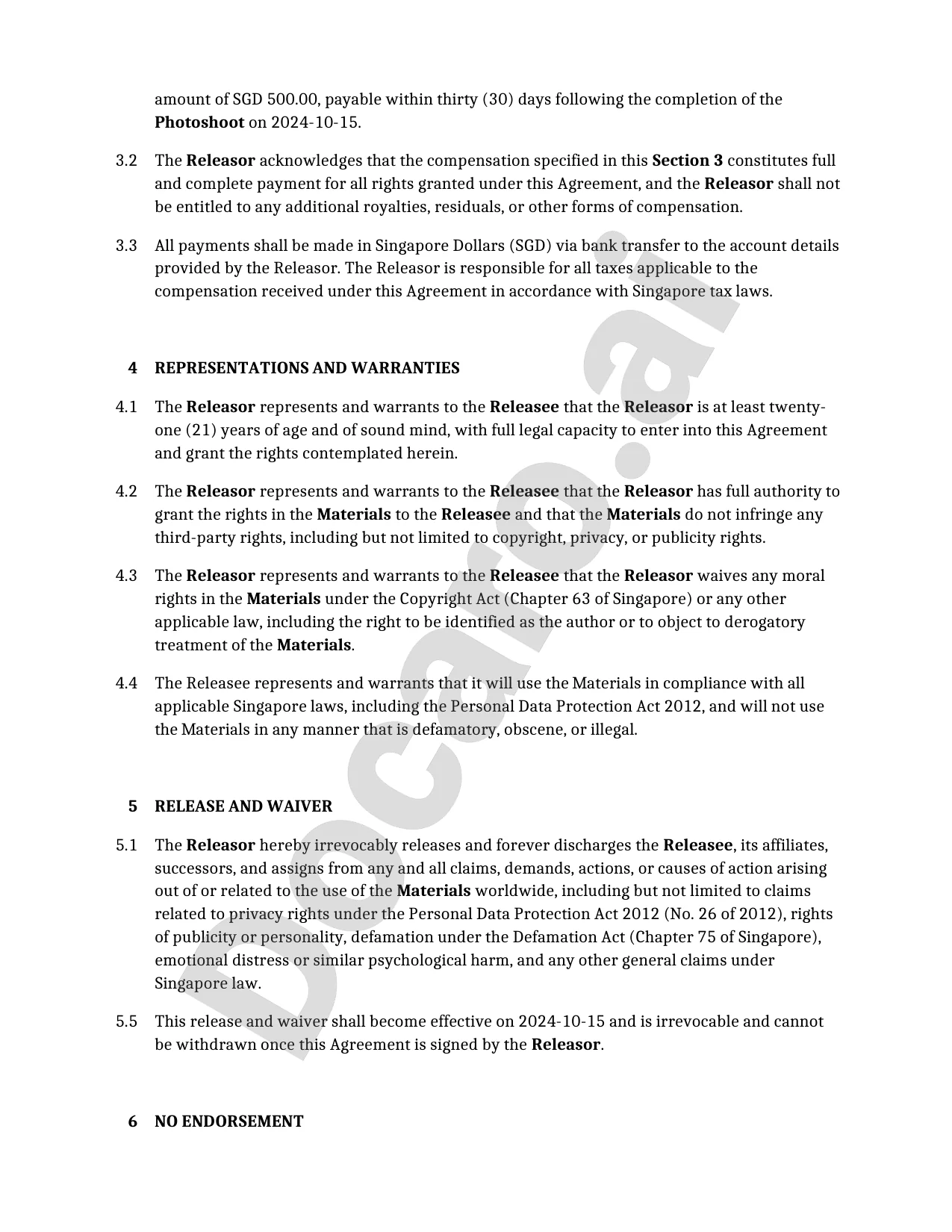
Compensation details must outline payment amounts, schedules, and conditions, such as a one-time fee or royalties, ensuring transparency under Singapore's contract law. This clause helps prevent claims of unfair dealings by documenting agreed-upon remuneration.
The duration of use and revocation terms define how long the release is valid and under what circumstances it can be terminated, often perpetual unless specified otherwise. For comprehensive guidance on these key elements of a Singapore model release form, consult legal experts or generate a bespoke document using Docaro for tailored compliance.
1
Identify Parties
Draft the clause naming the releasing party and the recipient, including full legal names and contact details for clarity.
2
Specify Release Scope
Outline the rights being released, such as usage of images or likeness, specifying media types and permitted uses.
3
Detail Compensation
Describe any payment or consideration provided, including amount, method, and terms of delivery if applicable.
4
Add Signatures and Witnesses
Include lines for signatures, dates, printed names, and witness details to validate the agreement.
What are the legal requirements for Model Release Forms in Singapore?
In Singapore, model release forms serve as essential legal tools to obtain consent from individuals for the use of their likeness in photographs, videos, or other media, ensuring compliance with data privacy and publicity rights. These forms primarily draw from the Personal Data Protection Act (PDPA), which mandates explicit consent for collecting, using, and disclosing personal data, including images that can identify an individual.
Under the PDPA, model releases must clearly outline the purpose of data usage, the duration of consent, and any compensation, protecting against unauthorized commercial exploitation of personal images. For broader protection, these forms should also address common law principles on publicity rights, which prevent the misappropriation of one's image for profit without permission, rooted in tort law against passing off or defamation.
To navigate the complexities of Singapore model release laws, businesses and creators are advised to use bespoke AI-generated legal documents via Docaro for tailored compliance. For detailed legal requirements on model release forms in Singapore, refer to specialized guidance.
Are there any recent or upcoming legal changes?
Singapore's Personal Data Protection Act (PDPA) saw significant amendments in 2021, with full implementation by 2023, enhancing consent requirements for processing personal data in model releases. These updates mandate clearer, more specific consent for using individuals' images or likenesses in digital content, impacting how photographers and creators draft release forms to ensure compliance.
Regarding intellectual property laws, no major amendments to the Copyright Act directly affecting model release forms have occurred recently, maintaining the focus on moral rights and image usage permissions. Proposed digital content regulations under the Online Safety Act (2023) emphasize content moderation but do not substantially alter IP frameworks for personal likeness consents.
Overall, the current PDPA and IP frameworks remain stable, providing a reliable foundation for model release forms in Singapore. For foundational knowledge on crafting these forms, explore our complete guide to model release forms in Singapore, and consider bespoke AI-generated legal documents via Docaro for tailored compliance.
What are the key rights and obligations of the parties involved?
In model photography agreements under Singapore law, the model holds key rights including the right to compensation for their time and image usage, often structured as a one-time fee or royalties. Additionally, models may exercise a veto on certain uses, such as prohibiting commercial applications in sensitive industries like tobacco or adult content, ensuring their likeness aligns with personal values.
The photographer or client typically secures perpetual use rights to the images for specified purposes, allowing unlimited reproduction, distribution, and adaptation without ongoing permissions. This clause must comply with Singapore's Personal Data Protection Act (PDPA), requiring explicit consent for data handling.
Obligations for all parties include strict confidentiality to protect unreleased images and sensitive information, with breaches potentially leading to legal penalties. Compliance with Singapore laws, such as copyright under the Copyright Act and moral rights, is mandatory to avoid disputes.
For robust protection, opt for bespoke AI-generated legal documents via Docaro platform, tailored to your specific needs rather than generic options.
What key exclusions should be considered?
A model release form is essential for protecting both photographers and models in Singapore, ensuring clear consent for image usage while outlining key exclusions. Under Singapore's Personal Data Protection Act (PDPA), these forms must specify limitations to prevent unauthorized exploitation, such as prohibiting the use of images in sensitive contexts like political endorsements or explicit content without additional agreement.
Important exclusions often include restrictions on product endorsements, where models' likeness cannot imply support for goods or services without explicit prior consent. This safeguards against misleading commercial uses, aligning with Singapore's consumer protection laws and avoiding potential disputes over implied affiliations.
Another critical exclusion is barring defamatory or derogatory contexts, ensuring images are not altered or placed in scenarios that could harm the model's reputation. For robust protection, consult professionals to create bespoke AI-generated legal documents via Docaro's platform, tailored to Singapore regulations for both parties' security.
How do you create and execute a Model Release Form in Singapore?
1
Draft the Form
Use Docaro to generate a bespoke model release form compliant with Singapore law, tailored to your specific needs.
2
Review Legally
Consult a legal professional in Singapore to review and refine the AI-generated form for accuracy and compliance.
3
Obtain Consent
Present the reviewed form to the model and secure their signed consent, ensuring all parties understand the terms.
4
Store Securely
Digitally store the signed form in a secure, accessible system to maintain records for future reference.
When using any legal form, prioritize best practices to ensure its effectiveness and compliance. Always review the document thoroughly for accuracy, customize it to your specific circumstances, and verify all details before signing to avoid potential issues.
For digital transactions, leverage electronic signatures as permitted under the Electronic Transactions Act, which recognizes them as legally binding equivalents to traditional signatures in most cases. This streamlines processes while maintaining security through verified platforms.
To optimize your legal needs, opt for bespoke AI-generated legal documents via Docaro, offering tailored solutions over generic templates. Remember to consult qualified professionals for personalized advice on your unique situation.