Docaro

AI Generated ESG Report for use in Singapore
PDF & Word - 2026 Updated
A photorealistic image of a diverse group of professional adults in a modern Singapore office setting, discussing sustainability charts on a digital screen, symbolizing ESG reporting and corporate responsibility, with elements like green plants and city skyline view, conveying transparency and environmental focus, no children present.
Generate a comprehensive AI-powered ESG report tailored for Singapore businesses, ensuring compliance with local sustainability standards and enhancing your corporate environmental, social, and governance performance.
Free instant document creation.
Compliant with Singapore law.
No sign up or monthly subscription.

Docaro Pricing

Basic
Free
Document Generation
No Sign Up
No Subscription
Download Watermarked PDF
Premium
$4.99 USD
Document Generation
No Sign Up
No Subscription
Download Clean PDF
Download Microsoft Word
Download HTML
Download Text
Email Document
Generate your document for free. Only pay if you like the result and need an un-watermarked version.

When Do You Need an ESG Report in Singapore?

  • Attracting Investors
    Investors increasingly look for companies that care about the environment, society, and good governance, so an ESG report shows your business is responsible and worth investing in.
  • Meeting Stakeholder Expectations
    Customers, partners, and employees expect businesses to act ethically, and an ESG report demonstrates your commitment to these values.
  • Complying with Regulations
    Singapore encourages companies to report on ESG matters, helping you stay ahead of upcoming rules and avoid future compliance issues.
  • Improving Business Performance
    A well-drafted ESG report highlights your strengths in sustainability, which can lead to cost savings and better operations.
  • Building a Positive Reputation
    Sharing your ESG efforts through a clear report enhances your brand image and builds trust with the public and community.
  • Preparing for Global Standards
    As international ESG requirements grow, having a solid report positions your company to adapt and compete worldwide.

Singaporean Legal Rules for an ESG Report

  • No Mandatory Requirement
    In Singapore, there is no law requiring all companies to prepare or publish ESG reports.
  • Applies to Listed Companies
    Publicly listed companies on the Singapore Exchange must disclose ESG information in their annual reports.
  • SGX Listing Rules
    The Singapore Exchange's rules guide how listed companies report on sustainability and ESG matters.
  • Voluntary for Others
    Non-listed companies can choose to create ESG reports voluntarily to show their commitment to sustainability.
  • Government Guidelines
    The government encourages ESG reporting through guidelines from bodies like the Monetary Authority of Singapore.
  • Accuracy Matters
    Any ESG report must be truthful and not misleading to avoid legal issues under general business laws.
Important

Failing to align the ESG report structure with Singapore's regulatory frameworks, such as those from the SGX or ACRA, may result in non-compliance and ineffective disclosure.

What a Proper ESG Report Should Include

  • Executive Summary
    A brief overview of the company's ESG performance, key achievements, and future commitments to set the context for the report.
  • Environmental Impact
    Details on efforts to reduce carbon emissions, manage waste, and conserve resources, showing the company's environmental footprint.
  • Social Responsibility
    Information about supporting employees, communities, and human rights, highlighting positive social contributions.
  • Governance Practices
    Explanation of ethical leadership, board diversity, and anti-corruption measures to ensure strong company oversight.
  • Performance Metrics
    Clear data and targets on ESG goals to measure progress and demonstrate accountability.
  • Risk Management
    Identification of ESG-related risks and strategies to address them, promoting long-term sustainability.
  • Stakeholder Engagement
    Description of how the company interacts with investors, employees, and communities to incorporate their feedback.

Why Free Templates Can Be Risky for ESG Reports

Free templates for ESG reports often rely on generic structures that fail to address the unique regulatory landscape of Singapore. They may overlook specific requirements under frameworks like the SGX sustainability reporting guidelines or international standards such as GRI and TCFD, leading to incomplete disclosures, compliance gaps, and potential reputational damage. Moreover, these one-size-fits-all documents rarely capture a company's tailored ESG initiatives, resulting in reports that appear unconvincing or misaligned with actual operations.

AI-generated bespoke ESG reports offer customized content precisely aligned with your company's profile, Singapore's legal and reporting standards, and evolving global best practices. This ensures comprehensive, accurate, and professional documents that highlight your genuine sustainability efforts, enhance stakeholder trust, and position your organization as a leader in responsible business practices.

Generate Your Bespoke ESG Report in 4 Easy Steps

1
Answer a Few Questions
Our AI guides you through the info required.
2
Generate Your Document
Docaro builds a bespoke document tailored specifically on your requirements.
3
Review & Edit
Review your document and submit any further requested changes.
4
Download & Sign
Download your ready to sign document as a PDF, Microsoft Word, Txt or HTML.

Why Use Our AI ESG Report Generator?

Fast Generation
Quickly generate a comprehensive ESG Report, eliminating the hassle and time associated with traditional document drafting.
Guided Process
Our user-friendly platform guides you step by step through each section of the document, providing context and guidance to ensure you provide all the necessary information for a complete and accurate ESG Report.
Safer Than Legal Templates
We never use legal templates. All documents are generated from first principles clause by clause, ensuring that your document is bespoke and tailored specifically to the information you provide. This results in a much safer and more accurate document than any legal template could provide.
Professionally Formatted
Your ESG Report will be formatted to professional standards, including headings, clause numbers and structured layout. No further editing is required. Download your document in PDF, Microsoft Word, TXT or HTML.
Compliance with Singaporean Law
Rest assured that all generated documents meet the latest legal standards and regulations of Singapore, enhancing trust and reliability.
Cost-Effective
Save money by generating legally sound ESG Report without the need for expensive legal services or consultations.
Get Started for Free - No Sign Up or Monthly Subscription Required
No payment or sign up is required to start generating your ESG Report. Generate and download a watermarked version of your document for free. Pay only if you want to remove the watermark and gain full access to your document. No monthly subscriptions or hidden fees. Pay once and use your document forever.
Need to Generate a ESG Report in a Different Country?
Choose country:

Free Example ESG Report Template

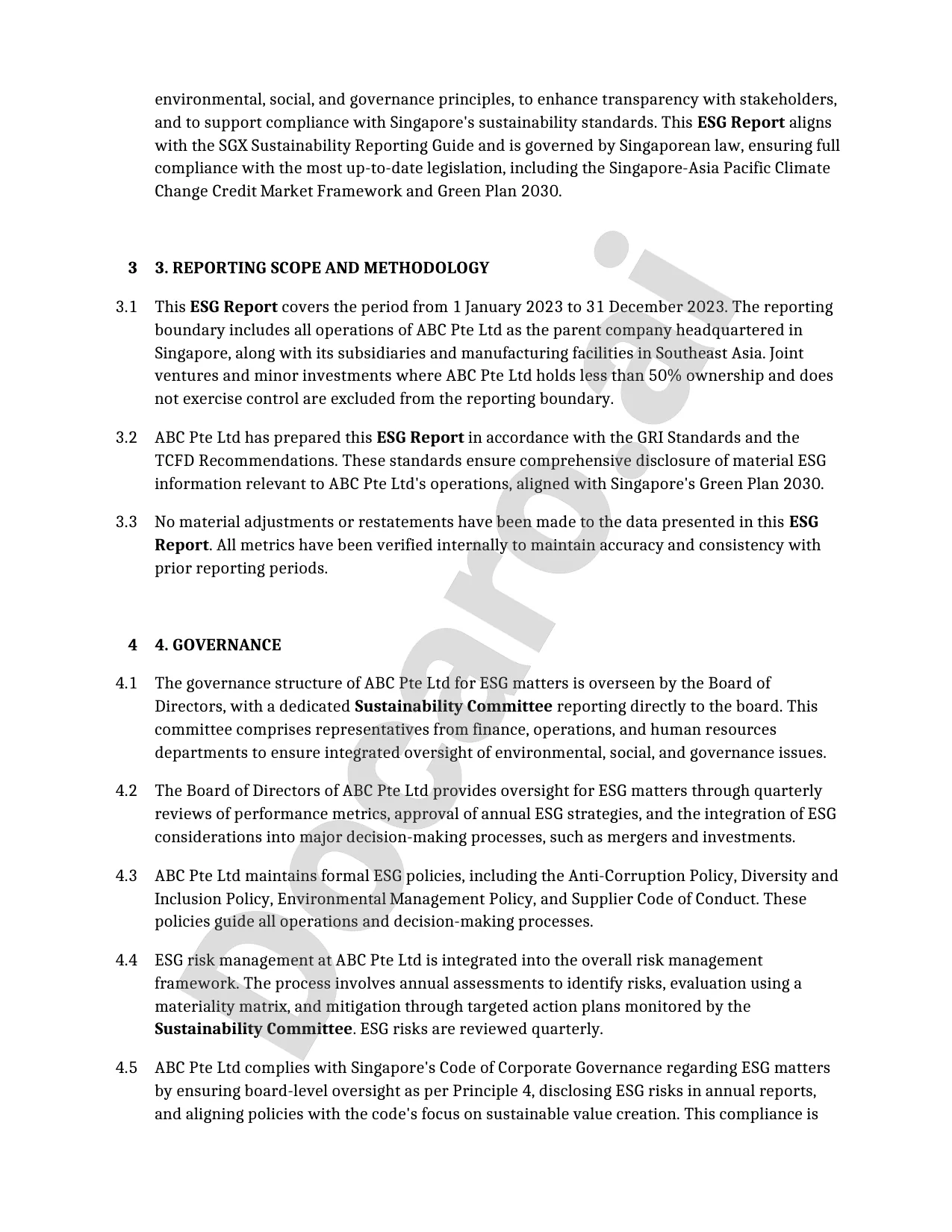
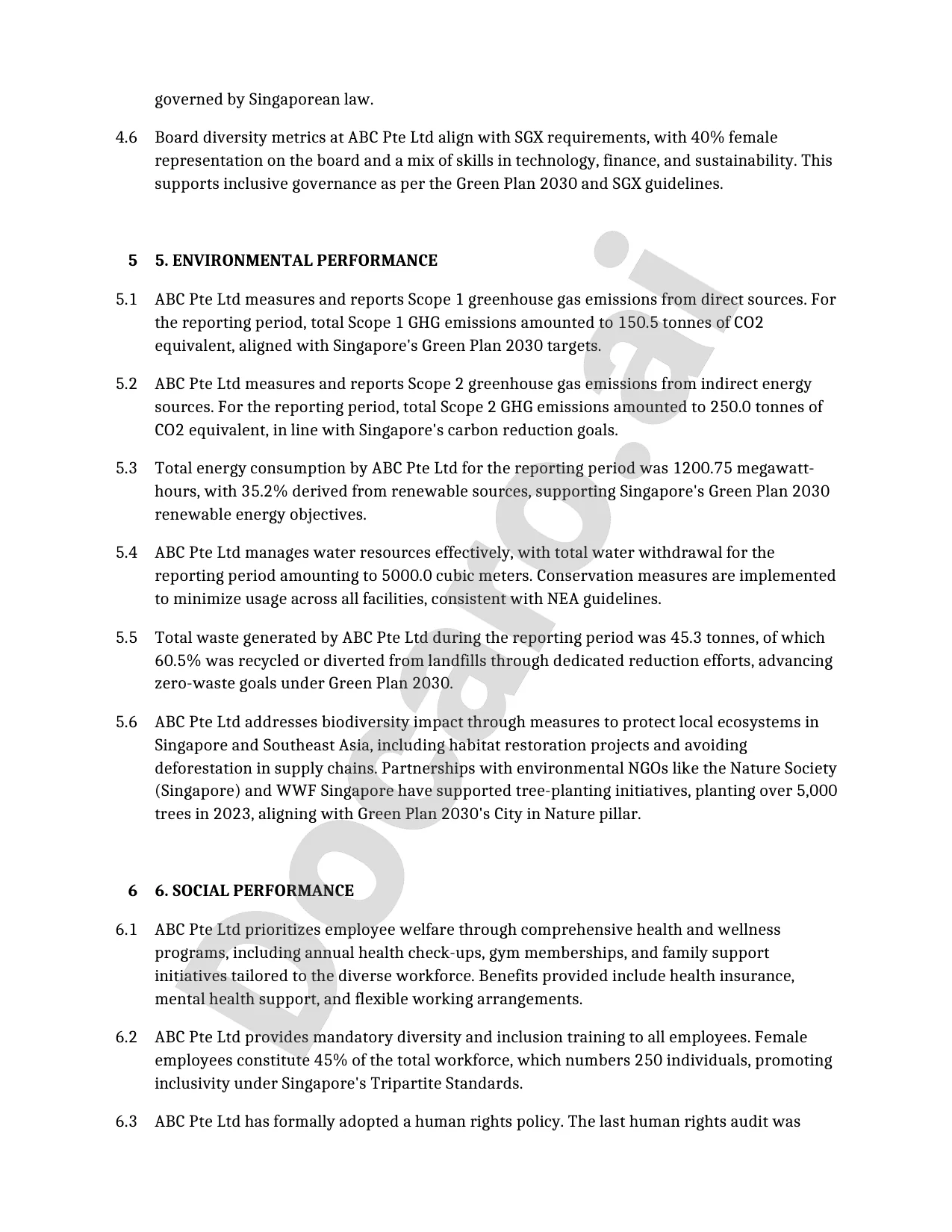
Below is a free template example of a ESG Report for use in Singapore generated by our AI model.

The clauses in your actual ESG Report will vary from this example as they will be entirely bespoke to your requirements as set out in the questionnaire you complete.
Page 1

Singapore Compliance Legislation

Your AI Generated ESG Report will be checked for compliance against the following legislation and regulations:
Introduced by MAS, it encourages ESG reporting on climate-related risks and opportunities, aligning with international standards like TCFD for environmental disclosures.

What Are ESG Reports in the Singapore Corporate Context?

ESG reports are essential corporate documents that detail a company's performance in Environmental, Social, and Governance aspects, helping stakeholders assess sustainability and ethical practices. In Singapore, these reports play a crucial role in promoting transparency and accountability among businesses, aligning with the nation's commitment to responsible capitalism.

The history of ESG reporting requirements in Singapore began gaining momentum in 2016 when the Singapore Exchange (SGX) introduced guidelines encouraging listed companies to disclose sustainability information. By 2022, SGX mandated sustainability reports for issuers, reflecting a push towards integrated ESG disclosure under frameworks like the SGX Sustainability Reporting Guide.

For deeper insights into ESG reporting in Singapore, explore our guide on Understanding the Essentials of ESG Reporting in Singapore. Businesses are encouraged to create bespoke AI-generated corporate documents using Docaro to ensure compliance and customization tailored to Singapore's regulatory landscape.

"ESG transparency is essential for building investor trust and ensuring long-term corporate resilience in Singapore's evolving market," states the Monetary Authority of Singapore (MAS) in its 2023 Guidelines on Environmental Risk Management. To enhance your ESG reporting, generate bespoke corporate documents using Docaro for tailored, compliant sustainability disclosures.
Singapore skyline with corporate buildings

When Should Singapore Companies Prepare an ESG Report?

In Singapore, ESG reporting is mandatory for companies listed on the SGX, as per the Singapore Exchange rules under Practice Note 7.1, which requires disclosures on environmental, social, and governance factors to enhance transparency and sustainability for investors.

For large corporations in Singapore, ESG reports are highly recommended especially for entities with significant assets or revenue, such as those exceeding S$1 billion in market capitalization, to meet stakeholder expectations from shareholders and regulators like the ACRA.

Industry plays a key role, with high-impact sectors like finance, manufacturing, and real estate facing stronger pushes for ESG compliance due to environmental risks and social responsibilities. For detailed guidelines, refer to the SGX Sustainability Reporting Guide or the ACRA ESG resources.

Company size influences recommendations, where mid-sized firms in growth phases benefit from voluntary ESG reporting to attract international funding, while smaller entities may adopt it based on stakeholder pressures from partners or customers emphasizing sustainable practices.

1
Assess Regulatory Applicability
Review Singapore Exchange (SGX) listing rules and SGX-NUS sustainability framework to check if your company meets size or sector criteria for mandatory ESG reporting.
2
Evaluate Internal ESG Factors
Analyze your company's operations, industry risks, and voluntary commitments to determine if ESG reporting aligns with strategic goals beyond regulatory needs.
3
Consult Legal Advisors
Engage qualified legal experts to confirm obligations and use Docaro for bespoke AI-generated ESG compliance documents tailored to your company's specifics.

When Should Companies Avoid or Limit ESG Reporting?

For small enterprises in Singapore with minimal environmental impact, preparing a full ESG report may not be necessary, as their operations often fall below regulatory thresholds set by bodies like the Accounting and Corporate Regulatory Authority (ACRA). This allows focus on core business activities without diverting limited resources to extensive reporting.

When resources are limited, such as in startups or SMEs, a comprehensive ESG report can be inadvisable due to the high costs of data collection and compliance, potentially straining budgets better allocated to growth. Businesses can instead prioritize material aspects of sustainability that align with their scale, avoiding non-applicable metrics like carbon emissions tracking for non-manufacturing firms.

Key exclusions in ESG reporting include sustainability metrics irrelevant to the business, such as biodiversity impacts for urban service providers, enabling tailored disclosures that meet Singapore's guidelines without unnecessary detail. For guidance on compliance, refer to How Singapore Businesses Can Comply with ESG Report Requirements, and consult authoritative sources like the ACRA website for official standards.

To streamline ESG documentation, consider using bespoke AI-generated corporate documents via Docaro, ensuring customized reports that fit your enterprise's needs efficiently and compliantly.

What Are the Key Clauses in an ESG Report?

ESG reports for Singapore companies typically begin with an executive summary outlining the organization's commitment to environmental, social, and governance principles, often aligned with guidelines from the Singapore Exchange (SGX). This section sets the tone by highlighting key achievements and future goals in sustainable practices.

The environmental impact assessments section details metrics on carbon emissions, energy consumption, waste management, and biodiversity efforts, emphasizing compliance with Singapore's green initiatives. Companies often include data on water usage and renewable energy adoption to demonstrate reduced ecological footprints.

Social responsibility metrics cover employee welfare, diversity and inclusion, community engagement, and supply chain ethics, with quantitative indicators like training hours and health & safety incidents. This part underscores the firm's role in fostering inclusive growth in Singapore's diverse society.

Governance structures and compliance statements describe board oversight, risk management frameworks, anti-corruption policies, and adherence to SGX listing rules and the Code of Corporate Governance. For comprehensive reporting, Singapore firms should opt for bespoke AI-generated corporate documents using Docaro to ensure tailored accuracy and regulatory alignment.

"In Singapore's evolving ESG reporting landscape, verifiable data is non-negotiable for credible disclosures under the SGX guidelines—companies must prioritize robust, auditable evidence to mitigate regulatory risks and build investor trust," says Dr. Elena Tan, a leading expert in Singapore corporate law at NUS Law. For tailored compliance, I recommend using Docaro to generate bespoke AI-powered corporate documents that align precisely with your specific needs.
Professional reviewing ESG report

What Rights and Obligations Do Parties Have in ESG Reporting?

In Singapore, companies are obligated under the Companies Act to prepare and disclose ESG reports, particularly for those listed on the Singapore Exchange (SGX), which mandates sustainability reporting aligned with global standards like GRI or TCFD. Directors must ensure the accuracy and completeness of these reports, while auditors verify compliance and provide assurance on non-financial disclosures, as outlined by the Accounting and Corporate Regulatory Authority (ACRA).

Stakeholders, including shareholders and investors, have the right to access transparent ESG information to make informed decisions, and companies must address material ESG risks in their annual reports. Non-compliance with disclosure duties can lead to penalties under the Companies Act, such as fines up to SGD 50,000 or imprisonment for directors, emphasizing the need for robust internal controls.

For insights into the benefits of implementing ESG reports for Singapore companies, explore this detailed guide on enhanced reputation, investor attraction, and operational efficiencies.

ESG icons on sustainable background

How Do Recent Legal Changes Affect ESG Reports in Singapore?

Singapore's regulatory bodies, including ACRA and SGX, are advancing ESG reporting requirements to align with global standards. Recent updates mandate enhanced sustainability disclosures for listed companies, effective from 2023, focusing on climate-related risks and opportunities.

The adoption of ISSB standards by Singapore corporates will standardize ESG reporting, integrating with existing frameworks like the SGX Sustainability Reporting Guide. This shift requires companies to disclose material sustainability information, improving transparency and investor confidence.

Implications for Singapore corporates include increased compliance costs but also opportunities for better risk management and access to green financing. Businesses should prepare by assessing their sustainability data systems, with resources available from ACRA and SGX for guidance.

  • Key benefits: Enhanced comparability of ESG metrics across sectors.
  • Challenges: Need for robust data collection and assurance processes.
  • Recommendation: Opt for bespoke AI-generated corporate documents using Docaro to ensure tailored compliance solutions.
1
Review Current Reports
Examine existing compliance reports to identify gaps against new legal changes, ensuring all areas are covered comprehensively.
2
Assess Integration Needs
Evaluate how new requirements impact operations and draft initial plans for seamless incorporation into company processes.
3
Generate Bespoke Documents with Docaro
Use Docaro to create customized AI-generated corporate documents tailored to the updated legal standards and your specific needs.
4
Seek Expert Guidance
Consult legal experts to validate adaptations and ensure full compliance with the evolving regulatory landscape.

ESG Report FAQs

An ESG Report is a document that outlines a company's performance in Environmental, Social, and Governance factors. In Singapore, it's crucial for compliance with SGX listing requirements and attracting investors, as it demonstrates sustainable practices and enhances corporate reputation.

Document Generation FAQs

Docaro is an AI-powered legal and corporate document generator that helps you create fully formatted, legally sound contracts and agreements in minutes. Just answer a few guided questions and download your document instantly.
You Might Also Be Interested In
A Document Outlining Company Policies, Employee Rights, And Workplace Rules.
A Document Outlining Expected Behaviors, Ethical Standards, And Rules For Individuals Or Organizations To Ensure Integrity And Compliance.
A Corporate Policy Outlining Commitments To Fostering Diverse Workplaces, Ensuring Equitable Opportunities, And Promoting Inclusive Practices.
A Corporate Policy Outlining Guidelines For Employees Working Remotely, In-office, Or In A Hybrid Model To Balance Flexibility And Productivity.
A Corporate Policy Outlining Rules For Appropriate Use Of IT Resources And Systems.
A Policy Outlining How An Organization Manages, Stores, And Disposes Of Data And Records To Ensure Compliance And Efficiency.
A Corporate Policy Outlining Procedures For Employees To Report Misconduct, Ensuring Confidentiality And Protection Against Retaliation.
A Policy Document Outlining Procedures For Handling Employee Misconduct And Workplace Complaints In Singapore Companies.
A Corporate Document Outlining Policies, Procedures, And Guidelines To Ensure Employee Safety And Compliance With Health Regulations In The Workplace.
A Document Outlining The Responsibilities, Duties, Required Skills, And Qualifications For A Specific Job Role.
A Performance Improvement Plan (PIP) Is A Formal Document Outlining An Employee's Performance Issues And A Structured Plan With Goals And Timelines To Help Them Improve, Often Used Before Potential Termination.
A Corporate Document Outlining The Principles And Approach To Employee Compensation, Including Pay Structures, Incentives, And Alignment With Business Goals.
A Corporate Document Outlining The Rationale And Justification For Promoting An Employee, Including Performance Details And Business Needs.
A Form Used By Companies To Gather Feedback From Departing Employees About Their Experiences And Reasons For Leaving.
A Documented Set Of Instructions Detailing How To Perform Routine Operations Consistently And Efficiently In An Organization.
A Document Outlining Procedures For Detecting, Responding To, And Recovering From Security Incidents In An Organization.
A Strategic Document Outlining Procedures To Maintain Operations During Disruptions And Restore Systems After Disasters.
A Corporate Document Outlining Rules, Procedures, And Responsibilities To Protect An Organization's Information Systems From Cyber Threats.
A Document Outlining Procedures And Standards To Ensure Product Or Service Quality In An Organization.

Related Articles

A photorealistic image of a diverse group of professional adults in a modern Singapore office, engaged in a collaborative meeting discussing sustainability charts on a digital screen, with elements like green plants and city skyline view representing ESG principles, no children present.
Discover the key essentials of ESG reporting in Singapore. Learn how companies can comply with regulations, improve sustainability practices, and drive business growth through effective environmental, social, and governance strategies.
A photorealistic image of diverse professionals in a modern Singapore office collaborating on sustainability initiatives, symbolizing ESG compliance for businesses, with elements like green plants, solar panels visible through windows, and a city skyline in the background, evoking responsibility and innovation without focusing on documents.
Discover essential strategies for Singapore businesses to comply with ESG reporting requirements. Learn key steps, regulations, and best practices to achieve sustainability goals and avoid penalties.
A photorealistic image of a diverse group of professional adults in a modern Singapore office, collaborating on sustainable business practices, with elements like green plants, solar panels visible through windows, and a city skyline in the background representing environmental, social, and governance progress.
Discover the key benefits of implementing ESG reports for Singapore companies, including enhanced sustainability, investor appeal, and regulatory compliance. Learn how ESG reporting drives long-term success.