What is a Deed of Separation in Singapore?
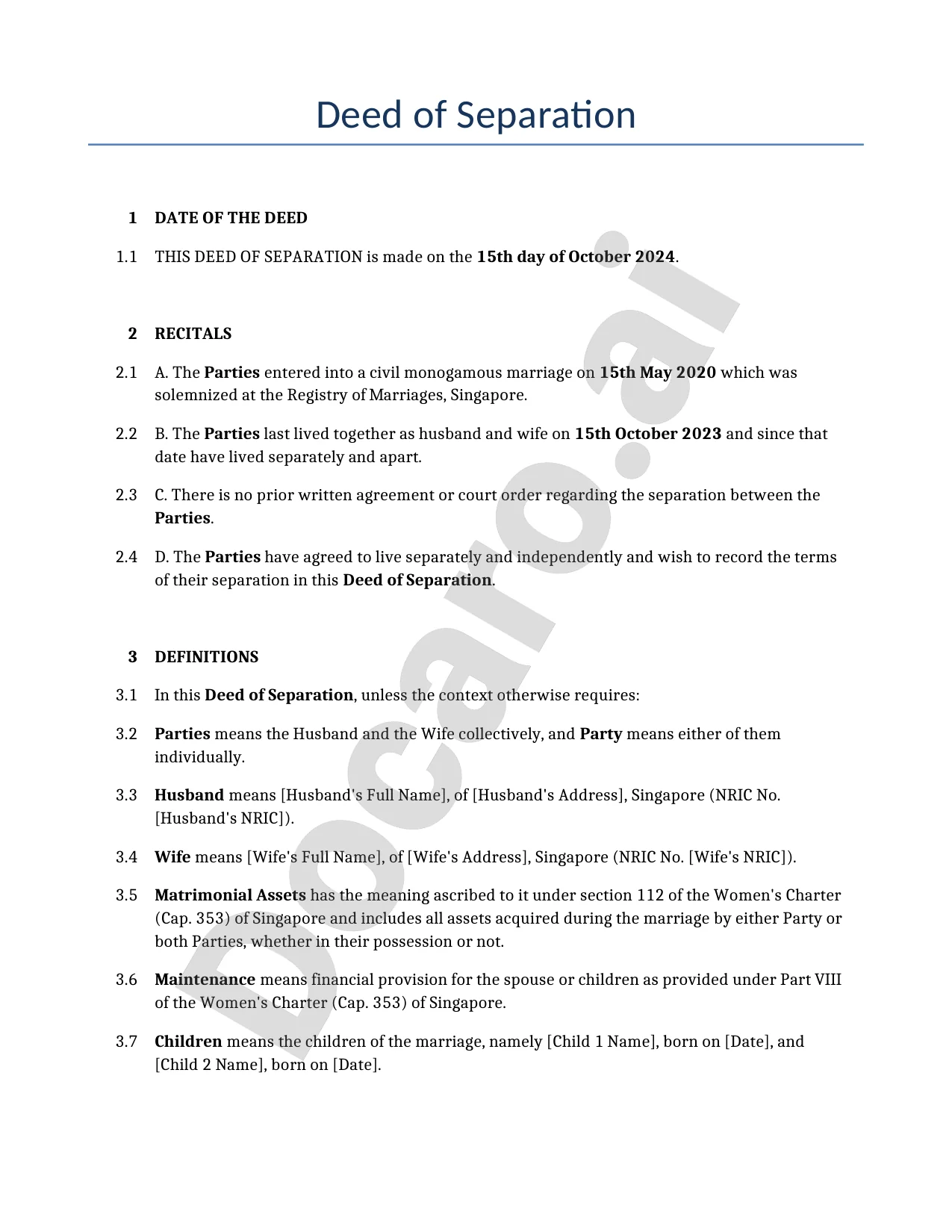
In Singaporean family law, a Deed of Separation serves as a formal legal agreement between spouses who intend to live apart while still being married. This document outlines key arrangements such as child custody, maintenance, and division of assets, providing structure during the separation period without dissolving the marriage.
The primary purpose of a Deed of Separation is to enable spouses to manage their separation amicably and avoid immediate divorce proceedings. Governed by the Women's Charter, it allows couples to address practical matters legally while preserving the possibility of reconciliation.
Importantly, a Deed of Separation is non-binding on reconciliation, meaning spouses can reunite without legal obstacles under the Women's Charter. For customized Singapore family law documents like this, consider using Docaro AI-generated legal agreements tailored to your specific needs.
When should you use a Deed of Separation?
A Deed of Separation in Singapore is an ideal legal document for married couples seeking to formalize their separation without immediately pursuing divorce. It allows spouses to outline terms for living apart while remaining legally married, providing structure during a difficult period.
- When spouses want to formalize separation without divorcing, a Deed of Separation clarifies responsibilities like asset division and spousal support, offering peace of mind without ending the marriage.
- For addressing child custody or financial arrangements temporarily, the deed establishes interim agreements on parenting time, child maintenance, and household finances, ensuring stability for the family.
- If considering divorce after a cooling-off period, the deed serves as a trial framework, helping couples test arrangements before finalizing a divorce application under Singapore's family law.
Learn more in this complete guide to Deed of Separation in Singapore. For personalized needs, opt for bespoke AI-generated legal documents using Docaro to ensure your agreement fits your unique situation.

When should you avoid using a Deed of Separation?
A Deed of Separation in Singapore is a voluntary agreement for spouses to live apart while addressing financial and child-related matters, but it should not be used in cases of ongoing domestic violence. In such urgent situations, immediate court intervention is essential to ensure safety, making the deed inappropriate as it lacks enforcement mechanisms for protection.
If one spouse seeks an immediate divorce, a Deed of Separation is unsuitable since it does not dissolve the marriage and requires mutual consent to proceed. Instead, proceeding directly to divorce proceedings through the Family Justice Courts allows for a faster resolution under the Women's Charter, bypassing the separation period.
When reconciliation is imminent, relying on a Deed of Separation could complicate matters by formalizing the split prematurely. Couples in this scenario should explore mediation or counseling services offered by organizations like the Singapore Mediation Centre to facilitate amicable reunification without legal entanglements.
Alternatives to a Deed of Separation include applying for a Personal Protection Order (PPO) via the Family Justice Courts for domestic violence protection, which provides swift remedies like barring the abuser from contact. For permanent separation, initiating divorce proceedings is advisable, and consulting professionals to generate bespoke legal documents using Docaro AI ensures tailored solutions compliant with Singapore law.
What are the key clauses in a Deed of Separation?
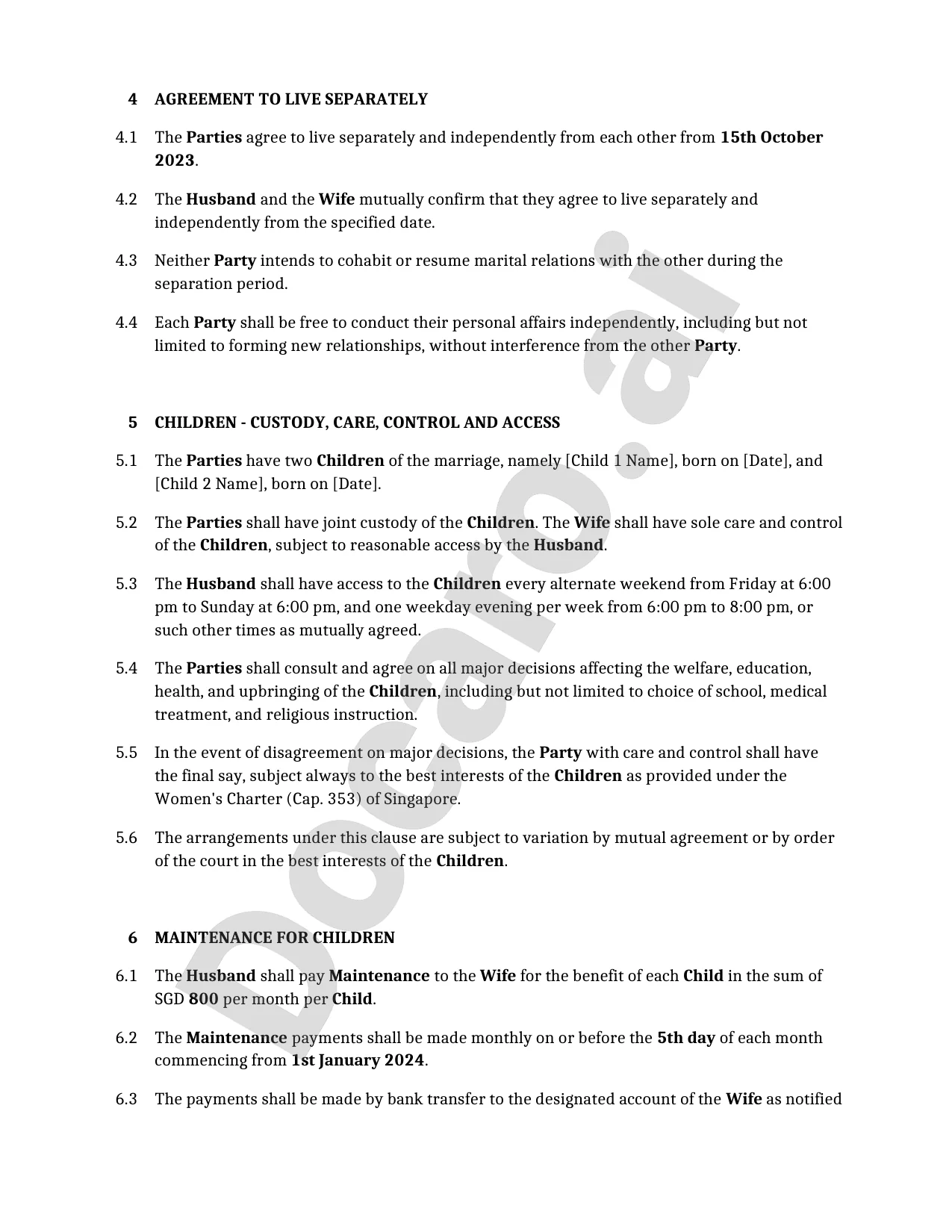
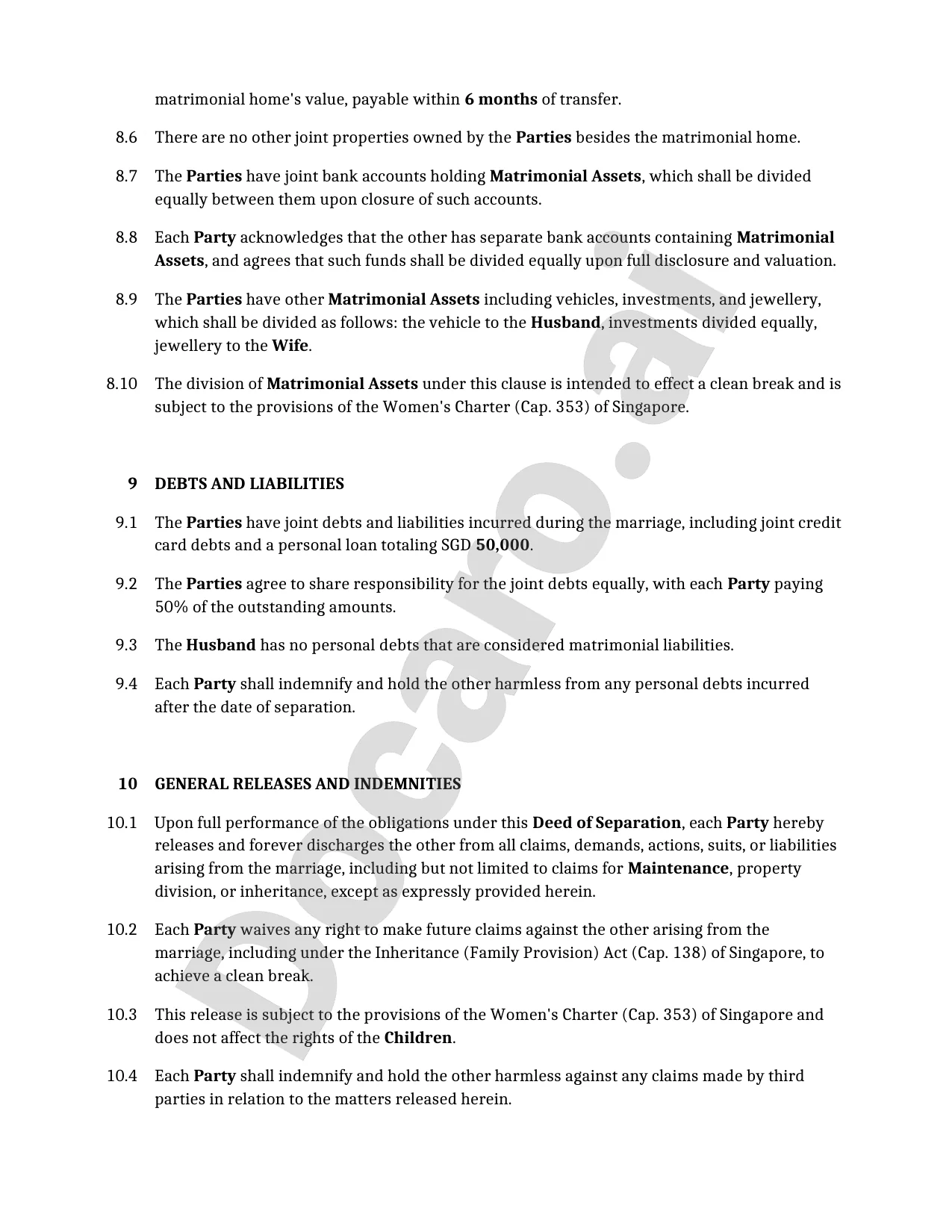
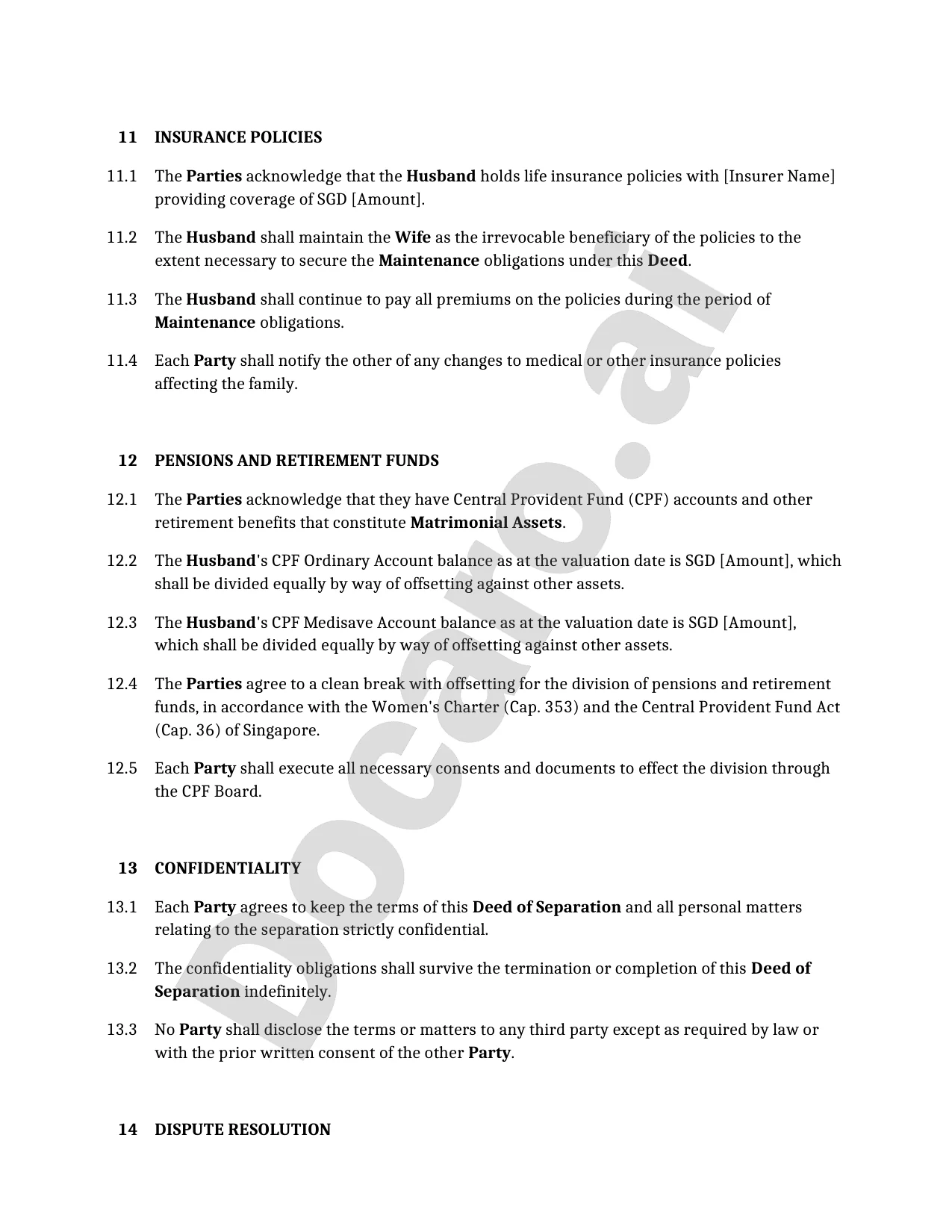
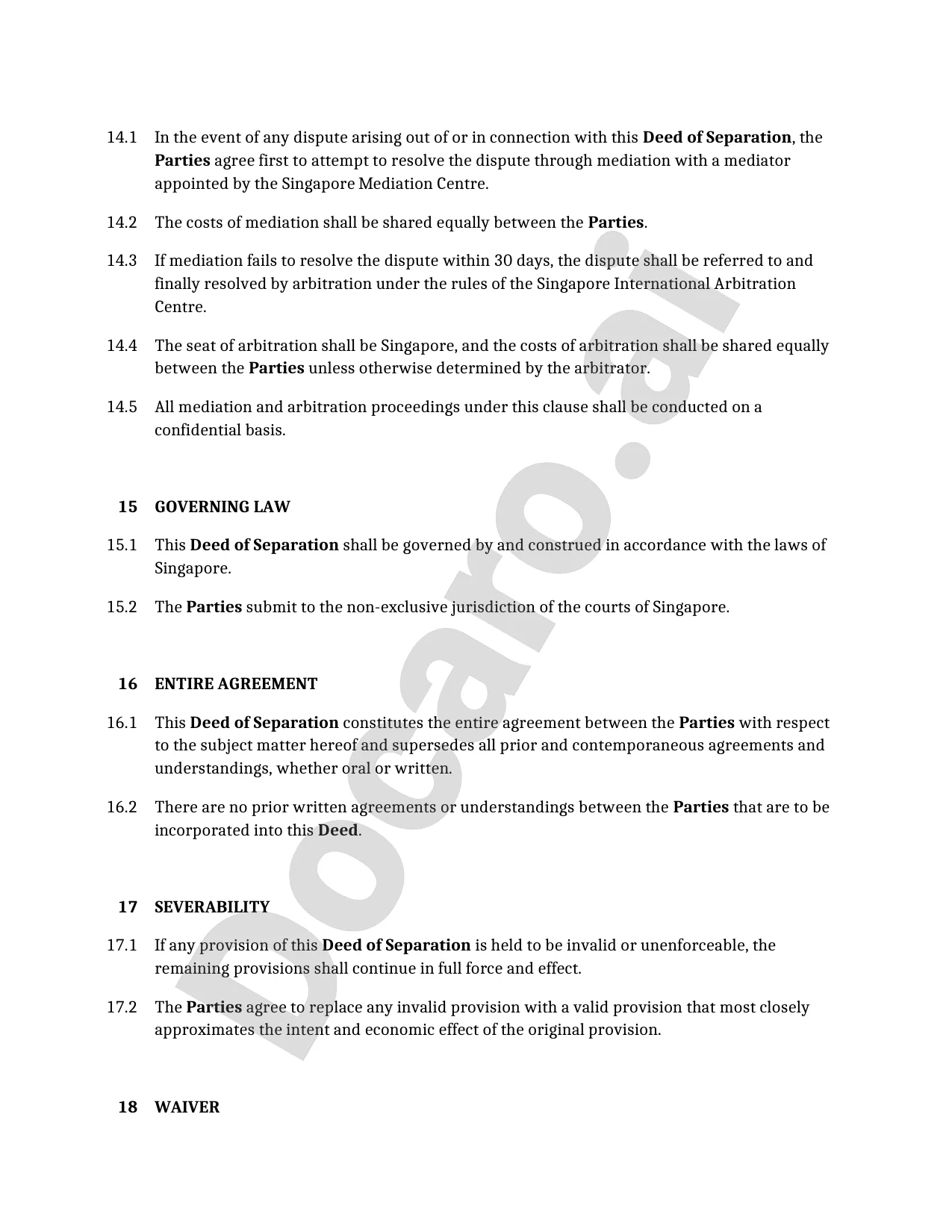
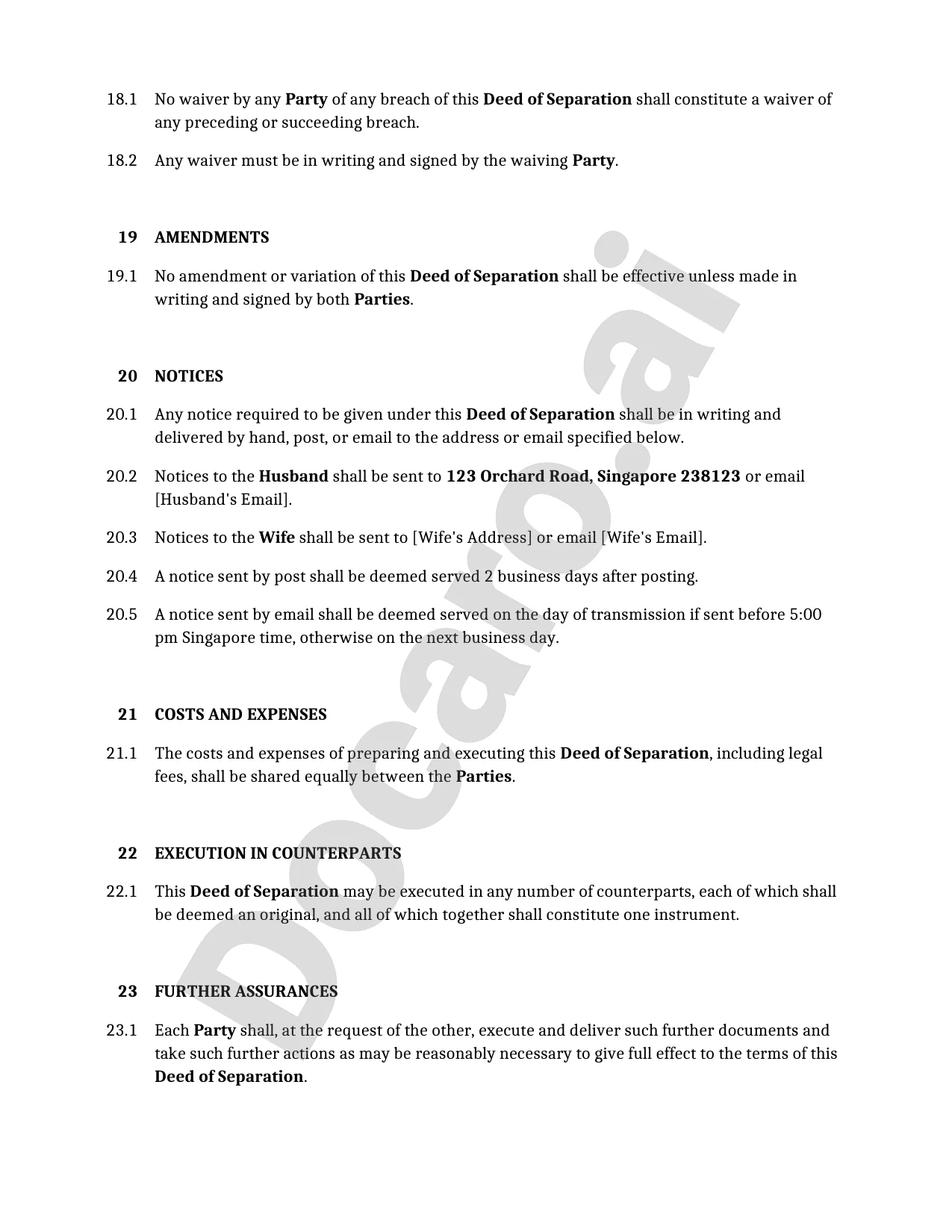
A Deed of Separation in Singapore is a legally binding document that outlines the terms for separating couples, helping to formalize arrangements without immediate divorce. It typically includes essential clauses on maintenance, asset division, child custody, and communication agreements to ensure clarity and reduce future disputes.
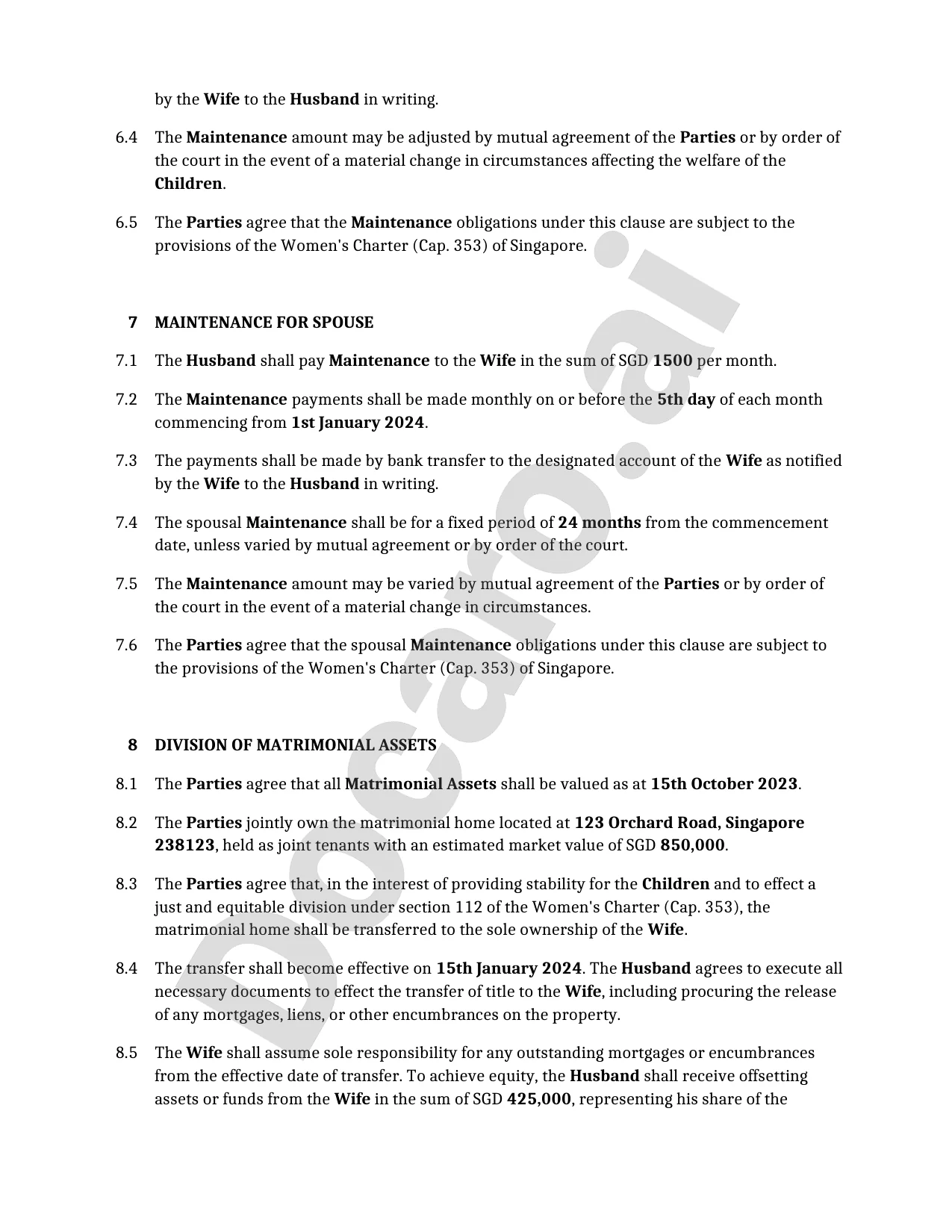
Key provisions often cover spousal and child maintenance, specifying amounts, payment methods, and durations to support financial needs post-separation. For division of assets, the deed details how matrimonial and personal properties, including homes, savings, and investments, will be split equitably under Singapore's family law principles.
- Child custody and access: Specifies primary caregiver, visitation schedules, and decision-making rights for the child's welfare.
- Communication agreements: Outlines respectful interaction protocols, dispute resolution methods, and restrictions on harassment.
To create a customized Deed of Separation, consider using Docaro for bespoke AI-generated legal documents tailored to your situation. For detailed guidance, read How to Draft a Legally Binding Deed of Separation in Singapore.
"In Singapore, clear and detailed maintenance and custody clauses in a Deed of Separation are essential to safeguard children's welfare, ensuring financial stability and parental responsibilities are explicitly defined to prevent future disputes. I recommend using Docaro to generate bespoke AI-assisted legal documents tailored to your specific family circumstances." – Dr. Lim Wei Ling, Family Law Expert, Singapore.
What are the key rights and obligations of the parties?
A Deed of Separation in Singapore is a legal agreement that allows married couples to live apart without dissolving their marriage, providing a structured framework for their separation. It emphasizes the right to live separately, enabling spouses to reside independently while remaining legally married, and does not terminate the marital bond, meaning neither party can remarry until a divorce is finalized.
Under the Deed, spouses have obligations for spousal and child maintenance, where one party may be required to provide financial support to the other and any dependent children, based on factors like income and needs. These maintenance provisions ensure the welfare of family members during the separation period.
Regarding rights to matrimonial assets, the Deed outlines how property, finances, and other shared assets are divided or managed, often mirroring what might occur in a divorce but without ending the marriage. For personalized legal agreements like a Deed of Separation, consider using Docaro for bespoke AI-generated documents tailored to your situation.

What key exclusions should be considered?
In a Deed of Separation in Singapore, one key exclusion is that it does not automatically trigger a divorce; couples remain legally married unless they pursue judicial separation or divorce proceedings through the courts. This means if circumstances change, such as reconciliation or renewed conflicts, the agreement may require amendments, but it offers no inherent mechanism for dissolution without further legal steps.
Another important exclusion involves inheritance rights, where the deed typically cannot fully override statutory inheritance under the Intestate Succession Act or a valid will, potentially leaving the separated spouse with residual claims upon death. Parties should consider these limitations when drafting to avoid unintended family law disputes in Singapore.
Enforcement of certain clauses, like those on child custody or maintenance, often requires court approval in Singapore, as family courts retain jurisdiction to ensure the child's best interests are prioritized over private agreements. For robust, customized protection, opt for bespoke AI-generated legal documents via Docaro, tailored to evolving circumstances.
Are there recent or upcoming legal changes affecting Deeds of Separation?
Singapore's Women's Charter underwent significant amendments through the Women's Charter (Amendment) Act 2022, effective from July 1, 2024, introducing divorce by mutual agreement as a new ground for irretrievable breakdown of marriage. These changes emphasize therapeutic justice, extending the mandatory co-parenting programme to all divorcing couples with minor children and enhancing court powers to enforce child access orders, which indirectly impact Deeds of Separation by promoting cooperative post-separation arrangements for custody and care.
Regarding maintenance calculations, the Family Justice Reform Act 2023, passed but not yet fully in force as of 2026, proposes new enforcement processes under Parts 9 and 9A of the Women's Charter to improve compliance with spousal and child maintenance orders. No major shifts in the core calculation factors under Section 114—such as income, earning capacity, and needs—have occurred post-2020, maintaining stability in how courts assess obligations in separation deeds.
On custody presumptions, recent laws reinforce the paramountcy of the child's welfare without introducing new presumptions favoring one parent, but they expand options like the Enforcement of Child Access Orders effective January 2, 2025, to ensure balanced access rights. For personalized advice on how these updates affect Deeds of Separation, consult a qualified family lawyer to navigate any ongoing implementations.
While the framework for family law in Singapore remains largely stable, ongoing refinements highlight the importance of tailored legal solutions. Consider using Docaro for bespoke AI-generated legal documents to address specific needs in separation agreements, ensuring compliance with the latest provisions.
How does a Deed of Separation differ from divorce?
In Singapore, a Deed of Separation and a divorce serve distinct purposes in resolving marital issues. A Deed of Separation allows couples to live apart while keeping the marriage legally intact, whereas a divorce permanently ends the marriage union.
The implications for property division differ significantly between the two options. Under a Deed of Separation, agreements on asset division and maintenance are binding but can be revisited if circumstances change, unlike divorce where the court's final order typically prevents reopening these matters unless exceptional conditions apply.
Remarriage is another key difference: spouses separated by a Deed cannot legally remarry, preserving the option to reconcile, while a divorce fully dissolves the marriage, enabling both parties to wed others without restrictions.
For a detailed comparison, read the article on Key Differences Between Deed of Separation and Divorce in Singapore. Consult professionals for bespoke AI-generated legal documents using Docaro to ensure your specific needs are met.
How can you get started with a Deed of Separation?
1
Consult a Family Lawyer
Schedule a consultation with a qualified family lawyer in Singapore to understand your rights and the legal implications of a Deed of Separation.
2
Discuss Terms with Spouse
Engage in open discussions with your spouse to negotiate and agree on key terms such as asset division, child custody, and maintenance.
3
Draft Using Docaro
Use Docaro to generate a bespoke Deed of Separation document tailored to your agreed terms, ensuring it complies with Singapore law.
4
Notarize and Stamp
Have the deed notarized if required, and submit it to the Inland Revenue Authority of Singapore for stamping to make it legally binding.
You Might Also Be Interested In
A Legal Contract Outlining Asset Division And Rights In Case Of Divorce Or Death, Signed Before Marriage.
A Legal Contract Outlining Asset Division And Spousal Rights Entered Into After Marriage.
A Legal Document Outlining Arrangements For Child Care, Custody, And Support Between Separated Parents.
A Legal Agreement Outlining Financial Support For Children After Parental Separation Or Divorce.
A Legal Contract Outlining Rights, Obligations, And Property Arrangements Between Unmarried Cohabiting Partners In Singapore.
A Parenting Plan Is A Legal Document Outlining Arrangements For Child Custody, Access, And Upbringing Between Separated Parents In Singapore.
A Legal Document Authorizing A Minor To Travel Without Both Parents Or Guardians, Often Required For International Trips.