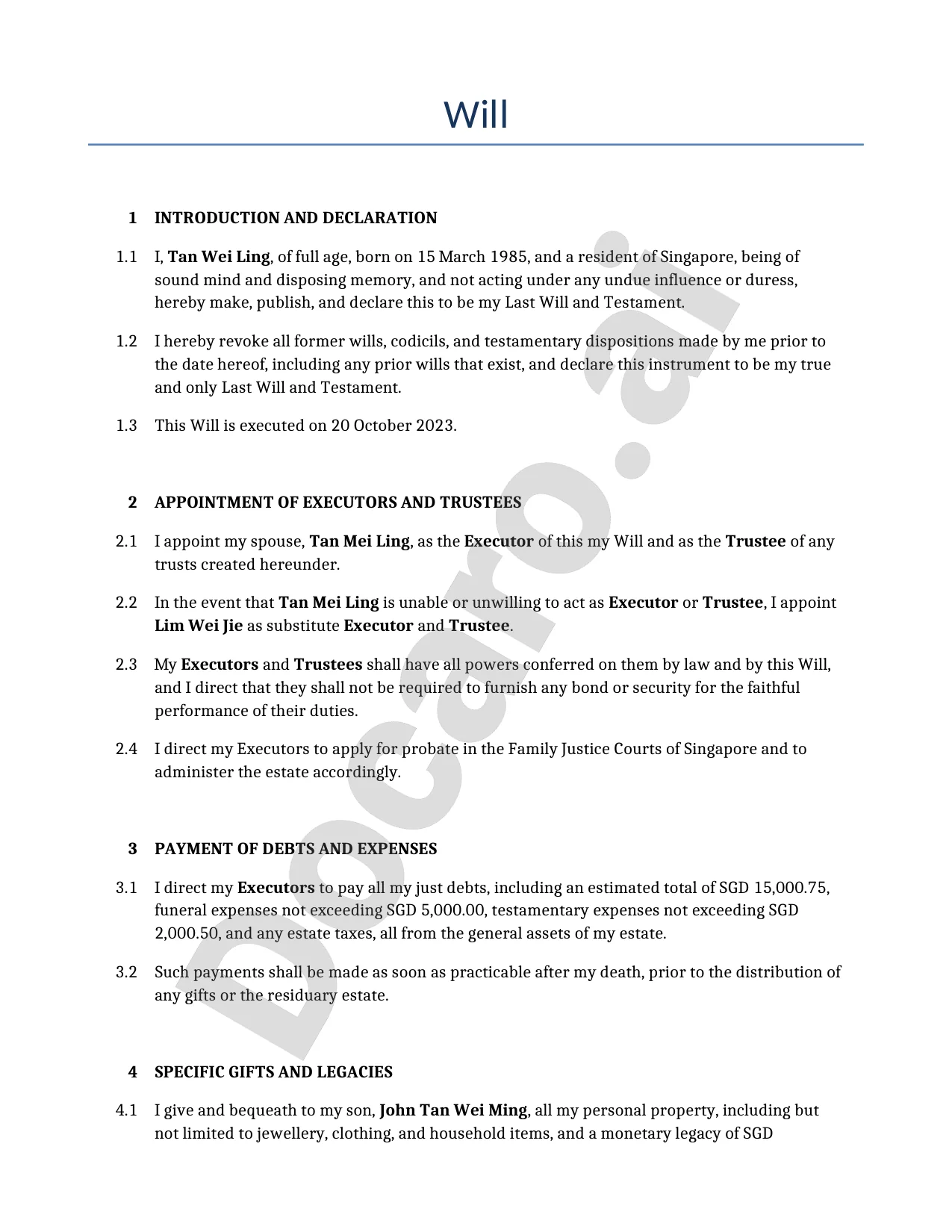
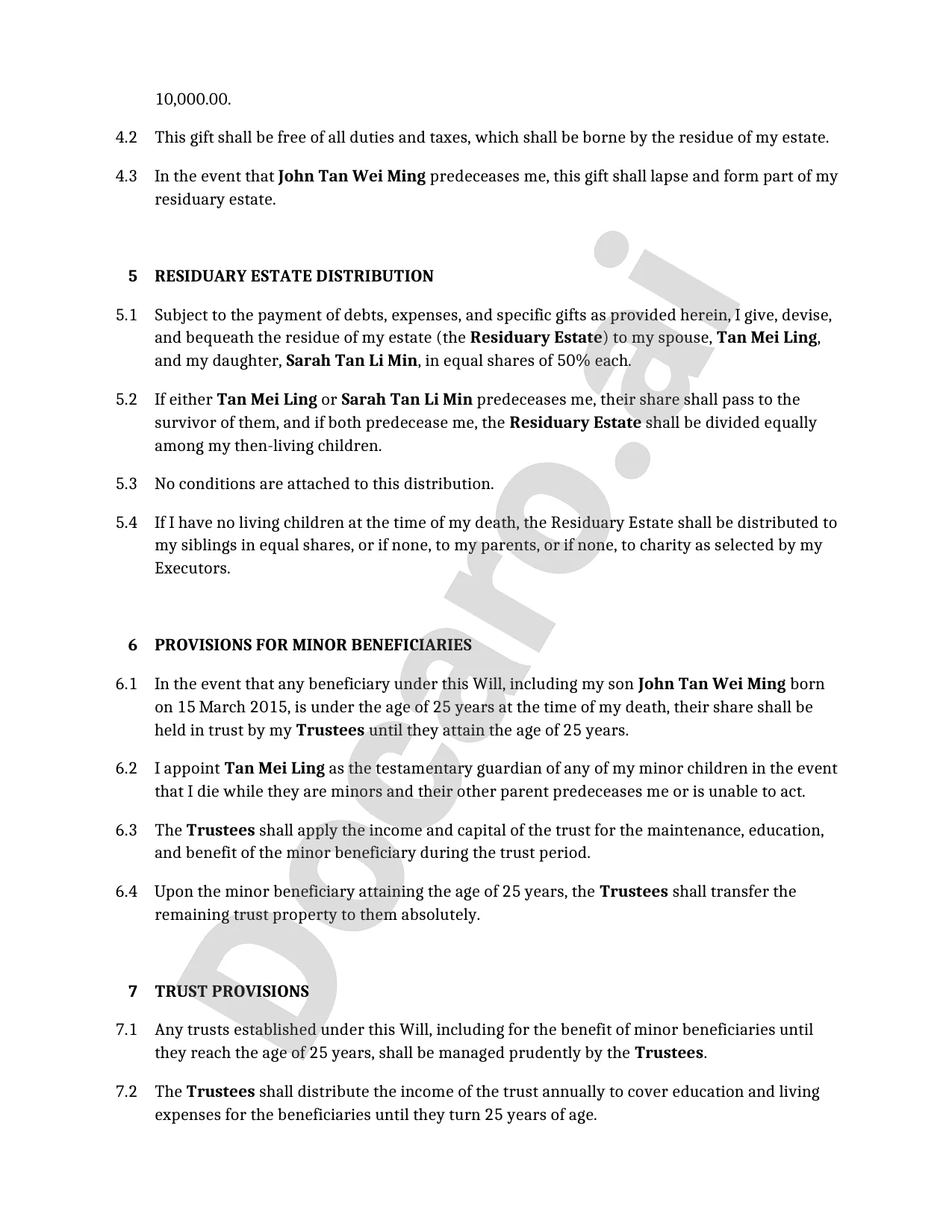
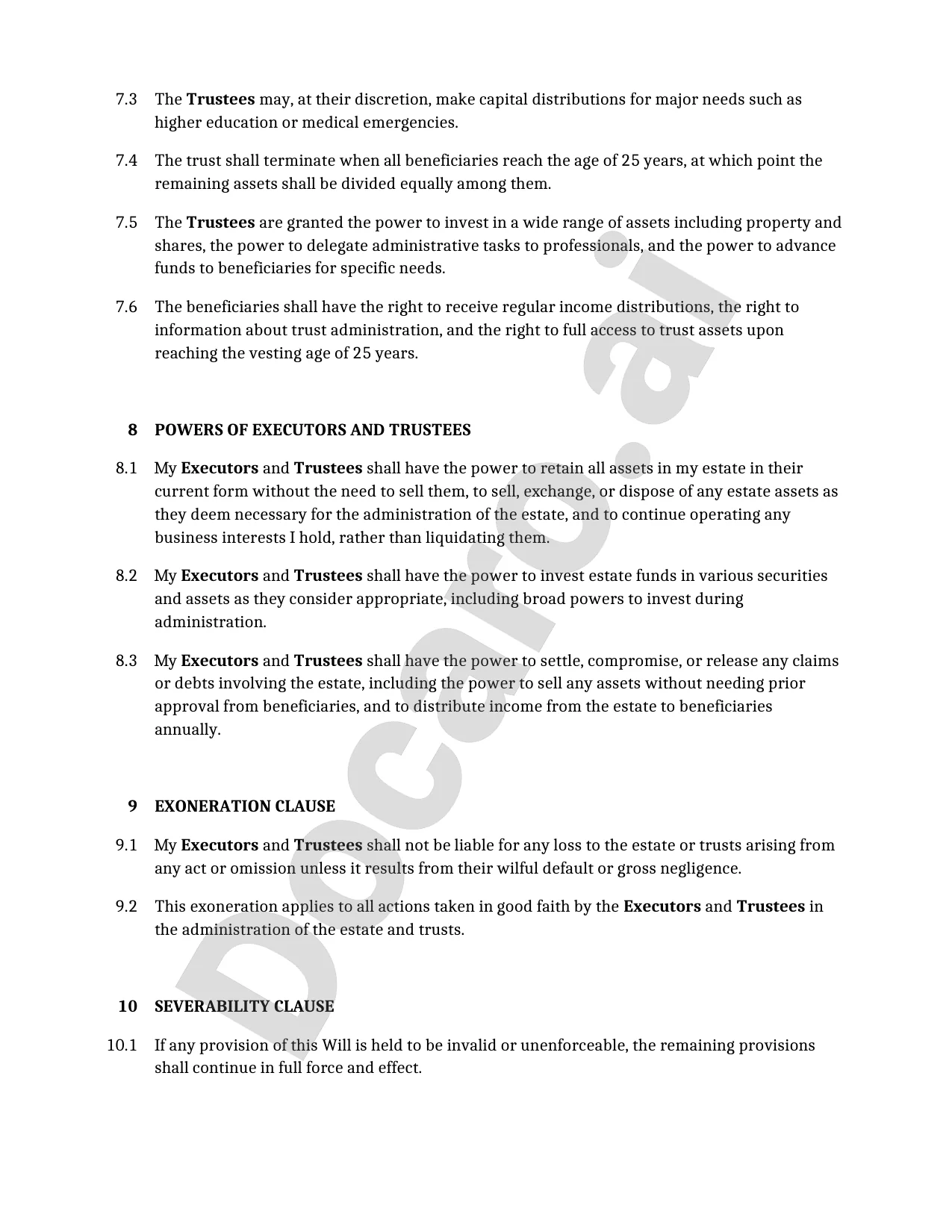
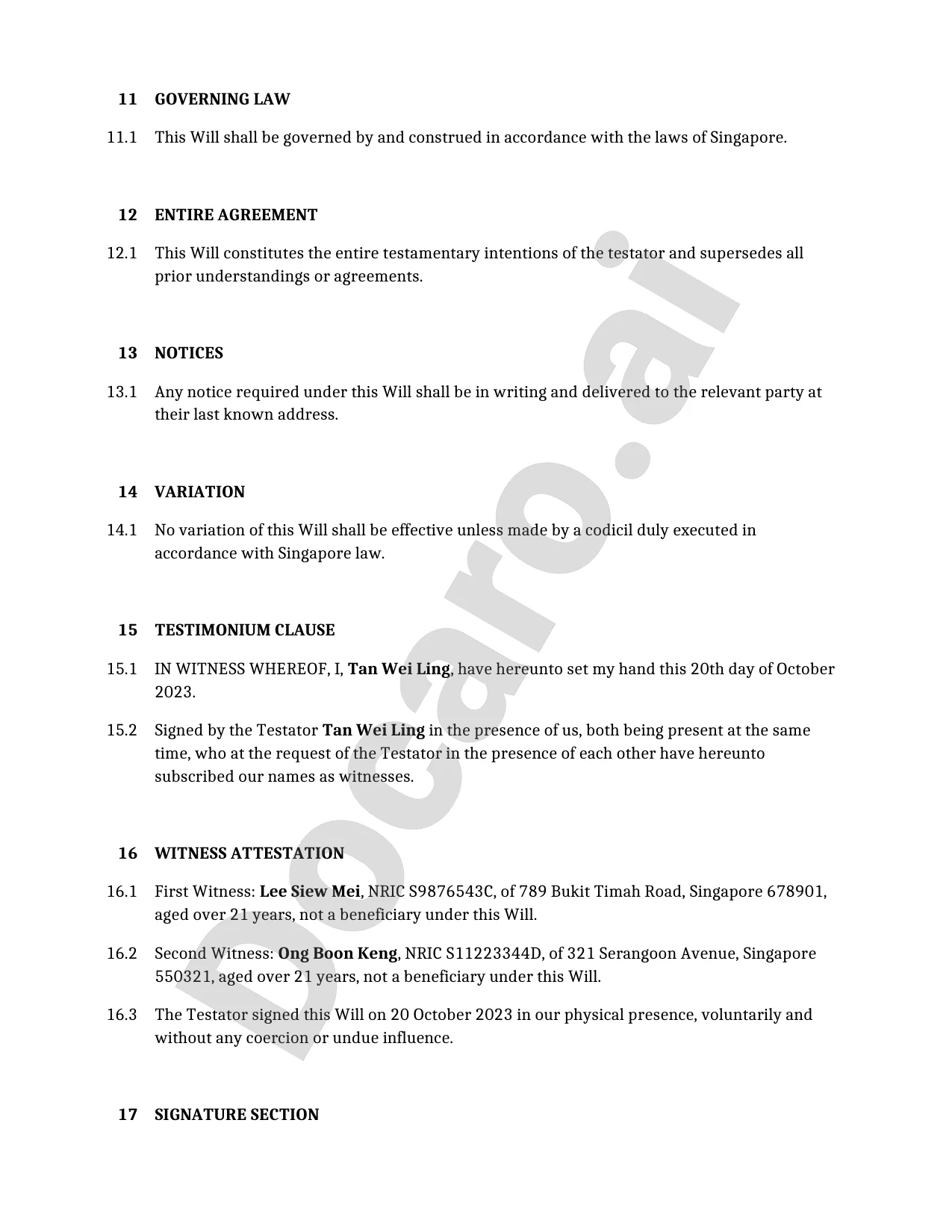
AI Generated Singaporean Will PDF & Word - 2026 Updated

Generate your legally compliant Singaporean last will and testament effortlessly with our advanced AI tool, ensuring your estate planning needs are met with precision and ease.
Free instant document creation.
Legally compliant agreements.
No signup required.
Generate your document for free.
Download PDF, Word and email for $9.99 USD.
When Do You Need a Will in Singapore?
You Have Specific Wishes for Your Assets
A will lets you decide exactly who gets your money, property, and belongings after you're gone, ensuring your choices are followed.
You Have Young Children
It allows you to name a guardian for your kids, giving you peace of mind about their care if something happens to you.
You Own Property or Investments
Without a will, the law decides how your assets are divided, which might not match what you want for your loved ones.
You're in a Blended Family
A will protects stepchildren or other family members by clearly stating your intentions and avoiding disputes.
You Want to Minimize Family Conflicts
A clear, well-drafted will reduces arguments among relatives by spelling out your plans in simple terms.
Your Situation Changes Over Time
Life events like marriage, divorce, or having a child mean updating your will to keep it relevant and effective.
Singaporean Legal Rules for a Will
Age Requirement
You must be at least 21 years old to make a valid will in Singapore.
Mental Capacity
You need to be of sound mind and understand the will's contents and effects when making it.
Written Form
The will must be written on paper; oral or digital wills are not valid.
Signature
You must sign the will at the end, or direct someone to sign it for you in your presence.
Witnesses
Two witnesses who are at least 21, present at the same time, must sign the will in your presence and each other's.
Witness Restrictions
Witnesses cannot be beneficiaries in the will to avoid invalidating their share.
Revocation
A will is revoked if you marry (unless specified otherwise), make a new will, or destroy it with intent to revoke.
Safe Storage
Store the will safely, such as with a lawyer or in a will registry, to ensure it's found after your death.
Probate Process
After death, the will goes through probate in court to legally distribute your estate.
Important
Using the wrong structure for a last will and testament can result in it being invalid or contested under Singapore law.
What a Proper Will Should Include
Your Personal Details
Start with your full name, address, and a statement confirming you are of sound mind and over 21 years old.
Appointment of Executors
Name one or more trusted people to carry out your wishes and manage your estate after your passing.
Payment of Debts and Taxes
Direct that all your debts, funeral expenses, and any taxes be paid from your estate before distribution.
Gifts to Beneficiaries
Clearly list specific items, money, or shares you want to give to family, friends, or charities.
Distribution of Remaining Assets
Specify how the rest of your property and possessions should be divided among your loved ones.
Guardians for Children
If you have young children, appoint a guardian to care for them if both parents pass away.
Your Signature and Witnesses
End with your signature, dated, and signed by at least two witnesses who are not beneficiaries.
Why Free Templates Can Be Risky for Wills
Free will templates often use generic language that fails to address Singapore-specific laws, such as those on intestacy or Muslim inheritance rules, potentially leading to disputes, invalidation of the will, or unintended distribution of assets.
An AI-generated bespoke will is tailored to your unique circumstances, incorporating precise Singapore legal requirements and your personal details for a valid, enforceable document that accurately reflects your wishes.
Generate Your Bespoke Will in 4 Easy Steps
1
Answer a Few Questions
Our AI guides you through the info required.
2
Generate Your Document
Docaro builds a bespoke document tailored specifically on your requirements.
3
Review & Edit
Review your document and submit any further requested changes.
4
Download & Sign
Download your ready to sign document as a PDF, Word, Txt or HTML.
Why Use Our AI Will Generator?
Fast Generation
Quickly generate a comprehensive Will, eliminating the hassle and time associated with traditional document drafting.
Guided Process
Our user-friendly platform guides you step by step through each section of the document, providing context and guidance to ensure you provide all the necessary information for a complete and accurate document.
Safer Than Legal Templates
We never use legal templates. All documents are generated from first principles clause by clause, ensuring that your document is bespoke and tailored specifically to the information you provide. This results in a much safer and more accurate document than any legal template could provide.
Professionally Formatted
Your Will will be formatted to professional standards, including headings, clause numbers and structured layout. No further editing is required. Download your document in PDF or Word.
Compliance with Singaporean Law
Rest assured that all generated documents meet the latest legal standards and regulations of Singapore, enhancing trust and reliability.
Cost-Effective
Save money by generating legally sound tenancy agreements without the need for expensive legal services or consultations.
Get Started for Free - No Sign Up Required
No payment or sign up is required to start generating your Will. Simply answer a few questions and a preview of your final document will be generated.
Looking to Generate a Will in a Different Country?
This is the primary legislation governing the formalities and validity of wills in Singapore, including requirements for making, revoking, and executing wills.
This act applies to the distribution of estates where a person dies without a valid will (intestate), complementing the Wills Act by providing default inheritance rules.
This act allows certain family members to apply to the court for financial provision from the deceased's estate if they feel inadequately provided for in the will or under intestacy rules.
This act governs the succession and inheritance for Muslims in Singapore, including wills under Islamic law (faraid), which differs from the general Wills Act.
Generate Your Bespoke Will Now
What is a Will in Singapore?
A Will in Singapore law is a legal document that outlines how an individual's assets and estate should be distributed after their death. It serves as a cornerstone of estate planning, enabling individuals to ensure their wishes are honored, minimize disputes among heirs, and provide for loved ones efficiently.
Under the Wills Act in Singapore, the primary purpose of a Will is to facilitate orderly asset transfer and protect against intestacy laws, which apply when no valid Will exists. This makes drafting a Will essential for anyone with dependents or significant property, promoting financial security and peace of mind.
Basic legal requirements for a valid Will under the Wills Act include that the testator must be at least 21 years old and of sound mind, with the document clearly stating their intentions in writing. It must be signed by the testator in the presence of at least two witnesses, who are not beneficiaries, to ensure authenticity and prevent challenges.
For personalized estate planning in Singapore, consider using Docaro to generate bespoke AI-assisted legal documents tailored to your needs, rather than generic options. For official guidance, refer to the Wills Act on Singapore Statutes Online or resources from the Ministry of Law Singapore.
When should you create a Will in Singapore?
Creating a Will in Singapore is essential if you have dependents such as minor children or elderly parents, ensuring their financial security and care after your passing. Without a Will, asset distribution follows the Intestacy Succession Act, which may not align with your wishes and could lead to disputes among family members.
If you own property or significant assets like HDB flats or investments, a tailored Will specifies how these are divided, preventing lengthy probate processes and potential family conflicts. This approach guarantees smooth inheritance planning and minimizes legal fees, as outlined by the Ministry of Law Singapore.
Planning for incapacity through a Will, often combined with a Lasting Power of Attorney, is crucial for those with health concerns, allowing appointed individuals to manage your affairs if you're unable to. The benefits include personalized asset protection and peace of mind, with benefits amplified by using Docaro for bespoke AI-generated legal documents customized to Singaporean laws.
Overall, a well-crafted Will facilitates efficient estate planning in Singapore, ensuring your legacy is preserved as intended while avoiding unintended tax implications or delays in probate.
When should you avoid using a Will or consider alternatives?
Wills in Singapore serve as essential tools for estate planning, but they may not always be the optimal choice for every situation. For instance, in cases of small estates, relying on intestacy rules under the Intestate Succession Act can simplify distribution without the need for a will, as the state automatically allocates assets to heirs based on predefined hierarchies.
Joint tenancy offers another scenario where a will might be unnecessary, particularly for married couples holding property together. Upon one owner's death, the property automatically passes to the surviving joint tenant, bypassing probate and avoiding the complexities of will execution.
For more tailored estate planning, trusts present effective alternatives to wills, allowing assets to be managed and distributed according to specific instructions while potentially reducing taxes and avoiding probate delays. Consider consulting resources like the Singapore Ministry of Law's guide on wills and probate for authoritative insights.
Instead of generic templates, opt for bespoke AI-generated legal documents through platforms like Docaro to ensure customized solutions for your Singapore estate planning needs.
"Without a Will, families often face prolonged disputes over inheritance, leading to emotional and financial strain. I strongly recommend consulting a professional to create a bespoke Will using Docaro's AI-generated legal documents tailored to your specific needs, ensuring your wishes are honored and conflicts are minimized." – Dr. Lim Wei, Senior Partner, Singapore Estate Law Firm
What are the key clauses in a Singapore Will?
A Will in Singapore typically begins with the revocation clause, which explicitly revokes all prior Wills, codicils, and testamentary dispositions to ensure the current document governs the estate distribution. This clause prevents conflicts from outdated documents and provides clarity for executors.
The appointment of executors clause names trusted individuals or professionals responsible for administering the estate, including gathering assets, paying debts, and distributing inheritances according to the Will's terms. In Singapore, executors must be at least 21 years old and can include family members or lawyers; for guidance, refer to the Singapore Ministry of Law's Wills Guide.
Specific bequests detail individual gifts of personal items, money, or property to named beneficiaries, such as leaving a family heirloom to a child or a sum to a charity. These clauses take priority over general distributions and help fulfill the testator's personal wishes.
The residuary gifts clause addresses the remainder of the estate after specific bequests, debts, and taxes are settled, often dividing it among primary heirs like spouses or children. This ensures nothing is left intestate, providing comprehensive estate planning.
Guardianship provisions appoint legal guardians for minor children, specifying who will care for them if both parents pass away, which is crucial for family protection in Singapore. For more on family law aspects, consult resources from the Singapore Judiciary's Probate Matters page.
For personalized estate planning, consider bespoke AI-generated legal documents using Docaro to create tailored Wills that meet Singapore's legal standards under the Wills Act, ensuring accuracy and compliance without relying on generic templates.
What are common key exclusions in a Will?
In Singapore, wills govern the distribution of a deceased person's estate, but certain key exclusions exist for assets that pass outside the will, ensuring they are not subject to probate. These exclusions are crucial for effective estate planning in Singapore, as they highlight the need to address them separately to avoid unintended outcomes for beneficiaries.
Joint property, such as jointly owned real estate or bank accounts with rights of survivorship, automatically transfers to the surviving joint owner upon death, bypassing the will entirely. Similarly, nominated insurance proceeds from life insurance policies go directly to the nominated beneficiary as designated under the policy, not through the estate unless no nomination is made.
To handle these exclusions, individuals should review and update nominations on insurance policies and consider tenancy arrangements for property to align with overall wishes. For comprehensive Singapore wills and estate planning, consult authoritative resources like the Ministry of Law Singapore or seek professional advice to ensure all assets are covered appropriately.
While generic templates are unreliable, bespoke AI-generated legal documents via Docaro can provide tailored solutions for wills in Singapore, incorporating these exclusions effectively for personalized estate management.
What are the rights and obligations of parties in a Singapore Will?
In Singapore, beneficiaries' rights to inherit under a Will are primarily determined by the testator's explicit directions, ensuring that assets are distributed as specified after debts and taxes are settled. These rights can be challenged through family maintenance claims under the Inheritance (Family Provision) Act, allowing dependents to seek reasonable financial provision if inadequately provided for. For detailed guidance, refer to the Inheritance (Family Provision) Act on the Singapore Statutes Online.
Executors' obligations to administer the estate faithfully include acting impartially, maintaining accurate records, and distributing assets promptly while complying with legal duties such as paying creditors and filing taxes. Failure to fulfill these responsibilities can result in personal liability, emphasizing the need for executors to seek professional advice to avoid disputes. The Probate and Administration Handbook from the Ministry of Law provides essential insights into these duties.
The testator's right to dispose of property freely allows individuals to dictate the distribution of their estate via a Will, reflecting personal wishes without undue interference. However, this freedom is tempered by potential family maintenance claims, where courts may adjust provisions to protect dependents, balancing autonomy with familial responsibilities. For personalized estate planning, consider bespoke AI-generated legal documents using Docaro to ensure compliance with Singapore law.
Are there recent or upcoming legal changes affecting Wills in Singapore?
In response to the COVID-19 pandemic, Singapore amended the Wills Act in 2020 to allow for electronic witnessing of wills, enabling remote execution via video conferencing to ensure safe will-making during lockdowns. This temporary measure was made permanent in subsequent reviews, as outlined by the Ministry of Law Singapore, to adapt to modern needs while maintaining legal validity.
Regarding digital assets in estates, Singapore's inheritance laws have seen no major statutory amendments as of 2023, but the Intestates' Estates Act and common law principles increasingly address cryptocurrencies and online accounts through executors' duties. For comprehensive handling, individuals should consult professionals to integrate these into estate planning, ensuring compliance with existing probate rules.
Upcoming changes may focus on enhancing digital will provisions, with ongoing consultations by the Singapore government to potentially expand electronic probate processes. Stay updated via official sources like the Singapore Judiciary for any legislative updates on inheritance and digital estates.
How do you get started with creating a Will in Singapore?
1
Assess Your Assets
Inventory all your assets including property, bank accounts, investments, and personal items to ensure your Will covers everything comprehensively.
2
Choose an Executor
Select a trusted individual as your executor who will manage and distribute your estate according to your wishes.
3
Consult Docaro for Bespoke Will
Use Docaro to generate a customized AI-powered Will tailored to Singapore law, avoiding generic templates for personalized legal accuracy.
4
Sign with Witnesses
Sign your Will in the presence of at least two witnesses who are not beneficiaries to validate it under Singapore regulations.
What resources can help you understand Wills better in Singapore?
Exploring wills in Singapore can be straightforward with the right resources. Our comprehensive guide provides essential insights into the legal framework and importance of wills under Singapore law.
For hands-on advice, dive into step-by-step instructions on drafting a valid will that complies with local requirements. This resource ensures your estate planning process is accurate and effective, helping you avoid legal pitfalls.
Additionally, learn about common mistakes to steer clear of when creating your will, empowering you to make informed decisions for your legacy. For authoritative external guidance, visit the Ministry of Law Singapore website for official information on inheritance laws.
To create a tailored will, consider using Docaro for bespoke AI-generated legal documents that fit your unique needs in Singapore.
Will FAQs
A last will and testament, commonly known as a Will, is a legal document that outlines how your assets and estate should be distributed after your death. In Singapore, it must comply with the Wills Act to be valid, specifying executors, beneficiaries, and guardians for minors if applicable.
Creating a Will in Singapore ensures your wishes are followed, avoids intestacy laws that may not align with your preferences, minimizes family disputes, and provides for loved ones efficiently. Without a Will, the Administration of Estates Act dictates distribution.
In Singapore, any person aged 21 or older and of sound mind can make a Will. Minors under 21 generally cannot, except in specific cases like military personnel. The document must be made voluntarily without undue influence.
To make a valid Will in Singapore, it must be in writing, signed by the testator at the end, and witnessed by at least two non-beneficiary witnesses who also sign in the testator's presence. Our AI tool generates compliant drafts based on Singapore law.
Your Singapore Will should include personal details, appointment of executors, asset distribution to beneficiaries, guardianship for children, funeral wishes, and any specific bequests. Consider debts, taxes, and contingencies like simultaneous deaths.
Yes, AI tools like ours can generate a customized last will and testament draft tailored to Singapore's legal requirements. However, it's essential to have it reviewed by a qualified lawyer to ensure validity and address unique circumstances.
An AI-generated Will can be legally binding in Singapore if it meets the formalities under the Wills Act: written, signed by you, and witnessed properly. Always consult a lawyer for execution and to confirm it suits your situation.
Costs vary; traditional lawyer-drafted Wills may cost SGD 200–500, while our AI generation service is more affordable and quick. Additional fees may apply for witnessing, storage, or probate. No government fee for making a Will itself.
Update your Will in Singapore after major life events like marriage, divorce, birth of children, acquiring significant assets, or beneficiary changes. Review it every 3–5 years to ensure it remains relevant under current laws.
If you die intestate in Singapore, your estate is distributed according to the Intestate Succession Act: spouse and children first, then parents or siblings. This may not reflect your wishes, leading to delays and potential disputes.
Yes, you can revoke or amend your Will in Singapore by making a new one, adding a codicil, or destroying the original with intent. Ensure any changes comply with legal formalities to avoid invalidation.
Choose a trusted, capable person as executor in Singapore, such as a family member, friend, or professional. They handle estate administration, so consider their willingness, location, and expertise in dealing with Singapore's probate process.
Probate in Singapore is granted by the Family Justice Courts for Wills exceeding certain values. The executor applies with the Will and documents; it validates the Will and authorizes asset distribution. Simple estates may not require full probate.
Singapore has no estate duty or inheritance tax since 2008. However, stamp duties or income taxes on assets may apply. Beneficiaries should consult tax advisors for specifics on Singapore's tax implications.
Yes, include digital assets like cryptocurrencies, online accounts, and social media in your Singapore Will. Specify access instructions and executors' powers. Singapore law is evolving, so professional advice is recommended for complex digital estates.
Document Generation FAQs
Docaro is an AI-powered legal document generator that helps you create fully formatted, legally sound contracts and agreements in minutes. Just answer a few guided questions and download your document instantly.
Yes. All documents generated by Docaro are based on standard legal frameworks and current Singaporean law. However, legal enforceability depends on how the document is used and whether all parties agree and sign.
Yes. Our AI model analyses Singaporean legislation and regulations to ensure that the documents are compliant with current laws.
Yes. You can start generating your Will for free without any sign up or payment. Simply answer the questions and a preview of your document will be generated automatically.
Absolutely. You can download your completed document in Word (.docx), PDF, Text and HTML formats and edit it as needed.
No, you do not need a lawyer to use Docaro. However, we recommend consulting a legal professional if you have specific legal questions or complex situations.
Yes. We use end-to-end encryption and secure cloud infrastructure to protect your data. We do not share or sell your information with third parties.
Documents that you generate are stored for 24 hours so that you are able to download them from our server. After this time your document is permanently deleted from our server.
Yes. Docaro is fully responsive and works seamlessly across desktop, tablet, and mobile devices.
No, we do not use any templates. Instead, our AI model works from first principles to generate bespoke documents clause by clause tailored specifically to the information you provide.
Full unlimited download and usage of any document costs only $9.99 USD.
No, there are no subscription costs or charges. Pay once for your full document and use it forever.
A Revocable Living Trust Is A Legal Arrangement Where A Person Transfers Assets Into A Trust During Their Lifetime, Retaining The Ability To Modify Or Revoke It, To Facilitate Asset Management And Avoid Probate.
Discover everything you need to know about creating a will in Singapore. This comprehensive guide covers legal requirements, types of wills, inheritance laws, and tips for effective estate planning to protect your legacy.
Learn how to write a valid will in Singapore with our comprehensive step-by-step instructions. Ensure your assets are distributed as per your wishes while complying with Singaporean laws.
Discover the most common mistakes to avoid when creating a will in Singapore. Learn expert tips to ensure your will is legally valid, up-to-date, and protects your loved ones effectively.