Docaro

AI Generated Remote Work and Hybrid Work Policy for use in Singapore
PDF & Word - 2026 Updated
Discover how our AI-powered tool generates a customized remote work and hybrid work policy tailored for Singapore businesses, ensuring compliance with local labor laws and promoting flexible work arrangements.
Free instant document creation.
Compliant with Singapore law.
No sign up or monthly subscription.

Docaro Pricing

Basic
Free
Document Generation
No Sign Up
No Subscription
Download Watermarked PDF
Premium
$4.99 USD
Document Generation
No Sign Up
No Subscription
Download Clean PDF
Download Microsoft Word
Download HTML
Download Text
Email Document
Generate your document for free. Only pay if you like the result and need an un-watermarked version.

When Do You Need a Remote Work and Hybrid Work Policy in Singapore?

  • Shifting to Remote or Hybrid Models
    You need this policy when your company starts allowing employees to work from home or mix office and remote days to guide how these arrangements operate smoothly.
  • Supporting Employee Flexibility
    It's essential if you want to attract and keep talent by offering work options that fit their lifestyles, ensuring everyone understands the rules.
  • Maintaining Team Productivity
    A clear policy helps when remote work could disrupt workflows, by setting expectations for communication and performance to keep the team effective.
  • Ensuring Data and Workplace Safety
    You'll need it to protect company information and employee well-being in non-office settings, outlining simple steps for secure and safe remote practices.
  • Adapting to New Work Trends
    In Singapore's evolving job market, this document is key for businesses responding to post-pandemic changes, helping comply with local guidelines without hassle.

Singaporean Legal Rules for a Remote Work and Hybrid Work Policy

  • Employment Act Coverage
    The Employment Act applies to most employees, including those working remotely, ensuring basic rights like working hours and leave.
  • Working Hours and Overtime
    Employers must track remote workers' hours and pay overtime for work beyond 44 hours per week, just like in-office staff.
  • Health and Safety Duties
    Employers are responsible for ensuring remote workers' safety at home, such as providing equipment guidelines and addressing risks.
  • Data Protection Requirements
    Personal data handled remotely must follow the Personal Data Protection Act to keep information secure and private.
  • Equal Treatment Rules
    Remote and hybrid workers must receive the same pay, benefits, and opportunities as office-based employees to avoid discrimination.
  • Contract Clarity
    Employment contracts should clearly state remote or hybrid arrangements, including location, equipment, and reimbursement details.
  • Leave and Benefits
    All employees, regardless of work location, are entitled to annual leave, sick leave, and other statutory benefits.
Important

Failing to align remote or hybrid work policies with Singapore's Employment Act can inadvertently create non-compliance risks or disputes over employee entitlements.

What a Proper Remote Work and Hybrid Work Policy Should Include

  • Eligibility and Selection
    Clearly state who qualifies for remote or hybrid work based on role, location, and performance.
  • Work Equipment and Setup
    Outline what tools, software, and home office setups the company will provide or require.
  • Communication Guidelines
    Define how and when employees should connect with teams using email, video calls, and chat tools.
  • Working Hours and Availability
    Specify core hours for overlap and flexibility in scheduling to maintain productivity.
  • Productivity and Performance Tracking
    Describe methods to measure work output without constant monitoring, focusing on results.
  • Data Security and Confidentiality
    Explain rules for protecting company information when working from home or other locations.
  • Health and Safety Measures
    Cover requirements for a safe home workspace, including ergonomics and emergency procedures.
  • Expense Reimbursements
    Detail what costs, like internet or utilities, the company will cover for remote work.
  • Team Meetings and Collaboration
    Set expectations for participation in in-person or virtual team events and office visits.
  • Review and Adjustment Process
    Include how the policy will be evaluated and updated based on feedback and changes.

Why Free Templates Can Be Risky for Remote Work and Hybrid Work Policy

Free templates for remote work and hybrid work policies often rely on generic language that fails to address Singapore-specific employment laws, data protection regulations under the PDPA, and the unique needs of your organization. This can lead to compliance gaps, increased liability, and ineffective policies that don't mitigate risks like productivity issues or security breaches in distributed teams.

AI-generated bespoke documents create tailored remote work and hybrid work policies customized to your company's size, industry, and Singapore's legal framework. This ensures comprehensive coverage of local requirements, enhances enforceability, and provides flexible, precise guidelines that boost employee satisfaction and operational efficiency.

Generate Your Bespoke Remote Work and Hybrid Work Policy in 4 Easy Steps

1
Answer a Few Questions
Our AI guides you through the info required.
2
Generate Your Document
Docaro builds a bespoke document tailored specifically on your requirements.
3
Review & Edit
Review your document and submit any further requested changes.
4
Download & Sign
Download your ready to sign document as a PDF, Microsoft Word, Txt or HTML.

Why Use Our AI Remote Work and Hybrid Work Policy Generator?

Fast Generation
Quickly generate a comprehensive Remote Work and Hybrid Work Policy, eliminating the hassle and time associated with traditional document drafting.
Guided Process
Our user-friendly platform guides you step by step through each section of the document, providing context and guidance to ensure you provide all the necessary information for a complete and accurate Remote Work and Hybrid Work Policy.
Safer Than Legal Templates
We never use legal templates. All documents are generated from first principles clause by clause, ensuring that your document is bespoke and tailored specifically to the information you provide. This results in a much safer and more accurate document than any legal template could provide.
Professionally Formatted
Your Remote Work and Hybrid Work Policy will be formatted to professional standards, including headings, clause numbers and structured layout. No further editing is required. Download your document in PDF, Microsoft Word, TXT or HTML.
Compliance with Singaporean Law
Rest assured that all generated documents meet the latest legal standards and regulations of Singapore, enhancing trust and reliability.
Cost-Effective
Save money by generating legally sound Remote Work and Hybrid Work Policy without the need for expensive legal services or consultations.
Get Started for Free - No Sign Up or Monthly Subscription Required
No payment or sign up is required to start generating your Remote Work and Hybrid Work Policy. Generate and download a watermarked version of your document for free. Pay only if you want to remove the watermark and gain full access to your document. No monthly subscriptions or hidden fees. Pay once and use your document forever.
Need to Generate a Remote Work and Hybrid Work Policy in a Different Country?
Choose country:

Free Example Remote Work and Hybrid Work Policy Template

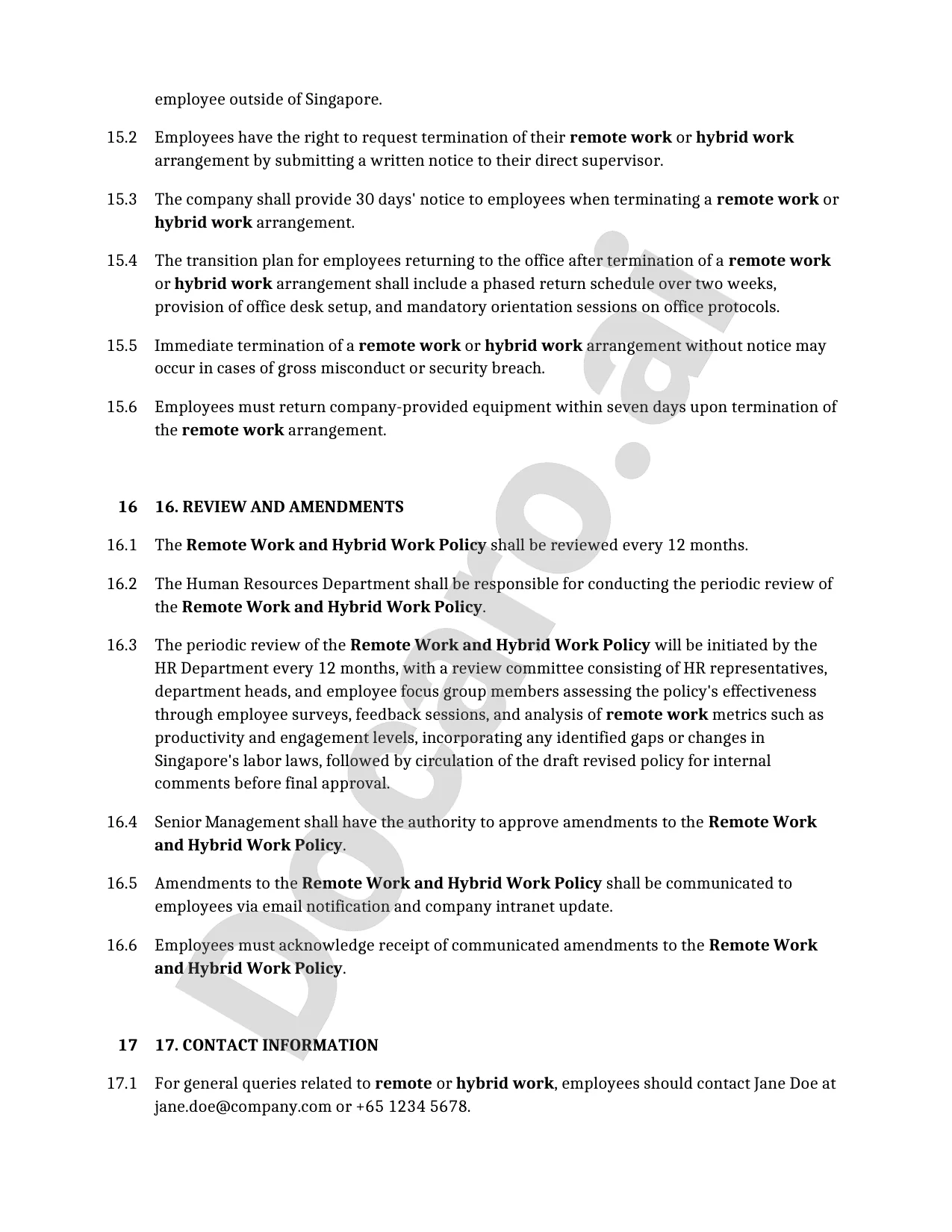
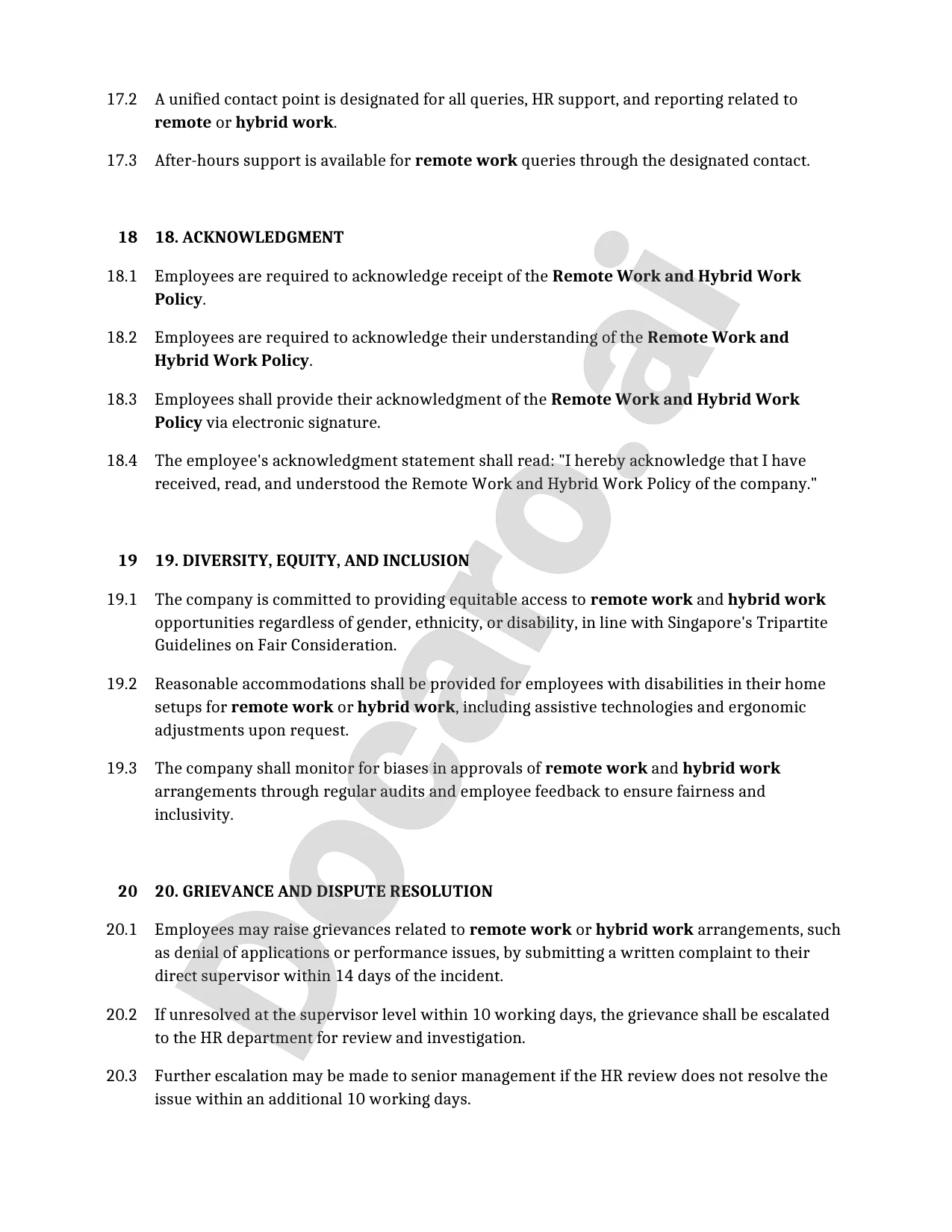
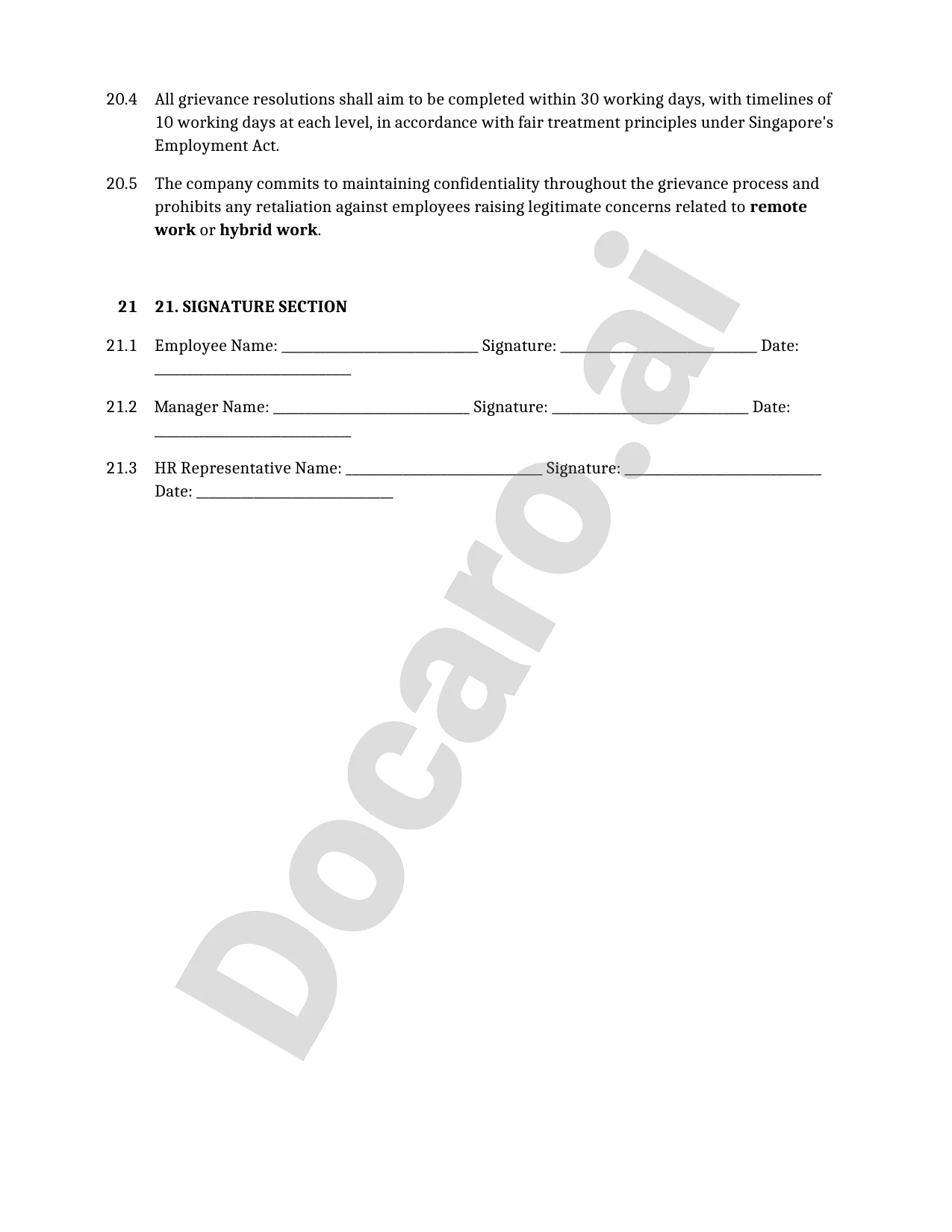
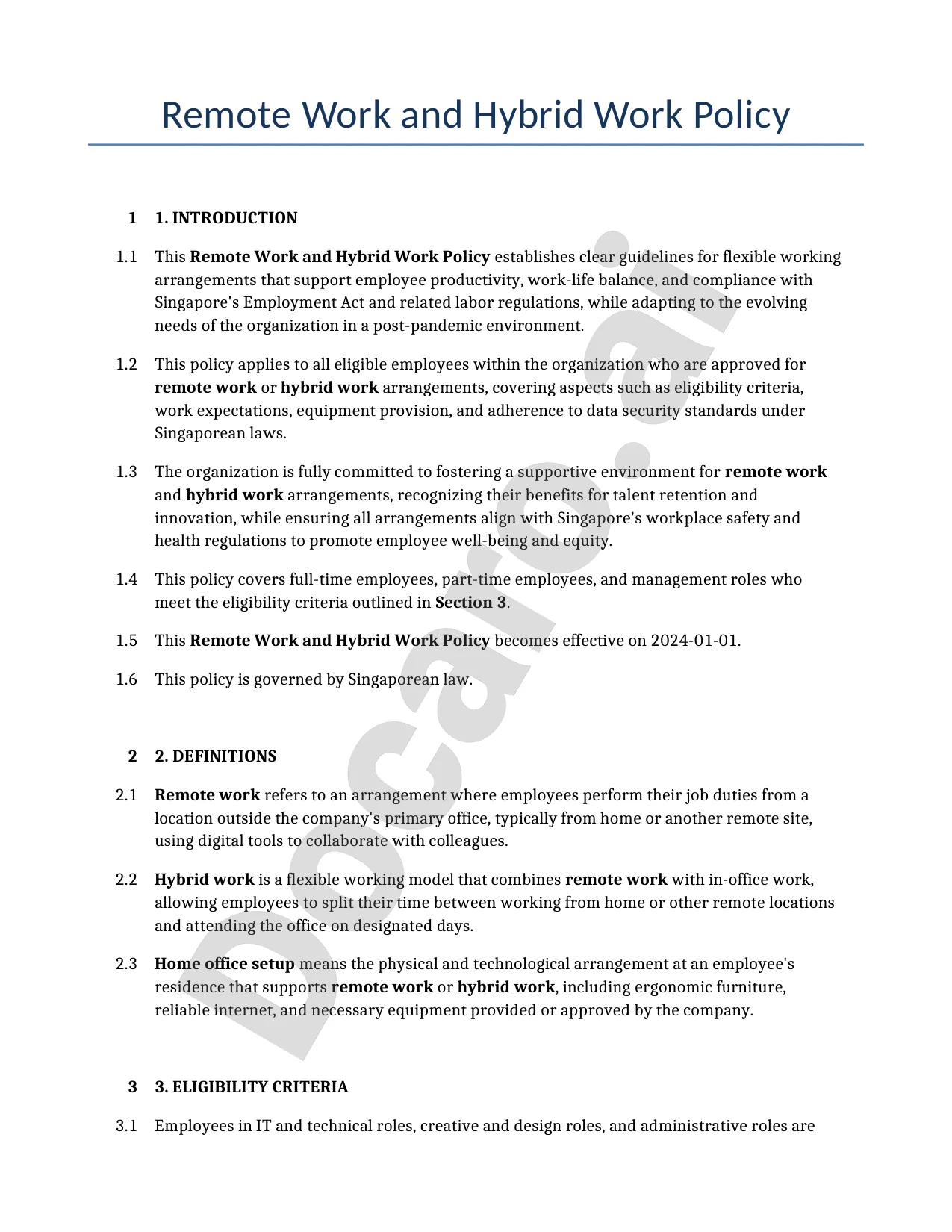
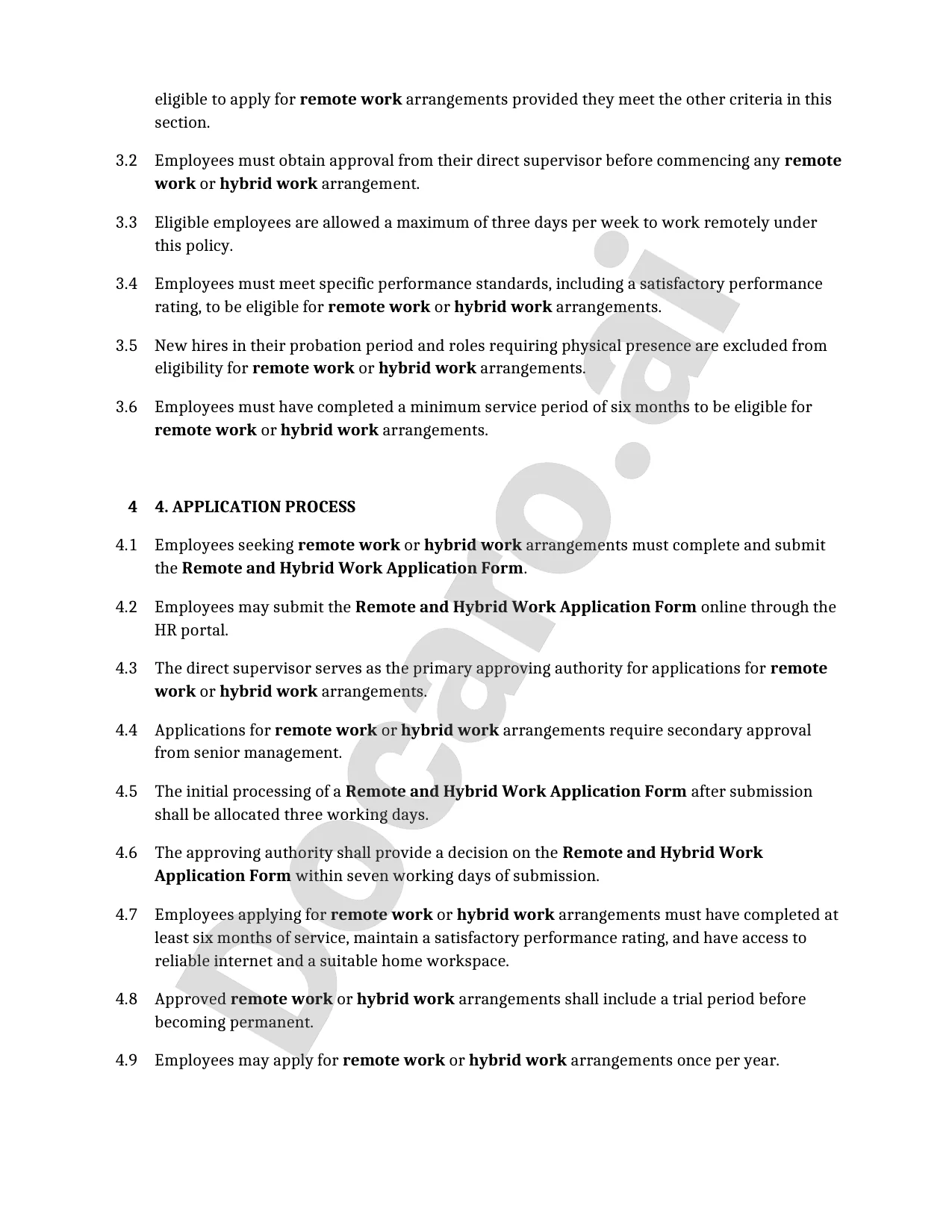
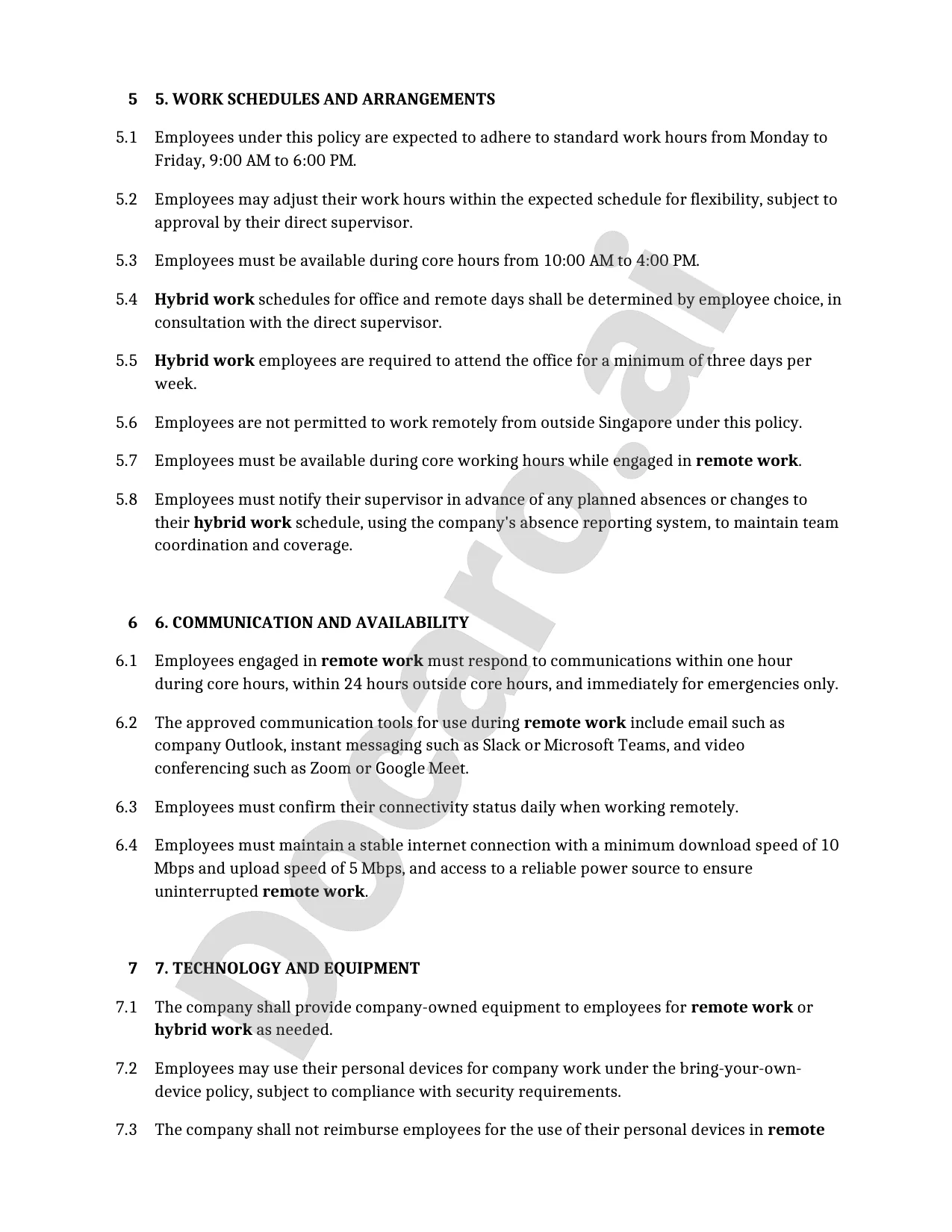
Below is a free template example of a Remote Work and Hybrid Work Policy for use in Singapore generated by our AI model.

The clauses in your actual Remote Work and Hybrid Work Policy will vary from this example as they will be entirely bespoke to your requirements as set out in the questionnaire you complete.
Page 1

Singapore Compliance Legislation

Your AI Generated Remote Work and Hybrid Work Policy will be checked for compliance against the following legislation and regulations:

What is a Remote Work and Hybrid Work Policy in Singapore?

A remote work policy in Singapore defines guidelines for employees performing their duties outside the traditional office environment, such as from home or other locations, while a hybrid work policy combines on-site and remote arrangements to offer flexibility. These policies align with Singapore's progressive labour laws under the Ministry of Manpower (MOM), ensuring compliance with employment standards and promoting work-life balance in a competitive corporate landscape.

The primary purpose of a remote and hybrid work policy document is to establish clear expectations for productivity, communication, and accountability, mitigating risks like data security breaches or performance inconsistencies. In the Singapore context, such policies support national initiatives like the Flexible Work Arrangements framework, fostering employee well-being and retention amid evolving workplace norms post-pandemic.

The basic scope covers key areas including eligibility criteria, required technology provisions, and health and safety measures tailored to Singapore's multicultural workforce. It also outlines procedures for requesting arrangements and dispute resolution, ensuring seamless integration into corporate operations without compromising business objectives.

For corporate use in Singapore, opt for bespoke AI-generated documents via Docaro to customize policies precisely to your organization's needs, rather than generic options. This approach guarantees relevance to local regulations and enhances efficiency in policy implementation.

Why are these policies important for Singapore companies?

In Singapore's dynamic business landscape, remote and hybrid work policies are essential for adapting to modern workforce needs while ensuring compliance with labour laws. These policies help businesses align with regulations from the Ministry of Manpower (MOM), such as flexible work arrangements under the Flexible Work Arrangements framework, reducing legal risks and promoting fair employment practices.

Implementing such policies significantly boosts employee satisfaction by offering flexibility that supports work-life balance, particularly in a high-cost city like Singapore. Satisfied employees are more productive and loyal, contributing to lower turnover rates and a positive company culture.

From an operational standpoint, remote and hybrid work enhances efficiency through cost savings on office space and access to a broader talent pool beyond geographical limits. Businesses can leverage technology for seamless collaboration, streamlining operations and fostering innovation in Singapore's competitive market.

  • Key benefits include regulatory adherence, improved morale, and scalable operations.
  • For tailored policies, consider bespoke AI-generated corporate documents using Docaro to meet specific business needs.

When should a company implement a Remote Work and Hybrid Work Policy in Singapore?

In the wake of the post-pandemic shifts, many Singapore companies have embraced hybrid work models to ensure business continuity while prioritizing employee health. Implementing a flexible work policy helps organizations adapt to these changes by outlining guidelines for remote and office-based arrangements, reducing operational disruptions as seen in guidelines from the Ministry of Manpower (MOM).

To address talent retention in Singapore's competitive job market, a well-defined policy on flexible working can attract and keep top performers who value work-life balance. This approach aligns with local trends where employees seek customizable schedules, fostering loyalty and reducing turnover, as highlighted in reports from the Singapore Business Review.

As flexible work trends evolve in Singapore, companies should implement such policies to stay agile amid technological advancements and changing employee expectations. Using bespoke AI-generated corporate documents from Docaro ensures these policies are tailored to specific business needs, promoting efficiency and compliance without relying on generic templates.

When should a company avoid or modify this policy?

In Singapore's manufacturing industry, remote or hybrid work policies often prove unsuitable due to the hands-on nature of assembly lines, quality control, and machinery operation, which demand physical presence to ensure safety and efficiency.

Roles in construction and engineering sectors also require on-site supervision and collaboration, making full remote setups impractical and potentially hazardous under Singapore's strict building regulations outlined by the Building and Construction Authority.

To adapt hybrid models where possible, companies might implement staggered shifts or limited off-site administrative tasks, but core production roles should remain fully on-site to comply with labour laws from the Ministry of Manpower, as detailed on their official site.

For bespoke modifications to work policies, consider using AI-generated corporate documents via Docaro to tailor solutions specific to your organization's needs in Singapore.

"Without a tailored remote work policy, Singapore employers expose themselves to risks like non-compliance with PDPA data protection laws, blurred work-life boundaries leading to employee burnout, and potential disputes over productivity metrics," says Dr. Lim Wei, employment law specialist at the Singapore Institute of Labour Studies. To mitigate these, I recommend generating bespoke remote work policies using Docaro's AI tools for customized, compliant corporate documents.

What are the key clauses to include in a Remote Work and Hybrid Work Policy for Singapore?

A Singapore-compliant policy for remote work must outline clear eligibility criteria to ensure fairness and compliance with local employment laws. Employees must be full-time staff with at least six months of service, demonstrate reliable home internet connectivity, and pass a basic security assessment; for detailed guidelines, refer to the Ministry of Manpower's remote work resources.

Work hours in the policy should specify standard operating times aligned with Singapore's Employment Act, typically 9 AM to 6 PM, with flexibility for core hours but mandatory logging of productive time. This ensures adherence to overtime regulations and promotes work-life balance without compromising business needs.

Communication protocols require daily check-ins via approved tools like Slack or Microsoft Teams, prompt response times within two hours during work hours, and weekly progress reports to maintain transparency. These measures foster collaboration while respecting data protection standards under Singapore's Personal Data Protection Act.

Equipment provision includes company-supplied laptops and ergonomic setups for eligible employees, with reimbursement for minor home office expenses up to SGD 200 annually, subject to approval. Performance evaluation will be based on quarterly KPIs, output metrics, and feedback sessions, ensuring alignment with organizational goals and fair assessments.

How do data security and confidentiality fit into these clauses?

1
Conduct Security Assessment
Evaluate current remote work setup for vulnerabilities, including device usage and network access, compliant with Singapore's PDPA guidelines.
2
Draft Bespoke Policy Document
Use Docaro to generate customized AI-driven policy outlining secure data handling, access controls, and encryption for remote employees.
3
Implement Training and Tools
Roll out mandatory training sessions on policy adherence and deploy secure tools like VPNs and multi-factor authentication.
4
Monitor and Review Compliance
Establish ongoing monitoring protocols and periodic audits to ensure adherence and update the policy as needed.

What recent or upcoming legal changes affect Remote Work Policies in Singapore?

In 2023, Singapore's Ministry of Manpower (MOM) introduced mandatory guidelines for flexible work arrangements under the Employment Act, requiring employers to consider employee requests for telecommuting, flexi-time, or staggered hours seriously. These updates aim to support work-life balance while ensuring business needs are met, with employers obligated to respond within one month of a formal request.

Key provisions include protection against discriminatory practices for employees making such requests, applicable to most workers earning up to S$2,600 monthly, with extensions to higher earners in non-managerial roles. For remote and hybrid policies, MOM emphasizes clear communication and trial periods, but no strict mandates on implementation beyond the consideration process.

Upcoming changes in 2024 will enhance these guidelines by incorporating feedback from tripartite consultations, potentially strengthening enforcement for hybrid work setups post-COVID. Employers can refer to the official MOM flexible work arrangements page for detailed guidelines and templates.

  • Requests must be in writing and based on valid reasons like family responsibilities or health.
  • Rejections require justification related to business operations, not personal bias.
  • Tripartite Advisory on Flexible Work Arrangement Requests provides practical examples for implementation.

What are the key rights and obligations for employers and employees under these policies?

In Singapore's remote and hybrid work environments, employers are obligated under the Employment Act to provide necessary resources such as secure IT equipment, software, and ergonomic setups to ensure employees can perform their duties effectively. This aligns with guidelines from the Ministry of Manpower (MOM), emphasizing a safe and productive workspace even outside traditional offices; for detailed provisions, refer to the MOM remote working page.

Employers must also maintain clear communication channels and conduct regular check-ins to monitor progress, while ensuring compliance with data protection laws like the Personal Data Protection Act (PDPA) for handling sensitive information in remote settings.

Employees, in turn, are required to uphold productivity levels comparable to office-based work, adhere to agreed working hours, and promptly report any issues with provided resources to their employer. This responsibility supports the mutual trust essential in hybrid models, as outlined in MOM's fair employment practices.

Both parties should document remote work agreements to clarify expectations, and for customized corporate documents like these, consider using bespoke AI-generated solutions from Docaro tailored to Singapore's legal framework.

What key exclusions should be considered in the policy?

In a Singapore remote work policy, important exclusions often apply to specific employee categories to ensure compliance with local employment laws. For instance, the policy may not cover part-time or contract workers, senior executives, or those in roles requiring on-site presence, such as lab technicians or security personnel, as outlined in guidelines from the Ministry of Manpower.

Geographic limitations are crucial in Singapore remote work policies, typically restricting remote arrangements to within Singapore or approved overseas locations with prior employer consent. This helps manage data security and tax implications, aligning with regulations from the Inland Revenue Authority of Singapore.

Emergency clauses provide flexibility during unforeseen events, allowing temporary remote work activation for all eligible employees in cases like public health crises or natural disasters. These clauses reference Singapore's workplace safety protocols to prioritize employee well-being while maintaining operational continuity.

For tailored Singapore remote work policies, organizations should opt for bespoke AI-generated corporate documents using Docaro to address unique needs and ensure legal adherence without relying on generic templates.

How can businesses navigate related resources for Remote Work in Singapore?

Navigating remote work regulations in Singapore requires businesses to stay updated on evolving labour laws and data protection standards. For a detailed breakdown, refer to our comprehensive guide on Singapore remote work regulations, which covers compliance essentials from the Ministry of Manpower.

Crafting an effective hybrid work policy tailored to Singapore businesses involves balancing flexibility with productivity and security. Explore best practices in our article on crafting a hybrid work policy for Singapore, and consider using bespoke AI-generated corporate documents via Docaro for customized solutions.

The benefits and challenges of remote and hybrid work in Singapore include enhanced talent attraction alongside potential isolation for employees. Delve deeper into these aspects with our resource on benefits and challenges of remote work in Singapore, supported by insights from the Singapore National Employers Federation.

For official guidance, visit the Ministry of Manpower's remote work page to ensure your policies align with national standards.

Remote Work and Hybrid Work Policy FAQs

A remote work policy is a corporate document outlining guidelines for employees working from home or outside the office. In Singapore, where hybrid work models are increasingly common post-COVID, companies need this policy to comply with MOM regulations, ensure data security, and maintain productivity. Our AI tool generates customized remote work policies tailored to Singapore's employment laws.

Document Generation FAQs

Docaro is an AI-powered legal and corporate document generator that helps you create fully formatted, legally sound contracts and agreements in minutes. Just answer a few guided questions and download your document instantly.
You Might Also Be Interested In
A Document Outlining Company Policies, Employee Rights, And Workplace Rules.
A Document Outlining Expected Behaviors, Ethical Standards, And Rules For Individuals Or Organizations To Ensure Integrity And Compliance.
A Corporate Policy Outlining Commitments To Fostering Diverse Workplaces, Ensuring Equitable Opportunities, And Promoting Inclusive Practices.
A Corporate Policy Outlining Rules For Appropriate Use Of IT Resources And Systems.
A Policy Outlining How An Organization Manages, Stores, And Disposes Of Data And Records To Ensure Compliance And Efficiency.
A Corporate Policy Outlining Procedures For Employees To Report Misconduct, Ensuring Confidentiality And Protection Against Retaliation.
A Policy Document Outlining Procedures For Handling Employee Misconduct And Workplace Complaints In Singapore Companies.
A Corporate Document Outlining Policies, Procedures, And Guidelines To Ensure Employee Safety And Compliance With Health Regulations In The Workplace.
A Document Outlining The Responsibilities, Duties, Required Skills, And Qualifications For A Specific Job Role.
A Performance Improvement Plan (PIP) Is A Formal Document Outlining An Employee's Performance Issues And A Structured Plan With Goals And Timelines To Help Them Improve, Often Used Before Potential Termination.
A Corporate Document Outlining The Principles And Approach To Employee Compensation, Including Pay Structures, Incentives, And Alignment With Business Goals.
A Corporate Document Outlining The Rationale And Justification For Promoting An Employee, Including Performance Details And Business Needs.
A Form Used By Companies To Gather Feedback From Departing Employees About Their Experiences And Reasons For Leaving.
A Documented Set Of Instructions Detailing How To Perform Routine Operations Consistently And Efficiently In An Organization.
A Document Outlining Procedures For Detecting, Responding To, And Recovering From Security Incidents In An Organization.
A Strategic Document Outlining Procedures To Maintain Operations During Disruptions And Restore Systems After Disasters.
A Corporate Document Outlining Rules, Procedures, And Responsibilities To Protect An Organization's Information Systems From Cyber Threats.
A Document Outlining Procedures And Standards To Ensure Product Or Service Quality In An Organization.
A Corporate Document Outlining A Company's Performance And Initiatives In Environmental, Social, And Governance Areas To Demonstrate Sustainability And Ethical Practices.

Related Articles

Discover essential remote work regulations in Singapore. This comprehensive guide covers legal requirements, compliance tips, and best practices for successful remote working in 2023.
Discover how to craft an effective hybrid work policy tailored for Singapore businesses. Learn key strategies, legal considerations, and tips to boost productivity and employee satisfaction in a post-pandemic world.
Explore the key benefits and challenges of remote and hybrid work models in Singapore. Learn how businesses and employees are adapting to flexible work arrangements in 2024.