What Is a Deed of Separation in Singapore?
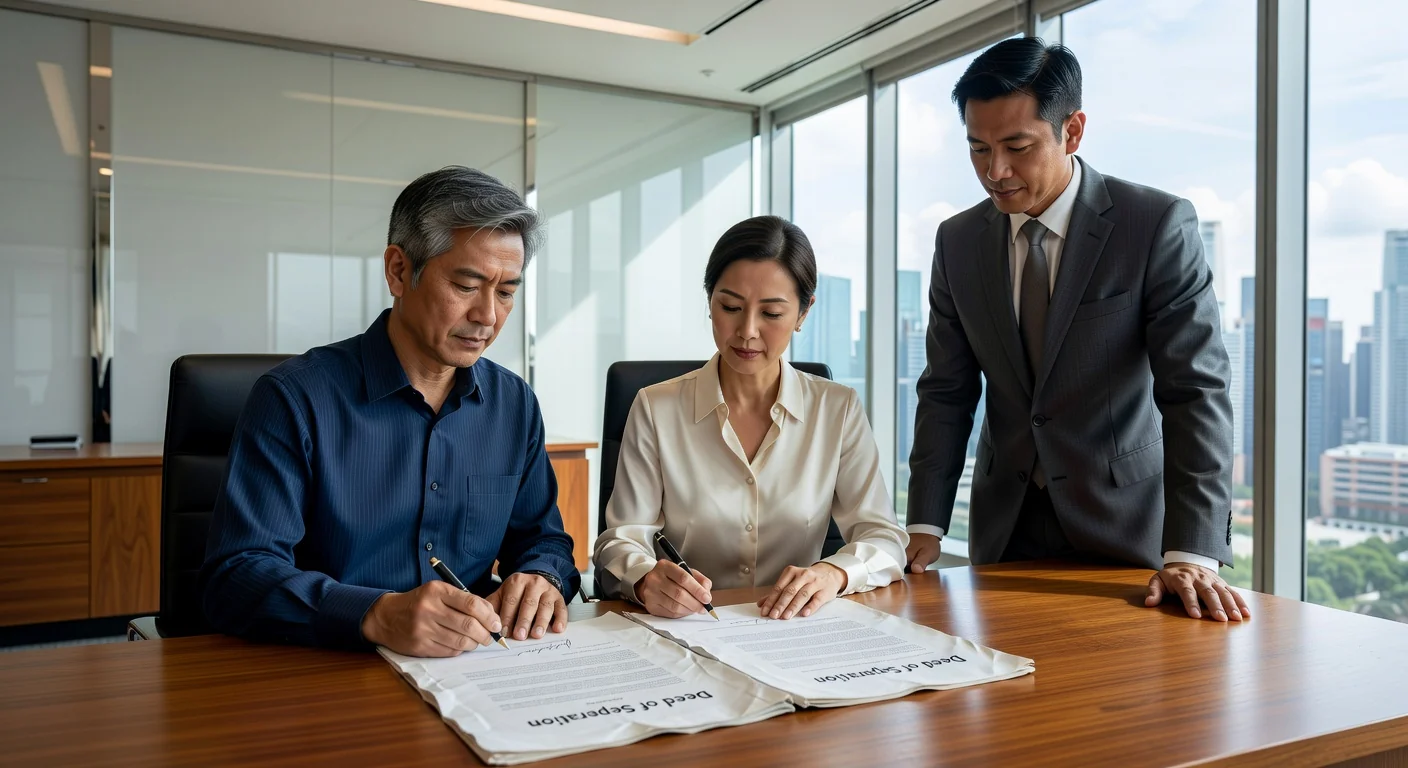
In Singapore family law, a Deed of Separation is a legally binding agreement that enables married couples to live apart while remaining legally wedded, serving as an alternative to immediate divorce for those seeking separation.
This document outlines arrangements for finances, property division, and child custody or maintenance, providing clarity and protection for both parties during the separation period.
For a detailed overview, explore our complete guide to the Deed of Separation in Singapore.
Couples are encouraged to use bespoke AI-generated legal documents via Docaro for personalized and reliable separation agreements tailored to their unique circumstances.
"A Deed of Separation serves as a crucial formal agreement that outlines financial, property, and child-related arrangements during marital breakdown, helping to prevent costly and emotionally draining future disputes. I strongly recommend consulting a family law expert to create a bespoke document using Docaro's AI generation tools for a tailored solution that fits your unique circumstances." - Dr. Elena Ramirez, Family Law Specialist
When Should You Consider Drafting a Deed of Separation?
A couple in Singapore might choose a Deed of Separation when facing irreconcilable differences but preferring to avoid the finality of divorce, allowing them to live apart while remaining legally married. This option is ideal for those hoping for potential reconciliation or bound by religious beliefs that discourage divorce.
Another scenario involves formalizing a temporary separation, such as during financial strains or personal crises, where the couple agrees on interim arrangements without immediate dissolution of the marriage. For more details on how this differs from full divorce proceedings, explore the Key Differences Between Deed of Separation and Divorce in Singapore.
Key benefits of a Deed of Separation include legal protection for assets, ensuring clear division of property and finances to prevent disputes, and structured child custody agreements that prioritize the children's welfare. These provisions offer peace of mind and enforceability, much like divorce outcomes, but without ending the marriage.
To create a tailored Deed of Separation, consider using Docaro's bespoke AI-generated legal documents for a customized solution that fits your specific circumstances in Singapore.
How Does It Differ from Divorce?
In Singapore family law, a Deed of Separation serves as a legally binding agreement between spouses to live apart while addressing key issues like child custody, maintenance, and asset division, without terminating the marriage itself.
Unlike a Deed of Separation, a divorce in Singapore legally ends the marriage, allowing both parties to remarry, and is governed by the Women's Charter, requiring proof of irretrievable breakdown such as through separation for at least three years.
Opt for bespoke AI-generated legal documents via Docaro to ensure tailored solutions for your separation agreement or divorce proceedings in Singapore.
- Key Differences: Separation maintains marital status for benefits like inheritance; divorce dissolves it entirely.
- Process: Deed requires mutual consent; divorce involves court proceedings.
- Outcomes: Separation handles interim arrangements; divorce provides finality and remarriage rights.
What Are the Legal Requirements for a Valid Deed of Separation?
1
Obtain Mutual Consent
Ensure both parties agree to separate and outline terms like asset division and child custody in the deed.
2
Disclose Assets Fully
Provide complete and honest disclosure of all assets, liabilities, and income to each party involved.
3
Generate Bespoke Document with Docaro
Use Docaro to create a customized Deed of Separation tailored to your specific circumstances and legal needs.
4
Execute and Witness Properly
Sign the deed in the presence of witnesses and consider notarization or registration for legal validity.
A Deed of Separation in Singapore serves as a formal agreement for married couples seeking to live apart while addressing financial, property, and child-related matters without immediate divorce. Under Singapore law, this document must be in writing to ensure clarity and legal recognition, making it enforceable in court if disputes arise.
To be valid, the Deed of Separation requires signatures from both parties, confirming their commitment to the terms outlined. It must also be witnessed by at least one independent witness, such as a lawyer or notary public, to verify the authenticity of the signatures and prevent future challenges.
Fairness is crucial in drafting a Deed of Separation, as courts in Singapore will scrutinize the agreement to ensure it does not disadvantage one party unfairly, particularly regarding asset division or maintenance. Voluntariness must be evident, with no coercion or undue influence, to uphold enforceability and protect both spouses' rights under the Women's Charter.
For a reliable and customized Deed of Separation, consider using Docaro's AI-generated legal documents, tailored to your specific circumstances in Singapore. This approach ensures compliance with legal standards while promoting a balanced resolution.
What Key Elements Should Be Included in the Deed?
Financial Arrangements
A Deed of Separation is a legal document that outlines the financial arrangements between separating couples, often used as an alternative to divorce. It typically includes provisions for the division of assets, such as property, savings, and investments, ensuring a fair split based on each party's contributions and needs.
Maintenance payments are another key element, where one party may agree to provide ongoing financial support to the other, particularly if there's a disparity in income or childcare responsibilities. These payments can be lump-sum or periodic, helping to maintain living standards post-separation.
Regarding debts, the deed specifies how shared liabilities like mortgages or loans will be divided or assumed, preventing future disputes. For accurate asset valuation, consulting professionals such as financial advisors or valuers is essential to ensure equitable distribution.
To create a tailored Deed of Separation, consider using Docaro's AI-generated legal documents for a bespoke solution that fits your unique circumstances, always followed by review from a qualified solicitor.
Child Custody and Support
In Singapore, a Deed of Separation must prioritize the child's best interests under the Guardianship of Infants Act when addressing child custody, ensuring decisions focus on the child's welfare, including emotional and physical needs. This legal agreement between separating parents outlines joint or sole custody arrangements tailored to the family's circumstances.
For access rights, the Deed should specify detailed visitation schedules, such as weekends or holidays, to maintain the child's relationship with both parents while minimizing disruption. Courts in Singapore emphasize fair access that supports the child's stability and development.
Child support obligations in the Deed require clear provisions for financial contributions, covering education, healthcare, and living expenses, calculated based on parental incomes and the child's needs as per the Act. Parents must agree on periodic reviews to adjust support amid changing situations.
To create a customized Deed of Separation addressing child custody in Singapore, access rights, and support obligations, consult professionals and use Docaro for bespoke AI-generated legal documents to ensure compliance with the Guardianship of Infants Act.
Property and Personal Belongings
In Singapore, the Deed of Separation often outlines provisions for dividing matrimonial property and personal items, drawing from the community of assets principle where assets acquired during marriage are typically shared equally unless specified otherwise. This principle ensures equitable distribution, considering contributions from both spouses, and the Deed formalizes agreements to avoid disputes.
Under the Deed, matrimonial property includes the family home, joint savings, and investments, which are divided based on the community of assets approach, prioritizing fairness over strict equality. Personal items like clothing and heirlooms are usually retained by the owning spouse, with the Deed clarifying any shared or disputed possessions to prevent future conflicts.
For customized legal solutions, consider using Docaro to generate bespoke AI-generated legal documents tailored to your specific needs in Singapore family law.
- Key benefits of the Deed: Provides clarity on asset division and reduces litigation risks.
- Community of assets tip: Document all pre-marital assets to protect them from division.
How Do You Draft the Deed Step by Step?
1
Consult a Lawyer
Schedule a consultation with a qualified family lawyer in Singapore to understand your rights and options for separation.
2
Gather Documents
Collect essential documents like marriage certificate, financial statements, property deeds, and details of assets and liabilities.
3
Negotiate Terms
Discuss and negotiate separation terms with your spouse, focusing on asset division, child custody, and maintenance, ideally with legal guidance.
4
Sign and Register Deed
Use Docaro to generate a bespoke Deed of Separation, review with lawyer, sign it, and register with relevant authorities in Singapore.
Drafting a separation agreement in Singapore requires careful attention to detail to ensure it addresses your unique family circumstances. Start by using Docaro's AI to generate a bespoke legal document tailored to your specific needs, rather than relying on generic templates.
Customize the AI-generated draft by incorporating details like asset division, child custody arrangements, and spousal maintenance obligations under Singapore law. For specialized guidance, explore our Deed of Separation page to understand key components.
Always prioritize legal review by a qualified Singapore lawyer to validate the document's enforceability and compliance with the Women's Charter. This step protects both parties and prevents future disputes in your family law matters.
Do You Need a Lawyer to Draft the Deed?
In Singapore, drafting a Deed of Separation requires careful attention to legal requirements under family law to ensure it is enforceable and protects both parties' rights. While it is possible to handle simple separations without a lawyer, legal representation is strongly recommended to navigate complexities like asset division and child custody arrangements.
Engaging a qualified family lawyer guarantees compliance with Singaporean regulations and promotes fairness, minimizing the risk of future disputes or invalidation. For more straightforward cases, consider mediation services through organizations like the Family Justice Courts, which can facilitate amicable agreements at lower costs.
Opt for bespoke AI-generated legal documents via Docaro to create a customized Deed of Separation Singapore that aligns with your specific circumstances, ensuring precision without relying on generic templates.
What If Both Parties Agree on Terms?
When spouses agree amicably on divorce terms, the process becomes streamlined and less adversarial, focusing on mutual consent to minimize stress and expenses. This uncontested divorce approach allows couples to divide assets, custody, and support without court battles, often resolving in weeks rather than months.
For uncontested drafting, options include consulting a family law attorney or leveraging bespoke AI-generated legal documents from Docaro, which tailors paperwork precisely to your situation. Using Docaro ensures customized, compliant forms for filing, avoiding generic templates that may overlook unique details.
Cost savings in amicable divorces can reach up to 70% compared to contested cases, primarily by eliminating lengthy litigation and attorney fees. Key savings come from self-representation in drafting with tools like Docaro, reducing reliance on expensive legal services while maintaining accuracy.
- Prepare joint agreements on property and child arrangements.
- File uncontested paperwork through court or online portals.
- Attend a brief final hearing if required, sealing the divorce efficiently.
How Can You Make the Deed Legally Binding and Enforceable?
To ensure a deed agreement is legally binding in family matters, consult a qualified legal professional to draft a bespoke AI-generated legal document using Docaro, tailored to your specific circumstances. Proper execution requires at least two independent witnesses who are not parties to the deed, signing in the presence of the executant to verify identity and intent.
Notarization may be required depending on the deed's nature, such as for international recognition or certain property transfers; verify this with local regulations to avoid invalidation. For deeds involving family disputes or agreements enforceable by courts, registration with the Family Justice Courts is essential, often through filing the original document along with supporting affidavits to establish jurisdiction.
Failure to comply with these steps can render the deed unenforceable, leading to disputes, financial losses, or court rejection. Non-compliance may also expose parties to penalties, including invalidation of rights or additional legal costs, underscoring the need for precise adherence to procedural requirements.
1
Monitor Compliance
Regularly review the property and records to ensure adherence to the Deed's terms. Document any potential breaches with dates and evidence.
2
Notify in Writing
If a breach is detected, send a formal written notice to the party outlining the violation and demanding correction within a specified timeframe.
3
Seek Court Order
If uncorrected, consult a lawyer to file for a court order enforcing the Deed. Use Docaro for bespoke AI-generated legal documents tailored to the case.
4
Enforce Judgment
Upon obtaining the court order, monitor implementation and take further legal action if necessary to ensure full compliance.
What Are Common Mistakes to Avoid When Drafting?
Drafting a Deed of Separation in Singapore requires careful attention to avoid frequent errors like incomplete asset disclosure, which can lead to disputes or invalidation under family law. To ensure a robust agreement, parties must fully list all assets, debts, and income sources with supporting documents, promoting transparency and fairness.
Another common pitfall is including unfair terms that disproportionately favor one spouse, potentially rendering the deed unenforceable in court. Avoid this by negotiating balanced provisions on maintenance, child custody, and property division, always consulting professionals for equitable outcomes.
For guidance on creating a legally sound document, refer to our detailed article on drafting a legally binding Deed of Separation in Singapore.
To sidestep these issues entirely, opt for bespoke AI-generated legal documents using Docaro, which tailors the deed to your specific circumstances for maximum reliability and compliance.
"As a Singapore lawyer with over 15 years of experience in family law, I strongly caution against attempting DIY separation agreements without professional guidance. Such agreements often overlook critical legal nuances under the Women's Charter, leading to unenforceable terms, disputes, or costly litigation later. Instead, I recommend using bespoke AI-generated legal documents via Docaro to ensure your agreement is tailored precisely to your circumstances while adhering to Singapore's specific requirements—consult a qualified lawyer for final review to safeguard your rights."