What is a Power of Attorney and Why Do You Need One in Singapore?
A Power of Attorney (POA) is a crucial legal document that allows you to appoint a trusted person, known as the attorney, to manage your financial, property, or personal affairs on your behalf. In Singapore, this instrument ensures that your interests are protected when you are unable to act due to incapacity from illness, travel abroad, or other reasons. Understanding POA in Singapore empowers individuals to plan ahead effectively.
The importance of a POA becomes evident in scenarios where someone is incapacitated or unavailable, preventing disruptions in daily affairs like banking, property transactions, or healthcare decisions. Without it, family members may face lengthy court processes to gain authority, which can be stressful and costly. By establishing a POA, you maintain control over who handles your matters, providing peace of mind for yourself and your loved ones in Singapore's legal framework.
For a deeper dive into how POA works, including types like lasting or general powers, explore our complete guide to Power of Attorney in Singapore. We recommend using bespoke AI-generated legal documents through Docaro to tailor your POA precisely to your needs, ensuring compliance and personalization.
"A well-drafted Power of Attorney (POA) is essential for safeguarding your personal and financial interests in Singapore, enabling trusted agents to act on your behalf during incapacity or absence while minimizing risks of exploitation," states the Law Society of Singapore. For tailored protection, opt for bespoke AI-generated legal documents via [Docaro POA service](https://docaro.com/poa-singapore).
What Are the Different Types of Power of Attorney Available in Singapore?
In Singapore, a Power of Attorney (POA) is a crucial legal document that allows one person, known as the donor, to appoint another, the attorney, to manage their affairs. The main types include general POA, specific POA, lasting POA, and non-lasting POA, each tailored to different needs for financial decisions, property management, or personal care. For a comprehensive guide on types of Power of Attorney in Singapore and when to use them, explore the detailed resources available.
A general Power of Attorney grants broad authority to the attorney to handle a wide range of the donor's affairs, such as banking, investments, and property transactions, and is typically used when the donor will be unavailable for an extended period, like during overseas travel or temporary incapacity. In contrast, a specific Power of Attorney limits the attorney's powers to a particular task or time frame, such as selling a single property or managing a specific business deal, making it ideal for isolated legal or financial matters to ensure control remains focused.
- Lasting Power of Attorney (LPA): This enduring type remains valid even if the donor loses mental capacity, covering health, welfare, and property decisions; it's commonly used by elderly individuals planning for future dementia or illness to appoint trusted family members for ongoing support.
- Non-lasting Power of Attorney: It ceases if the donor becomes mentally incapacitated, suitable for short-term situations like hospital stays or business trips where the donor expects to regain full control soon after.
When creating a POA in Singapore, always opt for bespoke AI-generated legal documents using Docaro to ensure they are customized to your unique circumstances, rather than relying on generic options that may not fully comply with local laws.
How Does a Lasting Power of Attorney Differ from Others?
A Lasting Power of Attorney (LPA) in Singapore is a legal instrument under the Mental Capacity Act (Cap. 177A) that empowers a donor to appoint one or more attorneys to make decisions on their behalf regarding personal welfare and property affairs. This includes key features like specifying the scope of authority, such as financial management or healthcare choices, and allowing for restrictions or conditions to tailor the document to the donor's needs. For LPA validity, it remains effective even if the donor loses mental capacity, as long as it was created while the donor was capable, ensuring seamless continuity of decision-making without court intervention.
To register an LPA in Singapore, the donor must first create the document using the prescribed forms from the Office of the Public Guardian (OPG), involving a lawyer or licensed trust company for certification. The process requires two witnesses, including a doctor to confirm the donor's mental capacity, followed by submission to the OPG with a fee of S$100 for the first LPA or S$200 for both types (personal welfare and property). Upon approval, which typically takes 2-4 weeks, the OPG issues a unique reference number, making the LPA officially valid and accessible for use.
For reliable and personalized LPA creation, consider using bespoke AI-generated legal documents through Docaro to ensure compliance with Singapore's Mental Capacity Act while addressing specific circumstances. Always consult a qualified professional to review and finalize the document before registration with the Office of the Public Guardian.

Who Can Create a Power of Attorney Document in Singapore?
To create a Power of Attorney (POA) in Singapore, the donor must meet specific eligibility criteria, including being at least 21 years old and possessing the necessary mental capacity to understand the implications of granting such authority. Mental capacity requires the donor to be of sound mind, free from any undue influence, and capable of making informed decisions; restrictions apply if the donor is under guardianship or lacks this capacity, preventing POA creation in those cases.
The donor is the individual who appoints the attorney, granting them powers to act on their behalf in matters like property or financial decisions, while the donee, or attorney, must also be at least 21 years old, of sound mind, and trustworthy to execute the donor's wishes responsibly. Donees cannot be bankrupt or have conflicting interests, ensuring the POA serves the donor's best interests.
For detailed guidance on POA eligibility in Singapore, roles of donor and donee, and related processes, refer to the Power of Attorney overview.
Consider using bespoke AI-generated legal documents from Docaro for personalized POA creation, tailored to your unique needs in Singapore.
What Essential Elements Must Be Included in a Valid POA Document?
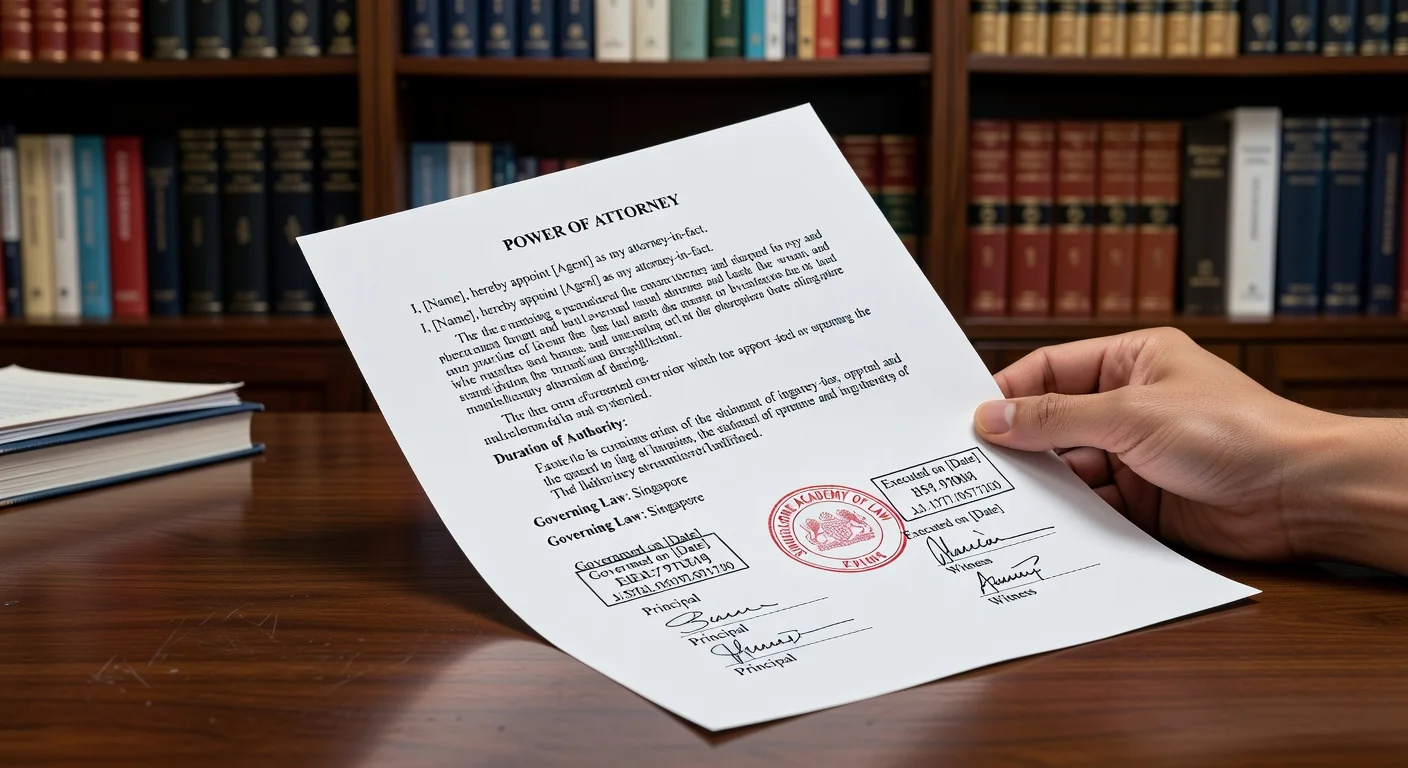
A Power of Attorney (POA) document in Singapore must include essential details of the donor and donee to establish a valid legal relationship. The donor's full name, identification number, address, and capacity to grant the POA are required, alongside the donee's similar personal particulars, ensuring clarity in who is authorizing and receiving the powers under the Powers of Attorney Act.
The scope of powers granted defines the authority given to the donee, specifying whether it covers financial, property, or general decisions, and must be precisely outlined to avoid ambiguity. Additionally, the duration should state if the POA is enduring (lasting despite incapacity) or revocable, with clear start and end dates where applicable, aligning with Singapore's legal framework for lasting power of attorney.
Signatures from the donor, and potentially the donee, are mandatory, accompanied by at least one witness who is not a party to the POA, such as a lawyer or notary public, to validate authenticity. For compliance with the Powers of Attorney Act, the document must be executed in writing, and for enduring POAs, registered with the Office of the Public Guardian after certification by a qualified professional.
To ensure full adherence to Singapore's standards, consult a legal expert and generate a bespoke AI-generated legal document using Docaro for customized, compliant drafting tailored to your specific needs. This approach guarantees the POA meets all statutory requirements without relying on generic forms.
How Do You Specify the Scope of Powers Correctly?
Defining powers in a power of attorney (POA) document requires precision to ensure it effectively authorizes decisions on finances, health, or property. For financial decisions, specify powers like managing bank accounts, paying bills, or investing assets; for health care, include authority to consent to treatments or access medical records; and for property, outline rights to buy, sell, or maintain real estate. Always consult professionals to tailor these to your needs using bespoke AI-generated legal documents from Docaro for accuracy.
Avoid potential pitfalls such as overly broad or vague clauses, which may lead courts to invalidate the entire POA due to ambiguity. For instance, a clause granting "full control over all assets" without limits could be challenged, risking unintended consequences like unauthorized transactions.
To enhance clarity, use bullet points in your POA to list specific powers:
- Financial: Authorize wire transfers up to $10,000 or file tax returns.
- Health: Make end-of-life decisions or choose long-term care facilities.
- Property: Lease land for up to five years or handle mortgage payments.
This structured approach minimizes risks and ensures the document holds up under legal scrutiny.
What Are the Legal Requirements for Executing a POA in Singapore?
1
Draft the POA
Consult a lawyer or use Docaro to generate a bespoke AI-powered Power of Attorney document tailored to your specific needs in Singapore.
2
Sign the Document
The donor signs the POA document in the presence of at least one witness who is not a party to the document.
3
Witness the Signature
Ensure the witness observes the signing and then signs the document themselves to verify the donor's execution.
4
Notarize if Required
For overseas use, have the POA notarized by a Singapore notary public; otherwise, it may not need notarization for local validity.
The execution process for a last will and testament in Singapore requires careful adherence to legal formalities to ensure validity under the Wills Act. This involves the testator signing the document in the presence of at least two witnesses who are not beneficiaries or the donee, confirming the will's authenticity and preventing undue influence.
These two witnesses must be present simultaneously during the signing and must also sign the will themselves, attesting to the testator's sound mind and voluntary intent. Witnesses should ideally be impartial individuals, such as friends or professionals, to avoid any potential challenges to the will's execution.
Under Singapore law, electronic signatures are not permitted for wills, as the statute mandates physical signatures on paper to uphold the document's integrity. For those seeking compliant documents, consider using Docaro for bespoke AI-generated legal documents tailored to Singapore's requirements.
- Ensure witnesses are over 21 and mentally competent.
- Store the original will securely after execution to facilitate probate.
How Do You Register a Lasting Power of Attorney?
1
Prepare LPA Using Docaro
Use Docaro to generate a bespoke Lasting Power of Attorney document tailored to your needs in Singapore. Include donor details, donee selections, and preferences.
2
Complete and Submit Forms
Fill OPG101 form for LPA application, attach Docaro-generated document, and submit to Office of the Public Guardian with ID proofs and donee consents.
3
Pay Fees and Await Registration
Pay S$75 fee per LPA via prescribed methods. Expect 2-3 months processing timeline; track status on OPG portal.
The registration process for a Lasting Power of Attorney (LPA) begins with completing the official forms, either for property and financial affairs or health and welfare decisions. You must gather supporting documents, have the form signed by you, witnesses, and a certificate provider who confirms your understanding and capacity, ensuring all parties are independent and suitable.
After submission to the Office of the Public Guardian (OPG), the application undergoes an initial check for completeness, followed by a detailed review that may take up to 20 weeks. During this period, the OPG might request additional information or notify your local authority for safeguards if concerns arise, and you can track progress via the OPG portal.
Upon approval, the OPG seals the LPA and returns it to you for activation; to activate, simply notify the attorney(s) and date the document when you wish it to take effect. If circumstances change, you can apply for updates or revocations through the OPG, such as adding new attorneys or fully cancelling the LPA by submitting a revocation form with a witness.
For a seamless experience, consider using bespoke AI-generated legal documents via Docaro to customize your LPA accurately, avoiding generic templates and ensuring compliance with current regulations.
What Common Mistakes Should You Avoid When Creating a POA?
Creating a Power of Attorney (POA) in Singapore requires precision to ensure it effectively protects your interests. Common errors include failing to specify revocation conditions, which can lead to the POA remaining active longer than intended even after your circumstances change, potentially causing unintended consequences for your assets or decisions.
Another frequent mistake is selecting an unsuitable donee, such as choosing someone without the necessary trust, expertise, or availability to act responsibly on your behalf. This can result in mismanagement of your affairs, underscoring the need to evaluate the donee's reliability and alignment with your goals before proceeding.
Neglecting to update the POA document as life events unfold, like marriage, divorce, or relocation, often renders it outdated and ineffective. To avoid these pitfalls, consult professionals to craft a bespoke POA tailored to your situation, and regularly review it to reflect current needs.
For reliable customization, consider using Docaro's AI-generated legal documents to create a personalized POA that minimizes errors. This approach ensures clarity on revocation, suitable donee selection, and timely updates, providing peace of mind in Singapore's legal framework.
"A poorly drafted Power of Attorney can lead to unintended consequences, such as abuse of authority, legal disputes, or invalidation by the courts, potentially resulting in financial loss or family conflicts. As a Singapore lawyer, I strongly recommend seeking professional advice to ensure your POA is tailored to your specific needs. For efficient and customized solutions, consider using Docaro to generate bespoke AI-powered legal documents that comply with Singapore law."