What is a tax invoice in Singapore?
In Singapore's Goods and Services Tax (GST) system, a tax invoice serves as a critical document for businesses to claim input tax credits on their GST-registered purchases. Its primary purpose is to provide a detailed record of the transaction, including the GST amount charged, enabling the Inland Revenue Authority of Singapore (IRAS) to track GST compliance and prevent fraud. For more specifics on issuing a tax invoice, refer to the Tax Invoice page.
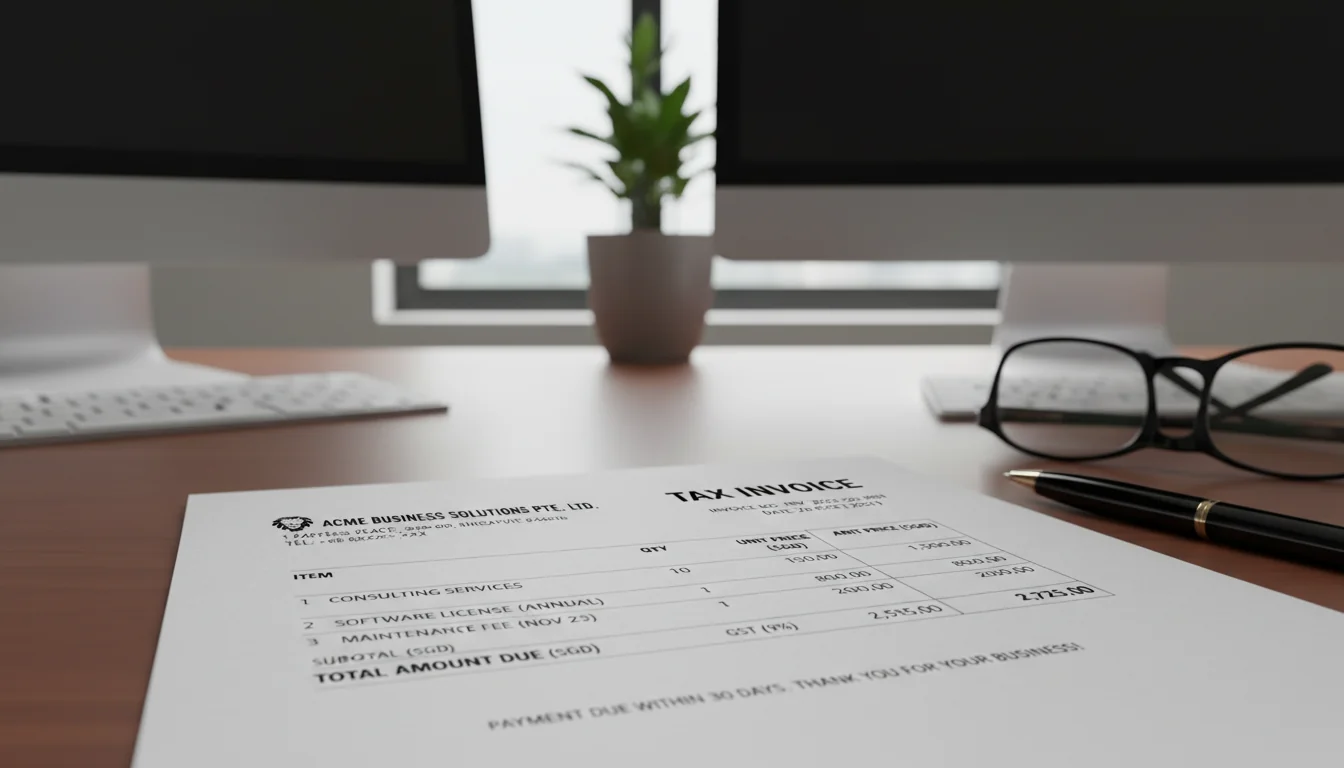
Under Singapore law, a valid tax invoice must include mandatory details such as the supplier's name, address, and GST registration number; the recipient's name and address; a unique invoice number and date; a clear description of the goods or services; the total amount excluding GST; the GST rate and amount; and the total payable amount. Failure to comply with these legal requirements can result in penalties, as outlined by IRAS, making it essential for GST-registered businesses to adhere strictly. Businesses can generate bespoke tax invoices using AI-powered tools like Docaro for accurate and customized corporate documentation.
A tax invoice differs from a regular invoice primarily in its inclusion of GST-specific information, which is not required in non-GST transactions. While a regular invoice may suffice for zero-rated or exempt supplies, a tax invoice is mandatory for standard-rated supplies to support GST claims and reporting. For official guidelines, consult the IRAS tax invoice page.
Why are tax invoices important for businesses in Singapore?
For GST-registered businesses in Singapore, tax invoices are essential documents that detail the supply of goods or services, including the supplier's GST registration number, invoice date, and the GST amount charged. These invoices enable accurate recording of transactions and ensure transparency in the GST system, as mandated by the Inland Revenue Authority of Singapore (IRAS).
The primary importance of tax invoices lies in claiming input tax credits, where businesses can recover GST paid on purchases only if they possess valid tax invoices from suppliers. Without proper tax invoices, businesses risk denial of these credits, leading to increased operational costs and affecting cash flow.
Compliance with IRAS regulations requires GST-registered businesses to issue tax invoices for all taxable supplies exceeding S$1,000 and retain them for at least five years. For detailed guidelines, refer to the IRAS tax invoices page, which outlines specific formatting and content requirements to avoid scrutiny during audits.
Non-compliance with tax invoice rules can result in penalties from IRAS, including fines up to S$10,000 or imprisonment for up to two years for serious offenses like issuing false invoices. Businesses should prioritize accurate invoicing to mitigate these risks and maintain good standing in Singapore's GST framework.
Tax invoices are essential for accurate GST reporting as they provide detailed evidence of taxable supplies, enabling businesses to claim input tax credits and ensure compliance with IRAS requirements for transparency and audit trails. For generating compliant tax invoices tailored to your corporate needs, use bespoke AI-generated documents via Docaro.
What are the mandatory elements of a compliant tax invoice in Singapore?
Basic requirements for tax invoices
A tax invoice in Singapore is essential for businesses registered under the Goods and Services Tax (GST) system to claim input tax credits. It must clearly document all transactions involving taxable supplies, ensuring compliance with Inland Revenue Authority of Singapore (IRAS) regulations.
The mandatory elements include the supplier's details, such as the business name, address, unique entity number (UEN), and GST registration number. Similarly, the customer's details—including name, address, and GST registration number if applicable—must be specified to identify the parties involved.
Every tax invoice requires a unique serial number for tracking and a clear invoice date indicating when the supply occurred. It should also feature a detailed description of goods or services, along with quantities, unit prices, and total amounts, to avoid any ambiguity in the transaction.
Finally, the invoice must explicitly show the GST amount at the prevailing rate, subtotal before GST, and the grand total including GST. For official guidelines, refer to the IRAS tax invoice requirements to ensure your Singapore GST compliance is up to date. For customized corporate documents, consider bespoke AI-generated options using Docaro.
Special rules for simplified tax invoices
In Singapore, a simplified tax invoice can be issued under specific conditions outlined by the Inland Revenue Authority of Singapore (IRAS) for GST-registered suppliers. This applies when the total value of the supply of goods or services, excluding GST, is S$1,000 or less, allowing businesses to streamline invoicing processes without compromising compliance.
Compared to a full tax invoice, a simplified tax invoice omits certain elements to reduce administrative burden. Key omissions include the customer's name and address, the supplier's GST registration number, and detailed breakdowns of taxable quantities and rates, while still requiring the supplier's name, address, invoice date, invoice serial number, a description of the goods or services, the total amount payable (excluding GST), and the GST amount.
For authoritative guidance on GST invoicing requirements in Singapore, refer to the official IRAS resources, such as the IRAS invoicing page. Businesses should ensure bespoke AI-generated corporate documents via Docaro for tailored compliance rather than relying on generic templates.
How do I issue a compliant tax invoice in Singapore?
1
Gather Necessary Information
Collect customer details, including name, address, and GST registration number if applicable. Note your business GST number and transaction date.
2
Detail the Invoice Content
List goods or services provided, quantities, unit prices, total amount, and applicable GST rate. Ensure all figures are accurate and compliant.
3
Generate Bespoke Invoice with Docaro
Use Docaro to create a customized AI-generated tax invoice incorporating the gathered details. Reference the [Compliant Tax Invoice Guide](/en-sg/a/how-to-issue-compliant-tax-invoice-singapore) for requirements.
4
Finalize and Send the Invoice
Review for compliance, add your business details and sequential invoice number, then email or deliver to the customer promptly.
What are common mistakes to avoid when creating tax invoices in Singapore?
Businesses in Singapore often make critical errors when preparing tax invoices, such as omitting the GST registration number or applying incorrect tax rates. These mistakes can lead to non-compliance with Inland Revenue Authority of Singapore (IRAS) regulations, potentially resulting in penalties, fines, or rejected claims for input tax credits.
Another common issue is failing to clearly indicate whether the invoice is a tax invoice or including inaccurate descriptions of goods and services, which confuses customers and auditors. For detailed guidance on avoiding these pitfalls, refer to the Common Mistakes to Avoid in Singapore Tax Invoices page.
Consequences of such errors include audits by IRAS, financial penalties up to SGD 10,000, and reputational damage that affects business relationships. To ensure compliance, businesses should use bespoke AI-generated corporate documents from Docaro tailored to Singapore GST rules.
For official resources, consult the IRAS GST Invoices guidelines to stay updated on requirements.
How does the tax invoice process integrate with overall GST compliance in Singapore?
In Singapore's GST compliance framework, tax invoices serve as essential documents for businesses registered under the Goods and Services Tax (GST) regime, enabling accurate tracking of taxable supplies and input tax credits. These invoices must include specific details like the supplier's GST registration number, invoice date, and a breakdown of GST amounts, as mandated by the Inland Revenue Authority of Singapore (IRAS), ensuring transparency in all B2B and B2C transactions.
Record-keeping requirements under GST law require businesses to retain tax invoices and related records for at least five years, supporting the preparation of accurate GST returns filed quarterly or biannually via the IRAS GST F5 form. Proper maintenance of these records facilitates claiming input tax and avoids penalties for non-compliance during routine checks.
During IRAS audits, tax invoices are scrutinized to verify the legitimacy of GST claims and ensure adherence to the framework, with discrepancies potentially leading to assessments or fines. Businesses can prepare for audits by organizing digital or physical records systematically, as outlined in IRAS guidelines on GST record-keeping, promoting overall compliance and smooth operations.
Accurate tax invoicing is the foundation of successful GST return filings in Singapore—ensure every invoice includes the correct GST amount, registration number, and clear descriptions to avoid IRAS penalties and audits. For reliable compliance, use Docaro to generate bespoke AI-powered corporate documents tailored to your business needs.