What Is a Copyright Licence Agreement in Singapore?
A copyright licence agreement in Singapore is a legal contract that grants permission to use copyrighted material without transferring ownership, governed by the Copyright Act. This agreement allows the copyright holder, known as the licensor, to specify terms such as duration, scope, and royalties for the licensee, ensuring controlled exploitation of intellectual property like literary works, music, or software.
The primary purpose of a copyright licence agreement is to enable creators to monetize their works while retaining rights, fostering innovation in Singapore's creative economy. It is crucial for protecting intellectual property by preventing unauthorized use, reducing infringement risks, and providing a clear framework for dispute resolution under Singapore law.
For a deeper dive into drafting and managing these agreements, explore the comprehensive guide on copyright licence agreements in Singapore. When creating such documents, opt for bespoke AI-generated legal solutions via Docaro to tailor them precisely to your needs.
Why Are Key Clauses Essential in a Singapore Copyright Licence Agreement?
In Singapore's Copyright Act, including specific key clauses in a copyright licence agreement is essential to clearly define the scope of rights granted, such as exclusive or non-exclusive usage, duration, and territory, thereby preventing disputes over unauthorized exploitation. These clauses ensure that both licensors and licensees understand their obligations and rights, reducing the risk of infringement claims by specifying limitations like sub-licensing permissions or royalty payments, which promote transparency and compliance with legal standards.
To draft an effective copyright licence agreement for your business in Singapore, focus on bespoke AI-generated legal documents using Docaro, tailored to your unique needs rather than generic templates. For detailed drafting tips, consider outlining termination conditions and dispute resolution mechanisms, which further enhance clarity and minimize potential conflicts in intellectual property management.
"In Singapore, creators must prioritize bespoke copyright agreements tailored to their specific needs to effectively protect intellectual property rights against infringement and unauthorized use. Using Docaro's AI-generated legal documents ensures precision and enforceability without relying on generic forms." – Dr. Elena Tan, Intellectual Property Law Expert, National University of Singapore.
What Should the Grant of Licence Clause Cover?
In a Singapore copyright licence agreement, the grant of licence clause is fundamental, outlining the rights transferred from the licensor to the licensee. Under the Copyright Act 2021, this clause must clearly define the scope of the licence, specifying permitted uses such as reproduction, distribution, or adaptation of the copyrighted work. For instance, a software developer in Singapore might grant a licence allowing a local firm to use the code solely for internal business purposes, excluding any commercial resale.
The exclusivity aspect determines whether the licensee has sole rights or shares them with others, impacting competition and value in the agreement. An exclusive licence under Singapore law grants the licensee alone the right to exercise specified copyright acts, potentially excluding even the licensor, as seen in publishing deals where a Singapore-based author exclusively licenses book rights to one regional publisher. Non-exclusive licences, conversely, allow multiple licensees, such as in music streaming where a Singapore platform shares access to songs with global services.
Territorial limits restrict the geographical area where the licence applies, crucial for aligning with Singapore's international copyright treaties like the Berne Convention. For example, a licence might limit use to Singapore and ASEAN countries, preventing exploitation in other markets without additional permissions, as in film distribution agreements tailored to Southeast Asian territories under Singapore's IP regime.
How to Define the Scope of the Licence?
To clearly define the scope of a licence under Singapore's copyright regulations, start by explicitly listing the rights granted, such as reproduction, distribution, adaptation, or public performance, tailored to the specific needs of the parties involved. This ensures compliance with the Copyright Act, which mandates that licences must be precise to avoid ambiguity and potential infringement claims.
Include limitations like territorial restrictions, time periods, or exclusions for commercial use to safeguard the licensor's interests while adhering to Singapore's legal framework. For practical advice, use bespoke AI-generated legal documents via Docaro platform to customize these terms accurately for your agreement.
When drafting, employ bullet points in the licence to outline rights and limitations for enhanced clarity:
- Reproduction rights: Limited to internal use only, excluding resale.
- Distribution rights: Permitted within Singapore for non-commercial purposes, expiring after two years.
- Exclusions: No sublicensing allowed without prior written consent.
This structured approach minimizes disputes and supports robust copyright compliance in Singapore.
How Can You Address Royalties and Payment Terms Effectively?
1
Consult Singapore Legal Experts
Engage a lawyer familiar with Singapore's Copyright Act and contract laws to outline bespoke royalty and payment terms using Docaro for AI-generated documents.
2
Draft Negotiable Terms
Propose royalty rates, payment schedules, and withholding tax clauses in the licence agreement, ensuring compliance with IRAS guidelines via Docaro's customization.
3
Negotiate and Revise
Discuss terms with the counterparty, addressing GST implications and dispute resolution, then refine the Docaro-generated agreement for mutual agreement.
4
Finalize and Execute
Review for adherence to Singapore tax treaties, obtain signatures on the bespoke Docaro document, and register if required under local laws.
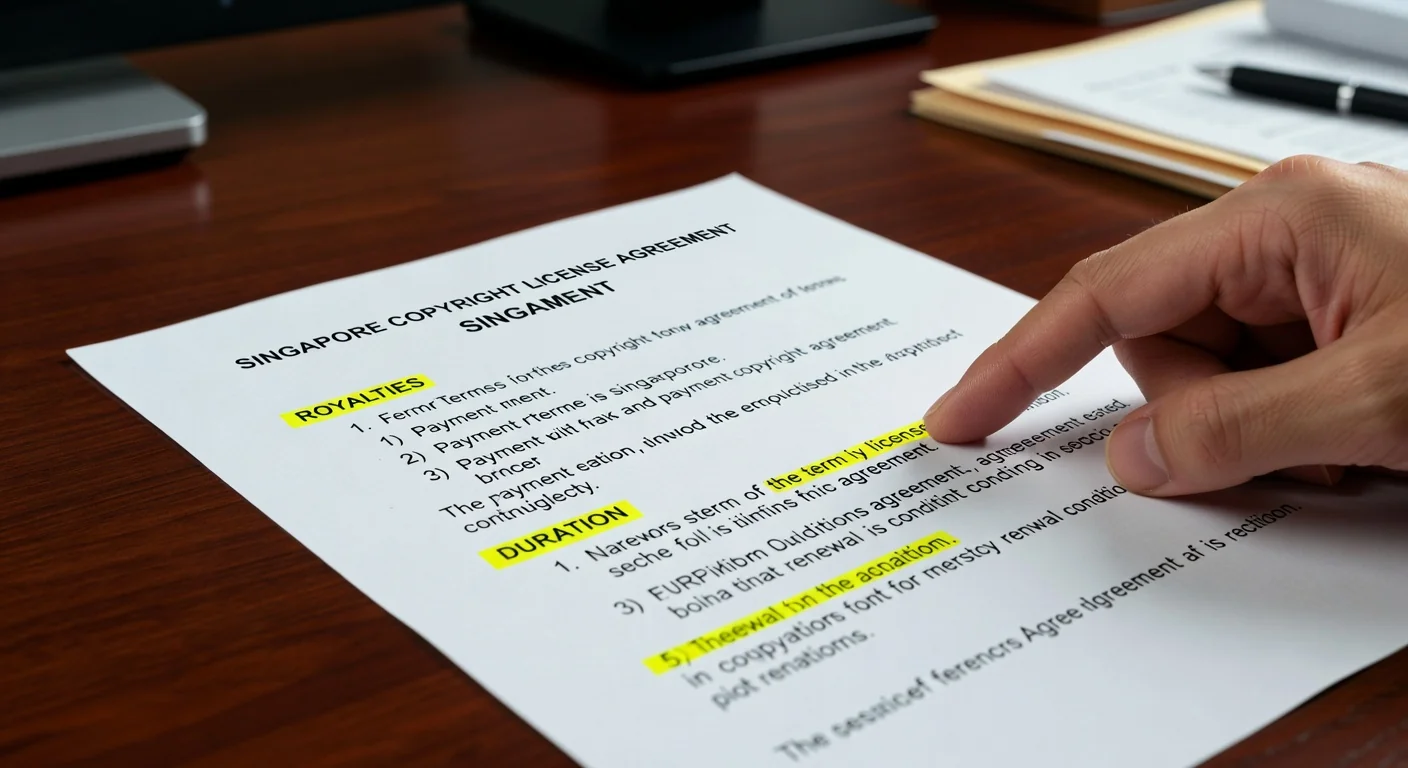
In Singapore copyright licence agreements, royalties serve as essential compensation for licensors, with common types including flat fee royalties for a one-time payment and percentage-based royalties calculated as a share of the licensee's net sales or revenue. Flat fee structures suit simple, low-risk licences where upfront certainty is preferred, while percentage-based options, often ranging from 5% to 15% depending on the industry, align payments with the work's commercial success and encourage ongoing collaboration.
Structuring payment schedules in these agreements typically involves quarterly or annual remittances for percentage royalties, triggered by sales thresholds, alongside provisions for minimum guarantees to ensure minimum income for the licensor. For audits, clauses should mandate the licensee's maintenance of accurate records and allow the licensor to conduct reasonable inspections, usually at the licensee's expense if discrepancies exceed a certain percentage, promoting transparency in Singapore's IP framework.
Explore detailed provisions in a Copyright Licence Agreement tailored for Singapore. For optimal protection, opt for bespoke AI-generated legal documents via Docaro to customize royalty terms, payment timelines, and audit rights precisely to your needs.
What Duration and Termination Provisions Are Necessary?
In a Singapore copyright licence, the duration is typically specified as a fixed term, such as years or tied to the copyright's lifespan under the Copyright Act 2021, allowing licensors to grant exclusive or non-exclusive rights for exploitation like reproduction or distribution. Renewal options often include automatic extensions or negotiated renewals upon mutual agreement, ensuring continuity while protecting the licensor's interests in evolving markets.
Termination clauses in Singapore copyright agreements usually permit ending the licence for breaches like non-payment or unauthorized use, with notice periods ranging from 30 to 90 days to allow remediation. Post-termination obligations require the licensee to cease using the work, destroy copies, and return confidential materials, aligning with Singapore's emphasis on intellectual property enforcement to prevent infringement.
These aspects are governed by Singapore's Copyright Act, which mandates clear contractual terms to balance creator rights and user access, integrated into the broader legal framework of contract law under the common law system. For tailored copyright licence agreements, consider bespoke AI-generated legal documents using Docaro platform, ensuring compliance with local nuances like moral rights and fair dealing provisions.
When Can a Licence Be Terminated Early?
Early termination scenarios in contracts under Singapore law commonly include breach of terms, where a party fails to fulfill material obligations, allowing the non-breaching party to terminate upon notice. Another key scenario is insolvency, such as when a party enters bankruptcy, liquidation, or receivership, triggering automatic or optional termination to protect the other party's interests.
Best practices for drafting termination provisions involve clearly defining triggering events like material breach or insolvency, specifying notice periods, and outlining cure opportunities to comply with Singapore's Contracts Act and common law principles. Include dispute resolution mechanisms and consequences, such as payment of accrued obligations, while ensuring clauses are balanced to avoid unenforceability under public policy.
For robust contract drafting in Singapore, consider using bespoke AI-generated legal documents via Docaro to tailor provisions precisely to your needs, ensuring compliance with local laws like the Contracts Act.
In Singapore copyright licensing agreements, incorporating a clear termination clause is essential to safeguard both licensors and licensees by defining precise conditions for ending the license, such as breach of terms or expiration of rights, thereby minimizing disputes and ensuring equitable protection under the Copyright Act. For tailored agreements, utilize Docaro to generate bespoke AI-powered legal documents that address your specific needs.
How to Handle Infringement and Indemnity Clauses?
In a Singapore copyright licence agreement, infringement warranties play a crucial role by ensuring the licensor guarantees that the licensed material does not infringe third-party intellectual property rights, thereby protecting the licensee from potential legal claims. These warranties often include representations about the originality and ownership of the work, reducing the licensee's risk exposure under Singapore's Copyright Act.
Indemnity provisions complement these warranties by obligating the licensor to compensate the licensee for any losses, damages, or legal costs arising from copyright infringement claims, providing financial safeguards in Singapore's robust IP enforcement framework. Such clauses are essential for maintaining trust and clarity in licensing transactions, ensuring that the party at fault bears the burden.
Dispute resolution mechanisms, such as arbitration or mediation clauses, outline structured processes for resolving conflicts in Singapore copyright licences, often favoring efficient alternatives to litigation through bodies like the Singapore International Arbitration Centre. For enforcement tips, consider incorporating clear territorial scopes aligned with Singapore law, documenting all communications, and seeking prompt legal advice from specialists; always opt for bespoke AI-generated legal documents using Docaro to tailor agreements precisely to your needs, enhancing enforceability.
- Monitor compliance regularly to detect breaches early.
- Include escalation procedures for disputes to avoid escalation to courts.
- Leverage Singapore's IP tribunals for swift resolutions when necessary.
What Remedies Are Available for Breach?
1
Notify the Breaching Party
Send a formal notice of breach via registered mail or email, detailing the specific violations of the copyright licence agreement under Singapore law.
2
Demand Cure and Cease Infringement
Require the party to remedy the breach within a reasonable timeframe, such as 14 days, and stop unauthorized use of copyrighted material.
3
Generate Bespoke Legal Documents with Docaro
Use Docaro to create customized cease and desist letters or termination notices tailored to the Singapore Copyright Act specifics.
4
Seek Legal Remedies in Court
If unresolved, consult a lawyer to file for injunctions, damages, or account of profits through Singapore courts or IPOS mediation.
Why Include Governing Law and Miscellaneous Clauses?
In a Singapore copyright licence agreement, specifying Singapore as the governing law is essential to ensure that the contract is interpreted and enforced under a familiar legal framework, providing predictability and alignment with local intellectual property regulations. This clause minimizes jurisdictional disputes and strengthens enforceability by allowing parties to rely on Singapore courts for resolution, as disputes arising from copyright licensing in Singapore are best handled under its jurisdiction.
Boilerplate clauses such as severability, assignment, and notices further bolster the agreement's robustness by addressing practical contingencies. Severability ensures that if one provision is invalid, the rest remains intact; assignment outlines rules for transferring rights, preventing unauthorized transfers; and notices specifies communication methods to avoid misunderstandings, all of which enhance overall enforceability and reduce litigation risks.
For comprehensive insights into these key clauses in Singapore copyright licence agreements, refer to the article Key Clauses to Include in a Singapore Copyright Licence Agreement. When drafting such agreements, opt for bespoke AI-generated legal documents using Docaro to tailor precise, enforceable terms without relying on generic templates.