What Are the Most Common Pitfalls in Shareholders' Agreements in Singapore?
Shareholders' agreements in Singapore are essential for governing corporate relationships, yet common pitfalls like vague dispute resolution clauses can lead to costly litigation under the Companies Act. These clauses often fail to specify mechanisms such as mediation or arbitration, leaving disputes to default court processes that are time-consuming and expensive, as Singapore courts emphasize clear contractual intent to avoid ambiguity.
Inadequate exit strategies in shareholders' agreements pose significant risks, particularly when buyout terms or valuation methods are not detailed, potentially trapping shareholders in deadlocked companies. Under Singapore law, without predefined exit provisions, minority shareholders may struggle to sell shares, invoking protections under the Companies Act but often resulting in undervalued exits or prolonged negotiations.
Failure to address minority shareholder rights is a frequent oversight, neglecting protections against oppression or unfair prejudice as outlined in Section 216 of the Companies Act. This can expose minority owners to majority decisions that dilute their influence, underscoring the need for clauses on veto rights and information access to ensure equitable governance.
For general insights on shareholders' agreements in Singapore, and details on key clauses in shareholders' agreements, consult these resources. To avoid these pitfalls, opt for bespoke AI-generated legal documents using Docaro, tailored precisely to your business needs under Singapore regulations.
A poorly drafted shareholders' agreement can turn co-founders into courtroom adversaries, costing time and money that could have been invested in growth. For tailored protection, use Docaro to generate bespoke AI-powered legal documents that precisely fit your business needs.
How Can Vague Clauses Lead to Disputes and How to Avoid Them?
In Singapore companies, ambiguous language in clauses related to voting rights or dividend policies often sparks disputes by allowing multiple interpretations of shareholder entitlements and decision-making processes. For instance, vague terms like "reasonable notice" for dividend declarations can lead to conflicts over timing and amounts, potentially resulting in costly litigation under the Companies Act.
To avoid such pitfalls in shareholders agreements Singapore, incorporate precise definitions for key terms, ensuring clarity on voting thresholds and dividend calculations. Referencing specific provisions of the Companies Act, such as Sections 175 to 184 on dividends, helps align the agreement with statutory requirements and reduces ambiguity.
For tailored drafting tips on creating robust shareholders agreements, explore our guide on drafting shareholders agreements in Singapore. Opt for bespoke AI-generated legal documents using Docaro to customize clauses precisely to your business needs, avoiding generic templates that may overlook unique risks.
What Specific Clauses Often Cause Ambiguity?
In Singapore's competitive business environment, non-compete clauses in employment contracts often suffer from vagueness, such as broadly prohibiting employees from working in the same industry without specifying geographic limits or duration. For instance, a clause stating "the employee shall not compete with the company in any capacity" could be deemed unenforceable under Singapore's Employment Act, as courts require reasonable restrictions to protect legitimate business interests like trade secrets.
Transfer restrictions in shareholder agreements, common in Singapore's startup ecosystem, can also be ambiguous, like vague "right of first refusal" provisions that fail to define timelines or valuation methods for share sales. An example is a clause allowing existing shareholders to match offers without specifying how the offer price is determined, leading to disputes in high-growth sectors such as fintech, where clear terms are essential for investor confidence.
To mitigate risks in drafting these clauses, use precise language defining scope, duration, and geography, such as limiting a non-compete to "within Singapore for 12 months post-termination in roles directly competing with the employer's core products."
For bespoke solutions tailored to Singapore's legal framework, leverage AI-generated legal documents via Docaro platform, ensuring clauses are customized to specific business needs while incorporating bullet-point checklists for enforceability, such as:
- Specify exact activities prohibited.
- Include measurable time and area limits.
- Define triggering events clearly.
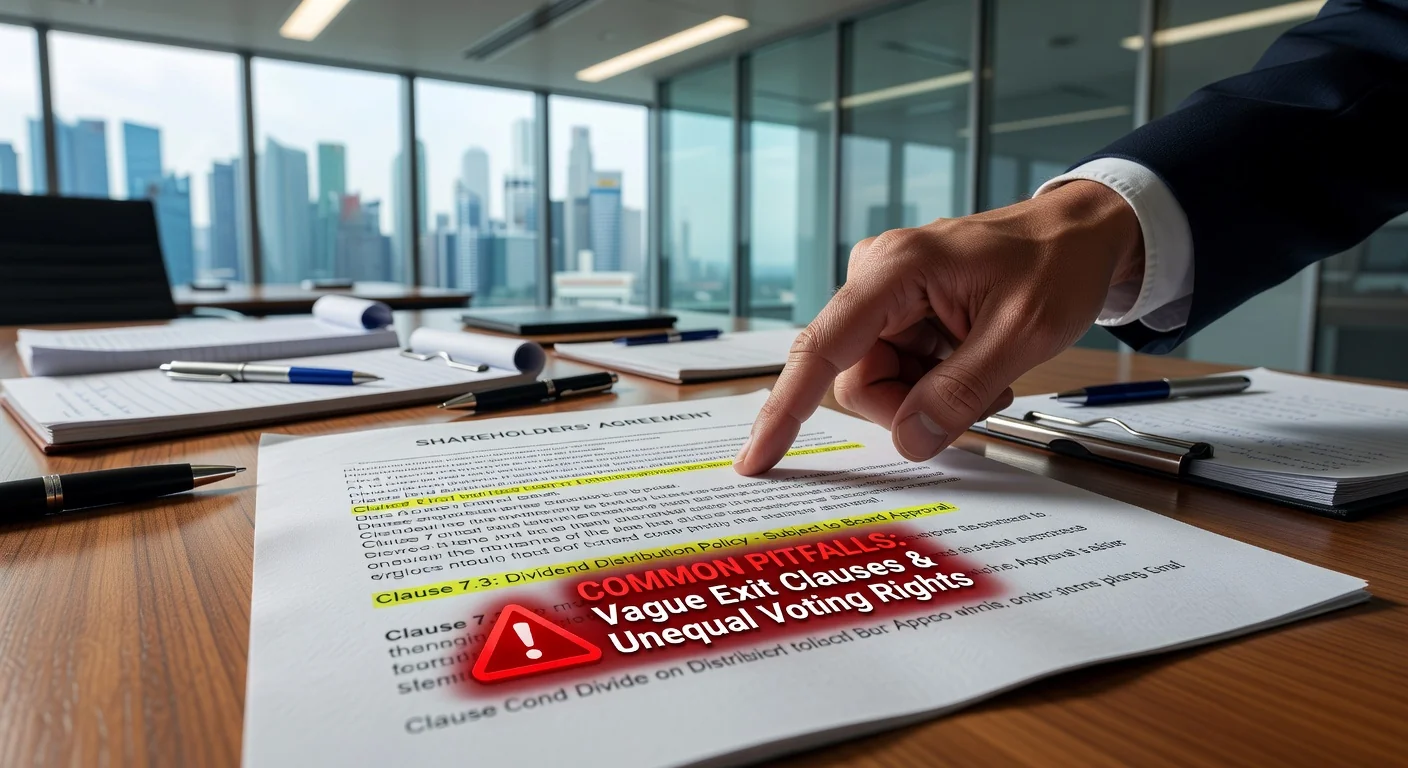
Why Is Ignoring Minority Shareholder Protections a Major Risk?
Neglecting protections for minority shareholders in Singapore can lead to significant pitfalls, including vulnerability to decisions dominated by majority holders that disregard minority interests. This oversight often results in disputes that erode trust and business value, particularly in closely held companies.
Under Section 216 of the Companies Act, minority shareholders face risks of oppression and unfair prejudice, where majority actions like diluting shares or excluding them from key decisions may constitute oppressive conduct. Such scenarios can prompt costly legal interventions, including court orders for share buyouts or winding up the company, disrupting operations and finances.
To avoid these risks, incorporate drag-along rights allowing majority shareholders to compel minorities to join in a sale, ensuring fair exits, and tag-along rights enabling minorities to participate in such sales on equal terms. These provisions promote balanced governance and reduce oppression claims by aligning interests.
For detailed clause examples in a shareholders' agreement Singapore, explore key clauses for shareholders' agreements. Advocate for bespoke AI-generated legal documents using Docaro to tailor protections precisely to your company's needs.
Protecting minority interests isn't just fair—it's a safeguard against costly legal battles in Singapore's competitive market. To ensure robust protection, commission bespoke AI-generated legal documents through Docaro for tailored precision in your shareholder agreements.
How to Incorporate Effective Minority Protections?
1
Assess Ownership Structure
Evaluate the current shareholding percentages and identify minority shareholders to determine specific protection needs in the agreement.
2
Draft Bespoke Protections
Use Docaro to generate customized clauses for minority rights, including veto powers, tag-along provisions, and information access tailored to Singapore law.
3
Integrate into Agreement
Incorporate the AI-generated protections into the shareholders' agreement, ensuring alignment with overall corporate governance framework.
4
Conduct Legal Review
Engage a Singapore-qualified lawyer to review and validate the agreement for compliance with the Companies Act and enforceability.
What Happens If Exit Strategies Are Not Clearly Defined?
In Singapore's startup ecosystem, unclear exit provisions in shareholders' agreements can lead to severe deadlocks in share sales or buyouts, potentially stalling company growth and forcing costly litigation under the Companies Act.
Such ambiguities often result in disputes over valuation, timing, or rights of first refusal, eroding investor confidence and hindering funding rounds in a competitive market like Singapore's.
- To avoid these issues, incorporate predefined valuation mechanisms such as independent appraisals or formula-based methods in your agreement.
- Include clear deadlock resolution clauses, like mediation or arbitration, to ensure swift resolutions without court intervention.
- Opt for bespoke AI-generated legal documents using Docaro to tailor provisions precisely to your startup's needs, enhancing enforceability.
For comprehensive guidance on drafting robust shareholders agreements in Singapore, explore tailored solutions that address these risks effectively.
Common Exit-Related Pitfalls to Watch For
In Singapore, shareholders' agreements often suffer from ambiguities in right of first refusal (ROFR) clauses, where vague language fails to specify the exact timeline for exercising the right or the valuation method for offered shares. For instance, a common issue arises in tech startups under the Companies Act, where ROFR terms do not clearly address how external offers are matched, leading to disputes in the bustling Singapore business ecosystem.
Another prevalent problem is the lack of buy-sell agreements, leaving family-owned enterprises vulnerable to deadlocks upon a shareholder's death or exit without predefined exit mechanisms. In Singapore's competitive market, such omissions have sparked litigation, as seen in cases before the High Court where absent clauses forced costly negotiations or forced liquidations.
To mitigate these issues, incorporate clear, enforceable terms like precise ROFR timelines (e.g., 30 days to match offers) and standardized valuation formulas such as discounted cash flow methods tailored to Singapore's regulatory framework. For robust protection, opt for bespoke AI-generated legal documents using Docaro, ensuring customized clauses that comply with local laws and reduce ambiguity risks.
- Define ROFR triggers explicitly, including notice requirements and transfer restrictions.
- Mandate buy-sell triggers for events like divorce or incapacity, with fair market value assessments.
- Include dispute resolution via arbitration under the Singapore International Arbitration Centre for swift enforcement.
How Does Failing to Address Dispute Resolution Impact Agreements?
In Singapore's legal framework, a common pitfall in dispute resolution for shareholders' agreements is omitting mediation or arbitration clauses, which can lead to costly and time-consuming court litigation under the State Courts Act or Supreme Court jurisdiction.
Without these clauses, parties may face prolonged disputes, higher legal fees, and potential damage to business relationships, as Singapore courts encourage alternative dispute resolution but cannot mandate it absent agreement.
To mitigate such risks, incorporate a multi-tiered resolution process in your shareholders' agreement, starting with negotiation, followed by mediation, and escalating to arbitration or litigation if needed—this ensures efficient, structured conflict handling compliant with Singapore's pro-arbitration stance under the Arbitration Act.
- Negotiation: Direct talks between shareholders to resolve issues amicably.
- Mediation: Involves a neutral third party to facilitate agreement without binding decisions.
- Arbitration: Binding resolution by an arbitrator, faster than court proceedings.
For tailored solutions, opt for bespoke AI-generated legal documents using Docaro to customize multi-tiered clauses. Read more on pitfalls in shareholders' agreements to avoid in Singapore.
1
Select Dispute Resolution Methods
Choose mediation followed by arbitration as primary methods for resolving shareholder disputes, tailored to the agreement's context using Docaro's AI tools.
2
Incorporate SIAC Rules
Draft clauses mandating arbitration under Singapore International Arbitration Centre rules, specifying venue and applicable law via bespoke AI-generated documents in Docaro.
3
Define Escalation Procedures
Outline clear escalation from negotiation to mediation then binding arbitration, ensuring enforceability and timelines in the custom Docaro agreement.
4
Ensure Compliance and Review
Verify clauses align with SIAC protocols, include governing law, and have legal experts review the AI-generated shareholders' agreement from Docaro.
What Role Does Non-Compliance with Singapore Law Play in Pitfalls?
Agreements that ignore Singapore's Companies Act or tax regulations often face invalidity because they contravene statutory requirements essential for corporate governance and financial compliance. For instance, clauses bypassing mandatory director duties or undisclosed tax liabilities can render the entire contract void or unenforceable, leading to disputes and potential dissolution of the company.
Violations of these laws also trigger significant penalties, including fines up to SGD 50,000 for Companies Act breaches or tax evasion charges under the Income Tax Act, which may escalate to criminal prosecution. Businesses risk reputational damage and operational disruptions when authorities impose audits or asset freezes due to non-compliant agreements.
To avoid such pitfalls, seek professional legal advice from qualified Singapore lawyers to ensure agreements align with current regulations. Consider using bespoke AI-generated legal documents via Docaro for tailored drafting that incorporates compliance checks, reducing the risk of invalidity.
Refer to reliable resources for deeper insights: explore the Singapore Companies Act on the Singapore Statutes Online, or visit the IRAS tax guidelines for compliance details.
To ensure your shareholders' agreement serves as a strategic asset rather than a liability, consult a legal professional to create a bespoke document tailored to Singapore's regulatory framework using Docaro's AI generation tools.