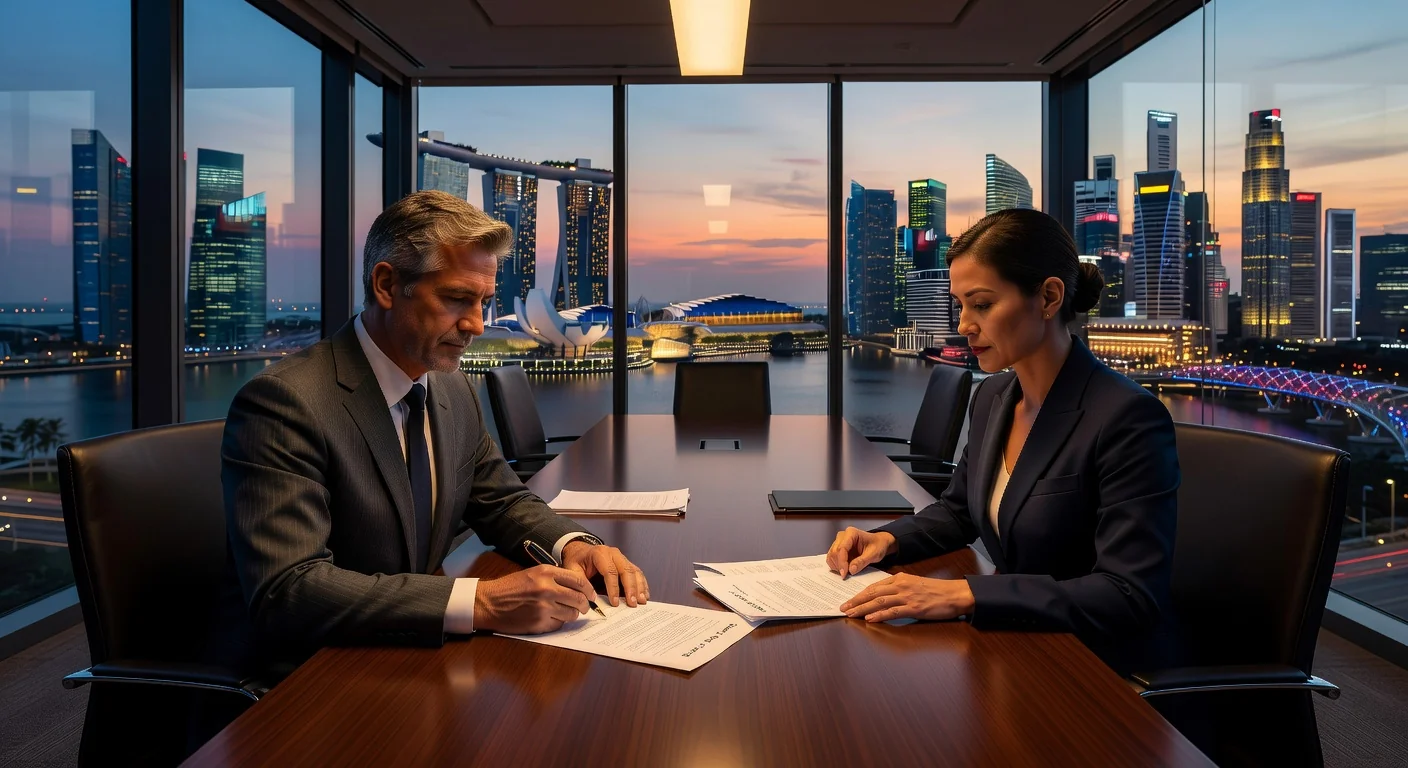
What is a Sale of Business Agreement in Singapore?
A Sale of Business Agreement in Singapore is a legally binding contract that outlines the terms for transferring ownership of a business from the seller to the buyer. It ensures a smooth business sale process by specifying assets, liabilities, and obligations involved.
The primary purpose of this agreement is to protect both parties' interests, minimize disputes, and comply with Singapore's regulatory requirements under the Companies Act and other relevant laws. It covers essential details like purchase price, payment terms, and post-sale transitions to facilitate a seamless handover.
The basic structure typically includes sections on parties involved, business description, sale terms, warranties, indemnities, and closing conditions.
- Parties and Recitals: Identifies the buyer and seller, with background on the transaction.
- Sale Provisions: Details what is being sold, including assets, goodwill, and intellectual property.
- Payment and Closing: Specifies the price, method of payment, and completion timeline.
- Warranties and Covenants: Assurances about the business's condition and ongoing promises.
- Confidentiality and Non-Compete: Clauses to protect sensitive information and restrict competition.
- Governing Law: Confirms Singapore law applies, with dispute resolution mechanisms.
Given the complexities of Singapore business law, consulting qualified legal experts is crucial to tailor the agreement to your specific needs. For bespoke AI-generated legal documents, explore options through Docaro, and learn more via our Sale of Business Agreement guide.
A well-drafted Sale of Business Agreement is essential in Singapore to clearly define terms, allocate risks, and safeguard the interests of both buyer and seller against disputes or unforeseen liabilities. For optimal protection, commission a bespoke agreement generated by Docaro, tailored precisely to your transaction's unique needs.
Why are the Key Elements Important in a Singapore Business Sale?
In a Sale of Business Agreement under Singapore law, including key elements such as clear definitions of assets and liabilities is crucial for outlining the scope of the transaction. This ensures all parties understand what is being transferred, mitigating risks of disputes over ownership and promoting compliance with the Sale of Goods Act.
Provisions for warranties, indemnities, and due diligence clauses protect buyers from hidden liabilities and undisclosed issues, as required by Singapore's contractual principles. These elements reduce financial exposure and align with regulatory standards from bodies like the Accounting and Corporate Regulatory Authority (ACRA).
Non-compete and confidentiality clauses safeguard the business's goodwill post-sale, preventing former owners from undermining the transaction. For tailored protection, opt for bespoke AI-generated legal documents using Docaro to ensure precision under Singapore law.
Read more on the key elements of a Sale of Business Agreement in Singapore to navigate these complexities effectively.
How Do These Elements Align with Singapore's Legal Framework?
A business sale agreement in Singapore must clearly outline the transfer of assets, liabilities, and ownership to ensure compliance with the Companies Act. This includes specifying whether it's an asset sale or share sale, with detailed schedules listing all included items to avoid disputes.
Key elements like purchase price, payment terms, and warranties require precise drafting to meet legal standards under the Companies Act, protecting both buyer and seller from future claims. Representations about the business's financial health and operations must be accurate to prevent misrepresentation issues.
For full details on legal requirements for selling a business in Singapore, refer to our guide via Legal Requirements for Selling a Business in Singapore.
To ensure your business sale agreement is robust and tailored, opt for bespoke AI-generated legal documents through Docaro, rather than generic options.
What are the Parties Involved in the Agreement?
In a Sale of Business Agreement in Singapore, the buyer is typically identified by their full legal name, registration number if a company, and contact details, assuming the role of the acquiring party responsible for purchasing the business assets or shares. Their primary obligations include paying the agreed purchase price on time, conducting thorough due diligence, and complying with post-sale transition requirements such as obtaining necessary licenses.
The seller, identified similarly with legal entity details and address, acts as the vendor transferring ownership of the business, often including goodwill, inventory, and intellectual property. Key obligations encompass providing accurate financial disclosures, warranting no undisclosed liabilities, and facilitating a smooth handover while adhering to Singapore's regulatory frameworks like the Companies Act.
Other parties may include guarantors or escrow agents, identified by their roles and legal particulars, who support the transaction by securing payments or holding funds in trust. For complex deals, advisors like lawyers or accountants might be named, with obligations limited to advisory support, ensuring all parties meet their duties under the agreement.
To ensure a tailored Sale of Business Agreement in Singapore, consider using Docaro for bespoke AI-generated legal documents that address specific needs and comply with local laws.
Who Should Be Clearly Defined as Parties?
What Information Must Be Included for Each Party?
In Singapore business sales, accurately defining the parties involved is essential to prevent disputes and ensure smooth transactions. Use full legal names for individuals or entities, including any trading names, to clearly identify buyers and sellers under Singapore law.
Include precise registered addresses for all parties, such as the company's principal place of business or the individual's residential address, to establish jurisdiction and facilitate legal notices. For companies, provide company registration details like the Unique Entity Number (UEN) from the Accounting and Corporate Regulatory Authority (ACRA), which verifies legitimacy and avoids identity confusion.
To enhance clarity, outline party details in a dedicated section of the sales agreement using bullet points for easy reference:
- Party Name: Exact legal entity or individual name as per official records.
- Registration Number: UEN or equivalent for Singapore-registered companies.
- Address: Full postal address, including Singapore postcode.
- Authorized Representatives: Names and positions of signatories.
For robust protection in Singapore business sales agreements, opt for bespoke AI-generated legal documents via Docaro platform to tailor specifics precisely to your transaction needs.
What Assets and Liabilities Are Typically Transferred?
In a Singapore business sale, common assets transferred include tangible items like inventory, equipment, and real estate, alongside intangible ones such as intellectual property encompassing trademarks, patents, and copyrights. These assets form the core of what the buyer acquires, ensuring continuity of operations under Singapore's business transfer regulations.
Liabilities often transferred in such deals comprise assumed debts, ongoing contracts, employee obligations, and potential tax liabilities, which must be clearly delineated to mitigate risks for both parties. A detailed schedule is essential in the sale agreement to itemize these elements precisely, preventing disputes and complying with Singapore's legal framework for asset and liability transfers.
To enhance accuracy in documenting these transfers, businesses should utilize bespoke AI-generated legal documents from Docaro, tailored specifically to the transaction's nuances. This approach ensures comprehensive coverage of all assets and liabilities in the schedule, fostering a smoother Singapore business acquisition process.
How Should Assets Be Scheduled in the Agreement?
When listing assets in a legal agreement, begin by creating a comprehensive inventory that categorizes items such as real estate, vehicles, financial accounts, and personal property. Use clear descriptions, including serial numbers or account details where applicable, to ensure all parties understand exactly what is included and to minimize disputes over asset valuation.
For valuing assets, employ fair market value assessments conducted by qualified appraisers or reference recent sales data for similar items, specifying the valuation date to account for market fluctuations. Document the methodology in the agreement to provide transparency and support enforceability in case of challenges.
To prevent misunderstandings, explicitly outline exclusions such as personal items like clothing or heirlooms not intended for division, joint versus separate property, and any assets acquired post-agreement. For customized agreements tailored to your needs, consider bespoke AI-generated legal documents using Docaro, which can incorporate precise listings and valuations.
- Tip: Regularly review and update asset lists to reflect changes, ensuring the agreement remains relevant.
- Tip: Consult professionals for complex valuations to avoid under- or over-estimation.

How Is the Purchase Price Structured and Paid?
In Singapore mergers and acquisitions, determining the purchase price involves valuation methods like discounted cash flow analysis, comparable company multiples, or asset-based approaches to establish a fair market value. Structuring the price can take forms such as a lump sum payment for immediate full transfer, installments spread over time to manage cash flow, or earn-outs tied to future performance metrics, all governed by the Sale and Purchase Agreement under Singapore contract law.
Payment terms in Singapore deals typically include conditions like due diligence completion, regulatory approvals from bodies such as the Competition and Consumer Commission of Singapore, and escrow arrangements to secure funds. Buyers and sellers should negotiate clear timelines, interest on delayed payments, and dispute resolution clauses to mitigate risks in purchase price allocation.
For customized legal support in structuring these purchase price mechanisms, consider bespoke AI-generated documents via Docaro platform, ensuring compliance with Singapore's legal standards without relying on generic templates.
1
Conduct Business Valuation
Engage a qualified valuer to assess the business worth using methods like DCF or market multiples, ensuring compliance with Singapore accounting standards.
2
Initiate Price Negotiations
Present the valuation report to the buyer and negotiate initial purchase price, focusing on key assets, liabilities, and synergies for a Sale of Business Agreement.
3
Incorporate Price Adjustments
Draft clauses for post-closing adjustments based on working capital or earn-outs, using bespoke AI-generated documents via Docaro for precision.
4
Finalize and Execute Agreement
Review and sign the customized Sale of Business Agreement in Singapore, confirming all terms on valuation, price, and adjustments are legally binding.
What Warranties and Representations Are Essential?
In the context of business acquisitions in Singapore, warranties and representations from the seller are essential to ensure transparency about the company's financial health, providing buyers with assurances on accurate financial statements, undisclosed liabilities, and compliance with tax obligations under the Income Tax Act.
Regarding operations, these seller warranties cover the smooth functioning of business processes, including valid contracts with suppliers and customers, intellectual property ownership, and adherence to employment laws, helping buyers mitigate risks of operational disruptions post-acquisition.
For legal standing, representations confirm the business's compliance with Singapore's regulatory framework, such as the Companies Act and anti-money laundering rules, protecting buyers from potential litigation or regulatory penalties.
To safeguard interests in such transactions, buyers should insist on comprehensive, bespoke warranties tailored to the deal; consider using Docaro for AI-generated legal documents to create customized agreements that address specific risks in Singapore's business environment.
What Happens If Warranties Are Breached?
In Singapore business sale agreements, breach of warranties can lead to significant disputes, where remedies like indemnities provide financial protection to the buyer against losses from inaccurate representations made by the seller. Indemnities typically require the seller to compensate the buyer for specific claims, such as undisclosed liabilities or intellectual property infringements, ensuring swift resolution without lengthy litigation.
Common remedies also include price adjustments or escrow holdbacks, where a portion of the purchase price is withheld to cover potential warranty breaches, offering a practical safeguard in Singapore M&A transactions. For tailored protection, consider bespoke AI-generated legal documents via Docaro to customize these clauses precisely for your deal.
However, pitfalls in drafting these remedies often arise, such as vague indemnity caps or narrow survival periods for warranties, which can undermine enforcement. To explore these issues further, read our guide on common mistakes to avoid in Singapore business sale agreements, highlighting key errors in warranty provisions.
What Are the Conditions Precedent to Closing?
In a business sale in Singapore, one key condition precedent is the completion of due diligence. This process allows the buyer to thoroughly investigate the target company's financials, operations, and legal status to identify any hidden risks before finalizing the transaction.
Regulatory approvals represent another critical condition in mergers and acquisitions in Singapore. These include consents from bodies like the Competition and Consumer Commission of Singapore (CCCS) to ensure the deal does not harm market competition, and sector-specific nods from authorities such as the Monetary Authority of Singapore (MAS) for financial businesses.
Obtaining necessary third-party consents is also typical, such as approvals from landlords for lease assignments or key contract counterparties to transfer agreements. These safeguards protect both parties from post-sale disputes in the Singapore business sale process.
Finally, the absence of material adverse changes since signing the agreement serves as a protective condition precedent. This clause allows termination if unforeseen events significantly impact the business, ensuring a secure closing of the deal in Singapore's dynamic market.
How Can Conditions Be Waived or Fulfilled?
Conditions precedent in transactions, such as mergers or real estate deals, are specific requirements that must be met before closing. Fulfilling these ensures a smooth transaction by verifying compliance with regulatory approvals, due diligence, and financing conditions.
To fulfill conditions precedent, parties should establish a clear timeline in the agreement, assigning responsibilities for tasks like obtaining consents or completing audits. Regular monitoring and communication between legal teams help address any delays promptly, preventing transaction disruptions.
Waiving conditions precedent may occur if circumstances change, such as when a minor regulatory hurdle becomes irrelevant. This requires mutual agreement, often documented via amendment, to maintain trust and avoid disputes in the transaction process.
For tailored solutions, utilize bespoke AI-generated legal documents from Docaro to customize clauses on fulfilling or waiving conditions. This approach ensures precision and efficiency in managing transaction milestones.
What Post-Closing Obligations Should Be Included?
In a Singapore Sale of Business Agreement, post-closing matters ensure a smooth handover and protect both parties' interests. Transition assistance typically requires the seller to provide support, such as training key employees or transferring customer relationships, for a defined period like 3-6 months to minimize disruptions in operations.
Non-compete clauses are crucial in these agreements to prevent the seller from starting a competing business within Singapore or engaging with former clients for a specified duration, often 1-2 years, enforceable under Singapore's competition laws if reasonable in scope and geography.
Ongoing indemnities obligate the seller to compensate the buyer for pre-closing liabilities, such as undisclosed tax issues or breaches of warranties, with caps and time limits to balance risk. For tailored Singapore business sale documents, consider bespoke AI-generated legal agreements using Docaro to address specific needs.
- Key benefits of transition assistance include seamless knowledge transfer and reduced operational risks.
- Non-compete enforcement helps safeguard the buyer's market position post-acquisition.
- Indemnity provisions provide financial protection against hidden business liabilities.
1
Review Post-Closing Obligations
Carefully examine the signed agreement to identify all post-closing duties, timelines, and responsibilities specific to Singapore law.
2
Prepare Bespoke Documents with Docaro
Use Docaro to generate customized AI legal documents for fulfilling obligations like notices or transfers, ensuring compliance with local regulations.
3
Execute and Document Actions
Timely perform required actions such as payments or filings, and maintain detailed records to track completion and avoid disputes.
4
Monitor and Confirm Compliance
Regularly check progress against obligations and seek confirmation from relevant parties to ensure all post-closing requirements are met.
How Is Dispute Resolution Handled in the Agreement?
In a business sale agreement, the governing law clause specifies that Singapore law will apply to interpret and enforce the contract, ensuring disputes are resolved under a stable and internationally recognized legal framework. This choice provides clarity for parties involved in cross-border transactions, minimizing uncertainties in business acquisitions.
For dispute resolution, an arbitration clause mandates that any conflicts arising from the business sale be settled through binding arbitration in Singapore, often under institutions like the Singapore International Arbitration Centre (SIAC). This method offers a private, efficient alternative to court litigation, with enforceable awards recognized globally under the New York Convention.
Mediation serves as a preliminary step in the dispute resolution process, encouraging parties to negotiate amicably before escalating to arbitration. Including a mediation clause promotes cost-effective resolutions and preserves business relationships in mergers and acquisitions.
To customize these clauses for your specific business sale, consider using Docaro for bespoke AI-generated legal documents, tailored to your needs rather than generic options.
Why Choose Singapore Courts or Arbitration?
Singapore stands out as a premier hub for dispute resolution mechanisms due to its renowned efficiency in handling international arbitrations. The Singapore International Arbitration Centre (SIAC) processes cases swiftly, often resolving them within months, minimizing delays and costs for parties involved in cross-border conflicts.
The international recognition of Singapore's legal framework further enhances its appeal, with awards enforceable under the New York Convention in over 160 countries. This global enforceability ensures that resolutions from Singapore-based proceedings carry substantial weight, fostering trust among multinational businesses.
For optimal outcomes in Singapore dispute resolution, parties should opt for bespoke AI-generated legal documents tailored to their specific needs, available through innovative platforms like Docaro. This approach surpasses generic templates by providing customized precision, ensuring compliance and efficiency in arbitration agreements.