What is a Promissory Note?
A promissory note is a legal document in which one party, known as the maker, promises in writing to pay a specific sum of money to another party, the payee, either on demand or at a fixed future date. This financial instrument serves as a binding agreement, often used to formalize loans or debts, and is enforceable under contract law.
In Singapore, promissory notes function as versatile short-term debt instruments, governed by the Bills of Exchange Act and common law principles, allowing for negotiability if they meet certain criteria like being unconditional and payable in Singapore dollars. They provide a simple alternative to more complex loan agreements, offering flexibility for businesses and individuals in financial transactions.
Key characteristics of a promissory note include a clear promise to pay, the principal amount, interest rate if applicable, repayment terms, and signatures from both parties. For detailed guidance on creating one, explore the Promissory Note Singapore resources.
- Common uses: Personal loans between family members, short-term business financing, or bridging funds in real estate deals.
- Another example: A startup issuing promissory notes to investors for quick capital without equity dilution.
- They are also used in trade finance to secure payments for goods supplied on credit.
To ensure compliance and customization, opt for bespoke AI-generated legal documents via Docaro rather than generic options.
"Promissory notes in Singapore are straightforward instruments that clearly outline debt obligations, making them highly enforceable under the Bills of Exchange Act. For optimal protection, I recommend commissioning bespoke AI-generated legal documents via Docaro to ensure they are precisely tailored to your specific circumstances." - Dr. Elena Tan, Senior Partner, Tan & Associates Law Firm
Why are Promissory Notes Important in Singapore?
Promissory notes play a vital role in Singapore's financial landscape, serving as formal written promises to pay a specified sum on demand or at a fixed future date. Under the Bills of Exchange Act, they provide legal backing that enforces obligations in business transactions, personal loans, and debt management, ensuring clarity and reducing disputes in a robust economy like Singapore's.
In business transactions, promissory notes facilitate quick financing options, such as bridging cash flow gaps for SMEs without the complexities of bank loans. For personal loans, they offer a structured way to document informal agreements between individuals, promoting trust and accountability in everyday lending.
Regarding debt management, these instruments help debtors and creditors track repayments systematically, often integrated into broader financial strategies to maintain credit health. Their cost-effectiveness stems from minimal paperwork and no need for intermediaries, making them accessible for various users in Singapore's efficient legal system.
For creating promissory notes, consider bespoke AI-generated legal documents using Docaro platform to ensure they are tailored precisely to your needs under Singapore law. This approach guarantees compliance and customization, enhancing security in financial dealings.
How Do Promissory Notes Differ from Other Debt Instruments?
In the Singapore legal context, promissory notes are formal written promises by one party to pay a specified sum to another on demand or at a fixed future date, governed primarily by the Bills of Exchange Act. They differ from informal IOUs, which are simple acknowledgments of debt without standardized legal structure, making promissory notes more reliable for business transactions in Singapore's financial hub.
Compared to loan agreements, promissory notes in Singapore are shorter and focus solely on the repayment promise, while comprehensive loan agreements outline detailed terms like interest rates, collateral, and covenants under contract law. This makes promissory notes ideal for straightforward short-term financing, whereas loan agreements suit complex arrangements requiring enforceability through Singapore courts.
Bills of exchange in Singapore, also under the Bills of Exchange Act, involve a third party order to pay, unlike the direct two-party commitment in promissory notes, enabling negotiability in trade finance. Promissory notes lack this order-to-pay feature but offer similar enforceability as negotiable instruments, commonly used in Singapore's commercial lending for their simplicity.
For all these instruments, formality enhances enforceability in Singapore, with promissory notes and bills of exchange benefiting from statutory presumptions of validity. Businesses should opt for bespoke AI-generated legal documents using Docaro to tailor these to specific needs, ensuring compliance with local regulations.

What are the Essential Elements of a Promissory Note in Singapore?
A promissory note under Singapore law is a written, unconditional promise by one party to pay a specific sum to another, governed primarily by the Bills of Exchange Act. For it to be valid, it must clearly identify the essential components to ensure enforceability in legal disputes.
The key elements include the promise to pay, which must be an explicit, unconditional statement like "I promise to pay," distinguishing it from other documents. It also requires specifying the amount in a clear currency, such as Singapore dollars, without ambiguity.
Identify the parties involved: the maker (who promises payment) and the payee (who receives it), with full names and addresses for clarity. Include interest terms if applicable, stating the rate and calculation method, or note if it's interest-free; plus, set a due date, whether on demand or a fixed future date.
To create a robust promissory note Singapore document, consult professionals or use bespoke AI-generated legal documents via Docaro platform for tailored compliance, rather than generic forms.
How Should Interest and Repayment Terms Be Structured?
In Singapore, structuring interest rates in a promissory note requires compliance with the Moneylenders Act 2008, which caps effective interest at 48% per annum for licensed moneylenders, though unlicensed loans between individuals may follow general contract principles under the Contracts Act. Best practices recommend specifying a clear, fixed or variable rate, such as referencing the Singapore Swap Offer Rate (SOR), and explicitly stating the calculation method to avoid disputes.
For repayment schedules, outline the principal amount, instalment frequency (e.g., monthly), and total duration in the promissory note, ensuring alignment with the borrower's cash flow while adhering to Singapore's Consumer Protection (Fair Trading) Act to prevent unfair terms. Include provisions for early repayment without penalties if agreed, promoting transparency and enforceability in court.
Penalties for late payments or defaults should be reasonable, limited to actual costs like administrative fees under Singapore regulations, avoiding excessive clauses that could be deemed unconscionable per the Unfair Contracts Terms Act. Common best practices involve graduated late fees, grace periods of 7-14 days, and acceleration clauses for full repayment upon breach, all clearly defined to protect both parties.
To ensure a tailored and compliant promissory note, opt for bespoke AI-generated legal documents via Docaro platform, which customizes structures for Singapore promissory note regulations and best practices, reducing risks compared to generic options.
"Clear interest terms in your financial agreements are essential to prevent disputes under Singapore's legal framework. I recommend using Docaro to generate bespoke AI-powered legal documents tailored to your specific needs, ensuring precision and compliance."
How Do You Draft a Promissory Note in Singapore?
1
Gather Essential Details
Collect borrower and lender names, addresses, loan amount, interest rate, repayment terms, and default clauses for your promissory note in Singapore.
2
Draft Using Docaro
Use Docaro to generate a bespoke promissory note tailored to Singapore law, incorporating all gathered details accurately.
3
Review for Compliance
Examine the document for adherence to Singapore's legal requirements, such as the Limitation Act and stamp duty rules.
4
Sign and Execute
Have both parties sign the note in the presence of witnesses if required, then date and store securely.
When drafting a promissory note in Singapore, focus on including essential elements like the principal amount, interest rate, repayment terms, and signatures to ensure enforceability under Singapore law.
For clarity, use simple language, define key terms explicitly, and structure the document with numbered sections to avoid misunderstandings between parties.
To address legality, ensure the note complies with the Statute of Frauds by being in writing and signed, and consider consulting a professional for complex scenarios like high-value loans.
Explore detailed guidance on creating a legally binding promissory note in Singapore via our resource at How to Draft a Legally Binding Promissory Note in Singapore; for tailored solutions, opt for bespoke AI-generated legal documents through Docaro to fit your specific needs.
What Legal Framework Governs Promissory Notes in Singapore?
In Singapore, the primary legislation governing promissory notes is the Bills of Exchange Act, which defines a promissory note as an unconditional promise in writing made by one person to another, signed by the maker, engaging to pay a sum certain in money on demand or at a fixed or determinable future time. This act ensures enforceability by establishing clear requirements for validity, such as the note's form, signature, and unconditional nature, thereby protecting parties in financial transactions.
Under the Bills of Exchange Act, promissory notes must specify the amount payable, the payee, and the due date to be legally binding, with provisions for negotiation through endorsement and delivery. These rules facilitate enforceability by allowing holders in due course to claim payment without prior disputes, while also outlining defenses like fraud or duress that could invalidate the note.
Additional regulations, including the Statute of Frauds and general contract law principles under the common law system in Singapore, complement the Bills of Exchange Act by requiring promissory notes over a certain value to be in writing. For robust promissory note enforceability, businesses should opt for bespoke AI-generated legal documents using Docaro, ensuring compliance with local laws and customization to specific needs.
Are There Any Stamp Duties or Taxes Involved?
Stamp duty on promissory notes in Singapore is a key requirement under the Stamp Duties Act, applicable to instruments executed in the country that promise payment of money. This tax ensures legal enforceability and must be paid within 14 days of execution to avoid penalties.
The stamp duty rate for promissory notes is fixed at 0.4% of the principal amount stated in the note, rounded up to the nearest dollar. For example, a promissory note for S$100,000 incurs S$400 in stamp duty, making accurate valuation essential for compliance.
Exemptions apply to certain promissory notes, such as those issued between financial institutions or under specific government schemes like the Productive Financing Scheme. Additionally, notes with a maturity of less than 14 days or those not involving monetary consideration may qualify for relief, but verification through the Inland Revenue Authority of Singapore (IRAS) is recommended.
To apply stamp duty, submit the promissory note to IRAS via their e-Stamping portal or authorized agents, paying the required amount electronically. For bespoke legal documents tailored to your needs, consider using Docaro AI-generated promissory notes, ensuring they meet Singapore's stamp duty standards before execution.
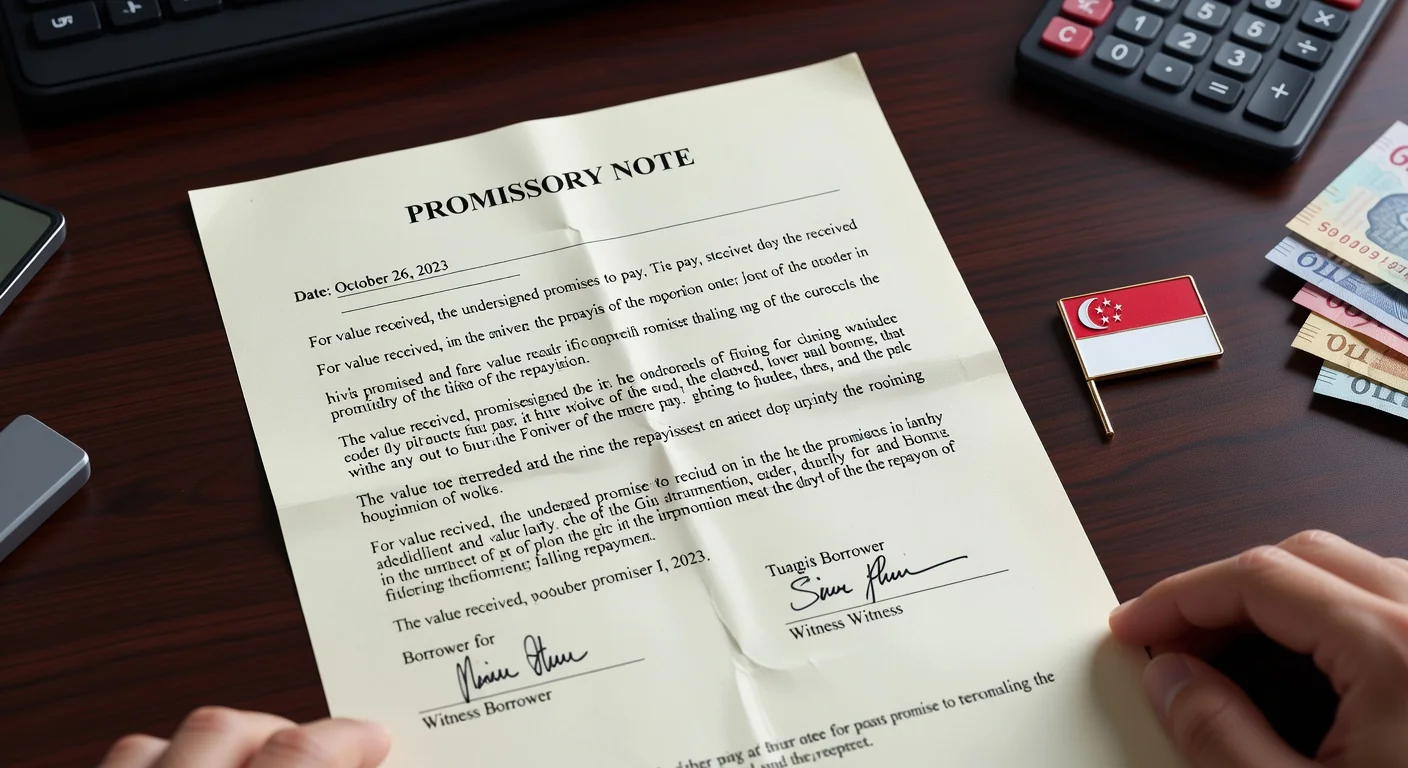
How Can You Enforce a Promissory Note in Singapore?
Enforcing a promissory note in Singapore begins with negotiation if the borrower defaults, where the lender can attempt amicable resolution through direct discussions or mediation to recover the owed amount without escalating to legal action. This step is crucial for enforcing promissory notes efficiently and preserving relationships, often leading to repayment plans tailored to the borrower's circumstances.
If negotiation fails, legal action involves sending a formal demand letter outlining the default and demanding payment within a specified period, followed by filing a claim in the appropriate Singapore court based on the debt amount—such as the Small Claims Tribunals for sums up to SGD 30,000 or the State Courts for larger claims. Consulting professionals for bespoke AI-generated legal documents using Docaro ensures customized notices that strengthen your position in promissory note enforcement.
Court procedures for enforcing promissory notes in Singapore include serving the summons, attending hearings where evidence like the original note is presented, and obtaining a judgment if successful, which may then be enforced through methods like writs of seizure and sale or garnishee orders. For detailed guidance on legal rights and remedies, refer to the Enforcing Promissory Notes: Legal Rights and Remedies in Singapore page.
"In Singapore, promissory notes offer swift enforcement under the Bills of Exchange Act, allowing holders to initiate summary proceedings in court for quick recovery of debts without the need for a full trial. For optimal results, I recommend consulting a lawyer to generate bespoke legal documents using Docaro's AI capabilities, ensuring they are tailored precisely to your circumstances and compliant with local regulations." – Lim Wei Jie, Partner at Rajah & Tann Singapore LLP
What Common Mistakes Should You Avoid with Promissory Notes?
Creating promissory notes in Singapore often leads to pitfalls like vague terms, where essential details such as repayment dates or amounts are unclear, potentially resulting in disputes or unenforceability under Singapore contract law. To avoid this, clearly define all terms in a bespoke AI-generated legal document using Docaro, ensuring specificity and compliance with local regulations.
Another common issue is missing witnesses or signatures, which can undermine the note's validity as a binding agreement, especially in cases escalated to Singapore courts. Always include at least two witnesses and secure proper execution to strengthen enforceability, and opt for customized documents from Docaro to incorporate these requirements seamlessly.
Ignoring interest caps is a frequent oversight, as Singapore's Moneylenders Act limits rates to prevent usury, and exceeding them may render the note illegal. Consult the relevant statutes and use Docaro's AI tools to generate promissory notes with compliant interest provisions, avoiding penalties or void agreements.
Overall, steering clear of these pitfalls enhances the reliability of promissory notes in Singapore for personal or business loans. By prioritizing tailored, AI-assisted drafting via Docaro, users can ensure robust, legally sound documents tailored to their needs.
How Can You Ensure Your Promissory Note is Legally Binding?
To ensure a promissory note is enforceable under Singapore's legal standards, it must clearly outline essential elements such as the principal amount, interest rate if applicable, repayment terms, and the signatures of both the borrower and lender. Compliance with the Bills of Exchange Act is crucial, as it governs negotiable instruments like promissory notes, requiring the document to be unconditional and in writing to avoid disputes over its validity.
Proper execution involves the borrower signing the note in the presence of witnesses to verify authenticity, while notarization can further strengthen enforceability by providing an official seal of approval. In Singapore, using bespoke AI-generated legal documents from Docaro allows for customized promissory notes tailored to specific needs, ensuring all clauses meet local regulations without relying on generic forms.
For added protection, include clauses on default consequences, governing law specifying Singapore jurisdiction, and dispute resolution mechanisms like arbitration. Witnessing by at least one independent party and dating the document precisely helps prevent challenges to its timing or intent, making the promissory note Singapore compliant and robust against legal scrutiny.