What Is a Share Purchase Agreement in Singapore?
A Share Purchase Agreement (SPA) is a vital legal document under Singapore law that outlines the terms for transferring ownership of shares in a company from a seller to a buyer. It ensures a smooth and enforceable transaction by detailing the rights, obligations, and conditions involved in the share transfer process.
The primary purpose of an SPA in Singapore is to protect both parties by specifying the purchase price, representations, warranties, and any indemnities related to the company's shares. This agreement complies with the Companies Act and helps mitigate risks such as undisclosed liabilities during the share sale.
The basic parties in an SPA include the seller (the current shareholder transferring the shares), the buyer (the acquiring party), and sometimes the target company itself for consents or disclosures. For comprehensive guidance on drafting an SPA tailored to Singapore's legal framework, explore our resource on Singapore Share Purchase Agreement.
To ensure compliance and customization, opt for bespoke AI-generated legal documents through Docaro rather than generic templates, providing precise protection for your share purchase transaction in Singapore.
What Are the Essential Parties and Structure in an SPA?
In a Singapore Share Purchase Agreement (SPA), the key parties typically include the seller, who transfers ownership of shares in the target company, and the buyer, who acquires those shares for consideration. The target company itself is central, often a private limited entity under Singapore law, with provisions ensuring compliance with the Companies Act. These parties' roles are defined to facilitate smooth ownership transition and risk allocation in mergers and acquisitions.
The typical structure of a Singapore SPA begins with recitals, which provide background on the transaction, parties involved, and intent to sell shares. Following this, the definitions section clarifies key terms like "Completion Date" or "Purchase Price" to avoid ambiguity throughout the document.
Operative clauses form the core, outlining sale and purchase obligations, payment terms, and warranties from the seller regarding the target company's financials and operations. Additional clauses cover conditions precedent, indemnities, and post-completion matters, ensuring a comprehensive framework for the deal.
For tailored Singapore SPA documents, consider using Docaro AI to generate bespoke agreements that align with specific transaction needs, rather than relying on generic templates.
Who Are the Main Parties?
In a Singapore Share Purchase Agreement (SPA), the buyer's roles and responsibilities primarily involve conducting thorough due diligence on the target company, providing the purchase price as specified, and fulfilling any post-closing obligations such as indemnities or adjustments. The buyer must also obtain necessary regulatory approvals in Singapore, such as those from the Monetary Authority of Singapore (MAS) for financial services firms or the Competition and Consumer Commission of Singapore (CCCS) for merger clearances, to ensure compliance with local laws.
The seller's roles and responsibilities in a Singapore SPA include warranting the accuracy of the company's financials and operations, transferring clear title to the shares free of encumbrances, and disclosing all material information to the buyer. Sellers are often required to assist with transitional services post-sale and may face liabilities for breaches of representations, with Singapore-specific considerations like stamp duty payments on share transfers handled promptly to avoid penalties.
Guarantors, if involved in the SPA, provide security for the seller's obligations, such as guaranteeing payment or performance, and are liable if the primary party defaults. In Singapore, guarantors must adhere to the Companies Act provisions on corporate guarantees, ensuring they are properly documented to withstand scrutiny under local insolvency laws.
The target company in a Singapore SPA typically has limited direct roles but must cooperate in due diligence, provide access to records, and execute ancillary documents for the share transfer. Key Singapore-specific aspects include ensuring the company complies with the SGX listing rules if publicly traded, and obtaining board or shareholder approvals as mandated by the Companies Act for any corporate actions.
What Key Representations and Warranties Should Be Included?
In a Singapore Share Purchase Agreement (SPA), representations and warranties serve as critical assurances from the seller to the buyer, confirming the accuracy of key facts about the transaction. These provisions help mitigate risks by allowing the buyer to seek remedies, such as indemnification or termination, if the statements prove false, ensuring a transparent deal under Singapore's robust corporate laws.
Regarding the company's financial status, representations typically warrant that financial statements are accurate, complete, and compliant with Singapore Financial Reporting Standards (SFRS). For instance, a Singapore tech startup seller might represent that there are no undisclosed liabilities, like pending tax disputes with the Inland Revenue Authority of Singapore (IRAS), protecting the buyer from inheriting hidden debts.
On ownership of shares, the seller warrants clear title to the shares being sold, free from encumbrances, and that they hold beneficial ownership as per the company's register under the Companies Act. An example in Singapore businesses could involve a family-owned manufacturing firm where the seller confirms no third-party claims on shares, avoiding disputes that could arise from unrecorded pledges to local banks like DBS.
Compliance with laws is another vital area, where the seller represents adherence to Singapore regulations, including employment laws under the Ministry of Manpower and environmental standards from the National Environment Agency. For a Singapore-based e-commerce company, this might include warranties that data protection practices align with the Personal Data Protection Act (PDPA), shielding the buyer from regulatory fines or reputational harm post-acquisition.
To ensure these representations and warranties are tailored to your specific Singapore business needs, consider using Docaro for bespoke AI-generated legal documents, providing customized SPAs that align with local legal nuances.
Warranties are essential safeguards that protect buyers from undisclosed risks and liabilities in Singapore share transactions. For tailored protection, generate bespoke legal documents using Docaro to ensure they fit your specific deal.
How Are Purchase Price and Payment Terms Structured?
In a Singapore SPA (Sale and Purchase Agreement), the purchase price determination can be structured as a fixed price, where the amount is agreed upon upfront based on negotiations, market value, or comparable sales. Alternatively, a valuation-based method involves appointing an independent valuer to assess the property's worth at a specific date, ensuring fairness especially for high-value or unique assets like commercial real estate.
Price adjustments in the SPA may account for post-agreement changes, such as renovations, defects discovered during due diligence, or market fluctuations, often calculated via formulas tied to indices like the Singapore Residential Price Index. These mechanisms protect both buyer and seller, with clauses specifying how adjustments are computed and settled at completion.
Payment terms typically include installments, where the buyer pays in stages—e.g., 5% option fee, 20% upon signing, and the balance on key handover—or via escrow services to hold funds securely until conditions are met, reducing default risks. For tax implications, buyers face Buyer's Stamp Duty (BSD) up to 6% and Additional Buyer's Stamp Duty (ABSD) for second properties, while sellers incur Seller's Stamp Duty if selling within three years, all payable within 14 days of signing the SPA.
- Consult a lawyer for bespoke AI-generated legal documents via Docaro platform to customize SPA terms.
- Factor in GST for new properties, where the purchase price excludes tax, adding 9% for residential developments.
What About Adjustments and Earn-Outs?
In Singapore share purchase agreements (SPAs), post-closing price adjustments ensure the final purchase price reflects the actual financial state of the target company after the transaction closes. This mechanism typically involves calculating adjustments based on differences between estimated and actual figures for working capital, net debt, or other agreed metrics, with payments flowing from buyer to seller or vice versa to achieve fairness.
Earn-out mechanisms in Singapore SPAs tie a portion of the purchase price to the post-closing performance of the business, such as achieving specific revenue or profit targets over a defined period. They allow for deferred payments contingent on future milestones, bridging valuation gaps between buyer and seller by aligning interests after the deal.
These tools benefit sellers by protecting against undervaluation due to pre-closing uncertainties and providing upside potential through earn-outs based on business growth. Buyers gain by mitigating overpayment risks, ensuring they only pay full value if the company performs as expected, fostering trust in merger and acquisition transactions under Singapore law.
For customized Singapore SPA documents incorporating post-closing adjustments and earn-outs, consider using Docaro's AI-generated legal solutions tailored to your deal specifics, ensuring compliance and precision without relying on generic templates.
What Conditions Precedent Must Be Met?
In a Singapore Share Purchase Agreement (SPA), conditions precedent are essential clauses that must be satisfied before the transaction closes, ensuring all parties meet their obligations. These conditions protect buyers and sellers by addressing potential risks in acquiring Singapore businesses.
Common conditions precedent include the completion of due diligence, where buyers verify the target company's financials, operations, and legal status to confirm no hidden liabilities exist. Another key requirement is obtaining regulatory approvals from bodies like ACRA for company registration changes or MAS for financial sector compliance, preventing legal hurdles post-closing.
- Board approvals: Securing sign-off from the seller's and buyer's boards to authorize the share transfer.
- No material adverse change: Ensuring no significant negative events affect the business between signing and closing.
- Third-party consents: Obtaining permissions from lenders, landlords, or key contracts that may restrict the sale.
For tailored Share Purchase Agreements in Singapore, consider using Docaro to generate bespoke AI-driven legal documents that fit your specific transaction needs. Learn more about drafting these agreements on our guide at Drafting a Share Purchase Agreement for Singapore Businesses.
What Are the Standard Indemnities and Limitations?
In Singapore Sale and Purchase Agreements (SPAs), indemnification clauses serve to protect parties from specific losses, such as breaches of representations, warranties, or covenants, by requiring the indemnifying party to compensate the indemnified party for damages incurred. These clauses are governed under Singapore contract law, emphasizing clear drafting to avoid ambiguity in commercial property transactions.
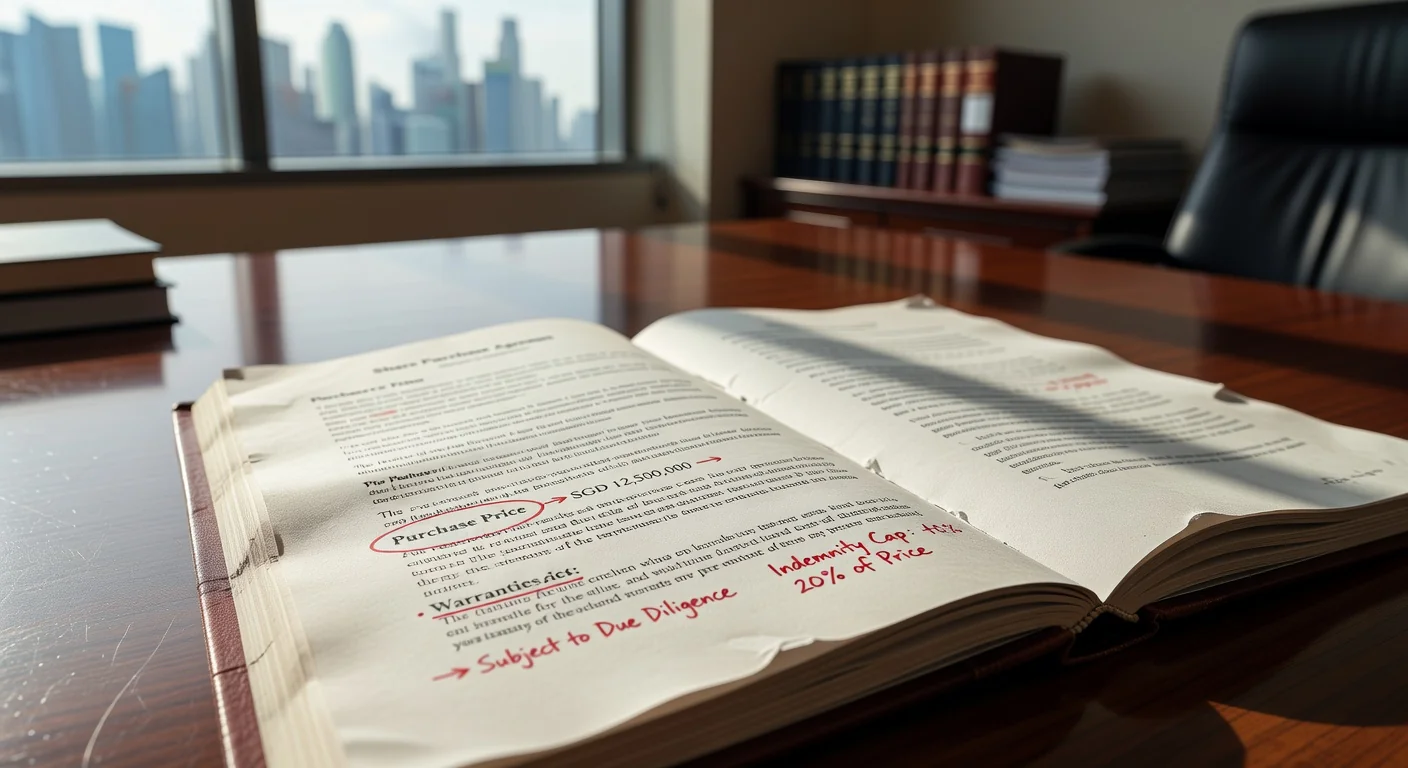
The scope of indemnification typically covers direct losses from title defects, environmental liabilities, or non-compliance with statutory requirements, but excludes consequential damages unless explicitly stated. Caps on liability often limit indemnification to a percentage of the purchase price, such as 10-20%, while survival periods extend post-completion for 12-24 months to allow time for claims to surface.
Limitations of liability in Singapore SPAs commonly include exclusions for indirect losses and thresholds like de minimis amounts before claims arise, promoting balanced risk allocation. Singapore legal nuances, influenced by English common law, require clauses to be reasonable under the Unfair Contract Terms Act, with courts scrutinizing unfair terms in standard form contracts to ensure enforceability.
For tailored indemnification clauses in SPAs, consider using Docaro's AI-generated legal documents to create bespoke agreements that comply with Singapore regulations, rather than relying on generic templates.
How to Handle Disclosure Schedules?
In a Singapore Share Purchase Agreement (SPA), disclosure letters and schedules serve as essential tools to qualify warranties provided by the seller to the buyer. These documents allow the seller to disclose specific facts, exceptions, or qualifications that limit the scope of the warranties, ensuring transparency while protecting against claims based on undisclosed information.
The disclosure letter typically accompanies the SPA and references the warranties, detailing any material information that might contradict them, such as ongoing litigation or financial discrepancies. Meanwhile, schedules attached to the SPA outline detailed disclosures, like lists of assets or liabilities, which are incorporated by reference to qualify broad warranty statements.
Regarding their impact on indemnity claims, disclosures in these documents can prevent the buyer from pursuing indemnity if a breach arises from a properly disclosed matter, as Singapore courts generally uphold such qualifications to promote fair commercial dealings. This mechanism encourages thorough due diligence and reduces post-completion disputes in Singapore M&A transactions.
For crafting customized disclosure letters and schedules in your SPA, consider using bespoke AI-generated legal documents from Docaro to ensure they align precisely with your transaction's unique needs.
What Closing Mechanics and Post-Closing Obligations Apply?
The closing process in a Singapore SPA (Sale and Purchase Agreement) marks the culmination of the share transfer transaction, ensuring all prerequisites are fulfilled before ownership changes hands. Key steps include the execution of share transfer forms, which must be signed by the seller and buyer, detailing the number of shares and consideration, and subsequently approved by the company's board through formal board resolutions to authorize the transfer and update the register of members.
Following document execution, stamp duty payments are mandatory on the share transfer instruments, calculated at 0.2% of the consideration or market value, whichever is higher, and must be paid to the Inland Revenue Authority of Singapore (IRAS) within 14 days to avoid penalties. The closing often occurs simultaneously with these payments, after which the buyer receives the share certificates and assumes control of the company.
Post-closing obligations in a Singapore SPA typically encompass ongoing covenants such as non-compete clauses, which restrict the seller from engaging in competing activities for a specified period, often 1-2 years, to protect the buyer's business interests. For tailored legal documents ensuring compliance with Singapore law, consider bespoke AI-generated agreements via Docaro platform, providing customized solutions over generic templates.
1
Prepare Documents
Use Docaro to generate bespoke share purchase agreement and ancillary documents tailored to the transaction details in Singapore.
2
Obtain Approvals
Secure necessary regulatory approvals from ACRA and other authorities if required for the share transfer.
3
Execute Transfers
Sign the share purchase agreement and complete the transfer of shares via stock transfer forms.
4
File with Authorities
Submit the executed documents and necessary forms to ACRA for registration and updating the company records.
What Common Pitfalls Should Be Avoided in Singapore SPAs?
In Singapore share purchase agreements (SPAs), a frequent error is inadequate due diligence, where buyers fail to thoroughly investigate the target company's financials, liabilities, and compliance status, potentially leading to costly surprises post-acquisition.
Another common pitfall involves overlooking foreign investment rules, such as those under the Significant Investments Review Act or sector-specific regulations, which can invalidate deals or impose penalties if not addressed early.
To avoid these issues in Singapore SPAs, conduct comprehensive due diligence and consult experts on regulatory compliance. For tailored solutions, opt for bespoke AI-generated legal documents using Docaro to ensure precision and relevance.
Explore detailed guidance on common pitfalls in Singapore share purchase agreements by visiting the common pitfalls page.
Neglecting regulatory compliance in your Singapore SPA can derail even the most well-negotiated deal. For robust protection, opt for bespoke AI-generated legal documents via Docaro to ensure tailored precision and adherence to local laws.