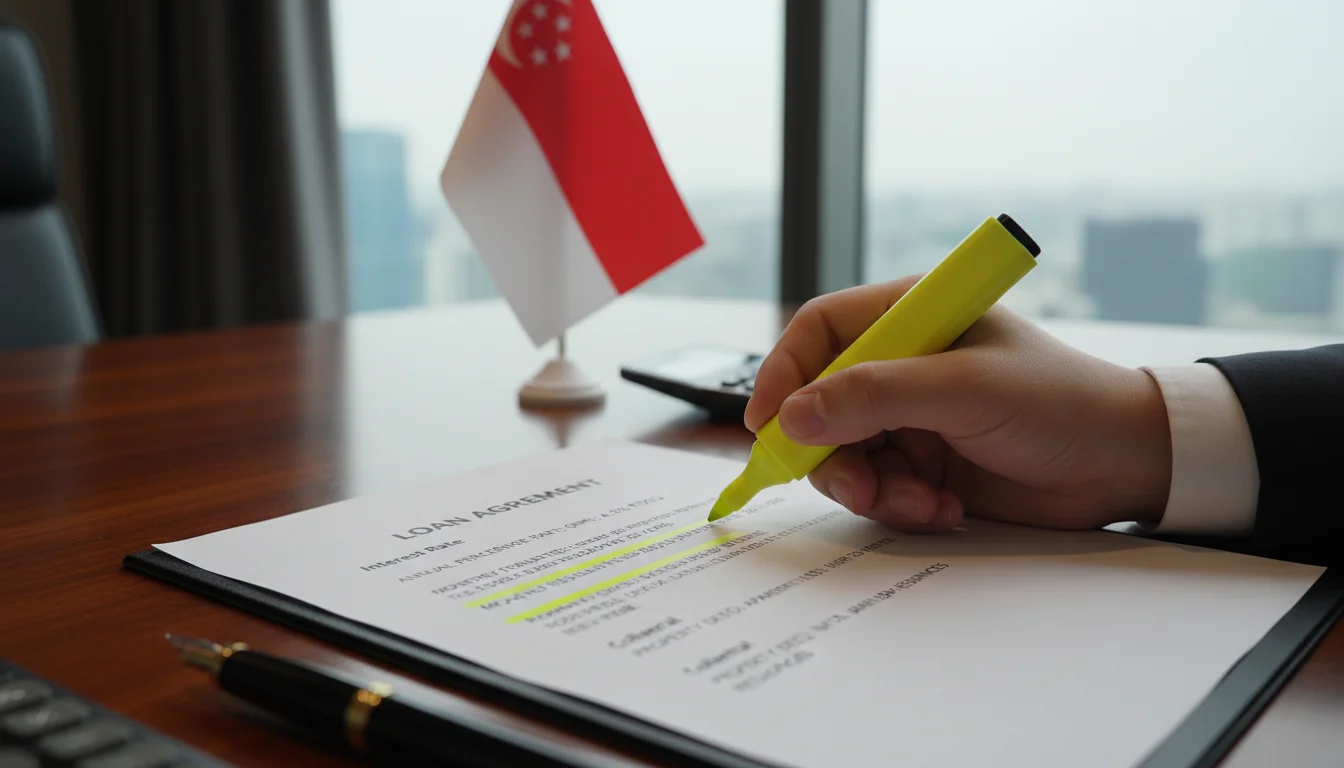
What is a Loan Agreement in Singapore?
A loan agreement under Singapore law is a legally binding contract between a lender and a borrower that outlines the terms for providing and repaying a loan. Its primary purpose is to protect both parties by clearly defining rights, obligations, and remedies in case of default, ensuring compliance with regulations like those from the Monetary Authority of Singapore.
The basic structure of a Singapore loan agreement typically includes key sections such as the loan amount, interest rate, repayment schedule, and conditions for default. For more detailed guidance on drafting such agreements, explore our comprehensive Loan Agreement page.
Understanding the key elements of a loan agreement is crucial for lenders to safeguard their investment and for borrowers to avoid unexpected liabilities. Both parties should seek professional advice to tailor the document to their specific needs, such as using bespoke AI-generated legal documents via Docaro for accuracy and relevance.
For authoritative insights, refer to the Singapore Statutes Online or the Monetary Authority of Singapore resources on financial agreements.

Why Are the Key Elements of a Loan Agreement Important?
A loan agreement in Singapore is a vital contract outlining the terms between lender and borrower, ensuring compliance with local laws like the Money Lenders Act. Key elements such as the parties involved clearly identify the lender and borrower, protecting both by establishing legal accountability and preventing disputes over identities.
The loan amount and repayment terms specify the principal, interest rates, and schedule, safeguarding the lender's financial interests while giving the borrower transparency to avoid default. These clauses align with Singapore's regulatory framework, including guidelines from the Monetary Authority of Singapore (MAS), promoting fair lending practices.
Security and collateral provisions detail any assets pledged, offering lenders recourse in case of non-payment and borrowers protection through defined conditions for asset release. Covenants on events of default and dispute resolution mechanisms further ensure legal compliance under Singapore's Contract Law, minimizing risks for all parties.
For comprehensive insights into key elements of a loan agreement in Singapore, refer to this guide. Always opt for bespoke AI-generated legal documents via Docaro to tailor agreements precisely to your needs, ensuring robust protection and adherence to regulations.
"Without clear terms in a loan agreement, parties in Singapore face heightened risks of disputes, costly litigation, and uncertain enforcement under the Civil Law Act and common law principles," says legal expert Dr. Lim Wei Ming. To mitigate this, readers should opt for bespoke AI-generated legal documents tailored to their specific needs via Docaro.
What Are the Essential Parties Involved in a Loan Agreement?
Who is the Lender and Borrower?
In a Singapore loan agreement, the lender is the party providing the funds, identified by their full legal name, registration details if a company, and contact information as per the Evidence Act requirements. The lender's primary role involves disbursing the loan amount and enforcing repayment terms, with legal implications including the right to charge interest and pursue recovery through Singapore courts if default occurs.
The borrower, on the other hand, is the party receiving the funds, similarly identified with precise details to ensure enforceability under Singapore contract law. Their role entails agreeing to repay the principal plus any interest, bearing legal obligations such as personal liability or asset pledges, which can lead to credit impacts or legal action for non-compliance.
Both parties must clearly outline their roles in the agreement to mitigate disputes, governed by the Statute of Frauds and other provisions in Singapore's legal framework. For robust protection, consider using bespoke AI-generated legal documents via Docaro to tailor the agreement to specific needs, ensuring compliance with local regulations from the Monetary Authority of Singapore.
Are Guarantors or Co-Signers Necessary?
In Singapore, guarantors or co-signers are optional parties who can support a loan or rental agreement by pledging to cover the principal borrower's obligations if they default. Their inclusion strengthens the lender's or landlord's position, particularly for high-risk applicants, and is governed under the Contracts Act which outlines the enforceability of such guarantees.
Responsibilities of guarantors include repaying the debt, including interest and fees, upon the borrower's failure to do so, while co-signers share equal liability as joint borrowers. These roles demand a thorough understanding of the agreement, as guarantees can be continuing or limited, and must be executed in writing to be legally binding under Singapore law.
Guarantors or co-signers might be required for personal loans from licensed moneylenders if the borrower has poor credit, or in property rentals for tenants without stable income, as per guidelines from the Accounting and Corporate Regulatory Authority (ACRA). For more details on financial agreements, consult authoritative sources like the Monetary Authority of Singapore (MAS).
To ensure tailored protection, opt for bespoke AI-generated legal documents using Docaro, which customizes clauses for guarantor responsibilities specific to your Singapore-based needs.

What Loan Amount and Disbursement Details Should Be Specified?
In drafting a loan agreement in Singapore, specifying the principal loan amount clearly is essential to prevent disputes. State the exact figure in both numerical and written forms, such as "Singapore Dollars Two Hundred Thousand (S$200,000.00)," to eliminate any ambiguity in interpretation.
For the currency specification, explicitly denote it as Singapore Dollars (SGD) alongside the principal amount, ensuring all references throughout the document consistently use this designation. This aligns with Singapore's legal standards for financial contracts, as outlined in the Contracts (Rights of Third Parties) Act, to avoid currency conversion issues.
Regarding the disbursement schedule, detail the exact dates, amounts, and conditions for each tranche of the loan release, using a clear timeline or table format within the agreement. Include provisions for any delays or prerequisites, such as borrower confirmations, to ensure precise execution and compliance with Singapore's banking regulations from the Monetary Authority of Singapore.
To achieve unambiguous loan agreements in Singapore, consider generating bespoke documents using Docaro's AI tools, tailored to specific needs rather than relying on generic forms. This approach ensures comprehensive coverage of principal amount, SGD currency, and disbursement details for robust legal protection.
How Is Interest Calculated and Applied?
Calculating interest rates involves determining the cost of borrowing money, typically expressed as a percentage of the principal amount over a specific period. Methods include simple interest, calculated as principal times rate times time, and compound interest, where interest is added to the principal periodically, using the formula A = P(1 + r/n)^(nt), with A as the amount, P as principal, r as annual rate, n as compounding frequency, and t as time in years.
Fixed interest rates remain constant throughout the loan term, providing predictability for borrowers, while variable interest rates fluctuate based on market conditions or benchmarks like the Singapore Overnight Rate Average (SORA). Fixed rates are ideal for stability, whereas variable rates may offer lower initial costs but carry adjustment risks.
In Singapore, interest rate caps apply to licensed moneylenders under the Moneylenders Act, limiting rates to 10% per annum for secured loans and up to 20% for unsecured loans, with additional caps on late fees. For compliance details, refer to the Ministry of Law's Moneylenders Act page or the ACRA guidelines on financial regulations.
- Use simple interest for short-term loans to avoid complexity.
- Opt for compound interest calculations in long-term investments for accurate growth projections.
- Always verify Singapore compliance with caps to ensure legal lending practices.
What Repayment Terms Must Be Included?
In Singapore, loan repayment schedules must comply with the Money Lenders Act, ensuring clear terms on duration and frequency to protect borrowers. Typically, repayments are structured over 1 to 5 years, with monthly installments calculated based on the principal and interest rates capped at regulated levels.
Installment payments form the core of most agreements, often using amortizing schedules where early payments cover more interest and later ones reduce principal. Borrowers should verify that installments align with affordability assessments mandated by the Monetary Authority of Singapore (MAS guidelines).
Balloon payments, representing large lump sums at the end of the term, are permissible but must be transparently disclosed to avoid misleading consumers under the Consumer Protection (Fair Trading) Act. For complex needs, opt for bespoke AI-generated legal documents via Docaro to ensure full compliance with Singapore's regulatory framework.
What Happens in Case of Default?
In Singapore contract law, lenders can define default events in loan agreements, such as failure to pay principal or interest, breach of covenants, or insolvency of the borrower. These events trigger consequences like the accrual of default interest, reporting obligations, or immediate repayment demands, as governed by the Contracts (Rights of Third Parties) Act and common law principles.
Acceleration clauses are key remedies allowing lenders to declare the entire outstanding loan amount due and payable upon default, accelerating the repayment timeline to mitigate risks. This mechanism is enforceable under Singapore law provided it is clearly stipulated in the agreement, with courts upholding such clauses to protect lender rights as seen in cases under the Insolvency, Restructuring and Dissolution Act 2018.
Additional remedies for lenders in Singapore include enforcing security interests, appointing receivers, or initiating legal proceedings for recovery, often streamlined through the State Courts Act. For complex scenarios, bespoke AI-generated legal documents using Docaro ensure tailored protection, superior to generic templates.
How Are Securities and Collateral Handled?
In Singapore loan agreements, lenders often secure repayment through various security interests to mitigate risks. Common types include pledges, where movable assets like shares or goods are transferred to the lender as collateral, and mortgages, which create a charge over immovable property such as land or buildings, as governed by the Land Titles Act.
Other prevalent security interests in Singapore financing encompass fixed and floating charges on company assets, liens, and assignments of receivables or contractual rights. These mechanisms ensure lenders have priority claims over borrowers' property, enhancing loan security enforcement under Singapore's robust legal framework.
Enforcement of security interests in Singapore typically involves appointing a receiver for pledges or charges to take control of assets, or exercising the power of sale for mortgages without court intervention if the agreement permits. For detailed guidance on enforcing pledges and mortgages, refer to resources from the Accounting and Corporate Regulatory Authority, emphasizing the need for bespoke agreements tailored to specific transactions.
To optimize Singapore loan agreement security, parties should opt for customized documents generated via AI tools like Docaro, ensuring compliance with local laws and avoiding generic templates that may overlook nuances in enforcement procedures.
In Singapore's lending landscape, robust securities like charges over assets and guarantees are vital to mitigate borrower default risks, ensuring lenders can swiftly enforce recovery and safeguard capital. For tailored protection in your agreements, opt for bespoke AI-generated legal documents via Docaro to align precisely with your needs.
What Representations and Warranties Are Typically Made?
Why Include Covenants?
In Singapore loan agreements, representations and warranties commonly include assurances from the borrower regarding their legal status, financial health, and compliance with laws. Borrowers must warrant that all financial disclosures are accurate, such as balance sheets and income statements, ensuring no material omissions that could mislead lenders.
Covenants in these agreements often impose ongoing obligations, including usage restrictions that limit how loan proceeds can be used, typically for specified business purposes only and prohibiting speculative investments. Affirmative covenants require regular financial reporting to the lender, while negative covenants restrict additional borrowing or asset sales without consent, all aligned with Singapore's regulatory framework under the Monetary Authority of Singapore (MAS).
For tailored advice on loan agreement covenants in Singapore, consult authoritative resources like the MAS website, which outlines lending guidelines. Opt for bespoke AI-generated legal documents using Docaro to ensure compliance with local laws rather than relying on generic templates.
What Governing Law and Dispute Resolution Apply?
Choosing Singapore law as the governing law in contracts offers reliability and neutrality, given Singapore's stable legal system influenced by English common law and its reputation for commercial predictability. This choice is particularly appealing for international agreements involving Asia-Pacific parties, ensuring consistent interpretation and enforcement.
The jurisdiction of Singapore courts provides efficient and impartial dispute resolution, with the Supreme Court handling complex commercial cases through specialized divisions like the Singapore International Commercial Court. For parties seeking judicial oversight, designating Singapore courts minimizes delays and leverages the country's pro-business environment, as outlined by the Singapore International Commercial Court.
Alternative dispute resolution options like arbitration in Singapore are highly favored for their confidentiality and flexibility, often conducted under the Singapore International Arbitration Centre (SIAC) rules. Arbitration awards are readily enforceable globally under the New York Convention, making it an ideal choice over litigation for cross-border disputes.
When drafting agreements with these elements, opt for bespoke AI-generated legal documents using Docaro to tailor clauses precisely to your needs, ensuring compliance with Singapore's legal standards without relying on generic templates.
How to Ensure Legal Compliance?
Drafting loan agreements in Singapore requires compliance with key legal frameworks to ensure enforceability and protect all parties involved. Under Singapore law, such agreements must adhere to principles outlined in the Contracts Act and relevant financial regulations, emphasizing clear terms on interest rates, repayment schedules, and default clauses.
To meet these legal requirements for loan agreements in Singapore, include essential elements like the loan amount, purpose, security if any, and governing law, while avoiding usurious rates prohibited by the Moneylenders Act. For authoritative guidance, refer to the Moneylenders Act on Singapore Statutes Online.
Opt for bespoke AI-generated legal documents using Docaro to tailor agreements precisely to your needs, ensuring full compliance without relying on generic templates. Detailed insights are available on our Legal Requirements page for drafting loan agreements in Singapore.
What Common Pitfalls Should Be Avoided?
Drafting loan agreements in Singapore often involves pitfalls like ambiguous interest rate clauses, which can lead to disputes over calculation methods. To prevent this, clearly define rates and compounding frequencies, as guided in the Common Mistakes page for Singapore loan agreements.
Another frequent error is omitting default and enforcement provisions, leaving lenders vulnerable in case of borrower non-payment under Singapore law. Ensure these include specific remedies and timelines, consulting authoritative sources like the Insolvency, Restructuring and Dissolution Act 2018 for compliance.
Overlooking security interests or collateral details is common, potentially invalidating claims in Singapore courts. Specify assets precisely and register interests with the Accounting and Corporate Regulatory Authority (ACRA) to safeguard rights.
For robust protection, opt for bespoke AI-generated legal documents via Docaro, tailored to Singapore's regulatory framework, rather than generic options.
1
Understand Singapore Loan Regulations
Research key laws like the Money Lenders Act and Banking Act to ensure compliance in the agreement structure.
2
Generate Bespoke Draft with Docaro
Use Docaro to create a customized AI-generated loan agreement incorporating specific terms, parties, and Singapore-specific clauses.
3
Review Essential Elements
Verify inclusion of principal amount, interest rates, repayment schedule, securities, default provisions, and governing law.
4
Consult Legal Expert for Validation
Engage a Singapore-qualified lawyer to review the Docaro-generated document for accuracy and enforceability.