What are Articles of Association in the UK?
Articles of Association in the UK serve as the internal rulebook for companies, outlining the fundamental rules governing their operations and management. Under the Companies Act 2006, these documents define how a company is run, including the rights and responsibilities of directors, shareholders, and the company's decision-making processes. They ensure compliance with legal requirements while allowing customization to suit the company's specific needs, making them essential for UK company formation and governance.
The key components of Articles of Association typically include provisions on share capital, directors' powers, meetings, voting rights, and dividend policies. For instance, they detail how general meetings are conducted, the appointment and removal of directors, and the procedures for issuing new shares. These elements collectively govern daily operations, resolve internal disputes, and protect stakeholder interests within the corporate structure.
Companies House provides default Model Articles as a standard template, which can be adopted in full or amended to fit unique circumstances during incorporation. These model articles are available for different company types, such as private companies limited by shares or guarantee, and are accessible via the official Companies House website. Using or modifying these models simplifies compliance with UK company law while enhancing business governance efficiency.
Articles of Association form the foundational rules governing a UK company's internal management, defining the rights and obligations of shareholders and directors, as well as operational procedures. Review and customize them carefully during company formation to ensure alignment with your business objectives.
Why are Articles of Association Important for UK Companies?
The Articles of Association are essential documents for UK companies, serving as the internal rulebook that governs their operations and management. They ensure compliance with the Companies Act 2006 by outlining procedures for decision-making, share issuance, and director responsibilities, thereby aligning company practices with statutory requirements. For a detailed guide, explore our resource on Articles of Association.
These articles facilitate smooth governance by providing clear rules for meetings, voting rights, and dispute resolution, which minimize conflicts and streamline administrative processes. This structure promotes efficiency in corporate decision-making and adaptability to business changes. To learn more about UK corporate governance, refer to the official Gov.uk Model Articles.
Importantly, the Articles of Association protect stakeholder interests, including shareholders, directors, and creditors, by defining rights, obligations, and protections against mismanagement. They safeguard minority shareholders through provisions on dividends and information access, fostering trust and long-term stability. Bullet points highlight key protections:
- Shareholder rights to dividends and voting;
- Director duties to act in the company's best interest;
- Mechanisms for resolving disputes fairly.

What is the Difference Between Articles of Association and Memorandum of Association?
In the UK, the Memorandum of Association and Articles of Association are fundamental documents for company formation under the Companies Act 2006. The Memorandum primarily outlines the company's formation, including details like the subscribers' intent to form the company and its initial objectives, serving as a foundational agreement. In contrast, the Articles govern the internal management of the company, covering rules on directors' powers, shareholders' meetings, and day-to-day operations.
Key differences between Articles of Association and Memorandum of Association lie in their scope and legal status post-2006 reforms. The Memorandum is now a historical document with limited ongoing relevance, as new companies formed after 1 October 2009 do not require a detailed objects clause, per Section 8 of the Companies Act 2006. For deeper insights, explore the Key Differences Between Articles of Association and Memorandum of Association, and refer to the official Companies Act 2006 on legislation.gov.uk for authoritative guidance.
- Memorandum: Focuses on external objectives and formation; filed once and rarely amended.
- Articles: Detail internal rules; can be altered by special resolution under Section 21.
How Does the Memorandum Relate to Modern UK Company Law?
The Memorandum of Association has undergone significant evolution under the Companies Act 2006, marking a shift in corporate governance for UK companies. Prior to this legislation, the Memorandum served as the foundational document outlining a company's objectives and scope of activities, often restricting operations to specified purposes. However, the Act streamlined incorporation by replacing this with a simple statement of intent to form a company, rendering the old Memorandum largely historical for pre-2009 entities.
For companies incorporated before July 1, 2009, the Memorandum of Association retains a limited role as a historical artifact, while the Articles of Association take precedence in governing internal operations. This change emphasizes flexibility, allowing companies to pursue any lawful activity without the rigid constraints of the former object clauses. As a result, modern company law focuses on the Articles for detailed rules on management and shareholder rights, reducing the Memorandum's practical utility.
To explore further, authoritative resources like the UK Government guidance on company incorporation provide detailed insights into these reforms. For instance, this official sourcebook outlines the transition process.
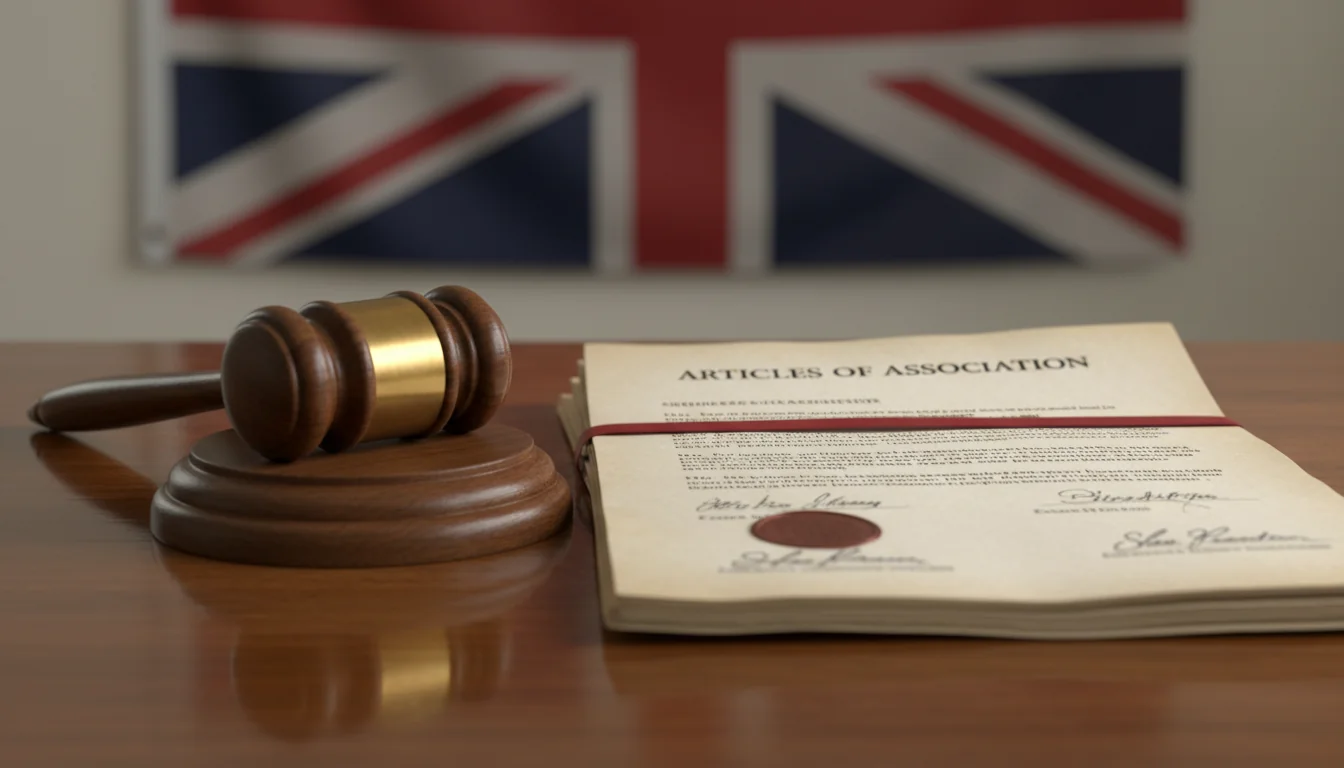
What are the Standard Contents of UK Articles of Association?
The UK Articles of Association serve as the foundational governance document for companies incorporated under the Companies Act 2006, often incorporating or adapting the Model Articles provided by the government for streamlined setup. These articles outline essential rules for company operations, including share capital provisions that detail the division of shares into classes, their nominal value, and procedures for issuing new shares or allotting them with board approval. Voting rights are typically allocated based on share ownership, with each share entitling one vote, and resolutions passing by majority unless otherwise specified for special resolutions. Dividends are addressed through policies on declaration by directors or shareholders, ensuring distributions from profits while protecting capital maintenance, as detailed in authoritative resources like the UK Government Model Articles.
Directors' Duties and Responsibilities?
What Powers Do Directors Have Under the Articles?
In typical Articles of Association for a company, directors are vested with broad powers to manage the company's business and affairs. This includes making strategic decisions, entering into contracts, and overseeing daily operations to ensure the company's success. These powers are often outlined to allow directors to act on behalf of the company without needing constant shareholder approval, promoting efficient governance.
Directors must also exercise stringent fiduciary duties, which encompass acting in good faith, exercising care and skill, and avoiding conflicts of interest. These duties ensure that directors prioritize the company's best interests over personal gain.
How Do Model Articles Work in the UK?
The Model Articles of Association are standard template documents provided by Companies House in the UK to simplify the incorporation and governance of companies under the Companies Act 2006. These articles outline essential rules for running a company, including provisions for directors' powers, shareholders' meetings, and decision-making processes. They serve as a default framework, ensuring compliance with legal requirements while reducing the need for bespoke drafting.
For private limited companies, the Model Articles are fully applicable and automatically apply if no custom articles are filed during incorporation, making them ideal for startups and small businesses seeking efficiency. In contrast, public limited companies (PLCs) must adopt the full set of Model Articles, which include additional provisions for public share offerings and stricter governance standards. Adoption occurs by referencing the Model Articles in the company's memorandum during registration on the Companies House portal, with customization possible through supplementary articles to tailor rules to specific needs.
To access the official Model Articles, visit the Companies House resource for private companies or the equivalent for public ones, ensuring up-to-date company formation guidance. Customizing involves amending the articles via a special resolution and filing with Companies House, which enhances corporate governance flexibility while maintaining legal validity.
Model Articles provide a standardized, legally compliant set of rules for UK companies, streamlining incorporation and reducing the need for custom drafting. Adopt them for new setups to ensure regulatory adherence and operational efficiency.
When Should You Customize the Model Articles?
Customizing Model Articles is advisable when a company requires unique shareholder agreements that go beyond standard provisions, such as implementing specific voting rights or dividend policies tailored to diverse investor needs. For instance, startups with multiple founders might need customized clauses to address equity splits and dispute resolution mechanisms not covered in the default Companies Act 2006 templates. This ensures the company's governance structure aligns precisely with its strategic goals, enhancing corporate governance efficiency.
Another scenario for customization arises in cases of specific governance needs, like protecting minority shareholders in family-owned businesses through tailored drag-along or tag-along rights. Companies in regulated industries, such as finance or tech, may customize articles to incorporate compliance requirements or board composition rules that differ from the model. By adapting these articles, businesses can mitigate risks and foster a robust framework for decision-making, as outlined in authoritative resources like the UK Government's Model Articles guidance.

How Can You Draft or Amend Articles of Association?
1
Review Legal Requirements
Examine the Companies Act 2006 and model articles to understand mandatory provisions and company-specific needs for articles of association.
2
Draft or Amend Document
Prepare or revise the articles, ensuring they align with legal standards, company objectives, and include necessary clauses like share rights and directors' powers.
3
Obtain Shareholder Approval
Convene a general meeting to pass a special resolution approving the draft or amendments to the articles of association.
4
File with Companies House
Submit the special resolution and updated articles to Companies House within 15 days for official registration. For more details, see [How to Draft and Amend Articles of Association for UK Companies](/en-gb/a/draft-amend-articles-of-association-uk-companies).
The drafting process for company articles of association requires careful attention to legal compliance and business needs, often starting with a review of the standard model articles provided by Companies House. Professional advice from solicitors is essential to customize these documents, ensuring they align with the company's governance structure and mitigate potential disputes. Engaging experienced corporate lawyers early can prevent costly revisions later in the company formation or amendment stages.
Amending articles of association involves a formal resolution process, typically requiring a special resolution passed by at least 75% of shareholders' votes, as outlined in the Companies Act 2006. Solicitors play a crucial role in drafting the amendment proposal, verifying its legality, and guiding the board through procedural requirements like notice periods and filing with Companies House. For complex changes, such as altering share rights, obtaining shareholder approval through a general meeting is non-negotiable to maintain transparency and avoid challenges.
To enhance corporate governance, companies should document all amendments meticulously and consider consulting authoritative sources like the UK Government's Model Articles. Bullet-point checklists can streamline the process:
- Assess the need for amendment and gather board input.
- Draft proposed changes with solicitor review.
- Convene a shareholder meeting for approval.
- File the updated articles with Companies House within 15 days.
What Are the Legal Requirements for Amendments?
The Companies Act 2006 sets out clear legal requirements for amending articles of association in the UK, primarily through the use of a special resolution. Under section 21, a company may amend its articles by passing a special resolution, which requires at least 75% of votes cast by shareholders entitled to vote on the resolution. This process ensures that significant changes to the company's constitution have substantial shareholder support, protecting minority interests.
Once the special resolution is passed, the company must comply with registration requirements under section 30 of the Companies Act 2006. The resolution and any amended articles must be filed with Companies House within 15 days of being passed, using form RR01 or RR02 for private and public companies respectively. Failure to register can result in the amendment not taking legal effect, emphasizing the importance of timely compliance for UK company law adherence.
For further details on amending articles of association, refer to the official guidance from GOV.UK or the full text of the Companies Act 2006 on legislation.gov.uk. These authoritative sources provide comprehensive insights into special resolutions and registration procedures, aiding businesses in maintaining compliance with corporate governance standards.
What Happens if Articles of Association Are Not Followed?
Breaching the Articles of Association in a company can lead to significant legal disputes among shareholders, directors, and the company itself. Such violations often arise when internal governance rules are ignored, resulting in actions that undermine the company's operations or shareholder rights. For instance, unauthorized decisions on share issuance or dividend distribution can trigger lawsuits, as seen in various corporate law cases documented by authoritative bodies.
One major consequence is the potential invalidation of decisions made in breach of these articles, which may require the company to unwind transactions or repeat processes correctly. This can cause financial losses and operational disruptions, eroding trust among stakeholders. Shareholders affected by such breaches have remedies like seeking court injunctions or derivative actions to enforce compliance and hold directors accountable.
To explore further, shareholders can refer to resources like the UK Government's Model Articles or consult legal experts for specific remedies under company law. Bullet-pointed remedies include:
- Filing for rectification of the register of members.
- Pursuing claims for breach of fiduciary duty.
- Applying for winding up if the breach is severe.
These steps ensure
corporate governance is upheld, protecting investor interests in the long term.
Complying with the UK's Companies Act 2006 ensures legal protection, prevents regulatory penalties, and upholds stakeholder trust in your organisation.