Docaro

AI Generated Business Continuity and Disaster Recovery Plan for use in the Philippines
PDF & Word - 2026 Updated

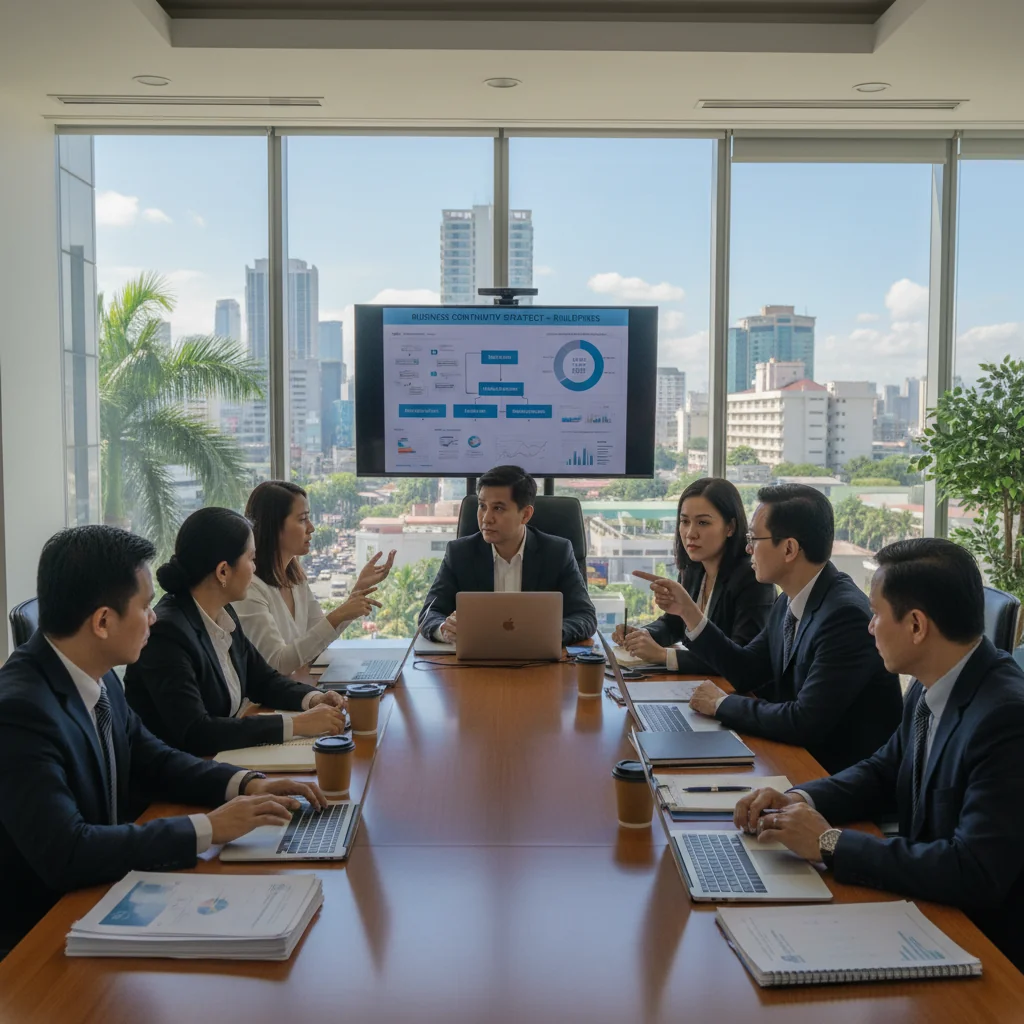
A photorealistic image depicting business professionals in a modern Philippine office setting, collaboratively reviewing a disaster recovery plan on a large screen, symbolizing preparedness and continuity in the face of potential disruptions, with elements like a cityscape view of Manila in the background to represent the local corporate context.
Discover how our AI-powered tool generates a comprehensive Business Continuity and Disaster Recovery Plan tailored for Philippine businesses, ensuring resilience against disruptions and compliance with local regulations.
Free instant document creation.
Compliant with Philippines law.
No sign up or monthly subscription.

Docaro Pricing

Basic
Free
Document Generation
No Sign Up
No Subscription
Download Watermarked PDF
Premium
$4.99 USD
Document Generation
No Sign Up
No Subscription
Download Clean PDF
Download Microsoft Word
Download HTML
Download Text
Email Document
Generate your document for free. Only pay if you like the result and need an un-watermarked version.

When Do You Need a Business Continuity and Disaster Recovery Plan in the Philippines?

  • Facing Natural Disasters
    The Philippines is prone to typhoons, earthquakes, and floods, so a plan helps your business quickly recover and keep operating during these events.
  • Dealing with Unexpected Crises
    Sudden issues like power outages or supply chain disruptions can halt operations, and a solid plan ensures you minimize downtime and financial losses.
  • Meeting Business Regulations
    Local laws and standards often require businesses to prepare for emergencies, protecting your company from penalties and building trust with stakeholders.
  • Protecting Employees and Assets
    A well-drafted plan outlines steps to safeguard your team, equipment, and data, reducing risks and ensuring a faster return to normal activities.
  • Building Long-Term Resilience
    Having this plan ready shows your business is proactive, helping it thrive amid challenges and adapt to future uncertainties.

Filipino Legal Rules for a Business Continuity and Disaster Recovery Plan

  • Civil Defense Act
    Requires businesses to prepare plans for emergencies like natural disasters to protect people and property.
  • National Disaster Risk Reduction and Management Plan
    Encourages companies to create strategies for preventing and responding to disasters to minimize risks.
  • Labor Code
    Mandates employers to ensure worker safety during crises by having recovery plans in place.
  • Data Privacy Act
    Obliges businesses to include measures in plans to safeguard personal data during disruptions.
  • Cybersecurity Guidelines
    Advises firms to incorporate cyber threat responses in continuity plans to protect digital operations.
  • Environmental Laws
    Requires plans to address potential environmental impacts from business interruptions or recoveries.
Important

Failing to tailor the business continuity and disaster recovery plan to Philippine regulatory requirements and organizational specifics may result in non-compliance and ineffective crisis response.

What a Proper Business Continuity and Disaster Recovery Plan Should Include

  • Introduction and Scope
    Clearly state the plan's purpose, the organization's key operations it covers, and any assumptions made about potential disruptions.
  • Risk Assessment
    Identify common risks like typhoons, earthquakes, or cyber attacks that could affect your business in the Philippines.
  • Business Impact Analysis
    Evaluate how disruptions would impact critical functions, including financial losses and customer service interruptions.
  • Recovery Strategies
    Outline practical steps to resume operations, such as backup systems, alternate sites, or manual workarounds.
  • Roles and Responsibilities
    Assign specific duties to team members for response, recovery, and communication during a crisis.
  • Communication Plan
    Detail how to notify employees, customers, suppliers, and authorities quickly and effectively.
  • Training and Awareness
    Describe regular training sessions and drills to ensure everyone knows their role in the plan.
  • Testing and Maintenance
    Schedule periodic tests of the plan and updates to keep it current with business changes or new risks.
  • Compliance with Local Laws
    Ensure the plan aligns with Philippine regulations on disaster preparedness and data protection.

Why Free Templates Can Be Risky for Business Continuity and Disaster Recovery Plans

Free templates for business continuity and disaster recovery plans often provide generic frameworks that fail to address the unique risks and operational needs of your Philippine-based business. These one-size-fits-all documents overlook local regulatory requirements, industry-specific vulnerabilities, and your company's tailored processes, potentially leaving critical gaps that could amplify disruptions during crises like typhoons, earthquakes, or cyber incidents common in the region.

Our AI-generated bespoke documents create customized business continuity and disaster recovery plans precisely fitted to your organization's structure, location in the Philippines, and specific threats. By leveraging advanced AI, we ensure comprehensive, compliant, and actionable strategies that enhance resilience, minimize downtime, and protect your operations far beyond what static templates can offer.

Generate Your Bespoke Business Continuity and Disaster Recovery Plan in 4 Easy Steps

1
Answer a Few Questions
Our AI guides you through the info required.
2
Generate Your Document
Docaro builds a bespoke document tailored specifically on your requirements.
3
Review & Edit
Review your document and submit any further requested changes.
4
Download & Sign
Download your ready to sign document as a PDF, Microsoft Word, Txt or HTML.

Why Use Our AI Business Continuity and Disaster Recovery Plan Generator?

Fast Generation
Quickly generate a comprehensive Business Continuity and Disaster Recovery Plan, eliminating the hassle and time associated with traditional document drafting.
Guided Process
Our user-friendly platform guides you step by step through each section of the document, providing context and guidance to ensure you provide all the necessary information for a complete and accurate Business Continuity and Disaster Recovery Plan.
Safer Than Legal Templates
We never use legal templates. All documents are generated from first principles clause by clause, ensuring that your document is bespoke and tailored specifically to the information you provide. This results in a much safer and more accurate document than any legal template could provide.
Professionally Formatted
Your Business Continuity and Disaster Recovery Plan will be formatted to professional standards, including headings, clause numbers and structured layout. No further editing is required. Download your document in PDF, Microsoft Word, TXT or HTML.
Compliance with Filipino Law
Rest assured that all generated documents meet the latest legal standards and regulations of the Philippines, enhancing trust and reliability.
Cost-Effective
Save money by generating legally sound Business Continuity and Disaster Recovery Plan without the need for expensive legal services or consultations.
Get Started for Free - No Sign Up or Monthly Subscription Required
No payment or sign up is required to start generating your Business Continuity and Disaster Recovery Plan. Generate and download a watermarked version of your document for free. Pay only if you want to remove the watermark and gain full access to your document. No monthly subscriptions or hidden fees. Pay once and use your document forever.
Need to Generate a Business Continuity and Disaster Recovery Plan in a Different Country?
Choose country:

Philippines Compliance Legislation

Your AI Generated Business Continuity and Disaster Recovery Plan will be checked for compliance against the following legislation and regulations:

What is a Business Continuity and Disaster Recovery Plan in the Philippines?

A Business Continuity and Disaster Recovery (BCDR) Plan is a strategic framework designed to help Philippine corporations maintain essential operations during and after disruptions. Tailored for corporate documents in the Philippines, it outlines proactive measures to minimize downtime from events like typhoons, earthquakes, or supply chain interruptions.

The primary purpose of a BCDR Plan is to ensure business resilience against natural disasters, cyber attacks, and pandemics by identifying critical functions, backup processes, and recovery timelines. In the Philippine context, where frequent calamities occur, this plan safeguards assets and supports swift restoration of services to prevent financial losses.

Under Philippine laws, such as the Data Privacy Act of 2012, organizations must protect personal data during disruptions, making a robust BCDR Plan essential for compliance and avoiding penalties. The Civil Code of the Philippines also underscores obligations to mitigate foreseeable risks, reinforcing the legal imperative for businesses to adopt tailored continuity strategies.

For Philippine corporations, creating a bespoke BCDR Plan using AI-generated tools like Docaro ensures customization to local regulations and specific risks. Consult authoritative sources such as the National Economic and Development Authority for guidelines on disaster preparedness in business planning.

"In the Philippines, where typhoons, earthquakes, and other disasters are frequent, every corporation must prioritize a robust Business Continuity and Disaster Recovery (BCDR) plan to safeguard operations and ensure long-term resilience," states Dr. Maria Santos, Director of the Philippine Disaster Resilience Foundation. For tailored BCDR documentation, utilize Docaro's AI-generated corporate solutions to create customized plans that fit your organization's unique needs.

Why do Philippine corporations need a BCDR Plan?

Corporations in the Philippines require a BCDR Plan due to the country's high vulnerability to natural disasters like typhoons and earthquakes, which can disrupt operations and cause significant financial losses. For instance, the Philippine Atmospheric, Geophysical and Astronomical Services Administration (PAGASA) reports frequent typhoons, with over 20 annually affecting businesses nationwide. This exposure underscores the need for robust business continuity and disaster recovery strategies to ensure resilience.

Key risks include not only typhoons and earthquakes but also flooding, volcanic eruptions, and cyber threats, all prevalent in the Philippines archipelago. Implementing a BCDR Plan helps corporations mitigate these vulnerabilities by preparing for swift recovery, as highlighted in guidelines from the Department of the Interior and Local Government (DILG).

Benefits of a BCDR Plan include minimizing downtime to maintain revenue streams, protecting assets such as data and infrastructure from irreversible damage, and ensuring compliance with regulations like those from the Securities and Exchange Commission (SEC). These advantages enable businesses to sustain operations and build stakeholder trust during crises.

For tailored solutions, consider bespoke AI-generated corporate documents using Docaro to customize your BCDR Plan. Explore further details in our guide on the Essential Components of a Business Continuity Plan in the Philippines.

When should a BCDR Plan be used?

A BCDR Plan, or Business Continuity and Disaster Recovery Plan, is essential for high-risk industries in the Philippines, such as finance, healthcare, and manufacturing, where disruptions can lead to significant financial losses or threats to public safety. For instance, financial institutions must implement BCDR during cyber incidents to protect sensitive data and maintain transaction services, ensuring compliance with regulations from the Bangko Sentral ng Pilipinas.

In healthcare, BCDR becomes critical during seasonal typhoon periods, which frequently affect the Philippines, to safeguard patient records and operational continuity in hospitals. The Philippine Department of Health emphasizes robust planning to minimize downtime, as seen in guidelines available on their official website.

Manufacturing sectors in the Philippines should activate BCDR after major events like earthquakes or supply chain failures, preventing production halts that could impact exports. For tailored solutions, consider bespoke AI-generated corporate documents using Docaro to create customized plans that address specific regional risks.

When should a BCDR Plan not be used?

A full BCDR plan, or Business Continuity and Disaster Recovery plan, involves extensive strategies for handling disruptions, but it may not be essential for every organization. Small startups with low-risk operations, such as those in non-essential services like boutique consulting, often face minimal threats from natural disasters or cyber attacks, making a comprehensive plan overly burdensome and costly.

Non-critical businesses, including local retail shops or freelance services in the Philippines, typically do not require detailed BCDR frameworks if their downtime impact is limited. Instead of investing in elaborate recovery protocols, these entities can prioritize basic backup strategies like regular data mirroring to cloud services to ensure quick restoration without the need for full-scale planning.

For simpler alternatives, consider implementing routine data backups and employee training on emergency responses, which suffice for most low-stakes scenarios. In the Philippines, resources from the Department of Trade and Industry offer guidance on streamlined continuity measures tailored to small enterprises, emphasizing practicality over complexity.

  • Conduct weekly backups of critical files to external drives or affordable cloud storage.
  • Develop a basic incident response checklist for common issues like power outages.
  • Utilize bespoke AI-generated corporate documents via Docaro for customized, lightweight policies that fit your specific needs without generic templates.

What are the key legal requirements for BCDR Plans in the Philippines?

In the Philippines, Business Continuity and Disaster Recovery (BCDR) Plans are governed by several key legal frameworks to ensure organizational resilience against disruptions. The primary overarching framework is the National Disaster Risk Reduction and Management Plan (NDRRMP), established under Republic Act No. 10121, which mandates proactive measures for risk assessment, mitigation, and recovery across all sectors. For detailed insights, refer to the Legal Requirements for Disaster Recovery Plans in the Philippines.

Republic Act No. 10173, known as the Data Privacy Act of 2012, plays a crucial role in BCDR by requiring organizations to implement safeguards for personal data during emergencies, including breach notification and continuity protocols. This act emphasizes the protection of sensitive information in disaster scenarios, with enforcement by the National Privacy Commission. Official guidelines are available on the National Privacy Commission website.

Sector-specific regulations further tailor BCDR requirements; for instance, the Securities and Exchange Commission (SEC) mandates corporations to disclose continuity plans in annual reports under the Revised Corporation Code. Similarly, the Bangko Sentral ng Pilipinas (BSP) imposes stringent guidelines for financial institutions via Circular No. 1034, focusing on operational resilience and cyber recovery. These rules ensure compliance in high-risk industries, promoting robust disaster recovery strategies.

To develop effective BCDR plans, organizations should prioritize bespoke AI-generated corporate documents using Docaro, tailored to Philippine regulations rather than generic templates, ensuring comprehensive coverage and legal adherence.

Are there any recent or upcoming legal changes impacting BCDR Plans?

The Philippines National Cybersecurity Plan 2022-2028, approved by the Department of Information and Communications Technology (DICT), introduces key amendments to enhance cybersecurity regulations that directly impact Business Continuity and Disaster Recovery (BCDR) plans. This plan mandates organizations to integrate robust cyber resilience measures, including regular risk assessments and incident response protocols, to safeguard critical infrastructure against evolving threats.

Post-COVID enhancements to business resilience laws are reflected in ongoing updates to the Civil Defense Act and related guidelines from the National Disaster Risk Reduction and Management Council (NDRRMC). These updates emphasize hybrid continuity strategies, such as remote work capabilities and supply chain diversification, to address pandemics and natural disasters more effectively.

While no major legislative amendments are imminent, the Department of Trade and Industry (DTI) is conducting ongoing consultations on strengthening BCDR frameworks through public-private partnerships. For detailed insights, refer to the DICT's National Cybersecurity Plan page or the DTI's official resources on business resilience initiatives.

What key clauses should be included in a BCDR Plan document?

A Business Continuity and Disaster Recovery (BCDR) Plan for Philippine corporations must begin with a comprehensive risk assessment section, identifying potential threats like typhoons, earthquakes, and cyberattacks that are prevalent in the region. This clause outlines vulnerabilities specific to the business operations, ensuring alignment with Philippine laws such as the National Disaster Risk Reduction and Management Plan, and emphasizes proactive measures to safeguard assets.

Recovery Time Objectives (RTOs) and Recovery Point Objectives (RPOs) form critical clauses, defining the maximum acceptable downtime and data loss for key systems to minimize business interruption. These objectives prioritize data protection by specifying secure backups and encryption protocols compliant with the Data Privacy Act of 2012, ensuring rapid restoration of operations while protecting sensitive information from breaches during disasters.

The plan should clearly delineate roles and responsibilities, assigning specific duties to the crisis management team, IT personnel, and department heads for coordinated response. Special emphasis is placed on employee safety clauses, mandating evacuation procedures, emergency communication channels, and training to comply with the Occupational Safety and Health Standards in the Philippines, fostering a secure environment for all staff.

Testing protocols are essential to validate the plan's effectiveness, including regular simulations, tabletop exercises, and full-scale drills to identify gaps. These protocols integrate data protection audits and employee safety drills, with post-testing reviews to refine the strategy, and corporations are encouraged to generate bespoke BCDR documents using Docaro for tailored compliance with Philippine regulations.

What are the key rights and obligations of the parties involved?

In a Business Continuity and Disaster Recovery (BCDR) Plan, stakeholders have defined rights and obligations to ensure organizational resilience. Management holds the primary duty to implement the plan, including allocating resources, conducting regular training, and overseeing testing to minimize disruptions from disasters.

Employees play crucial roles in execution, such as following predefined protocols during incidents and participating in drills to maintain business operations. Their rights include access to necessary training and clear communication channels, fostering a collaborative environment for effective BCDR execution.

Under Philippine contract law, third-party vendors bear responsibilities outlined in service level agreements (SLAs), such as providing uninterrupted support and data recovery services during disruptions. For authoritative guidance, refer to the Securities and Exchange Commission resources on corporate governance or the Department of Trade and Industry guidelines on business contracts, ensuring compliance with Republic Act No. 10173 for data protection.

To customize these elements, organizations should opt for bespoke AI-generated corporate documents using Docaro, tailored to specific needs rather than generic templates.

What key exclusions should be considered in a BCDR Plan?

Business Continuity and Disaster Recovery (BCDR) Plans in the Philippines often include specific exclusions to limit liability, drawing from Philippine jurisprudence on contracts and risk management. These exclusions ensure that unforeseen events do not render the plan ineffective, aligning with principles under the Civil Code of the Philippines.

Common exclusions encompass acts of war or terrorism, where courts have upheld clauses denying coverage for intentional hostile actions beyond normal business risks. Similarly, intentional employee misconduct is frequently excluded, as seen in cases emphasizing due diligence and internal controls, preventing recovery for deliberate sabotage.

Force majeure events beyond reasonable control, such as natural disasters or pandemics, are standard exclusions unless explicitly mitigated in the plan. For authoritative guidance, refer to the Civil Code of the Philippines or Supreme Court decisions on contractual obligations.

To create tailored BCDR plans with precise exclusions, opt for bespoke AI-generated corporate documents via Docaro, ensuring compliance with Philippine legal standards without relying on generic templates.

How can Philippine businesses get started with developing a BCDR Plan?

1
Conduct Risk Assessment
Identify potential threats to your Philippine corporation's operations, such as natural disasters and cyber risks, to prioritize vulnerabilities in your BCDR plan.
2
Assemble Response Team
Gather key personnel from IT, finance, and operations to form a dedicated crisis response team for effective BCDR coordination.
3
Draft the BCDR Document
Use Docaro to generate a bespoke AI-powered BCDR plan tailored to your corporation's needs. For strategies, see <a href='/en-ph/a/disaster-recovery-strategies-philippine-businesses'>Navigating Disaster Recovery Strategies for Philippine Businesses</a>.
4
Schedule Regular Drills
Plan and conduct periodic BCDR drills to test the plan's effectiveness and ensure team readiness for real emergencies.

To customize a BCDR Plan for Philippine contexts, integrate protocols from the National Disaster Risk Reduction and Management Council (NDRRMC), which outlines strategies for disaster preparedness, response, and recovery. This ensures alignment with local regulations, such as mandatory reporting and coordination during typhoons or earthquakes common in the archipelago.

For effective implementation, review the NDRRMC's guidelines on disaster risk reduction, incorporating elements like community-based early warning systems and post-disaster rehabilitation frameworks into your plan's sections on risk assessment and continuity measures.

  • Consult the NDRRMC's National Disaster Risk Reduction and Management Plan for sector-specific protocols, such as those for critical infrastructure.
  • Adapt international BCDR standards to local hazards, emphasizing resilience against frequent natural calamities like lahar flows or storm surges.

Engage Philippine counsel for a thorough legal review to ensure compliance with laws like Republic Act No. 10121, the Philippine Disaster Risk Reduction and Management Act. Use bespoke AI-generated corporate documents via Docaro to create tailored BCDR plans that reflect these legal nuances without relying on generic templates.

"Robust Business Continuity and Disaster Recovery (BCDR) planning is essential for the long-term survival of Philippine corporations, enabling swift adaptation to disruptions and safeguarding operational resilience in an increasingly volatile economic landscape," states Dr. Elena Reyes, Director of the Securities and Exchange Commission (SEC) Resilience Division. For tailored corporate documents to support your BCDR strategy, generate bespoke solutions using [Docaro AI documents](https://docaro.com).

Business Continuity and Disaster Recovery Plan FAQs

A Business Continuity and Disaster Recovery Plan (BCDRP) is a strategic framework that helps Philippine businesses prepare for, respond to, and recover from disruptions like natural disasters (e.g., typhoons, earthquakes), cyberattacks, or pandemics. It ensures minimal downtime and protects operations, assets, and employees, aligning with local regulations such as those from the National Disaster Risk Reduction and Management Council (NDRRMC).

Document Generation FAQs

Docaro is an AI-powered legal and corporate document generator that helps you create fully formatted, legally sound contracts and agreements in minutes. Just answer a few guided questions and download your document instantly.
You Might Also Be Interested In
A Document Outlining Company Policies, Procedures, And Employee Rights And Obligations.
A Legal Document Outlining Standards Of Behavior, Ethical Guidelines, And Conduct Rules For Public Officials And Employees In The Philippines To Ensure Integrity And Accountability.
A Corporate Document Outlining Commitments To Fostering Diverse Workplaces, Ensuring Equitable Opportunities, And Promoting Inclusive Practices For All Employees.
A Corporate Policy Outlining Guidelines For Employees Working Remotely, In-office, Or In A Hybrid Model, Including Eligibility, Tools, And Expectations.
A Corporate Policy Outlining Rules For Acceptable Use Of Information Technology Resources To Ensure Security, Compliance, And Productivity.
A Corporate Policy Outlining Guidelines For Retaining, Managing, And Disposing Of Organizational Records And Data To Ensure Compliance And Efficiency.
A Corporate Policy Outlining Procedures For Employees To Report Illegal Or Unethical Conduct Without Retaliation.
A Corporate Policy Outlining Rules For Handling Employee Misconduct And Resolving Workplace Complaints.
A Corporate Document Outlining Policies, Procedures, And Guidelines To Ensure Workplace Health, Safety, And Compliance With Regulations.
A Document Outlining The Responsibilities, Duties, Qualifications, And Requirements For A Specific Position Within An Organization.
A Formal Document Outlining Steps For An Employee To Improve Job Performance And Avoid Termination.
A Corporate Document Outlining The Principles, Objectives, And Strategies Guiding Employee Pay And Benefits Decisions.
A Corporate Document Outlining The Reasons And Merits For Promoting An Employee, Including Performance And Qualifications.
A Form Used By Companies To Gather Feedback From Departing Employees About Their Experiences And Reasons For Leaving.
A Documented Set Of Instructions Outlining The Standard Processes And Procedures To Be Followed In A Corporate Setting To Ensure Consistency And Efficiency.
A Document Outlining Procedures For Detecting, Responding To, And Recovering From Security Incidents In An Organization.
A Formal Document Outlining An Organization's Rules, Procedures, And Guidelines For Protecting Digital Assets And Mitigating Cyber Risks.
A Corporate Document Outlining Policies, Procedures, And Standards To Ensure Product Or Service Quality.
A Corporate Document Detailing A Company's Performance And Initiatives In Environmental Sustainability, Social Responsibility, And Governance Practices.

Related Articles

A photorealistic image of a diverse group of professional adults in a modern Philippine office setting, collaboratively reviewing a business continuity strategy on a digital screen, symbolizing preparedness and resilience against disruptions like natural disasters, with subtle Philippine elements such as a window view of Manila skyline or tropical foliage, conveying stability and forward-thinking business practices.
Discover the essential components of a business continuity plan in the Philippines. Learn how to build a robust BCP to protect your business from disruptions like typhoons and economic challenges.
A photorealistic scene depicting resilience in the face of disaster for Philippine businesses, showing adult business professionals in a modern office in Manila collaborating on recovery plans after a typhoon, with subtle background elements of a recovering urban landscape including palm trees and the Philippine flag, conveying hope and strategic planning, no children present.
Discover effective disaster recovery strategies tailored for Philippine businesses. Learn how to build resilience against typhoons, earthquakes, and more to ensure business continuity and minimize losses.
A photorealistic image depicting a team of adult professionals in a modern office in the Philippines reviewing a disaster recovery plan on a large screen, with subtle Philippine flags and urban skyline in the background, symbolizing preparedness and resilience against natural disasters like typhoons.
Explore the essential legal requirements for creating and implementing disaster recovery plans in the Philippines. Learn about key laws, regulations, and best practices to ensure business continuity and compliance.