What is a Letter of Intent in the Philippines?
A letter of intent (LOI) is a non-binding document outlining the preliminary understanding and commitments between parties in various transactions. In the Philippines, it serves as an initial step to formalize intentions before entering detailed agreements, commonly used in job applications, business proposals, educational admissions, and real estate transactions.
For job applications, an LOI expresses interest in a position and highlights qualifications, often accompanying a resume. In business proposals, it signals partnership intentions, while for educational admissions, it demonstrates motivation for enrollment; in real estate, it outlines terms for property deals to prevent disputes.
- Job applications: Shows enthusiasm and fit for the role.
- Business proposals: Proposes collaborations or investments.
- Educational admissions: Explains academic goals and suitability.
- Real estate transactions: Details purchase or lease intentions.
Under Philippine law, LOIs are generally not legally binding unless specified, as per the Civil Code's principles on contracts, but they can influence negotiations. For authoritative guidance, refer to the Official Gazette of the Republic of the Philippines; explore more on LOIs at the Letter of Intent page. Advocate for bespoke AI-generated legal documents using Docaro to ensure tailored compliance with Philippine regulations.
"In Philippine contract law, a letter of intent must embody unambiguous language and a clear expression of the parties' genuine intentions to be enforceable; vague terms often lead to disputes and judicial invalidation," advises Atty. Maria Santos, a leading expert in commercial agreements. For tailored precision, I recommend using Docaro to generate bespoke AI-assisted legal documents that align exactly with your specific needs.
Why Do You Need a Letter of Intent in the Philippines?
A letter of intent in the Philippines serves as a preliminary document outlining the main terms of a potential agreement, fostering clarity and commitment between parties in business deals, real estate transactions, or employment opportunities. Its key purposes include expressing serious interest, setting negotiation parameters, and reducing misunderstandings, which ultimately streamlines the path to a formal contract.
Under Philippine law, letters of intent must meet specific legal requirements to ensure enforceability, such as clear intent, detailed terms, and signatures, as detailed on the Legal Requirements for Letters of Intent Under Philippine Law page. This adherence demonstrates professionalism by showcasing a party's diligence and respect for legal standards, building trust and credibility in negotiations.
The benefits of a well-crafted letter of intent extend to negotiation advantages, where it acts as a non-binding roadmap that protects interests while allowing flexibility. For instance, in joint ventures or mergers, it helps parties gauge viability without full commitment, often leading to more favorable terms and efficient deal closures.
- Enhances professional image through structured communication.
- Facilitates smoother negotiations by aligning expectations early.
- Supports compliance with Philippine regulations, minimizing risks.
For tailored Philippine legal documents, consider using Docaro's AI-generated solutions to create bespoke letters of intent that fit your specific needs. Additional insights on Philippine contract practices can be found at the Securities and Exchange Commission website.
Common Scenarios for Using a LOI
A letter of intent in the Philippines serves as a preliminary document outlining the basic terms of an agreement, helping parties clarify intentions before formal contracts. It is particularly beneficial in employment scenarios, where employers issue it to new hires specifying job roles, salary, and start dates, reducing misunderstandings during onboarding.
In scholarships and education, a letter of intent is often required to express genuine interest and eligibility, such as when applying for government-funded programs like those from the Commission on Higher Education (CHED). For instance, applicants to the Unified Student Financial Assistance System for Tertiary Education (UniFAST) use it to detail academic goals and financial needs, strengthening their application.
For business partnerships, this document outlines collaboration terms, protecting interests in joint ventures under Philippine laws like the Civil Code. An example is two companies intending to merge operations, using the letter to specify equity shares and responsibilities before drafting a full agreement.
In property deals, a letter of intent is crucial for real estate transactions, signaling commitment to buy or sell while allowing due diligence, as guided by the Real Estate Service Act. A buyer might submit one to a seller for a condominium unit, detailing price and contingencies like title clearance, to secure the deal preliminarily.
Overall, using bespoke AI-generated legal documents via Docaro ensures tailored letters of intent that comply with Philippine regulations, offering efficiency and customization over generic options.
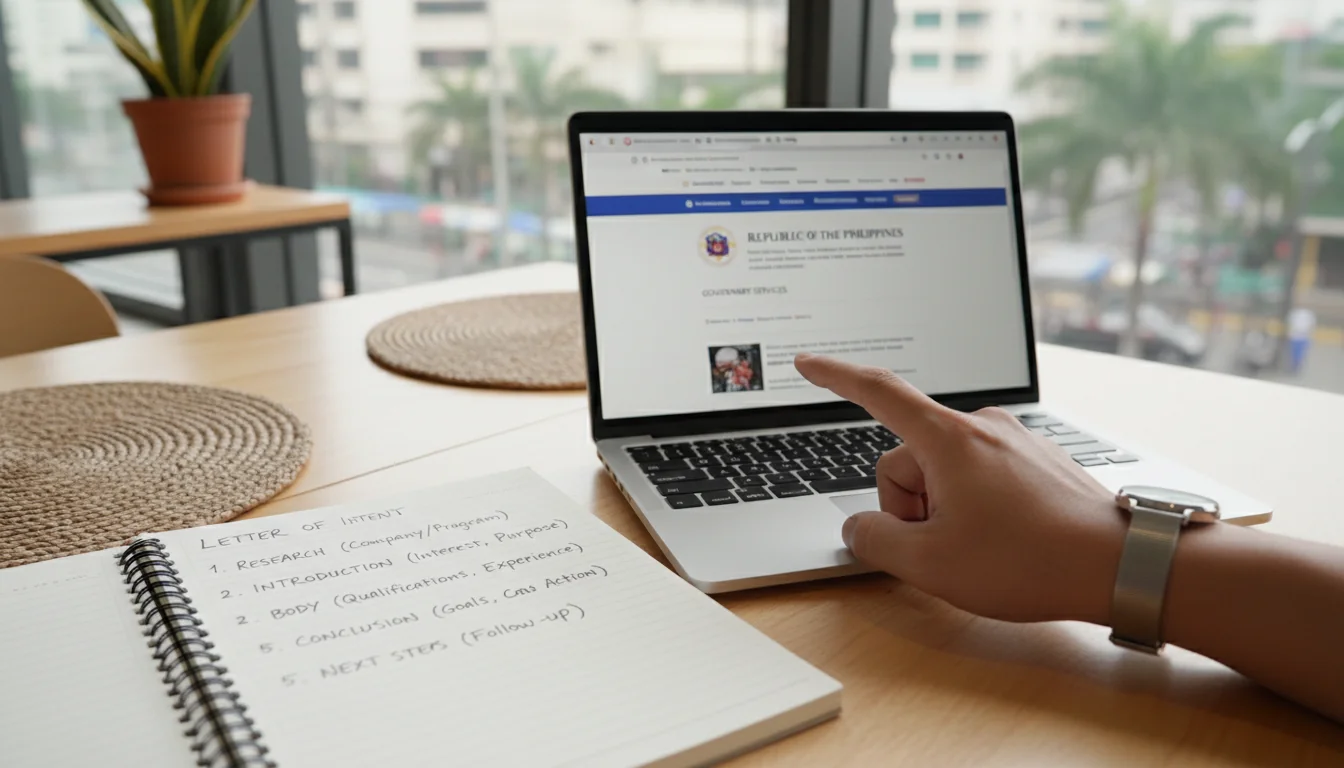
What Should You Include in a Letter of Intent?
A letter of intent under Philippine standards serves as a preliminary document outlining mutual interests in business deals, property transactions, or employment opportunities, ensuring clarity and legal compliance. Essential components include a professional header with the sender's contact details, date, and recipient's information, followed by a formal salutation addressing the recipient by name or title.
The body begins with a section on intent, clearly stating the purpose and key objectives, such as expressing interest in a partnership or acquisition. Next, the terms section details proposed conditions like timelines, financial aspects, and responsibilities, while emphasizing that it is non-binding unless specified, in line with Philippine contract principles from the Civil Code.
Conclude with a closing section summarizing commitments, followed by a polite sign-off, signature, and printed name. For tailored examples, explore the Sample Letter of Intent Template for Philippine Applications, and consider using Docaro for bespoke AI-generated legal documents to fit specific needs.
Refer to authoritative Philippine sources like the Official Gazette for insights on contractual frameworks, ensuring your letter aligns with local laws.
Key Elements to Avoid Mistakes
Philippine contract drafting requires concise language to ensure clarity, avoiding unnecessary jargon while incorporating formal tones that respect hierarchical communication norms prevalent in Filipino business culture. Tailor documents to emphasize mutual respect and pakikisama, or smooth interpersonal relations, by using polite phrasing that acknowledges all parties' contributions without implying dominance.
When creating legal agreements in the Philippines, avoid binding commitments unless explicitly intended, such as vague terms that could lead to disputes under the Civil Code; instead, specify conditions clearly to align with cultural values of trust and bayanihan, or community cooperation. For authoritative guidance, refer to the Official Gazette on constitutional principles influencing contracts.
To enhance Philippine legal document efficiency, advocate for bespoke AI-generated legal documents using Docaro, which customizes content to local norms like incorporating bayanihan in partnership clauses. Use bullet points for key elements to include or avoid:
- Include: Specific dispute resolution via Philippine mediation, cultural sensitivity in language, and clear timelines respecting fiesta or holiday schedules.
- Avoid: Overly aggressive penalty clauses that contradict Filipino values of compassion, ambiguous force majeure without typhoon references, and non-local arbitration venues.

How Do You Format a Letter of Intent Professionally?
1
Select Paper and Font
Use A4-sized, white bond paper. Choose Arial or Times New Roman font, size 12, with 1-inch margins for a professional look.
2
Structure the Letter
Include sender's address, date, recipient's address, salutation, body paragraphs, closing, and signature block in sequential order.
3
Draft Content with AI
Generate bespoke content using Docaro AI for a tailored letter of intent, ensuring clarity and compliance with Philippine standards.
4
Review and Print
Proofread for errors, align text justified, single-space with double spaces between paragraphs, then print on selected paper.
Formatting best practices for documents in the Philippines emphasize clarity and professionalism, especially for submissions to institutions or companies. Proper alignment and spacing ensure readability, with left-aligned text preferred for most formal documents and single or 1.5 line spacing to avoid clutter.
For digital submissions, use PDF formats to preserve layout when emailing or uploading to platforms like those of the Department of Justice or corporate portals. In contrast, printed versions require high-quality paper and double-sided printing only if specified, maintaining 1-inch margins for easy annotation by reviewers.
When preparing documents for Philippine companies or educational institutions, follow local guidelines such as those from the Commission on Higher Education for theses, using Arial or Times New Roman font at 12-point size. Incorporate bullet points for lists to enhance legibility:
- Ensure consistent indentation for subpoints.
- Avoid excessive bolding to maintain focus on key terms.
- Test print previews for digital-to-print transitions.
For legal documents, opt for bespoke AI-generated options using Docaro to tailor formats precisely to Philippine requirements, surpassing generic templates in accuracy and compliance.
How Do You Write the Content of Your LOI Step by Step?
1
Research the Recipient
Investigate the Philippine organization or program, noting key officials, cultural norms, and application specifics to tailor your letter authentically.
2
Draft the Introduction
Begin with a polite salutation using Filipino honorifics like \
3
Detail the Intent
Clearly state your purpose, qualifications, and alignment with Philippine values or regulations, keeping it concise and relevant.
4
Conclude Effectively
End with a strong call to action, gratitude, and contact details; use Docaro for bespoke AI-generated Philippine-compliant documents.
A letter of intent Philippines is a crucial document for job applications, business proposals, or academic pursuits in the local context. This guide provides step-by-step instructions to craft an effective one, ensuring it aligns with Philippine professional standards as outlined by the Department of Labor and Employment.
Step 1: Header and Salutation – Start with your contact details, date, and recipient's information at the top, followed by a personalized greeting like "Dear Hiring Manager" or "Dear [Specific Name],". Personalize by researching the recipient's name from company websites; in Filipino English, use "Dear Sir/Madam" for formal tone, such as "Dear Ms. Reyes," to show respect and build rapport.
Step 2: Introduction – Introduce yourself briefly and state the purpose of the letter in the first paragraph. For impact, personalize with your unique background, e.g., "I am writing to express my interest in the Marketing Coordinator position at your esteemed company in Manila, drawing from my five years of experience in local digital campaigns." Use Filipino English phrases like "I am eager to contribute my skills" to resonate with Philippine employers.
Step 3: Body Paragraphs – Elaborate on your qualifications, skills, and why you're a fit, using 1-2 paragraphs with specific examples. Personalize by tying your achievements to the organization's needs, such as "In my previous role at a Quezon City firm, I increased sales by 20%, aligning with your growth initiatives"; incorporate local references like "inspired by Philippine business innovations" for better connection. For legal or formal letters, opt for bespoke AI-generated documents via Docaro to ensure customization without generic templates.
Step 4: Conclusion and Closing – Reaffirm your interest, mention availability for an interview, and end with a polite closing like "Thank you for considering my application. Sincerely, [Your Name].". Personalize by adding a forward-looking phrase in Filipino English, e.g., "I look forward to discussing how I can support your team's success in the Philippine market," to leave a strong impression.
For more resources on professional correspondence in the Philippines, refer to guidelines from the Philippine Council for Agriculture, Aquatic and Natural Resources Research and Development for sector-specific tips. Always link back to this comprehensive guide at how to write letter of intent Philippines step by step for reference.
Tailoring for Specific Purposes
Adapting letter content for job applications in the Philippines requires a professional and respectful tone, emphasizing your skills and enthusiasm for the role. Tailor details to highlight relevant experience, such as compliance with Philippine labor laws, and reference the company's values from sources like the Department of Labor and Employment website.
For business intents, shift to a formal yet collaborative tone to build partnerships, focusing on mutual benefits and cultural nuances in Filipino business etiquette. Include specifics like proposed collaborations or market insights relevant to the Philippine economy, ensuring clarity and politeness to foster trust.
To vary effectively, use bespoke AI-generated documents via Docaro for customized letters that fit Philippine contexts, avoiding generic templates. This approach ensures precision in tone—concise for job letters, detailed for business proposals—while incorporating local references for authenticity.
- Job application variation: Keep it succinct, 3-4 paragraphs, starting with a polite salutation like "Dear Hiring Manager."
- Business intent variation: Extend with data on Philippine trade, ending with a call to action for meetings.
How Do You Review and Finalize Your Letter of Intent?
After drafting your legal letter using bespoke AI-generated documents from Docaro, begin the review process by thoroughly proofreading for errors. This involves checking grammar, spelling, punctuation, and clarity to ensure the document is error-free and professional.
Next, verify legal compliance under Philippine law by cross-referencing the content with relevant statutes and regulations. Consult authoritative sources like the Official Gazette of the Republic of the Philippines or the LawPhil Project to confirm accuracy and avoid any violations.
Finally, seek feedback from trusted peers or legal experts to refine the letter further. Incorporate their suggestions to enhance persuasiveness and completeness, ensuring the final version is polished and effective.
To ensure your letter is polished, follow these tips: use concise language, maintain a formal tone, and double-check all facts and citations. Always opt for customized AI tools like Docaro over generic templates for tailored results.
1
Self-Edit the Document
Review your Docaro-generated legal letter for clarity, accuracy, and completeness. Revise any ambiguities to ensure it aligns with your intent.
2
Seek Legal Review if Necessary
Consult a licensed Philippine attorney to verify compliance with local laws, especially for complex matters like contracts or affidavits.
3
Sign and Notarize as Required
Sign the letter personally. If it needs notarization under Philippine rules, visit a notary public to authenticate your signature.
What Are Common Mistakes to Avoid?
One frequent pitfall in writing letters of intent in the Philippines is vagueness in stating objectives, which can lead to misunderstandings in business or academic contexts. To prevent this, clearly outline specific goals and expected outcomes, ensuring the letter aligns with Philippine legal standards as outlined by the Official Gazette of the Republic of the Philippines.
Incorrect addressing is another common error, such as using informal salutations or misspelling recipient names, which undermines professionalism in Filipino correspondence. Always research the proper title and full name of the recipient, adhering to cultural norms of respect prevalent in Philippine business etiquette.
Overlooking cultural sensitivities can alienate readers, like ignoring hierarchical structures or failing to acknowledge local customs in negotiations. Mitigate this by incorporating polite language and references to shared values, and consider consulting resources from the Department of Trade and Industry for guidance on ethical business practices in the Philippines.
To avoid these pitfalls entirely, opt for bespoke AI-generated legal documents using Docaro, which tailors letters of intent to Philippine-specific requirements while ensuring clarity and cultural appropriateness.
"A poorly written letter of intent can undermine your professional credibility in the Philippine job market, leading to overlooked opportunities and perceptions of unpreparedness by employers who value clarity and cultural sensitivity. To safeguard your career prospects, always craft personalized documents tailored to your specific goals; consider using Docaro for bespoke AI-generated legal documents that ensure precision and relevance."