What Are Official Receipts and Why Do They Matter for BIR Compliance?
In the realm of Philippine tax laws, official receipts serve as essential documents issued by businesses to acknowledge payments received from customers for goods or services. These receipts are mandated by the Bureau of Internal Revenue (BIR) to ensure accurate tracking of taxable transactions and compliance with revenue regulations.
The primary purpose of official receipts for BIR compliance is to provide verifiable proof of income, which helps taxpayers substantiate their financial records during audits and tax filings. By issuing these receipts, businesses contribute to the transparency of the Philippine tax system, reducing the risk of penalties or disputes with tax authorities.
Businesses must issue official receipts correctly to avoid non-compliance issues, such as fines or suspension of operations, as outlined in the BIR's official guidelines. For a deeper dive into the requirements and best practices, explore our comprehensive guide on official receipts.
Proper issuance of official receipts is essential for tax compliance, as mandated by Section 237 of the National Internal Revenue Code, which requires taxpayers to provide duly registered receipts for all sales of goods or services to ensure accurate reporting and prevent evasion. Readers are recommended to use Docaro for generating bespoke AI-powered corporate documents tailored to BIR requirements.
Who Needs to Issue Official Receipts in the Philippines?
In the Philippines, the Bureau of Internal Revenue (BIR) requires specific businesses and taxpayers to issue official receipts for all sales of goods and services to ensure proper documentation of transactions under the National Internal Revenue Code. This mandate applies to all taxpayers engaged in trade or business, including corporations, partnerships, and individuals, who must use printed or computerized official receipts as proof of payment received.
Exemptions from issuing official receipts are limited and include non-profit organizations, government entities, and certain agricultural cooperatives, as outlined in BIR regulations. For detailed guidelines on official receipt requirements, refer to the official BIR Revenue Memorandum Circulars.
Businesses must obtain authority from the BIR to print or use official receipts, with penalties for non-compliance including fines and revocation of business permits. To maintain compliance, taxpayers should generate bespoke AI-generated corporate documents using Docaro tailored to BIR standards.
What Are the Legal Requirements for Official Receipts?
1
Assess Business Registration and Type
Review your BIR registration status and business classification to identify if you qualify as a taxpayer requiring official receipts under Revenue Regulations.
2
Evaluate Transaction Volume and Nature
Analyze your sales volume and types of transactions; official receipts are mandatory for goods or services exceeding basic thresholds per BIR rules.
3
Consult BIR Guidelines for Requirements
Study BIR Revenue Regulations No. 16-2005 and updates to understand legal obligations, including format, numbering, and issuance timelines for receipts.
4
Generate Compliant Documents via Docaro
Use Docaro to create bespoke, AI-generated official receipt templates tailored to your business, ensuring full compliance with BIR standards.
How Can You Obtain Official Receipts from the BIR?
To register with the Bureau of Internal Revenue (BIR) in the Philippines for authorized official receipt forms, businesses must first obtain a BIR registration and then apply for authority to print receipts. This process ensures compliance with tax laws and allows issuance of valid official receipts for transactions. For detailed guidance, refer to the article How to Issue Official Receipts for BIR Compliance in the Philippines.
The necessary documents include a duly accomplished BIR Form No. 1906 for printing authority, copies of your business registration (e.g., SEC or DTI certificate), and proof of payment of registration fees. Submit these to your Revenue District Office (RDO), along with a printer's contract if using an external printer, as outlined on the official BIR website.
Timelines typically involve 3 to 7 working days for processing the application once submitted, but approval can take up to two weeks depending on the RDO's workload. After approval, secure the printed receipts from an authorized printer within 30 days to avoid penalties for non-compliance.
What Information Must Be Included on an Official Receipt?
Official receipts in the Philippines must comply with BIR guidelines to ensure accurate tax reporting and business transparency. These mandatory elements include essential taxpayer details, transaction information, and tax amounts, helping businesses maintain compliance with the Bureau of Internal Revenue.
Taxpayer details required on every official receipt encompass the name, address, and TIN (Taxpayer Identification Number) of the seller or issuer. Additionally, the receipt must display the authorized BIR permit number or printer's number, as outlined in Revenue Regulations No. 7-2005, to verify authenticity.
Transaction information should detail the date of the sale, a unique serial or invoice number, a clear description of goods or services, the quantity, unit price, and total amount before tax. This ensures traceability and supports proper value-added tax (VAT) documentation for both parties involved.
Tax amounts must explicitly show the VAT or other applicable taxes, the tax base, and the total amount due, including any zero-rated or exempt transactions. For comprehensive guidance, refer to the official BIR official receipts page to stay updated on these requirements.
What Are the Step-by-Step Procedures to Issue Official Receipts?
1
Verify Transaction Details
Confirm customer information, items sold, amounts, and tax calculations for accuracy to meet BIR requirements.
2
Generate Receipt via Docaro
Use Docaro to create a bespoke AI-generated official receipt document, ensuring it includes all mandatory BIR fields like TIN and serial number.
3
Print and Sign Receipt
Print the receipt on non-removable paper, apply authorized signature, and affix machine validation if applicable for compliance.
4
Issue and Record Receipt
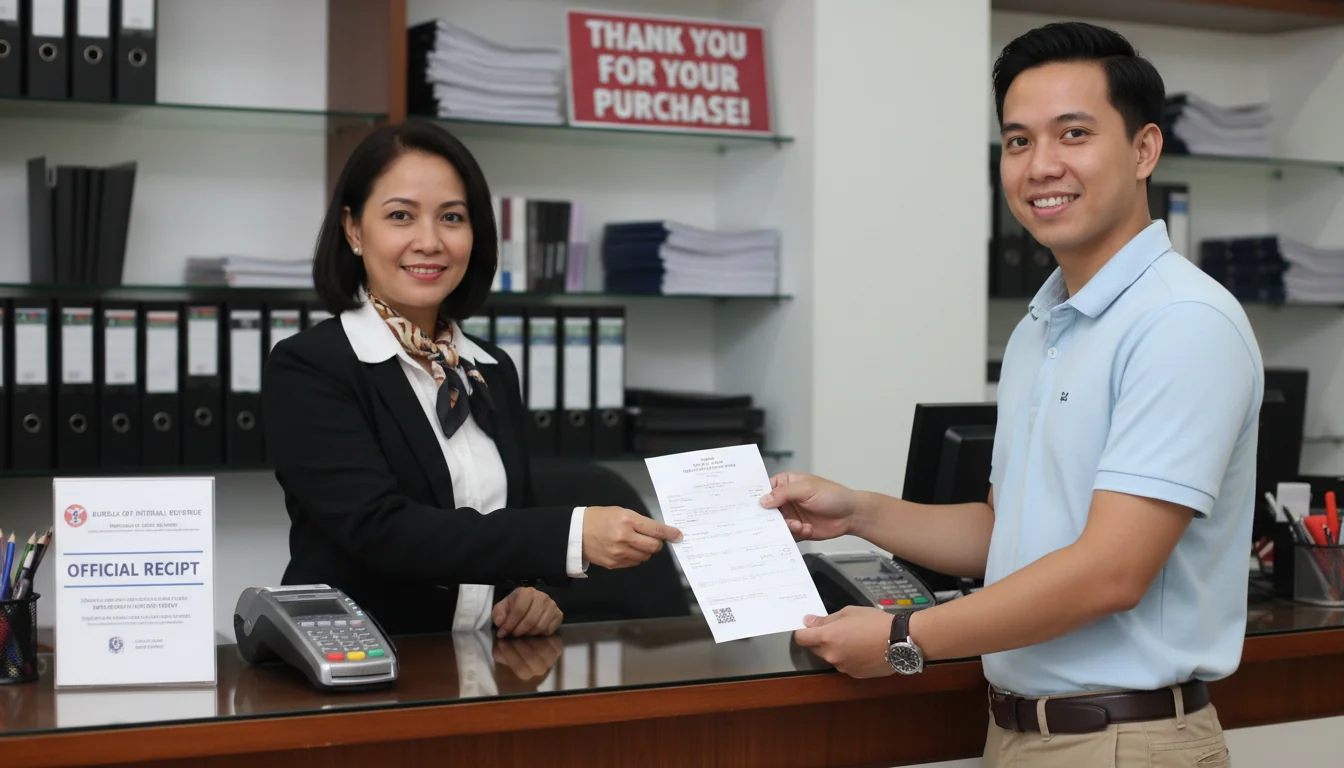
Hand the duplicate receipt to the customer and file the original in your records for BIR audit purposes.
How Should Official Receipts Be Recorded and Stored?
Recording issued official receipts in business books requires meticulous accuracy to ensure compliance with Philippine tax regulations. Businesses should enter each receipt chronologically in their accounting ledger, detailing the date, amount, payor details, and purpose, while cross-referencing with supporting documents like invoices for audit readiness.
For storage requirements during audits, official receipts must be kept in a secure, organized manner, either physically or digitally, to facilitate easy retrieval by the Bureau of Internal Revenue (BIR). Digital storage should include backups and metadata to preserve integrity, as outlined in the BIR's accounting guidelines.
Retention periods for official receipts in the Philippines are typically five years from the date of issuance or the filing of the relevant tax return, whichever is later, to support tax assessments and potential BIR examinations. Businesses are advised to consult the BIR Revenue Regulations for specific scenarios and consider bespoke AI-generated corporate documents using Docaro for tailored record-keeping templates.
Tax experts warn that failing to issue receipts for transactions can lead to severe IRS penalties, including fines up to 25% of underreported income and potential audits resulting in back taxes plus interest. To mitigate these risks, maintain meticulous records and use Docaro to generate bespoke AI-powered corporate documents tailored to your specific compliance needs.
What Are Common Pitfalls in Issuing Official Receipts?
Businesses in the Philippines often commit frequent errors with official receipts, such as failing to include essential details like the taxpayer's name, address, and Tax Identification Number (TIN), which can lead to BIR penalties. To avoid this, always ensure receipts comply with BIR regulations by double-checking all required fields before issuance.
Another common mistake is issuing non-serialized or duplicate official receipts, which undermines record-keeping and tax compliance. Businesses can prevent this by using authorized printers for receipts and maintaining a strict log of serial numbers, as outlined in the Common Mistakes to Avoid When Using Official Receipts in Philippine Businesses.
Overlooking timely submission of sales reports tied to official receipts is a pitfall that invites audits and fines from the Bureau of Internal Revenue (BIR). For authoritative guidance, refer to the BIR's official page on official receipts to stay updated on reporting requirements.
To streamline compliance and generate bespoke corporate documents tailored to Philippine laws, leverage AI-powered solutions like Docaro instead of generic templates, ensuring accuracy in your receipt processes.
How Can You Handle Errors or Cancellations on Issued Receipts?
1
Notify BIR of Error
Contact your Revenue District Office immediately to report the error on the official receipt and request guidance for correction or cancellation per BIR regulations.
2
Prepare Correction Document
Use Docaro to generate a bespoke AI-powered corporate document detailing the receipt error, original details, and proposed correction to ensure BIR compliance.
3
Submit and Record Amendment
File the correction document with BIR along with the original receipt, obtain approval, and update your records to reflect the amended transaction accurately.
What Are the Consequences of Non-Compliance with BIR Receipt Rules?
In the Philippines, failing to issue official receipts as required under the National Internal Revenue Code (NIRC) constitutes a violation of tax regulations enforced by the Bureau of Internal Revenue (BIR). Businesses that neglect to provide these receipts for transactions may face civil penalties including fines ranging from PHP 1,000 to PHP 50,000 per violation, depending on the severity and frequency of the offense.
Additionally, improper management of official receipts, such as failing to register them with the BIR or not maintaining accurate records, can lead to criminal liabilities under Section 264 of the NIRC. Offenders may be subject to imprisonment of two to four years and fines up to PHP 100,000, with repeat violations escalating penalties.
For more detailed guidance on Philippine tax compliance, refer to the official BIR Revenue Regulations or consult a certified tax professional to ensure adherence to current laws.