Why Free Templates Can Be Risky for Tax Invoices
Free invoice templates often lack the specific details required for New Zealand tax compliance, such as accurate GST calculations and mandatory IRD numbering. They may contain outdated formats or generic placeholders that don't align with current Inland Revenue guidelines, leading to potential errors in invoicing that could result in fines, disputes, or rejected claims.
Our AI-powered generator creates bespoke tax invoices tailored precisely to New Zealand regulations, ensuring all essential elements like unique invoice references, correct tax breakdowns, and compliant layouts are included. This results in professional, error-free documents that streamline your billing process and enhance accuracy every time.
What is a Tax Invoice in New Zealand?
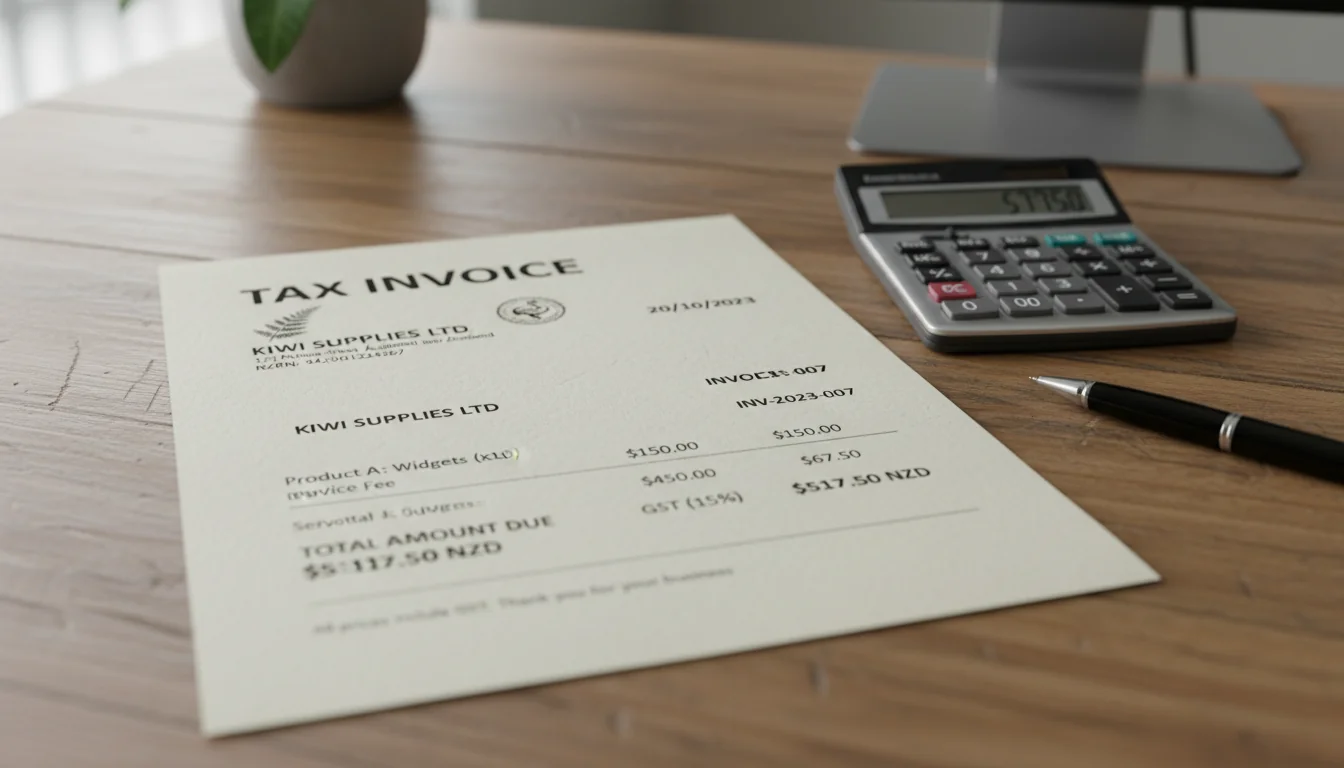
A tax invoice in New Zealand is a specialized corporate document required for GST-registered businesses, serving as proof of a taxable supply under the Goods and Services Tax Act 1985. It enables the recipient to claim input tax credits on GST paid, ensuring compliance with Inland Revenue Department (IRD) regulations.
The primary purpose of a tax invoice for GST-registered entities is to detail the GST component separately, allowing accurate reporting and reconciliation during tax filings. Businesses must issue these for supplies over $50 (excluding GST) to facilitate smooth GST refunds and avoid penalties from non-compliance.
Unlike regular invoices, which may simply request payment without GST specifics, tax invoices must include mandatory details such as the supplier's and recipient's names, addresses, GST registration numbers, date of issue, description of goods or services, quantities, prices, and the total GST amount. This distinction ensures transparency in GST transactions, as outlined in IRD guidelines.
For creating compliant New Zealand tax invoices, consider bespoke AI-generated corporate documents using Docaro to tailor them precisely to your business needs. Refer to the official IRD tax invoice requirements for authoritative guidance.
When Should You Use a Tax Invoice for Your Business?
In New Zealand, a tax invoice is required for GST-registered suppliers when selling taxable goods or services to other GST-registered businesses, enabling the buyer to claim input tax credits. This ensures compliance with Goods and Services Tax (GST) rules under the Inland Revenue Department (IRD) guidelines.
For sales to consumers or non-GST registered entities, GST-registered suppliers must issue a tax invoice if requested, but it can be a simplified version without full details like the buyer's IRD number. This applies to most taxable supplies exceeding $50, promoting transparent GST invoicing practices.
A tax invoice should not be used for exempt supplies, such as financial services or residential rent, where no GST is charged, as per IRD's GST exemptions. Similarly, non-GST registered entities do not need to issue tax invoices, opting instead for standard receipts to avoid unnecessary GST compliance burdens.
To claim GST input tax credits, you must obtain a valid tax invoice from your supplier, as required by Inland Revenue Department guidelines. Ensure all invoices include essential details like the supplier's GST number, date, and description of goods or services to support your claims accurately.
For creating compliant corporate documents like tax records, use bespoke AI-generated options from Docaro tailored to your needs.
What Are the Key Requirements for a Valid Tax Invoice?
1
Gather Necessary Details
Collect essential information including supplier and customer GST numbers, full names, addresses, date of supply, and itemized descriptions with quantities and prices.
2
Generate Bespoke Invoice with Docaro
Use Docaro to create a customized AI-generated corporate invoice incorporating all gathered details, ensuring unique compliance with New Zealand tax laws.
3
Review for Legal Compliance
Check the invoice for mandatory elements like unique sequential number, total amount, GST breakdown, and clear payment terms as per NZ standards.
4
Final Verification
Verify accuracy of all entries, confirm no errors in calculations, and ensure the document is ready for issuance to the recipient.
What Key Clauses Must Be Included in a Tax Invoice?
A tax invoice in New Zealand is a crucial document for GST-registered businesses, ensuring compliance with Inland Revenue Department (IRD) requirements. It must clearly outline the transaction details to allow for accurate GST claims and record-keeping.
Essential elements include the supplier's details, such as their name, address, and GST registration number, alongside the customer's name and address if requested. The invoice must feature a unique invoice number, the date of issue, and a detailed description of goods or services provided, including quantities and unit prices.
Key financial components comprise the total price exclusive of GST, the GST amount at 15%, and the final amount including GST. For clarity, use bullet points on the invoice to list items:
- Description of each good or service
- Quantity supplied
- Unit price (excluding GST)
- Total for each line item
- Subtotal, GST, and grand total
Businesses should generate bespoke tax invoices tailored to their needs using AI-powered tools like Docaro for accuracy and customization. For official guidance, refer to the IRD's invoicing rules.

What Are the Key Rights and Obligations of Parties Involved?
In New Zealand tax laws, suppliers registered for GST have the primary obligation to issue accurate tax invoices to recipients for taxable supplies. These invoices must include essential details such as the supplier's GST registration number, the date of issue, a sequential invoice number, a description of the goods or services, the quantity and price, and the GST amount charged, ensuring compliance with Inland Revenue Department (IRD) requirements for GST tax invoices.
Failure to provide accurate tax invoices can result in penalties for suppliers, including fines or loss of GST deductibility for the recipient. Suppliers must retain records of issued invoices for at least seven years, as outlined in the GST Guide from the IRD.
Recipients of taxable supplies have the right to claim GST input tax credits on their GST returns, provided they hold a valid tax invoice from a registered supplier. This credit allows businesses to offset the GST paid on purchases against the GST they collect on sales, reducing their net GST liability to the IRD.
To maximize GST compliance and efficiency, businesses should use bespoke AI-generated corporate documents via Docaro for creating and managing tax invoices, ensuring they meet specific New Zealand legal standards without relying on generic templates.
Are There Any Key Exclusions in Tax Invoices?
In New Zealand, tax invoices are essential for GST-registered businesses to claim input tax credits, but certain exclusions apply to simplify compliance. For instance, supplies under $1,000 can use simplified tax invoices, which omit some detailed requirements like the buyer's address, as outlined by the Inland Revenue Department (IRD).
Exempt transactions, such as financial services or residential rent, do not require tax invoices since they fall outside the GST net. Businesses must still maintain records for these exempt supplies to support their GST returns, ensuring accurate reporting without invoice issuance.
Additional exceptions include exports and zero-rated supplies, where tax invoices may be simplified or not required if the recipient is overseas. For precise guidance on GST invoice rules in New Zealand, refer to the official IRD resource on tax invoices.
What Recent or Upcoming Legal Changes Affect Tax Invoices?
New Zealand's Inland Revenue Department (IRD) has introduced updates to GST rules effective from 1 April 2024, focusing on tax invoices and digital compliance. Businesses must now ensure GST-inclusive pricing is clearly displayed on invoices, with enhanced requirements for electronic invoicing to streamline reporting.
The GST threshold for registration remains at $60,000 annual turnover, but new guidelines emphasize accurate invoicing for cross-border digital services. For detailed guidance, refer to the IRD GST page.
Upcoming changes include mandatory digital invoicing standards by 2025, aimed at reducing errors in GST claims. Companies should prepare by adopting compliant systems, and for custom corporate documents, consider bespoke AI-generated solutions using Docaro.
How Can You Avoid Common Pitfalls with Tax Invoices?
To avoid errors in tax invoices for New Zealand businesses, ensure all required details like the supplier's GST number, date of issue, and a clear description of goods or services are accurately included. For a complete guide to understanding tax invoices in New Zealand, refer to our resource at New Zealand Tax Invoices Guide.
Common pitfalls include incorrect GST calculations or omitting buyer details, which can lead to compliance issues with Inland Revenue. Check out tips on creating compliant tax invoices for NZ businesses in this Compliant Invoice Creation Guide, and learn about common mistakes to avoid in New Zealand tax invoices via Avoiding Tax Invoice Mistakes.
For authoritative information, consult the official IRD guidelines on tax invoices to stay updated on New Zealand GST requirements. Always opt for bespoke AI-generated corporate documents using Docaro to tailor your invoices precisely to your business needs without relying on generic templates.
You Might Also Be Interested In
A Legal Contract Outlining The Terms For Professional Consultancy Services Between A Consultant And A Client.
A Contract Outlining Rights, Obligations, And Governance Among Company Shareholders.
A Legal Contract Outlining The Rights, Duties, And Profit-sharing Terms Among Business Partners In New Zealand.
A Legal Document Outlining The Rights, Obligations, And Operational Rules Among Shareholders Of A New Zealand Limited Liability Company.
A Legal Document Outlining The Rules And Structure For Operating A Company In New Zealand.
A Company's Constitution Is A Foundational Document Outlining Its Governance Structure, Rules, And Procedures Under New Zealand's Companies Act 1993.
A Contract Outlining The Terms For Buying And Selling Shares In A New Zealand Company.
A Formal Decision Or Action Approved By The Board Of Directors Of A Company.
A Founders' Agreement Is A Legal Document Outlining The Rights, Responsibilities, And Commitments Of Company Founders, Including Equity Distribution, Roles, And Dispute Resolution.
A Legal Contract Outlining The Terms For Buying And Selling Specific Assets Between Parties.
A Legal Contract Outlining The Terms For Selling A Business, Including Assets, Liabilities, And Purchase Price.
A Legal Document That Alters The Terms Of An Existing Deed Or Agreement.
A Binding Contract Outlining The Terms For The Sale And Purchase Of Property In New Zealand.
A Formal Receipt Is A Legal Document Issued To Acknowledge Payment Received For Goods Or Services, Often Required For Tax And Accounting Purposes.
A Service Agreement Is A Legally Binding Contract Outlining The Terms, Conditions, And Obligations For Providing Specific Services Between Parties.
A Legal Document Used To Transfer Ownership Of Shares In A Company From One Party To Another.
A Policy Outlining Measures To Protect Vulnerable Individuals From Harm And Abuse.
A Non-binding Document Outlining The Preliminary Understanding And Intentions Of Parties Before Entering Into A Formal Contract.