What is a Notice to Quit in New Zealand?
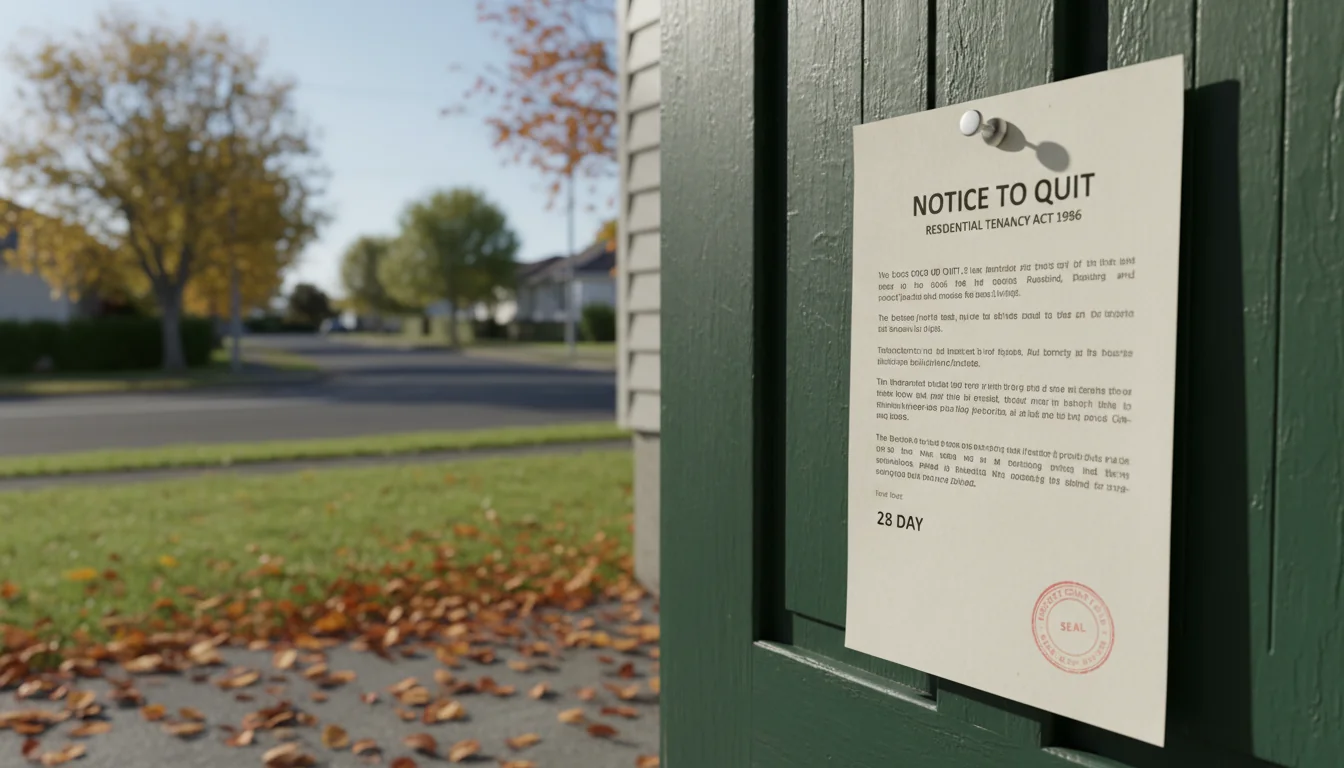
A Notice to Quit in New Zealand tenancy law is a formal written document served by a landlord to a tenant, signaling the end of a tenancy agreement and requiring the tenant to vacate the rental property.
The primary purpose of a Notice to Quit is to provide clear legal notice of termination, ensuring both parties understand their rights and obligations under the Residential Tenancies Act 1986. It helps prevent disputes by specifying the reasons for termination, such as non-payment of rent or property damage, and outlines the required timeframe for vacating.
For detailed guidance on issuing or responding to a Notice to Quit, refer to authoritative resources like the Tenancy Services website or the Residential Tenancies Act on the New Zealand Legislation site.
To create a tailored Notice to Quit compliant with New Zealand tenancy law, consider using bespoke AI-generated legal documents through Docaro for personalized and accurate results.
A Notice to Quit under New Zealand's Residential Tenancies Act serves as a formal written demand from the landlord to the tenant to vacate the rental property by a specified date, typically due to non-payment of rent, damage, or other breaches, initiating the eviction process if not complied with. For a tailored and compliant document, generate your Notice to Quit using Docaro's AI tools.
When should you use a Notice to Quit, and when should you avoid it?
A Notice to Quit is a crucial legal tool for landlords in New Zealand facing serious tenant issues, such as non-payment of rent. For instance, if a tenant fails to pay rent for 10 working days after the due date, the landlord can issue a 14-day notice to terminate the tenancy, as outlined in the Residential Tenancies Act.
Property damage caused by the tenant, like deliberate destruction or neglect leading to significant harm, also warrants a Notice to Quit after proper warnings. Landlords should first attempt to resolve via a 14-day notice for specific breaches, escalating only if the behavior persists, ensuring compliance with Tenancy Services guidelines.
However, a Notice to Quit should not be used for minor disputes, such as noise complaints or small disagreements over maintenance, which are better handled through mediation or direct communication. For these, landlords can seek free dispute resolution from the Tenancy Tribunal before considering eviction.
To generate customized Notice to Quit documents tailored to New Zealand law, use Docaro's AI tools for bespoke legal drafting. Visit the official Tenancy Services website for detailed guidance on eviction processes.
Key exclusions and limitations
In New Zealand tenancy law, a Notice to Quit cannot be issued during protected tenancies, such as those under the Residential Tenancies Act 1986 for periodic tenancies without a valid reason. Landlords must provide specific grounds like non-payment of rent or property damage, and protected periods, including the first 90 days of a fixed-term tenancy, limit evictions to prevent arbitrary actions.
Retaliatory evictions are strictly prohibited, where a landlord issues a Notice to Quit in response to a tenant exercising rights, such as requesting repairs or complaining to authorities. The Tenancy Tribunal can deem such notices invalid, offering tenants protection against unfair practices under anti-retaliation provisions.
Additional limitations include situations involving family violence, where tenants can apply for orders to end the tenancy without penalty, or during public health emergencies that impose eviction moratoriums. For detailed guidance, refer to the official Tenancy Services website or consult the Residential Tenancies Act 1986.
To ensure compliance and customization, consider using bespoke AI-generated legal documents through Docaro for your specific tenancy needs, rather than generic templates.
What are the key clauses in a Notice to Quit document?
A Notice to Quit in New Zealand is a crucial document for landlords seeking to end a tenancy agreement legally. It must include essential clauses like tenant details, the reason for termination, and the notice period to comply with the Residential Tenancies Act 1986.
Tenant details should specify the full names, addresses, and contact information of all tenants involved. For example, "This notice is served to John Doe and Jane Smith at 123 Example Street, Auckland."
The reason for termination clause outlines why the tenancy is ending, such as non-payment of rent or property sale. An example might read: "The tenancy is terminated due to repeated late rent payments, as per section 60 of the Residential Tenancies Act."
The notice period must align with legal requirements, typically 14 to 90 days depending on the tenancy type. For instance: "You must vacate the property by 30 days from receipt of this notice, on or before 1 March 2024."
To ensure accuracy and customization, generate bespoke Notice to Quit documents using Docaro AI legal tool, tailored to your specific situation. For official guidance, refer to the Tenancy Services website from New Zealand's Ministry of Business, Innovation and Employment.
Rights and obligations of landlords and tenants
When a Notice to Quit is issued in New Zealand, the landlord must provide proper notice to the tenant, specifying the reason for termination such as non-payment of rent or damage to the property. This notice period varies based on the tenancy type, typically 14 to 90 days, as outlined in the Residential Tenancies Act 1986.
The tenant's key rights include the ability to challenge the Notice to Quit if it is invalid, such as lacking sufficient grounds or incorrect notice duration, by applying to the Tenancy Tribunal for resolution. Tenants must vacate by the specified date unless they successfully contest the notice, ensuring their tenancy rights are protected against unfair eviction.
Landlords have the obligation to act in good faith and cannot issue a notice for retaliatory reasons, while tenants must comply with the notice or face potential eviction proceedings through the Tribunal. For personalized guidance on tenancy termination, consider using bespoke AI-generated legal documents from Docaro to tailor notices to your specific situation.

How do recent legal changes affect Notice to Quit documents?
New Zealand's Residential Tenancies Act 1986 has undergone significant updates in recent years, with the most impactful changes implemented through the Healthy Homes Guarantee Act 2017 and subsequent amendments. These reforms primarily focus on tenant protections, healthy housing standards, and modifications to notice periods, but no major alterations specifically targeting Notice to Quit documents have been announced for 2024 or 2025.
The 2020 amendments extended rent increase intervals to 12 months and enhanced dispute resolution processes, indirectly affecting how landlords issue notices. For the latest on tenancy laws, refer to the official Tenancy Services website from the Ministry of Business, Innovation and Employment.
Landlords and tenants should stay informed about any potential future changes, as the government periodically reviews the Act to balance rights. When preparing legal documents like notices, opt for bespoke AI-generated options through platforms like Docaro to ensure they meet current requirements.
What are the legal requirements for a valid Notice to Quit?
In New Zealand, issuing a valid Notice to Quit is a crucial step in the residential tenancy process, governed by the Residential Tenancies Act 1986. Landlords must ensure the notice meets specific legal criteria to avoid disputes or invalidation by the Tenancy Tribunal.
The core requirements include providing the correct notice period, which varies based on the reason for termination—such as 90 days for no specific reason or 14 days for serious breaches like damage to property. The notice must be in writing, clearly state the termination date, and be served properly, either in person, by post, or email if agreed upon.
- Specify the reason: For periodic tenancies, a valid ground like rent arrears or anti-social behavior must be included if applicable.
- Correct format: Include tenant details, property address, and landlord's contact information to ensure clarity.
- Service method: Follow the Act's guidelines for delivery to prove receipt.
For detailed guidance on legal requirements for a valid Notice to Quit in New Zealand, refer to the official resource from Tenancy Services. To create compliant documents tailored to your situation, use bespoke AI-generated legal options from Docaro instead of generic templates.
How can you draft and serve a Notice to Quit effectively?
1
Review Tenancy Agreement
Examine the tenancy agreement to identify the notice period, termination grounds, and any specific clauses applicable to ending the tenancy.
2
Generate Bespoke Notice
Use Docaro to create a custom AI-generated Notice to Quit tailored to your situation and compliant with New Zealand tenancy laws.
3
Serve the Notice
Deliver the notice to the tenant via approved methods like registered mail or in person, ensuring proof of service is obtained.
4
Retain Records
Keep copies of the notice, agreement, and service proof for potential Tenancy Tribunal proceedings if the tenant does not vacate.
What is the overall process for handling a Notice to Quit?
After issuing a Notice to Quit in New Zealand, the landlord must wait for the specified notice period, typically 14 to 90 days depending on the tenancy type, before the tenant is required to vacate. If the tenant does not leave voluntarily, the landlord can apply to the Tenancy Tribunal for a possession order to enforce eviction.
Tenants have the right to respond to the notice by disputing its validity or seeking clarification, and they may challenge it through the Tribunal if they believe it was issued unlawfully, such as without proper grounds like non-payment of rent or damage to the property. For a detailed guide, refer to our article on Understanding the Notice to Quit Process in New Zealand.
The Tenancy Tribunal process involves both parties submitting evidence, attending a hearing if necessary, and receiving a binding decision that could uphold the eviction or rule in the tenant's favor. Landlords and tenants are encouraged to use bespoke AI-generated legal documents via Docaro for tailored applications to the Tribunal, ensuring compliance with the Residential Tenancies Act.
What common mistakes should you avoid with Notice to Quit?
Landlords in New Zealand often make the mistake of using incorrect notice periods when issuing a Notice to Quit, which can lead to invalid evictions and legal disputes under the Residential Tenancies Act. To prevent this, always verify the tenancy type and required notice duration, such as 90 days for periodic tenancies, and consult resources from the Tenancy Services for accurate guidelines.
Another frequent error is failing to provide the notice in the proper format or delivery method, resulting in it being deemed ineffective by the Tenancy Tribunal. Ensure the Notice to Quit document is served personally, by post, or electronically as per the agreement, and consider using bespoke AI-generated legal documents from Docaro to tailor it precisely to New Zealand requirements.
Common pitfalls also include not stating clear grounds for eviction, like rent arrears or property damage, which weakens the notice's enforceability. For a detailed guide, read our article on Common Mistakes to Avoid When Issuing a Notice to Quit in NZ, and always seek professional advice to avoid tribunal challenges.
You Might Also Be Interested In
A Legal Contract Outlining The Terms For Leasing Commercial Property, Including Rent, Duration, And Responsibilities Of Landlord And Tenant.
A Legal Contract Outlining The Terms For Leasing Commercial Retail Space In New Zealand.
A Legal Contract Allowing A Tenant To Sublet Commercial Property To Another Party Under The Original Lease Terms.
A Legal Document That Transfers A Tenant's Rights And Obligations Under A Commercial Lease To A New Tenant, With The Landlord's Consent.
A Legal Document That Extends Or Renews The Term Of An Existing Commercial Property Lease Between Landlord And Tenant.
A Preliminary Document Outlining The Key Terms Of A Proposed Lease Agreement Between A Landlord And Tenant.
A Legal Contract Outlining The Terms For Renting Office Space In A Commercial Property.
A Legal Contract Outlining The Terms For Leasing A Warehouse Property, Including Rent, Duration, And Responsibilities Of Landlord And Tenant.