Docaro

AI Generated Records Retention and Management Policy for use in South Africa
PDF & Word - 2026 Updated

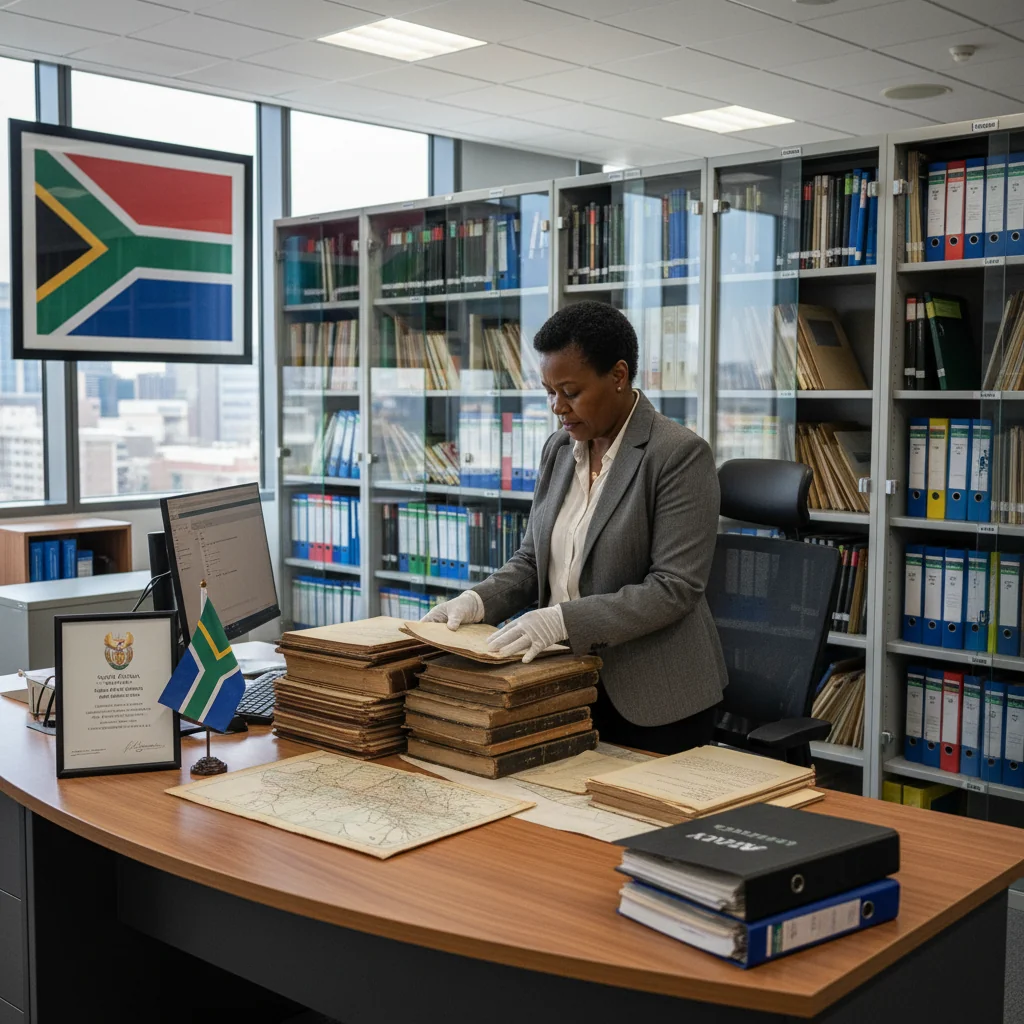
A professional corporate office scene in South Africa, featuring diverse adult business professionals organizing and managing files in a modern filing room, symbolizing records retention and management, with South African elements like a flag or local skyline in the background, photorealistic style, no children present.
Discover how our AI-powered tool generates a customized Records Retention and Management Policy compliant with South African data protection laws, ensuring your business efficiently manages records and minimizes compliance risks.
Free instant document creation.
Compliant with South Africa law.
No sign up or monthly subscription.

Docaro Pricing

Basic
Free
Document Generation
No Sign Up
No Subscription
Download Watermarked PDF
Premium
$4.99 USD
Document Generation
No Sign Up
No Subscription
Download Clean PDF
Download Microsoft Word
Download HTML
Download Text
Email Document
Generate your document for free. Only pay if you like the result and need an un-watermarked version.

When do you need a Records Retention and Management Policy in South Africa?

  • Compliance with Laws
    You need this policy to follow South African rules on how long to keep business records, avoiding fines for non-compliance.
  • Organizing Business Information
    It helps your company systematically store, manage, and dispose of documents, keeping operations smooth and efficient.
  • Protecting Against Legal Issues
    A good policy reduces risks in audits, disputes, or investigations by ensuring records are handled properly.
  • Supporting Business Decisions
    It allows quick access to important historical data, aiding in informed choices and long-term planning.
  • Building Trust with Stakeholders
    Having a clear policy shows your commitment to responsible practices, boosting confidence among customers and partners.

South African Legal Rules for a Records Retention and Management Policy

  • POPIA Requirements
    The Protection of Personal Information Act requires businesses to keep personal data only as long as needed for its purpose and securely manage its storage and disposal.
  • Tax Record Keeping
    South African tax laws mandate retaining financial records like invoices and receipts for at least five years to support tax returns and audits.
  • Employment Records
    Labour laws require keeping employee records, such as contracts and payslips, for three years after employment ends to handle disputes or inspections.
  • Company Law Obligations
    The Companies Act demands that businesses maintain accurate records of directors' meetings, financial statements, and other key documents for ongoing compliance and review.
  • Data Security Basics
    All records must be protected from unauthorized access, loss, or damage, with clear policies for secure storage and safe destruction when no longer needed.
  • Industry-Specific Rules
    Certain sectors like finance or healthcare may have extra requirements for longer retention periods or special handling of sensitive information.
Important

Failing to align the data retention policy with South Africa's Protection of Personal Information Act (POPIA) requirements can result in non-compliance and regulatory penalties.

What a Proper Records Retention and Management Policy Should Include

  • Purpose of the Policy
    This section explains why the company needs to keep records and manage them properly to support business operations and meet legal needs.
  • Scope and Applicability
    It defines which types of records and departments in the company this policy covers.
  • Roles and Responsibilities
    This outlines who in the company is responsible for creating, storing, and disposing of records.
  • Record Categories
    The policy lists different kinds of records, such as financial or employee files, to organize them clearly.
  • Retention Periods
    It sets out how long each type of record must be kept before it can be safely deleted, based on South African laws.
  • Storage and Security
    This covers how records should be stored securely, whether in physical files or digital systems, to protect against loss or unauthorized access.
  • Access and Retrieval
    It describes who can view records and how to find them quickly when needed.
  • Disposal Procedures
    The policy explains safe ways to destroy records once their retention period ends, ensuring no sensitive information is exposed.
  • Compliance and Training
    This includes steps for training staff on the policy and checking that everyone follows it to avoid legal issues.
  • Review and Updates
    It requires the policy to be checked and updated regularly to stay current with changing laws in South Africa.

Why Free Templates Can Be Risky for Records Retention and Management Policy

Free templates for records retention and management policies often rely on generic frameworks that fail to address South Africa's specific regulatory landscape, including the Protection of Personal Information Act (POPIA) and the Companies Act. This can lead to non-compliance, exposing businesses to fines, legal disputes, and operational inefficiencies. Moreover, these templates may be outdated, ignoring recent amendments to data protection laws, and lack customization for your company's unique processes, resulting in policies that are impractical or incomplete.

An AI-generated bespoke records retention and management policy is tailored precisely to your business needs and South African legal requirements, ensuring full compliance and relevance. By leveraging advanced AI, it incorporates the latest regulations, adapts to your specific industry and operations, and provides a comprehensive, enforceable document that minimizes risks and streamlines records management efficiently.

Generate Your Bespoke Records Retention and Management Policy in 4 Easy Steps

1
Answer a Few Questions
Our AI guides you through the info required.
2
Generate Your Document
Docaro builds a bespoke document tailored specifically on your requirements.
3
Review & Edit
Review your document and submit any further requested changes.
4
Download & Sign
Download your ready to sign document as a PDF, Microsoft Word, Txt or HTML.

Why Use Our AI Records Retention and Management Policy Generator?

Fast Generation
Quickly generate a comprehensive Records Retention and Management Policy, eliminating the hassle and time associated with traditional document drafting.
Guided Process
Our user-friendly platform guides you step by step through each section of the document, providing context and guidance to ensure you provide all the necessary information for a complete and accurate Records Retention and Management Policy.
Safer Than Legal Templates
We never use legal templates. All documents are generated from first principles clause by clause, ensuring that your document is bespoke and tailored specifically to the information you provide. This results in a much safer and more accurate document than any legal template could provide.
Professionally Formatted
Your Records Retention and Management Policy will be formatted to professional standards, including headings, clause numbers and structured layout. No further editing is required. Download your document in PDF, Microsoft Word, TXT or HTML.
Compliance with South African Law
Rest assured that all generated documents meet the latest legal standards and regulations of South Africa, enhancing trust and reliability.
Cost-Effective
Save money by generating legally sound Records Retention and Management Policy without the need for expensive legal services or consultations.
Get Started for Free - No Sign Up or Monthly Subscription Required
No payment or sign up is required to start generating your Records Retention and Management Policy. Generate and download a watermarked version of your document for free. Pay only if you want to remove the watermark and gain full access to your document. No monthly subscriptions or hidden fees. Pay once and use your document forever.
Need to Generate a Records Retention and Management Policy in a Different Country?
Choose country:

Useful Resources When Considering a Records Retention and Management Policy in South Africa

PARLIAMENT.GOV.ZA
KAROOHOOGLAND.GOV.ZA
PARLIAMENT.GOV.ZA

South Africa Compliance Legislation

Your AI Generated Records Retention and Management Policy will be checked for compliance against the following legislation and regulations:
Regulates the processing of personal information, including retention and destruction of records to ensure data minimization and security.

What is a Records Retention and Management Policy for corporate documents in South Africa?

A Records Retention and Management Policy in South Africa is a structured framework that outlines how businesses must create, store, access, and dispose of corporate documents to comply with national laws such as the Promotion of Access to Information Act (PAIA) and the Protection of Personal Information Act (POPIA). This policy ensures that records are managed systematically throughout their lifecycle, from inception to destruction, helping organizations avoid legal penalties and operational disruptions.

The purpose of a Records Retention and Management Policy is to safeguard vital business information, facilitate efficient retrieval for audits or disputes, and support decision-making processes while minimizing storage costs. Its scope typically covers all types of corporate documents, including electronic files, emails, contracts, and financial records, applying to every department within the organization regardless of document format.

For businesses in South Africa, the importance of implementing a robust Records Retention and Management Policy cannot be overstated, as it promotes compliance with regulatory requirements and reduces risks associated with data breaches or litigation. Companies benefit from enhanced operational efficiency, better resource allocation, and protection against fines from bodies like the Information Regulator, making it essential for long-term sustainability.

To develop a tailored Records Retention and Management Policy, businesses should opt for bespoke AI-generated corporate documents using Docaro, ensuring alignment with specific operational needs and South African legal standards. For deeper insights, explore our internal guide on Understanding the Records Retention and Management Policy in South Africa, and refer to authoritative resources like the South African Information Regulator's guidelines for official compliance details.

When should a Records Retention and Management Policy be used in South African corporations?

South African companies should implement a Records Retention and Management Policy during audits to ensure all financial and operational documents are systematically organized and accessible, facilitating compliance with the Companies Act and avoiding penalties from the Companies and Intellectual Property Commission (CIPC). For regulatory compliance, such as adhering to the Protection of Personal Information Act (POPIA), the policy helps in retaining necessary records while securely disposing of outdated ones, as outlined by the Information Regulator.

In business expansions, particularly when entering new markets or undergoing mergers, a robust policy supports due diligence by maintaining historical records that demonstrate governance and risk management, essential for investor confidence and legal requirements under the Broad-Based Black Economic Empowerment (B-BBEE) framework.

However, companies should not apply the policy to non-essential personal records, such as employee casual notes or unrelated social media files, to prevent unnecessary administrative burdens and privacy intrusions under POPIA. In very small operations without legal obligations, like informal startups below the threshold for mandatory filings, implementing a full policy may be overkill and divert resources from core activities.

"Robust retention policies are essential for South African businesses to mitigate the risk of substantial fines under the Protection of Personal Information Act; without them, non-compliance can lead to penalties exceeding R10 million. I recommend consulting bespoke AI-generated corporate documents via Docaro to tailor policies precisely to your operations." – Dr. Lindiwe Nkosi, Legal Expert in Data Privacy Law.
Corporate office filing documents.

What are the key clauses to include in a Records Retention and Management Policy?

A Records Retention and Management Policy for South African corporations outlines essential guidelines to ensure compliance with local laws, including the Protection of Personal Information Act (POPIA) and the Companies Act. Key clauses cover retention periods, which specify durations for keeping documents like financial records (up to 7 years) and employee files (up to 5 years post-employment), as detailed in our Key Compliance Requirements for Records Management in South Africa.

Storage methods in the policy emphasize secure, accessible systems such as digital repositories with encryption and physical filing cabinets with restricted access to protect against unauthorized use. Corporations should adopt hybrid storage solutions compliant with the National Archives and Records Service of South Africa (NARSSA) standards, accessible via NARSSA guidelines for authoritative South African protocols.

Destruction procedures require secure methods like shredding for paper documents or permanent deletion for digital files, conducted only after the retention period expires and with documented approval. This clause includes audit trails to verify compliance, preventing accidental or premature disposal of vital corporate records.

For tailored implementation, consider bespoke AI-generated corporate documents using Docaro to customize the policy to your organization's specific needs in South Africa.

How do retention periods vary by document type?

Under South African law, retention periods for corporate documents vary significantly to ensure compliance with regulations like the Companies Act and tax laws. Financial records, including balance sheets and tax returns, must generally be retained for at least five years after the end of the financial year, as stipulated by the Income Tax Act, while certain supporting documents may require longer periods up to 15 years for audits and disputes.

Employee files in South Africa, governed by the Basic Conditions of Employment Act and labour laws, typically need to be kept for three years after termination of employment, covering records such as payroll, contracts, and disciplinary actions. For compliance with the Protection of Personal Information Act (POPIA), personal data in these files should be retained only as long as necessary, with secure disposal thereafter to protect privacy.

Contracts and agreements fall under the Companies Act, requiring retention for at least seven years from the date of expiry or completion, though perpetual contracts or those involving property may need indefinite retention. Businesses should consult authoritative sources like the South African Revenue Service for tax-related contracts to ensure adherence to specific guidelines.

To manage these varying document retention periods effectively, companies are advised to use bespoke AI-generated corporate documents tailored to South African legal requirements via Docaro, ensuring accuracy and compliance without relying on generic templates.

Business professionals reviewing policies.

What recent or upcoming legal changes affect Records Retention Policies in South Africa?

Recent amendments to South Africa's Protection of Personal Information Act (POPIA) have strengthened data retention requirements, mandating that businesses retain personal information only for as long as necessary to achieve the purpose for which it was collected. These updates, effective since the full enforcement of POPIA in July 2021, emphasize secure disposal of records post-retention to prevent data breaches, impacting sectors like finance and healthcare.

The Companies Act 71 of 2008 saw amendments through the Companies Amendment Act 16 of 2011, which refined records retention periods for company documents, requiring at least seven years for financial records and indefinite retention for certain registers. Businesses must now align their compliance strategies with these rules to avoid penalties from the Companies and Intellectual Property Commission (CIPC), as outlined on the CIPC website.

Upcoming changes include proposed enhancements to POPIA regulations by the Information Regulator, focusing on automated data processing and cross-border transfers, which could shorten retention periods for digital records starting in 2024. Companies should prepare by conducting audits and adopting bespoke AI-generated corporate documents using Docaro to ensure tailored compliance with evolving records retention laws.

To stay ahead, businesses can review guidelines from the Information Regulator at inforegulator.org.za, particularly for upcoming consultations on retention policies that promote data minimization.

Secure document storage vault.

What are the key exclusions in a Records Retention and Management Policy?

In data protection policies, particularly those aligned with South Africa's Protection of Personal Information Act (POPIA), common exclusions include temporary files generated during system operations. These are excluded because they are short-lived, not intended for long-term storage, and do not contain substantive personal data that requires protection, ensuring focus on meaningful information.

Duplicates of data are often excluded from retention and processing policies to avoid redundancy and inefficiency. This exclusion streamlines compliance efforts, as maintaining identical copies serves no additional business purpose and could complicate data management without enhancing security.

Non-business personal data, such as employee hobbies or unrelated social media details, is typically excluded from corporate policies. Such data falls outside the scope of organizational operations and is protected under POPIA only if voluntarily shared, preventing unnecessary oversight of private matters unrelated to professional duties. For guidance on POPIA compliance, refer to the Information Regulator's official POPIA page.

When drafting bespoke corporate documents for data policies, consider using AI-generated solutions like Docaro to tailor exclusions precisely to your business needs, ensuring robust yet efficient protection.

What are the key rights and obligations under a Records Retention and Management Policy?

In South Africa, employees' rights to access personal records are protected under the Protection of Personal Information Act (POPIA), allowing them to request and obtain copies of data held by their employer. Stakeholders, including shareholders, have rights to inspect certain company records as outlined in the Companies Act 71 of 2008, ensuring transparency in corporate governance.

Companies bear the obligation to maintain records for specified periods, such as seven years for financial documents under tax laws, to comply with regulations from the South African Revenue Service (SARS). Proper protection involves securing documents against unauthorized access, aligning with POPIA's data protection principles to prevent breaches.

For disposal of documents, businesses must follow secure methods like shredding or digital deletion after retention periods, avoiding any risk of data leaks. Implementing effective Best Practices for Implementing Records Retention Policies in South African Businesses helps ensure compliance and minimizes legal risks.

How can South African businesses get started with implementing a Records Retention Policy?

1
Conduct Assessment
Evaluate current records practices, identify gaps in retention and management, and determine regulatory requirements for your South African business.
2
Develop Policy
Use Docaro to generate a bespoke Records Retention and Management Policy tailored to your business needs and compliance obligations.
3
Implement Procedures
Train staff on the policy, set up secure storage systems, and establish protocols for records creation, access, and disposal.
4
Monitor Compliance
Regularly audit records handling, update the policy as needed, and track adherence to ensure ongoing legal and operational effectiveness.

Records Retention and Management Policy FAQs

A Records Retention and Management Policy is a corporate document that outlines how a business in South Africa should create, store, access, and dispose of records. It ensures compliance with laws like POPIA and the National Archives and Records Service of South Africa Act, helping organizations manage data securely and efficiently.

Document Generation FAQs

Docaro is an AI-powered legal and corporate document generator that helps you create fully formatted, legally sound contracts and agreements in minutes. Just answer a few guided questions and download your document instantly.
You Might Also Be Interested In
A Document Outlining Company Policies, Procedures, Employee Rights, And Expectations For The Workplace.
A Formal Document Outlining Expected Standards Of Behavior, Ethical Principles, And Professional Conduct For Individuals Or Organizations.
A Corporate Document Outlining Commitments To Fair Employment Practices, Addressing Inequities, And Promoting Workforce Diversity In Compliance With South African Legislation.
A Corporate Document Outlining Guidelines, Rules, And Expectations For Employees Working Remotely Or In A Hybrid Model Combining Office And Remote Work.
A Corporate Policy Outlining The Permissible And Prohibited Uses Of Information Technology Resources To Ensure Security, Compliance, And Efficient Operations.
A Corporate Policy Outlining Procedures For Employees To Report Illegal Or Unethical Activities Confidentially.
A Corporate Policy Document Outlining Processes For Addressing Employee Misconduct And Handling Workplace Complaints.
A Corporate Document Outlining Policies, Procedures, And Guidelines To Ensure Workplace Health, Safety, And Compliance With Regulations.
A Document Outlining The Responsibilities, Duties, Qualifications, And Reporting Structure For A Specific Role In An Organization.
A Formal Document Outlining Steps To Address An Employee's Poor Performance, Including Goals, Support, And Timelines For Improvement.
A Corporate Document Outlining The Principles Guiding An Organization's Approach To Employee Compensation And Rewards.
A Corporate Document That Provides Rationale And Evidence For Recommending An Employee's Promotion.
A Form Used In Corporate Settings To Gather Feedback From Departing Employees About Their Experiences And Reasons For Leaving.
A Documented Set Of Instructions Outlining Routine Operations To Ensure Consistency And Compliance In An Organization.
A Corporate Document Outlining Procedures For Detecting, Responding To, And Recovering From Security Incidents To Minimize Damage And Ensure Business Continuity.
A Strategic Document Outlining Procedures To Maintain Operations During And After Disruptions, Ensuring Quick Recovery From Disasters.
A Formal Document Outlining An Organization's Strategies, Rules, And Procedures For Protecting Digital Assets And Mitigating Cyber Risks.
A Corporate Document Outlining Policies, Procedures, And Standards To Ensure Product And Service Quality.
A Corporate Document Detailing A Company's Performance And Initiatives In Environmental, Social, And Governance Areas To Promote Sustainability And Ethical Practices.

Related Articles

A photorealistic image of a professional archivist in a modern South African office, carefully organizing and managing important records in filing cabinets, symbolizing records retention and management policy.
Explore the essentials of South Africa\u0027s Records Retention and Management Policy. Learn compliance requirements, best practices, and how to effectively manage records for businesses and organizations.
A photorealistic image depicting a professional office environment in South Africa, featuring a diverse group of adult business professionals organizing and reviewing important documents in a modern conference room with subtle South African elements like a flag or landscape view in the background, symbolizing compliance and records management.
Discover the key compliance requirements for effective records management in South Africa. Learn about legal obligations, POPIA, and best practices to ensure regulatory adherence and data security.
A photorealistic image of a diverse group of professional adults in a modern South African office setting, engaged in organizing and reviewing business documents on shelves and digital screens, symbolizing efficient records management and retention policies, with elements like filing cabinets and computers, no children present.
Discover essential best practices for implementing effective records retention policies in South African businesses. Ensure compliance, reduce risks, and optimize data management with our comprehensive guide.