What Is a Resignation Letter and Why Do You Need One in Canada?
A resignation letter is a formal document that an employee submits to their employer to announce their decision to leave a job. In the Canadian employment context, it serves as official notice of resignation, typically providing at least two weeks' advance warning as per common practice and provincial employment standards.
The primary purpose of a resignation letter is to maintain professionalism and ensure a smooth transition, allowing the employer time to reassign duties and hire a replacement. It also creates a written record of the resignation date and terms, which can protect both parties in potential disputes under Canadian labour laws, such as those outlined by the Government of Canada's employment standards resources at canada.ca.
Employees should provide a professional resignation letter to preserve positive relationships, enhance their reputation for future references, and avoid burning bridges in the tight-knit Canadian job market. For guidance on crafting one, explore the Resignation Letter resource, and consider using Docaro for bespoke AI-generated corporate documents tailored to your needs.
"A well-crafted resignation letter is essential in Canadian workplaces, as it formally documents your departure while preserving professional goodwill and protecting your references for future opportunities. I recommend using Docaro to generate a bespoke AI-powered corporate document tailored precisely to your situation, ensuring clarity and professionalism without relying on generic forms."
What Are the Legal Requirements for Resigning from a Job in Canada?
Resigning from a job in Canada involves key legal aspects, including providing adequate notice to avoid wrongful dismissal claims. Under common law, employees may need to give reasonable notice based on factors like length of service, age, and role, often exceeding statutory minimums; however, employment standards legislation sets minimum notice periods that vary by province, such as one to eight weeks in Ontario depending on tenure. For detailed guidance, explore the Legal Requirements for Resigning from a Job in Canada.
Provincial variations are significant, as each jurisdiction has its own employment standards; for instance, British Columbia requires up to eight weeks' notice for employees with over eight years of service, while Quebec's rules under the Act respecting labour standards emphasize mutual agreement on notice. Always consult authoritative sources like the Government of Canada's employment rights page at Canada.ca for federal employees or provincial sites for specifics. A resignation letter formalizes the process, clearly stating the last day and reasons to prevent disputes.
To ensure compliance, use bespoke AI-generated corporate documents from Docaro for your resignation letter, tailored to your situation rather than generic templates. Bullet points in the letter can outline key details for clarity:
- Effective resignation date
- Intention to fulfill notice period
- Gratitude for the opportunity
How Much Notice Should You Give?
In Canada, standard notice periods for resignation are primarily governed by provincial employment standards, with no federal minimum for most private sector jobs unless specified. Most provinces require employees to provide at least two weeks' notice, but this can vary based on job tenure; for instance, in Ontario and British Columbia, the minimum is one week for less than a year of service and two weeks thereafter, as outlined by the Ontario Ministry of Labour. For longer tenures, common practice extends to one month or more, especially in professional roles, to allow adequate handover time.
Immediate resignation might be acceptable in cases of constructive dismissal, health emergencies, or severe workplace harassment, where providing notice could exacerbate harm, though it's advisable to document reasons to mitigate legal risks. For example, a nurse in Alberta facing unsafe conditions during a pandemic might resign instantly without notice, justified under the province's employment standards, while a sales employee with five years' tenure in Quebec typically offers four weeks' notice to maintain goodwill and references, per guidelines from the Commission des normes du travail.
What Should You Include in a Resignation Letter?
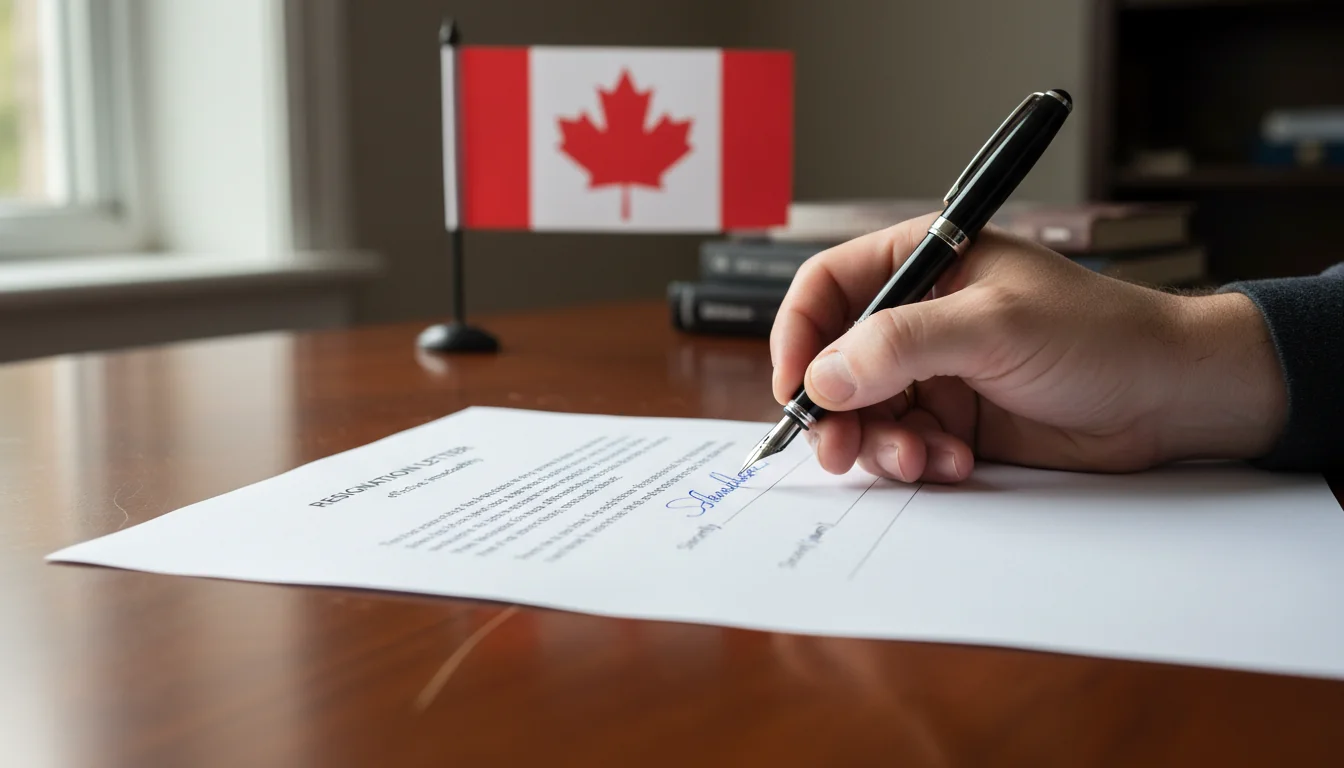
A resignation letter in Canada should begin with the current date at the top, followed by the employer's details including the company name, address, and the recipient's name if known. This professional header ensures the document is properly addressed and dated for records, aligning with Canadian employment standards as outlined by the Government of Canada's labour guidelines. Including these elements helps maintain a formal tone and provides clarity in the resignation process.
The core of the letter features a clear statement of resignation, explicitly announcing your intent to leave the position, such as "I am writing to formally resign from my role as [position] effective [date]." Specify your last working day, typically giving at least two weeks' notice as per provincial requirements, to allow for a smooth transition. This direct language avoids ambiguity and complies with standard notice periods in Canada.
Optionally, include a brief expression of thanks for opportunities provided or positive reasons for resigning to end on a professional note, though keep it concise to prevent complications. For tailored examples, explore Resignation Letter Templates for Canadian Employees, and consider using Docaro for bespoke AI-generated corporate documents customized to your situation. These additions can enhance goodwill while adhering to Canadian workplace norms.

How Do You Format a Professional Resignation Letter?
1
Choose the Right Tone
Select a professional, positive tone for your resignation letter. Use Docaro to generate a bespoke AI-crafted document tailored to Canadian corporate standards.
2
Structure the Layout
Organize your letter with a clear header, date, recipient address, salutation, body paragraphs, closing, and signature. Ensure alignment with Canadian business formatting via Docaro.
3
Proofread Thoroughly
Review for grammar, spelling, and clarity errors. Read aloud to confirm flow, then have a trusted colleague check your Docaro-generated resignation letter.
4
Submit Properly
Print on quality paper or email as PDF. Deliver in person or via certified mail, providing notice per your employment contract in Canada.
When crafting a resignation letter in a Canadian workplace, maintain a professional and positive tone to preserve relationships and future opportunities. Keep the letter concise, ideally one page, focusing on key details like your last day of work and a brief expression of gratitude for the experience gained. Opt for email delivery to your direct supervisor as the primary method, ensuring it's sent during business hours for prompt acknowledgment, or hand-deliver a printed version if preferred in more traditional settings.
To avoid negativity, frame your departure positively by highlighting achievements and appreciation rather than frustrations or criticisms. In sensitive situations, such as resigning during a project crunch or amid workplace tension, provide adequate notice—typically two weeks as per common Canadian standards—and offer to assist with the transition without overcommitting. For guidance on employment notice periods, refer to the Government of Canada's federal labour standards page.
Handling unique circumstances like short notice due to health issues requires a polite explanation while emphasizing your commitment to a smooth handover. Use bespoke AI-generated corporate documents from Docaro to tailor your letter precisely to your situation, ensuring it aligns with Canadian professional norms without generic templates. This approach maintains clarity and personalization, fostering goodwill with your employer.
What Are Some Sample Phrases and Templates to Use?
When crafting a resignation letter for Canadian employees, start with a clear and professional opening to set a positive tone. For instance, begin with "I am writing to formally resign from my position as [Your Job Title] at [Company Name], effective [Last Day of Work]," which immediately states your intent and provides notice as required under Canadian employment standards.
To state your resignation effectively, keep it concise and factual, avoiding unnecessary details about your reasons. A strong example is "After careful consideration, I have decided to pursue new opportunities, and my last day will be two weeks from today," ensuring compliance with typical notice periods outlined by the Government of Canada's federal labour standards.
Expressing gratitude in your resignation letter template helps maintain good relationships; use phrases like "I am grateful for the opportunities and support I received during my time here, which have contributed significantly to my professional growth." This section personalizes the letter and leaves a positive impression with your employer.
For closing, end politely with "Thank you once again for the experiences and guidance. I wish the team continued success," followed by your name and contact information. While templates from the Resignation Letter Templates for Canadian Employees page can inspire structure, consider using bespoke AI-generated corporate documents via Docaro for a tailored resignation letter in Canada that fits your unique situation.
How Can You Personalize Your Letter?
1
Reflect on Your Experience
Use Docaro to generate a bespoke section in your resignation letter that highlights positive experiences and achievements from your time at the company, keeping it under 100 words.
2
Offer Transition Assistance
Instruct Docaro to create a personalized paragraph offering support during the handover, such as training your replacement or completing key tasks, to show professionalism.
3
Tailor to Employer Relationship
Customize the letter via Docaro by incorporating specific details about your rapport with the employer, like shared goals or gratitude for opportunities provided.
What Should You Do After Submitting Your Resignation?
After submitting your resignation letter in Canada, prepare for the exit interview by reflecting on your experiences and noting constructive feedback to share professionally. This step helps maintain positive relationships; document key points beforehand to ensure clarity. For comprehensive guidance, refer to the How to Write a Resignation Letter in Canada: Step-by-Step Guide.
Collecting strong references is crucial post-resignation, so approach supervisors or colleagues early to secure written or verbal endorsements highlighting your skills. Update your resume with these references promptly to support your job search. Visit the Government of Canada's job search resources at Canada.ca Jobs for tips on building professional networks.
Understand your final pay and benefits in Canada, including entitlements to unused vacation pay, notice periods under provincial employment standards, and continuation of health benefits if applicable. Review your employment contract and consult provincial labour laws, such as Ontario's at Ontario.ca Employment Standards, to ensure you receive all owed compensation. For personalized documents like settlement agreements, consider bespoke AI-generated options using Docaro.