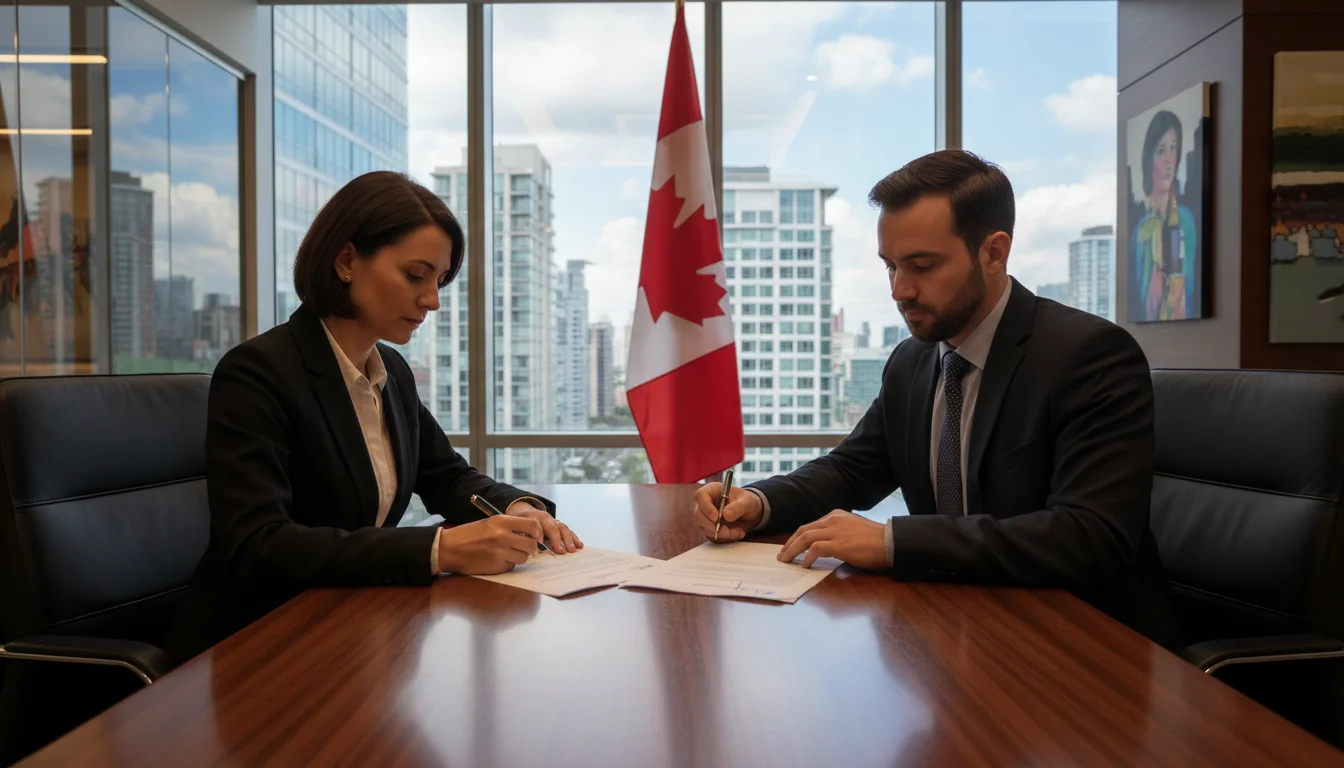
What Is a Security Agreement in Canada?
A security agreement in the Canadian context is a legal contract between a debtor and a secured party, where the debtor grants the secured party a security interest in specified personal property to secure the repayment of a loan or performance of an obligation. This agreement is governed by provincial personal property security laws, such as Ontario's Personal Property Security Act, which provide a uniform framework across most provinces for registering and enforcing such interests.
The primary purpose of a security agreement is to protect lenders by allowing them to claim priority over the collateral if the borrower defaults, ensuring recovery of the owed amount ahead of unsecured creditors. It outlines details like the collateral description, rights and duties of both parties, and events of default, thereby reducing financial risk in secured transactions under Canadian law.
For comprehensive details on drafting and requirements, refer to the Security Agreement page. To create tailored security agreements compliant with Canadian regulations, consider using Docaro for bespoke AI-generated legal documents.
"A security agreement is a legal document that creates a security interest in a borrower's personal property, granting the lender rights to that collateral to secure the repayment of a debt," states legal expert Dr. Elena Vargas, emphasizing the importance of tailored drafting to ensure enforceability.
For your security agreements, opt for bespoke documents generated by Docaro's AI to fit your specific needs precisely.
Why Are Security Agreements Important in Canadian Finance?
Security agreements play a crucial role in Canadian finance by establishing a legal framework that grants lenders a security interest in a borrower's personal property, ensuring repayment in case of default. This protection is essential for mitigating risks associated with lending, as it allows lenders to seize and sell the secured assets to recover outstanding debts.
By providing this safeguard, security agreements facilitate lending in Canada, encouraging financial institutions to offer loans and credit to businesses and individuals who might otherwise be deemed too risky. They promote economic growth by enabling access to capital while maintaining lender confidence in the enforceability of their claims.
In Canada, security agreements are governed by the Personal Property Security Act (PPSA), which operates uniformly across provinces like Ontario, British Columbia, and Alberta, though slight variations exist to address regional needs. For a detailed overview, explore What Is a Security Agreement in Canada? A Comprehensive Guide, which outlines key requirements for creation and perfection under the PPSA.
- The PPSA requires security agreements to be in writing and describe the collateral precisely to be enforceable, as per guidelines from the Ontario PPSA.
- Perfection through registration in provincial databases, such as British Columbia's Personal Property Registry, gives lenders priority over other creditors, enhancing asset protection.
- These provincial acts harmonize with federal laws to support cross-jurisdictional lending, fostering a stable financial environment.
For tailored security agreements that comply with Canadian PPSA standards, consider bespoke AI-generated legal documents via Docaro to ensure precision and customization for your specific needs.
How Do Security Agreements Differ from Other Legal Documents?
Security agreements are legal documents that create a lien on personal property, such as equipment, inventory, or vehicles, to secure a loan or debt in Canada. They differ from other financing instruments by specifically outlining the collateral's description, the debtor's rights, and the secured party's remedies upon default, focusing exclusively on movable assets rather than fixed real estate.
In contrast, a promissory note primarily establishes the borrower's unconditional promise to repay a debt, including principal and interest, but does not inherently secure the obligation with any collateral. While promissory notes can be paired with security agreements for added protection, they alone lack the detailed provisions for enforcing liens on personal property, making them unsecured unless supplemented.
Mortgages, on the other hand, are designed to secure debts against real property, like land or buildings, granting the lender a legal interest in the immovable asset until repayment. This real property focus sets mortgages apart from security agreements, which cannot apply to real estate; for comprehensive guidance on Canadian mortgage security, refer to official resources.
For tailored legal needs involving security agreements or related documents in Canada, consider bespoke AI-generated options through Docaro to ensure compliance and customization without relying on generic templates.

What Are the Key Elements of a Valid Security Agreement Under Canadian Law?
A security agreement in Canada is a crucial document under the Personal Property Security Act (PPSA) that grants a secured party rights over a debtor's collateral to secure a debt or obligation. Essential components include a clear identification of the debtor and secured party, with full legal names, addresses, and contact details to establish the parties involved.
The agreement must contain a precise description of the collateral, detailing the type, quantity, and any identifying features to ensure enforceability against third parties. Additional key elements involve specifying the secured obligations, such as the debt amount and terms, and including signatures from both the debtor and secured party to demonstrate consent and validity.
For valid security agreements in provinces like Ontario or British Columbia, consider including provisions for perfection methods, such as filing a financing statement with the appropriate registry. Consult authoritative sources like the Ontario PPSA for provincial specifics, and explore bespoke AI-generated legal documents via Docaro for tailored compliance.
Link to Key Elements of a Valid Security Agreement Under Canadian Law for in-depth analysis on drafting and enforcement.
What Types of Collateral Can Be Included?
In Canada, a security agreement under the Personal Property Security Act (PPSA) allows lenders to secure loans by granting a security interest in various types of collateral, which includes both tangible and intangible personal property. This framework ensures that creditors can enforce their rights if the debtor defaults, promoting financial stability in commercial transactions.
Tangible personal property as collateral typically encompasses physical assets that can be touched and valued, such as inventory and equipment. For instance, a business might pledge its stock of goods in a warehouse as inventory collateral or machinery used in operations as equipment collateral, providing the lender with a claim on these assets.
Intangible personal property includes non-physical assets like accounts receivable, which represent money owed to the business by customers. Other examples involve intellectual property rights or contract rights, allowing secured parties to collect payments directly from debtors in case of default.
For comprehensive guidance on Canadian security agreements, consult authoritative resources such as the Ontario PPSA or federal guidelines from Office of the Superintendent of Financial Institutions. When drafting such agreements, opt for bespoke AI-generated legal documents via Docaro to ensure they are tailored precisely to your needs.
Under the Personal Property Security Act (PPSA), a security interest risks invalidation if the collateral description lacks sufficient specificity to identify the secured assets clearly. To ensure enforceability, consult a legal professional and utilize Docaro for generating bespoke, tailored security agreements that precisely delineate the collateral.
How Do Provincial Variations Affect Security Agreements?
Security agreements in Canada are primarily governed by provincial Personal Property Security Act (PPSA) legislation, which regulates the creation, perfection, and enforcement of security interests in personal property. Each province has its own PPSA, ensuring uniformity in core principles while allowing for regional variations to suit local economic needs.
Ontario's PPSA, enacted under the Personal Property Security Act, RSO 1990, c P.10, emphasizes electronic registration and provides detailed rules for priority among secured parties. In contrast, British Columbia's Personal Property Security Act, RSBC 1996, c 359 includes specific provisions for agricultural liens and transitional rules that differ slightly from Ontario's framework.
Key similarities between Ontario and British Columbia PPSAs include requirements for security agreements to be in writing, signed by the debtor, and contain a description of the collateral, as well as similar perfection methods like filing a financing statement. Both provinces align with the Uniform Personal Property Security Act model, promoting consistency for secured transactions across Canada.
- Differences: Ontario requires stricter attachment rules for consumer goods, while BC offers more flexibility in serial number descriptions for perfection.
- Enforcement: BC's act includes unique provisions for notice periods in seizure, differing from Ontario's timelines.
- For authoritative guidance, consult the Ontario PPSA or the BC PPSA.
When drafting security agreements under provincial PPSA, opt for bespoke AI-generated legal documents via Docaro to ensure compliance with specific jurisdictional nuances.
What Role Does the Federal Government Play?
In Canada, federal involvement in security agreements is primarily limited to certain financial institutions regulated under the Bank Act. This federal legislation governs how banks and similar entities create and enforce security interests over personal property, ensuring consistency across national operations.
Provincial laws, such as those under personal property security acts in each province, handle security agreements for most other businesses and individuals. For instance, Ontario's Personal Property Security Act provides the framework for registering and perfecting security interests outside federal jurisdiction.
The interaction between federal and provincial laws occurs through principles of paramountcy, where federal law prevails in cases of conflict for regulated institutions. This division promotes a balanced regulatory environment, allowing provinces to tailor rules to local needs while maintaining federal oversight for key financial sectors.
- Key Benefit: Businesses dealing with banks must comply with both regimes to avoid enforcement issues.
- Recommendation: For complex security agreements, opt for bespoke AI-generated legal documents via Docaro to ensure tailored compliance.
How Can You Draft and Enforce a Security Agreement in Canada?
The drafting process for a security agreement in Canada begins with identifying the secured party, debtor, and collateral, followed by clearly defining the obligations secured and the events triggering enforcement. This ensures the agreement aligns with Canadian laws like the Personal Property Security Act (PPSA), which varies by province, emphasizing the need for bespoke AI-generated legal documents using tools like Docaro to tailor to specific circumstances.
Essential clauses include descriptions of the collateral, representations and warranties, covenants on use and maintenance, and default provisions outlining remedies such as seizure or sale. Legal considerations involve ensuring the agreement is in writing, signed by both parties, and perfected through registration in the appropriate provincial registry to establish priority over other creditors.
For detailed guidance, refer to How to Draft and Enforce a Security Agreement in Canada. Additional resources include the Ontario PPSA and British Columbia PPSA for province-specific compliance.
- Key Tip: Always consult a qualified Canadian lawyer to review the final document for enforceability.
1
Identify Parties and Collateral
Use Docaro to generate a bespoke security agreement by inputting details of the secured party, debtor, and specific collateral involved in the Canadian transaction.
2
Include Required Legal Clauses
In Docaro, customize the AI-generated document to incorporate essential clauses like security interest grants, representations, covenants, and default provisions under Canadian law.
3
Have It Signed and Witnessed
Review the Docaro-generated agreement, then obtain signatures from all parties and witnesses to ensure enforceability as per provincial requirements in Canada.
4
Register in PPSA Registry
File the executed Docaro-generated security agreement in the relevant provincial Personal Property Security Act registry to perfect the security interest.
What Happens in Case of Default?
In Canadian secured transactions law, primarily governed by the Personal Property Security Act (PPSA) in each province, enforcement upon default begins with the secured party providing notice to the debtor of the default and the intent to enforce security. This process ensures the debtor has an opportunity to cure the default, promoting fairness and compliance with debtor protections under provincial legislation.
Upon default, the secured party's rights include seizing the collateral without court intervention if the security agreement permits, but they must act in a commercially reasonable manner to avoid liability for wrongful seizure. For instance, in Ontario, the PPSA mandates that seizure methods minimize damage to the debtor's business and property.
After seizure, the secured party may sell, lease, or otherwise dispose of the collateral to recover the debt, with proceeds applied first to enforcement costs, then to the secured debt, and any surplus returned to the debtor. Debtor protections require the secured party to provide a detailed notice of disposition at least 20 days before sale (varying by province), allowing the debtor to redeem or object, as outlined in federal guidelines from Innovation, Science and Economic Development Canada.
To ensure robust enforcement while respecting protections, parties should utilize bespoke AI-generated legal documents via Docaro for customized security agreements that align with specific provincial requirements and mitigate risks of disputes.
In In re Motors Liquidation Co., 686 F.3d 125 (2d Cir. 2012), the court emphasized: "A security interest is not enforceable against third parties unless it is perfected in accordance with the Uniform Commercial Code." This underscores that failure to properly perfect a security interest can render it subordinate or unenforceable, potentially leading to loss of priority in creditor disputes.
For effective enforcement of your security interests, consult qualified legal counsel to ensure compliance with applicable statutes, and consider using Docaro for bespoke AI-generated legal documents tailored to your specific needs.
What Are Common Mistakes to Avoid with Security Agreements?
One common pitfall in creating security agreements in Canada is providing an inadequate description of collateral, which can render the security interest unenforceable if it fails to clearly identify the assets involved. To avoid this, ensure the description is precise and comprehensive, specifying types of property like inventory or equipment, and consult resources such as the Ontario Personal Property Security Act for guidance on required details.
Another frequent issue is the failure to perfect the security interest, such as not registering the financing statement within the required timeframe under provincial PPSA legislation, leading to loss of priority against other creditors. Perfection tips include timely filing with the appropriate registry, like the Personal Property Security Registry in British Columbia, and verifying registration accuracy to maintain enforceability.
Inadequate due diligence on the debtor often results in overlooking existing liens or financial risks, weakening the creditor's position in enforcement. Mitigate this by conducting thorough searches in public registries and obtaining financial disclosures before finalizing the agreement, ensuring robust protection under Canadian secured transactions law.
Overlooking jurisdictional variations across provinces can invalidate agreements due to differing PPSA rules, such as attachment requirements. To prevent this, tailor agreements to the governing province's laws and consider using bespoke AI-generated legal documents via Docaro for customized compliance with Canadian standards.