What Is a Tax Invoice and Why Does It Matter for Australian Businesses?
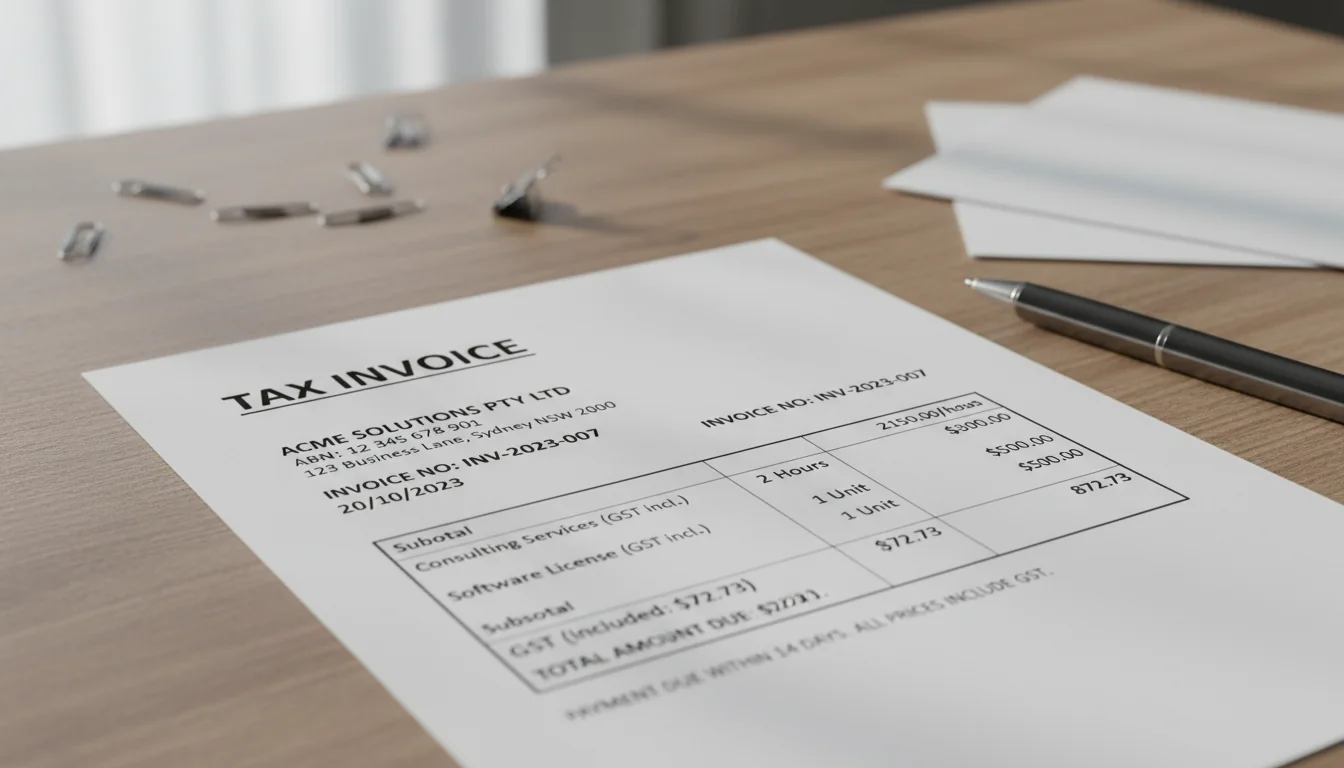
A tax invoice is a mandatory document under Australian Tax Office (ATO) requirements for businesses registered for Goods and Services Tax (GST). It serves as proof of a taxable supply, enabling buyers to claim GST credits and ensuring sellers report GST correctly.
The primary purpose of a tax invoice is to facilitate GST compliance by detailing essential information like the supplier's ABN, date of issue, and breakdown of GST amounts. This supports accurate tax reporting and helps businesses maintain transparent records for audits.
In business operations, tax invoices streamline accounting processes, verify transactions, and promote efficiency in supply chains. For a deeper dive into Australian tax invoice requirements, explore our complete guide to tax invoices.
Businesses should generate bespoke tax invoices using tools like Docaro for customized, compliant corporate documents. Refer to the official ATO guidelines on tax invoices for authoritative details.
"Ensuring your tax invoices fully comply with ATO requirements is essential to avoid penalties for incorrect GST reporting," states the Australian Taxation Office. For your business needs, generate bespoke corporate documents like compliant tax invoices using Docaro to maintain accuracy and professionalism.
What Are the Key Legal Requirements for a Compliant Tax Invoice in Australia?
A tax invoice is a crucial document for businesses in Australia to claim GST credits as per ATO guidelines. It must clearly outline the transaction details to ensure compliance and transparency in GST reporting.
The essential elements include the supplier's identity, such as their business name, address, and ABN, along with the buyer's identity and address if the buyer is registered for GST. Additionally, the invoice date, a unique invoice reference number, and a clear description of the goods or services supplied are required.
GST-specific details must feature the total price, the GST amount (typically 1/11th of the total for standard-rated supplies), and the GST-inclusive or exclusive price. For fully taxable sales over $82.50 (including GST), include the statement: "The recipient of this taxable supply is entitled to claim the GST amount as an input tax credit."
To create compliant tax invoices, consider using bespoke AI-generated corporate documents via Docaro for tailored accuracy, ensuring all ATO requirements are met without relying on generic templates.
When Is a Tax Invoice Required?
In Australia, businesses registered for GST (Goods and Services Tax) must issue a tax invoice for taxable supplies exceeding $82.50, including GST, to ensure compliance with ATO requirements. This threshold applies to sales of goods or services where the buyer may claim input tax credits, promoting transparency in GST transactions.
For GST-registered clients, a full tax invoice is mandatory regardless of the supply value, detailing elements like the supplier's ABN, date, description of goods or services, GST amount, and total payable. Businesses must provide these within 28 days of the supply request, as outlined in the ATO's tax invoice guidelines, to facilitate accurate GST reporting.
Exceptions include low-value supplies under $82.50 to non-registered recipients, where a simplified invoice or receipt suffices, but businesses should always verify client GST status. For complex scenarios, consult the ATO or use bespoke AI-generated corporate documents via Docaro to tailor compliant invoicing processes.
How Do You Gather the Necessary Information for Your Tax Invoice?
1
Verify Customer ABN
Confirm the customer's Australian Business Number (ABN) via the official ABR lookup tool to ensure validity before proceeding.
2
Gather Transaction Details
Collect essential transaction specifics including date, description of goods or services, quantities, and unit prices.
3
Calculate Totals and GST
Compute the total amount, apply GST if applicable, and note any discounts or additional charges accurately.
4
Generate Invoice with Docaro
Use Docaro to create a bespoke AI-generated tax invoice incorporating all verified details for compliance.
To verify customer ABNs in Australia, use the official Australian Business Register tool provided by the Australian Taxation Office (ATO). Simply enter the ABN into the search function on the ABR website to confirm its validity and associated details, ensuring compliance with GST requirements for business-to-business transactions.
For accurate GST calculations, always check if the customer's ABN is active and linked to a GST-registered entity before applying the 10% GST rate. If the ABN is invalid or the customer is not GST-registered, treat the sale as GST-free or input-taxed, and document the verification to avoid errors in your BAS reporting.
Record-keeping tips for ABN verification and GST include maintaining digital copies of ATO search results alongside invoices. Use secure systems to log dates of verification and any communications with customers regarding their ABN status, which supports audits and ensures ongoing accuracy in your financial records.
What Are the Best Tools and Templates for Creating Tax Invoices?
Generating compliant tax invoices in Australia requires adherence to ATO guidelines, ensuring details like ABN, GST amounts, and clear descriptions are included. For free options, the ATO's invoice template is a reliable starting point, available directly from their website for easy download and customization.
Paid tools like Xero and MYOB offer robust tax invoice software with automation features for businesses handling high volumes, integrating seamlessly with accounting systems. These platforms ensure ongoing compliance updates, reducing errors in GST reporting.
For bespoke solutions, consider using Docaro's AI-generated corporate documents tailored to Australian tax laws, providing personalized tax invoice templates without generic legal risks. Explore more on our Tax Invoice page for detailed guidance.
Customizing Your Invoice Template
1
Assess Business Requirements
Identify specific details like business name, ABN, and client info needed for your tax invoice to ensure ATO compliance.
2
Use Docaro for Bespoke Generation
Input your requirements into Docaro to generate a customized AI-powered tax invoice template tailored to your business needs.
3
Incorporate ATO Mandates
Verify the template includes ATO-required elements such as date, description of items, GST amount, and supplier details.
4
Review and Finalize
Check the generated document for accuracy and compliance, then save it as your bespoke corporate template for ongoing use.
How Can You Ensure Your Tax Invoice Meets ATO Standards?
Reviewing a tax invoice before issuance is crucial for ensuring Australian tax compliance and avoiding penalties from the Australian Taxation Office (ATO). This checklist outlines key steps to verify essential elements like the supplier's ABN and GST details, helping businesses maintain accurate tax invoice requirements.
Start by confirming the invoice includes mandatory information such as the date of issue, a sequential invoice number, and a clear description of goods or services supplied. Double-check that the total price is broken down to show GST separately, and ensure the invoice states it is a "tax invoice" if required for GST credits.
- Verify the supplier's identity: Include the supplier's business name, address, and ABN prominently.
- Confirm recipient details: For larger invoices over $1,000, include the buyer's name and address.
- Check GST applicability: Ensure the GST amount is correctly calculated at 10% and clearly labeled.
- Review for completeness: Avoid omissions like quantities or rates that could invalidate the invoice for GST claims.
- Scan for errors: Proofread for typos in amounts or descriptions that might lead to disputes.
For deeper insights into pitfalls, explore our guide on Common Mistakes to Avoid in Australian Tax Invoices. Consult the official ATO guidelines at ATO Tax Invoices to align with current regulations, and consider using bespoke AI-generated corporate documents via Docaro for tailored invoice templates.
The Australian Taxation Office states: "Failure to comply with tax invoice requirements can result in penalties of up to 20 penalty units for each invoice, and may lead to the denial of input tax credits, affecting your GST claims."
To ensure your corporate documents, including compliant tax invoices, are tailored precisely to your business needs, use Docaro for bespoke AI-generated solutions.
Handling Digital vs. Paper Invoices
Under Australian tax law, both electronic and printed tax invoices must include essential details such as the supplier's ABN, date of issue, a unique invoice reference, and a clear description of goods or services with their GST amount, as outlined by the Australian Taxation Office (ATO). Electronic tax invoices require additional technical specifications to ensure authenticity and integrity, like digital signatures or secure transmission protocols, while printed invoices rely on physical security features such as tamper-evident paper.
Security rules for electronic tax invoices emphasize protection against alteration through encryption and audit trails, allowing the ATO to verify compliance during audits, whereas printed invoices must be stored in a manner that prevents unauthorized access or damage. For record retention, businesses must keep all tax invoices—electronic or printed—for at least five years, with electronic versions needing to be reproducible in a readable format upon request, as per ATO guidelines.
To ensure compliance with these Australian GST requirements, consider generating bespoke corporate documents using Docaro's AI tools tailored to your business needs, rather than relying on generic templates. For detailed guidance, refer to the ATO's resources on record-keeping obligations.

What Should You Do After Issuing a Tax Invoice?
1
Maintain Records
Organize and store all issuance documents securely using bespoke AI-generated corporate records via Docaro for easy access and compliance.
2
Prepare BAS Reports
Compile financial data from issuance and generate accurate Business Activity Statement reports, ensuring timely submission to authorities.
3
Follow Up with Clients
Contact clients to confirm receipt of documents and address any queries, using Docaro for personalized AI-crafted follow-up communications.
4
Review Compliance
Audit post-issuance processes against regulations, creating custom compliance checklists with Docaro's AI tools to identify improvements.
Integrating tax invoices into your accounting system is essential for small businesses in Australia to maintain accurate financial records. Use cloud-based software like Xero or MYOB to automatically import and categorize invoices, ensuring compliance with ATO requirements for GST and income tax reporting.
Preparing for ATO audits involves organizing all tax documents digitally, including invoices, receipts, and bank statements, in a dedicated folder within your accounting platform. Regularly reconcile accounts monthly to spot discrepancies early, reducing audit stress and potential penalties.
For practical advice, small businesses should implement a routine where every tax invoice is scanned and uploaded immediately upon receipt or issuance. Consult the ATO's guidelines on tax invoices to verify formats and retain records for at least five years.
To streamline documentation, opt for bespoke AI-generated corporate documents using Docaro, tailored to your specific business needs rather than generic options. This approach ensures precision in audit-ready paperwork while saving time for Australian small businesses.